We are developing the social individualist meta-context for the future. From the very serious to the extremely frivolous... lets see what is on the mind of the Samizdata people.
Samizdata, derived from Samizdat /n. - a system of clandestine publication of banned literature in the USSR [Russ.,= self-publishing house]
|
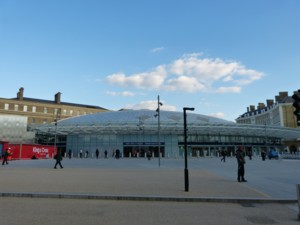
Last week, I read somewhere on the www that the new Kings Cross Station passenger concourse would be open to the general public for the first time on the following Monday, i.e. yesterday. When I got there yesterday afternoon, it was certainly functioning like a regular station concourse. It didn’t feel like it had only been open for a few hours, but then again it’s not as if an entire railway station opened, from nothing. This was a case merely of lots of people already using the approximate same place no longer having to thread their way through temporary arrangements, but instead having the pleasure of walking through this:
As you can see from my picture, I wasn’t the only photographer snapping away, and trust me, she and I were two of many. So maybe this really was the first public day of this new piece of London show-off modernity? The www confirmed it.
I knew roughly what this concourse was going to look like, having seen plenty of images of what the architects hoped it would look like, and, more recently, some photos taken by officially selected snappers before the rest of us were allowed in. But until you actually see things like this in the flesh, so to speak, you never really know what you think of them.
I was most agreeably surprised. Kings Cross, having been for the last decade put severely in the shade by the magnificently reborn St Pancras Railway Station, literally only a few dozen yards away, wasevidently making a huge effort to respond to that new Eurostar Palace. But I had feared something like one of those seemed-cool-but-actually-rather-naff, seventies, “designed” (as in: over-designed) pieces of lighting equipment. Not quite lava lamp, but in that kind of territory. I feared that the place would simply not be big enough to justify all that virtuoso metal patterning.
The reason I thought it would be too small for all that designer steelwork is that I had quite often walked past the outside of it, while they were building it. I photoed it again from the outside yesterday, and compared to how it looks inside, it appears from the outside to be tiny:
I say that St Pancras has upstaged Kings Cross for the last decade, but there are many who would contest this. St Pancras may have been awarded the Eurostar trains, but Kings Cross has … the Hogwart’s Express. Many of those visiting the new concourse gave no thought to its ceiling. They just wanted to have themselves photoed next to this sign:
I have a vague recollection of the real entrance to Platform 9¾ being in one of the old brick arches between Platforms 9 and 10, and an even vaguer recollection of waiting on Platform 10 for a train, and seeing some Pottermaniacs cavorting in front of this entrance. If that’s right, the sign I photoed yesterday is a fake. A fake, I tell you.
I guess they figure that the platform ticket business they might be doing is not worth all the bother.
There are several reasons why no sane Londoner would want former London Mayor, Ken Livingstone, to ever hold sway over even the smallest fragment of life in this fine old town ever again. But even by the standards of his immoderate, incendiary rhetoric over a long and inglorious career, this material I link to via Harry’s Place blog surely has to take the proverbial biscuit.
Last year, investigative journalist – and no right-wing hack – Andrew Gilligan, had a fascinating story about Ken’s interesting sources of funding. From Iran, no less.
Update: Livingstone’s anti-semitism has been a feature for some time. Even his own party is starting to get seriously rattled. He’s playing a very dangerous game: pandering to fundamentalist islam and trying to score points with them by bashing Jews. FFS.
Another update: Harry’s Place has more on the latest outrage.
In the post below, Michael Jennings writes, “Capital has been far too cheap, and much investment has gone to all kinds of stupid places where it cannot generate a genuine economic return.”
But politicians have not got it into their stupid heads, hence credit easing, a scheme in which the government guarantees loans to small businesses so that they can get an interest rate discount.
The BBC’s business editor Robert Peston writes:
The Treasury is not forcing the banks to take greater risks when lending to businesses. So there is no reason to assume that the total volume of lending to small businesses will increase much as a result of the scheme.
Apart, that is, from the reason that the interest rates are lower, so there will be more demand for the loans. And the risk to the banks is lowered, so they can make riskier loans without increasing the risk to themselves.
So lots of businesses will borrow money and it will increase GDP and the government will look good, but, as usual, the money would have been spent more usefully had it been left in private hands.
“If it [naked short selling] lowers share prices, that is because companies were overvalued. If the companies get into trouble as a consequence, that is because they were bad companies, not good ones. Bad companies deserve to be punished for being bad companies, so that capital can be better allocated elsewhere. (And yes, I am talking about the benefits of making it easy to take short positions *in general* rather than talking about the naked/covered distinction, which is a technical issue that I don’t actually think matters much. It may actually be better to discourage this and instead encourage people to take short positions via derivatives markets, which they can easily do). The truth is that we have had massive capital misallocation in recent decades. Capital has been far too cheap, and much investment has gone to all kinds of stupid places where it cannot generate a genuine economic return. Many companies have believed that they were good companies when in fact all they were doing was milking the fact that they had an unrealistically cheap cost of capital. For the last five years or so, this state of affairs has been ending, which is horribly painful. It would be over quickly if more people (politician, homeowners, and stakeholders in companies doing useless thing) would actually get it into their stupid heads that it has to end.”
Our own Michael Jennings, whose comment on my post of yesterday was too good to leave in the associated thread. I suspect this DVD, The Wall Street Conspiracy, will soon be heading for the trash can. I am wary of any “documentary” that starts from the premise that people in financial markets are like Bond villains destroying profitable firms in ways that make no sense even for the supposed “villains” in the case. For me, the key issue is transparency: if you are shorting a stock in a firm or whatever, and your counterparty is fully consenting to the transaction and you both understand the risks and don’t expect to get bailed out, then such activity should be put in the same category, IMHO, as off-piste skiing – risky but not criminal and certainly not fraudulent.
A while back, in a posting here about a meeting at the House of Commons addressed by Detlev Schlichter, at which James Delingpole was also present, I speculated that maybe Delingpole might at some point in the future choose to get stuck into the question of what has been going wrong with the world’s financial system.
So, I was delighted to encounter this recent Delingpole posting, about why the price of oil is going up. He features a video of Ron Paul saying that if you print lots and lots of money, everything goes up. Or, to put it another way, it’s not oil that is going up; it’s fiat money that is going down.
I see that Delingpole gives the Cobden Centre an appreciative mention, which will please them greatly.
Delingole, whose idea-spreading abilities I admire more and more, is a significant voice in the world. He has a huge following, which is well deserved. He takes important ideas seriously, but himself not so much, in a most engaging and yet informative way, the proof of his effectiveness being how much he gets up the noses of whatever bad guys he takes aim at.
If Delingpole could do to the world’s central banking racket what he has already done and continues to do to the world’s “climate science” racket, that might really be something.
Asks David Cameron:
Why is it that other infrastructure – for example water – is funded by private sector capital through privately owned, independently regulated, utilities… but roads in Britain call on the public finances for funding?
It might work, too, if roads really were private, with no subsidies to road owning companies and no government meddling in their operations, though I would be surprised if it works like that. The article suggests that this thinking is motivated by tight government finances. I rather like the idea of the government being forced to privatise everything because it has run out of money.
The president of the Automobile Association is not impressed:
In the water industry we saw big companies make big profits initially, at the same time as water and sewage costs went up by 42% and 36%.
Big profits are not a problem in themselves. But why would end user costs go up after privatisation if private companies are so efficient and competitive? It could be that before water privatisation the real costs were hidden inside other taxes, or it could be that water privatisation, much like rail privatisation, was anything but.
“Yelling “fire” in a crowded theater is a terrible thing to do — unless there’s a fire.”
Thomas Dolan, Barron’s. He was writing about a wonderful financial market practice – sometimes legal, sometimes not – known as “naked short-selling”. His article explains what that means. I got interested after getting a DVD in the mail, called The Wall Street Conspiracy, that reckons that this practice was responsible for destroying many an honest business. Sounds a bit like Michael Moore, but I will give it a view to see if it stacks up or is a pile of crap. One quick thought: the idea of selling something you don’t own or haven’t even borrowed yet does sound awfully close to outright fraud, like insuring a house against fire if you don’t even own the house. Or like fractional reserve banking……….Aaarrgggghhh…
Stanley Fish is rightly getting a lot of heat in the internet for his brazen assertion that it is okay to adopt double standards in terms of the kind of language used to describe women so long as the person using such terms holds the “right” views and is, in some more general sense, on the side of the intellectual “good guys”.
David Henderson, over at EconBlog, has what I think is the most devastating take-down of this character, all the more devastating for doing so in measured tones. The associated comment thread is well worth reading also.
“Might is right”. For heaven’s sake.
Former Samizdata contributor and full-time Tea Party/libertarian rabble-rouser Andrew Ian Dodge has been endorsed by the Libertarian Party of Maine for his independent US Senate run.
Libertarian Party of Maine Chairman, Shawn Levasseur spoke on Dodge’s change in party affiliation, “Andrew has been a long time friend of the LP in Maine. So when the news broke that he was leaving the Republican party, and would be petitioning to get directly onto the November ballot, we asked him to run as a Libertarian. He has often described himself as a libertarian. The only difference now is that he’s now capitalizing the ‘L’.””
Maine is an odd state that goes against the logic that only two parties matter in US politics. Maine, like Vermont, is perfectly happy to elect independents to high office.
Not content to just run for office he continues to publish his writing, despite being banned by his campaign from blogging. Andrew and his wife Kim just published Drifting into Oblivion about his, so far, successful battle against colon cancer.
The irony is that he will be 5 years free of cancer on election day in early November.
Good luck mate!
Bishop Hill and WUWT are both making much of this:
To be effective, a new set of institutions would have to be imbued with heavy-handed, transnational enforcement powers.
If CAGW-inspired regulation is to make any sense, it must be universal. There must be a World Government. There are those of us who have long believed that this was why CAGW was devised in the first place.
Time was when economic success was believed to result from such “cooperation”, and to impossible without it. So, the language of tyranny was economics. Then – alas for the tyrants – it became clear that economic success and tyranny are opposites, although that lesson has still to be completely learned.
Now, the language of tyranny is a different kind of “science”.
Nothing is so permanent as a temporary government program
– Milton Friedman
Stereotypes are good. They give you a starting point which can then be adjusted as more facts become available.
Most national stereotypes are easy enough. Americans? Enthusiastic Brits. Irish? Drunken Brits. French? Charming, friendly, cultured, unless, that is, you’re dealing with some arm of the government. Italians? Emotional incontinents, no sense of civic responsibility. But the Germans? Well, we all know what we’re thinking. And we all know it’s not true. Don’t we?
But what do we replace it with? Well, they’re officious. Are they perhaps then officious Brits? Not really. While there are superficial similarities in terms of language and religion pretty soon it all starts to break down. In many respects Britain and Germany are exact opposites of one another.
Take cars. The Germans can churn out reliable, cutting-edge cars like no one else. The British can’t. In fact the British are so bad at it they need the Germans to churn out their Rolls-Royces, Aston Martins and Minis. But while the British dominate motor sport the Germans can’t make a Formula 1 car to save their lives. Or, at least, haven’t been able to since, ahem, the 1930s. Nowadays, they need us to do it for them.
Take music. While the Germans were pioneers of classical music they are hopeless at rock.
Take association football. British clubs are streets ahead of German clubs but on the national level Germany has outperformed England in every World Cup since 1966 (and most of the ones before, incidentally).
Take libertarianism. Has Britain produced anyone like a Mises or a Hayek? [Yes, I know they’re Austrians but for the sake of simplicity I’m lumping them in with the Germans.]
From time to time I ask friends and acquaintances about this. One suggested that the Germans were great at taking first principles to their logical conclusions and bad at asking whether the first principles were correct or not. Another said something similar in that the Germans “take everything to extremes.”
This certainly helps to explain some of Germany’s oddities like unrestricted sections of the autobahn and that case of mutually-agreed cannibalism a few years ago. Whether they explain some of the other oddities, I am not quite sure. Is there a logic to classical music?
|
Who Are We? The Samizdata people are a bunch of sinister and heavily armed globalist illuminati who seek to infect the entire world with the values of personal liberty and several property. Amongst our many crimes is a sense of humour and the intermittent use of British spelling.
We are also a varied group made up of social individualists, classical liberals, whigs, libertarians, extropians, futurists, ‘Porcupines’, Karl Popper fetishists, recovering neo-conservatives, crazed Ayn Rand worshipers, over-caffeinated Virginia Postrel devotees, witty Frédéric Bastiat wannabes, cypherpunks, minarchists, kritarchists and wild-eyed anarcho-capitalists from Britain, North America, Australia and Europe.
|







Recent Comments