We are developing the social individualist meta-context for the future. From the very serious to the extremely frivolous... lets see what is on the mind of the Samizdata people.
Samizdata, derived from Samizdat /n. - a system of clandestine publication of banned literature in the USSR [Russ.,= self-publishing house]
|
The answer to a market where the participants compete to make things worse by following bad incentives is to ask what is creating those bad incentives and to stop doing that, not to impose a monopoly.
That thought is my response to, and my almost entire agreement with, an ASI blog posting by Anton Howes, which is critical of Education Minister Michael Gove’s plan to replace competing examination boards with a state monopoly examination board. Gove says these are now racing each other to the bottom, racing each other, that is to say, in lowering standards.
But, says Howes:
The proposals to limit exam board competition to monopolies for every subject (or duopolies between O-levels and CSEs) would therefore exacerbate the problem by limiting healthy academic discrimination even further. With only one exam board to be lobbied for each subject, we would face a system where every self-interested education minister could easily ‘dumb down’ the system even further, no matter how much an overhaul could raise standards in the immediate short term.
Howes is spot on in identifying one of the biggest reasons why state action is so frequently resorted to, even by politicians generally inclined to favour free market solutions. To start with, state action sometimes seems to improve matters, definitely so to many eyes. Only later does the arrangement revert to brazen, monopolised incompetence. Markets, on the other hand, often start out as a bit of a shambles, and only yield their benefits to politicians who are prepared to be patient. In the long run, markets are incomparably superior, and some politicians do know this. But politics mostly happens in the short run.
Howes also notes that “free marketeer” Lizz Truss MP supports Gove in this move towards state monopoly.
Alas, Howes himself gets a bit confused in his final paragraph:
… the real solution to grade inflation may lie in more accurate and discriminating government league tables, …
Excuse me! Now who is putting his faith in a government monopoly? But before even the next full stop arrives, Howes corrects himself.
… or even their replacement with a competing system of tables by universities, employers, and other private groups.
Quite so. But lose that “even”.
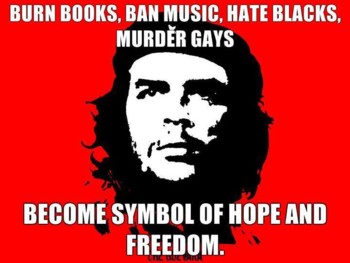
A few days ago I nearly photoed someone wearing one of those idiotic Che T-shirts, but I missed the shot.
This is the kind of thing such T-shirts ought to be saying:
Although, I’m not quite sure about the wording, the bit at the bottom I mean. Truly, I’m not sure. It looks to me somewhat like an admission of defeat, rather than an assertion of victory. It’s like the bad guys really have succeeded in burying the truth about this appalling person, and the good guys are conceding this. But the first bit digs up that truth and proclaims it, and that’s good.
I found it here.
More about the real Che in this earlier posting here.
I have just been reminded by a spam commenter that long before denouncing Jimmy Carr was fashionable, I denounced Jimmy Carr, in September 2008. Quote:
I am watching the late night rerun of 8 Out Of 10 Cats on the telly, and I have a complaint. Carr has just said that: “It’s true. 68 percent preferred brains to beauty.” No Carr. If you join me in thinking about this, Carr, what you will realise is that 68 percent of people said they preferred brains to beauty.
Time was when we ordinaries just had to put up with media distortions of this kind, but now, the internet has changed the balance of power. We can now shout back at our tellies, and be heard. The world will never be the same again.
Indeed not. Don’t bother following the link to read the whole thing, because you just did.
More seriously, on a related note to the one sounded by me in para 2 above, here is a posting at Guido’s about how Laurie Penny threw some mud at David Starkey, calling him a racist, and he then threw some more mud back at Ms. Penny. Two short video clips show both bits of mud flying through the air.
This is the first time I have ever see Laurie Penny in action. I definitely prefer her beauty to her brain.
Time was when the original mud thrown by Ms. Penny would have stuck, and Starkey would have been muddied for ever, even in the minds of those who would have sympathised with what he said, on account of the original performance by Starkey on Newsnight that was the basis of Ms. Penny’s accusation not being available for anyone to check, even if they saw it first time around. But the game no longer plays out like that.
As is further illustrated by the fact that, in trying to recover her position with subsequent tweeting following the debate shown in those video clips, Ms. Penny only dug herself deeper into her hole, also exposing her original racism accusation to yet another audience and enabling commenters to clarify the whole spat still further.
The complete video of the event over the weekend is still, alas, stuck behind the Sunday Times paywall. It will surely emerge soon.
Here is a brief comment I left over at Tim Worstall’s blog, regarding fractional reserve banking and supposed journalistic illiteracy about said:
“I can see why smart people are dubious about fractional reserve banking. The whole “maturity transformation” line that defenders of FRB come up with only works if you are prepared to take the risk that, in the event of a crisis, you won’t be able to get your money out of a bank when you want it. That is why, in a real free market, not the rigged charade we have now, FRBs would have to be clearly advertised as such, and without the moral hazard-machines of state deposit insurance and a central bank acting as lender of last resort, printer of funny money, etc. In such a laissez faire world, FRB might persist, but it would be a lot more restricted than now, and its capacity for causing booms and busts reduced. Like I say, it should not be illegal so long as everyone knows what it is.”
I just read this piece by Jeff Carter about how Germany is doing all the productive work for the entire EU. This bit in particular:
If I am the Germans I feel like the weightlifter on the bench press that just had a couple of manhole covers added to the bar. How can you have a European Union, when only one country in Europe is productive? Socialism is like that. They direct and regulate, you produce.
Which made me say to myself the phrase “Germany shrugs”. Which I then googled, and I got to this by Andrew Lawford:
Some time ago, I read an interesting article that outlined the fact that a Greek exit from the Euro would compound its problems in that it would have a new currency that would devalue markedly against the Euro, but would have all its debt still denominated in Euro. Obviously the situation would be resolved either by passing a law that redenominated all Greek debt into the new currency, or simply by defaulting on the payments of Euro debt. The end result for investors would be much the same.
The interesting thing to consider, though, is if Germany were to quit the Euro. The rule that applies to Greece would presumably apply to Germany too: a new currency would be introduced, but the nation’s debt would still be denominated in Euro. In this case, however, the new currency would presumably appreciate massively against the Euro, thus reducing Germany’s debt burden as measured in its new currency. This begs the question: would Germany redenominate all its Euro debt into its new currency? Certainly this is what investors expect as they push bund yields to record lows during the current “flight to quality”, but upon what basis can such a redenomination be expected?
And he ends by saying:
The Germans may simply shrug.
I am surprised that “Germany shrugs” (most of the google hits had an “off” bolted on to the end followed by whatever it was that Germany was shrugging off) is not a more common phrase. It certainly will be, Real Soon Now. Trouble is, the whole world, including us here, have been wondering for ages when “Germany”, by which I mean the people of Germany rather than their EU District Commissioner rulers, will finally demand that their leaders stop leading them into an economic morass and put their economic interests first.
I’m now inclined to think that I got it right at the end of this, where I said that the EU will only collapse when it has entirely run out of all its money and all its power, and all of it will then collapse.
How rightly horrified people would be if a prime minister were to publicly “name and shame” someone for sexual behaviour that he, the prime minister, found “morally repugnant” but which was not illegal. For the first couple of decades after its decriminalisation in 1967 homosexuality would have fallen in that category in the opinion of most British adults. Adultery still does fall into that category. I am pretty sure Cameron claims to find adultery morally repugnant, so let us hear his reasons for not making public denunciations of all the adulterous celebs out there in the same way that he has denounced Jimmy Carr for tax avoidance. And if it is right for him to denounce adulterous celebrities he should also denounce adulterous cabinet ministers and Tory donors, of course. If he would recoil from this course (and to be fair, he probably would) then he ought to be able to understand what is wrong with the man given the highest power in the land publicly denouncing as immoral the legal financial behaviour of a named individual.
The Times‘s behaviour in this affair has been disgusting, too. By all means write features denouncing tax avoidance – personally I think tax avoidance is morally neutral at worst, and more often good, but I recognise that opinions differ – and I would say that using already-public sources such as company accounts to expose the behaviour of individuals to public hostility is within the rights of a free press even when my sympathies are with the person exposed. One citizen slagging off another citizen is a very different thing from the prime minister slagging off a citizen. But the witchunting smirk of the Times‘s coverage makes me sick. Celebrity exposés for the people who think they are above celebrity exposés. And the witchunting howl of the Guardian‘s coverage as its writers scrambled like hyenas for the scraps left over from the Times‘s kill make me even more sick. These are the same people who were so high-minded about the press intrusions into privacy cited at the Levenson enquiry.
The original meaning of “bully” in the phrase bully pulpit was merely “wonderful”, i.e. that high office gave the holder a wonderful high platform from which he could reach a wide audience with his sermons. Nonetheless I have little doubt that from long before the time President Theodore Roosevelt first coined the term the bully pulpit has been used for bullying in the modern sense. The very fact that a prime minister or president potentially has the power to do harm to a private individual ought to clamp shut the leader’s mouth. No such scruples stopped Tony Blair from joining in the mob that got Glenn Hoddle fired from his job as England football manager for his religious beliefs, but then Cameron always has said he was the heir to Blair.
Decent silence ought to be kept by the great even more firmly in the case of a private citizen’s tax matters than in sexual matters or matters of belief, because a modern democratic state has largely ceased to employ mutaween or inquisitors (“diversity advisors” aside), but it does employ an army of tax collectors, and the prime minister or president is at the head of that army. A responsible ruler would be horrified by the thought that a careless word against an individual might well cause servile tax officials to attempt to win the ruler’s favour by focussing on that individual.
From Media Law by Geoffrey Robertson, Q.C. and Andrew Nicol, Q.C., I quote:
The arcane offence of scandalum magnatum was created by a statute of 1275 designed to protect “the great men of the realm” against discomfiture from stories that might arouse the people against them. The purpose of criminal libel was to prevent loss of confidence in government. It was, essentially, a public order offence, and since true stories were more likely to result in breaches of the peace, it spawned the aphorism “The greater the truth, the greater the libel.” Overtly political prosecutions were brought in its name, against the likes of John Wilkes, Tom Paine and the Dean of St Asaph. Truth is not a defence, unless the defendant can convince a jury that publication is for the public benefit. The burden of proof lies on the defendant, who may be convicted even though he or she honestly believed, on reasonable grounds, that what was published was true and a matter of public interest.
Some of our readers are learned in the law of the land. I appeal to you, find a way to bring a prosecution against divers great men of the realm, to whit David William Donald Cameron and Daniel Grian Alexander. Should not the law apply equally to great and small? Find grounds to bring suit against Cameron and Alexander for their criminal libel against James Anthony Patrick Carr, against whom said Cameron and Alexander, abusing their office, did arouse the fury of the mob despite Carr having broken no law.
In the 1950s, Anthony Crosland argued that we could take capitalism’s strength for granted. A future Labour government would be able to heap up the tax burden as well as the regulatory one – and the capitalist milch cow would continue to pour out the milk. Through experience, we in the UK have learnt that Croslandism is as flawed as any other form of socialism, but Europe, albeit unwittingly, is still in his thrall.
– Bruce Anderson
One of our commenters has made what I think is a very important point about the rapidly snowballing ‘Fast & Furious’ scandal that may well consume the Obama presidency:
The (vitally important) difference, however, is that ‘Wide Receiver’ (the Bush administration program) was carried out in cooperation with the Mexican government, and actually attempted to track the weapons crossing the border. ‘Fast & Furious’ was carried out in complete secrecy from the Mexican Government, and attempted to basically funnel weapons illegally to Mexican drug runners, so that the guns left at crime scenes could then be traced back to US gun dealers. As someone on NRO (I think it was Andrew McCarthy) pointed out, this operation REQUIRED the deaths of Mexican nationals. How this is distinguished from an act of war against Mexico is not at all clear to me. But then, I didn’t go to Harvard.
– Samizdata commenter ‘Disillusionist’ making a very germane point about the ‘Fast & Furious’ scandal.
America currently has the worst political class in its history. But if Europe doesn’t, it’s only because of how very bad it’s been in the past.
– Instapundit
Last night I attempted to describe what I thought of this (which I photoed about an hour before photoing that Pedibus):
But I feared that my efforts of last night might get Samizdata sued for libel by Santander, so I had to start again. Maybe Santander really do practise all that they are here preaching, on this bloke’s back.
But, Santander aside, what is it about corporate proclamations of this sort that makes them so vomit-inducing? (See what I mean.) I mean, you don’t have to run about London in a T-shirt like this, do you? Nobody pointed a gun at this bloke, or I do not suppose so. And if you really hate having to endure this kind of verbiage at work, you can always get some other sort of job, can’t you?
Maybe not. Maybe if you are an office worker, in a city like London, of a certain rank, doing a certain sort of work, then insincere verbiage exuding fake enthusiasm and moral ambition that is relentlessly out of line with what they actually reward you for doing and fire you for neglecting to do is something that cannot be avoided, no matter where you work. Besides which, moving from one job to another, although perhaps possible, is quite an upheaval. For many, another job that covers the outgoings would be hard to come by, in times like these.
Now I entirely realise that a T-shirt that I don’t like does not register very highly on the evilometer. It is nothing, for instance, compared to the kind of skullduggery that Johnathan Pearce’s piece earlier today, about Fast and Furious, alludes to. Nevertheless, I’d be interested if readers here are as put off by this kind of thing as I am.
I don’t think it’s just me. I have a number of friends who are, right now, being driven almost insane with suppressed rage by employment which (a) they would prefer to hang on to, despite it (b) involving lots of the usual tiresome crap that you have to put up with when you have a job, but which also includes (c) occasional bouts of psychological torture when, often at vast expense and involving huge amounts of travel, everyone is subjected to interminable out-of-hours company propaganda – propaganda that cannot simply be screened out, because it demands “involvement”, the content of which is insultingly disconnected from the daily grind. It’s a kind of spiritual bullying, and yet my friends just have to put up with it. If they said what they really thought, they’d be fired for insubordination on the spot.
I’m out of all this now, but my own most memorable experience of this kind of psychobabble company bullshit, so to speak, was actually very positive. But that was a long time ago, before this kind of stuff got way out of hand. And the person doing it to us really knew what she was talking about, did so with total honesty and lack of waffle or of third-hand verbiage she had got from a book that she didn’t understand, and she knew how to make it stick. And she was in general the absolute opposite of the kinds of bosses from hell who combine being mediocre with being mad that my friends now complain about.
Brian Micklethwait wrote about this “Fast and Furious” scandal some time ago here, but the story – which has not really caught fire in the MSM and has barely registered over this side of the Pond – has now gone into another level, according to Michael Graham (H/T, Instapundit):
In December 2010, Brian Terry — a former Marine and police officer turned Border Patrol agent — was working in Arizona, 11 miles from the Mexican border. He was killed in a gunfight with Mexican drug runners, and two of the AK-47s found at the scene were linked to a then-unknown program of the Bureau of Alcohol, Tobacco and Firearms called “Operation Fast and Furious.”
The name is perfect, because the president wants you furious — and fast. He wants you focused on those mean ol’ House Republicans who, according to Department of Justice consultant Robert Raben, are just “doing the bidding of the National Rifle Association.” Obama wants you debating Bush-era gun programs vs. his own, the limits of presidential privilege — anything except the fact that yesterday brought us the highest four-week average of initial jobless claims for the year.
President Obama has invoked something called executive privilege to prevent certain documents emerging about this case and how it has been handled. This is pretty serious stuff, as the guys at The Volokh Conspiracy blog argue. In fact, it is unconstitutional. (Not that the POTUS seems overly bothered by such considerations). The irony is rich, of course, because it has been claimed that the administration has been more than willing to leak details of things such as the US moves to capture OBL, and other targets, to its friends in the media and even Hollywood.
Now, I am not going to pretend that the Republicans are much better, if at all. These are politicians we are talking about here. The point, though, needs to be made loud and clear to those still operating under the illusion that the White House is occupied by someone with any consideration for the limits of power. It also shows that he is not all that smart: he’s given the GOP a nice big scandal to raise hell about between now and November.
What the f**k do they teach at Harvard these days?
Update: Good comment by Mark Steyn. Very apt:
“And by the way, if you are a viewer of nightly network news, you do not know anything about this story. I think ABC did its first story on Fast & Furious just last week, or a few days ago, for about 20 seconds. You would never have known that in fact citizens, many dozens, hundreds of citizens of America’s neighboring nation, Mexico, have been killed with guns provided for them by the United States government. That ought to be a national scandal, but it’s not, because the media have declined to run with it. But what we do know is that, in part because the media declined to run with it, Eric Holder & Co. thought they could in essence just deny to Congress the plain reality of the situation. What’s interesting about the assertion of executive privilege is whether Obama’s participation in this sorry story is absolutely direct, whether it concerns the operation, the knowledge that the operation had gone screwy, or even whether it’s just a kind of philosophical signing off on the operation. But the point is that this very much does confirm the, I think, tends to confirm the worst case narrative, that in respect of this particular story, the government is rotten and is lying about it. Senior cabinet officials are lying about it, and there is now a question mark over whether the President is also lying about it.”
|
Who Are We? The Samizdata people are a bunch of sinister and heavily armed globalist illuminati who seek to infect the entire world with the values of personal liberty and several property. Amongst our many crimes is a sense of humour and the intermittent use of British spelling.
We are also a varied group made up of social individualists, classical liberals, whigs, libertarians, extropians, futurists, ‘Porcupines’, Karl Popper fetishists, recovering neo-conservatives, crazed Ayn Rand worshipers, over-caffeinated Virginia Postrel devotees, witty Frédéric Bastiat wannabes, cypherpunks, minarchists, kritarchists and wild-eyed anarcho-capitalists from Britain, North America, Australia and Europe.
|






Recent Comments