We are developing the social individualist meta-context for the future. From the very serious to the extremely frivolous... lets see what is on the mind of the Samizdata people.
Samizdata, derived from Samizdat /n. - a system of clandestine publication of banned literature in the USSR [Russ.,= self-publishing house]
|
Can one say worthwhile things about a book that one has only begun to read? I think, often: yes. One thing one can definitely report is whether one is reading this or that book with enthusiasm, eager to learn what will follow, or only because of a self-imposed, well-I’ve-started-so-I-might-as-well-finish sense of mere duty.
So far, I have only read somewhat over a hundred and fifty pages of Steven Pinker’s The Better Angels of Our Nature, but it definitely passes the above test. It is a huge book. Just before finishing this posting I happened to drop my (paperback!) copy of it on my foot, and it really hurt. The text alone runs to over eight hundred pages, and the notes take it over a thousand, yet I already know that I am going to go on reading this book until I finish it, and that when I do finally finish it (I am a very slow reader) I will almost certainly be somewhat regretful, as if coming to the end of a wonderful holiday trip or a particularly satisfying job assignment.
There are so many things I could say about this book, so many thoughts in it and provoked by it that would be blog-worthy, but let me focus on just one, which is that it is such a very, very worthy subject for an academic to be writing about. Pinker has chosen a subject that, he says, needs a long book. Well, a decent but short book could have been written about the relentless decline of violence in human affairs, but I am very happy that this one is indeed extremely long. It is not so much, for me, that this subject needs a long book, as that it so very much deserves one.
The story Pinker tells is of the relentless rise of what he is not afraid to call civilisation. Simply, we humans have become ever less nasty and sadistic towards one another as the decades and centuries and millennia have rolled by, both qualitatively and quantitatively. To make this point, he has already (as I am reading) piled on plenty of agony, about such things as medieval torture devices, and I am sure there will be plenty more such horrors to come.
Says Pinker of this process of moral improvement (on page 160 of the Penguin paperback edition), in a deeply felt parenthetical interjection …
– and if this isn’t progress, I don’t know what is –
Well said. → Continue reading: I have yet to read most of it but I already greatly admire Steven Pinker’s The Better Angels of Our Nature
“You don’t have to support the campaign to reform Section 5. But one day, your teasing dig in a colleague’s leaving card will be taken the wrong way; or your mobile phone comment will be misheard by passers-by in a crowded street; and then they will come for you.”
– Victoria Coren, over at the Guardian. Her article refers to comments made about the American actress, Lucy Liu. (Time for a gratuitous link to the lovely lass, Ed).
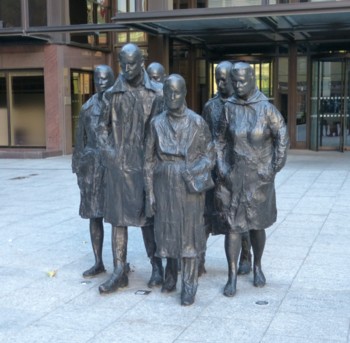
Here is a photograph of a sculpture, which I recently chanced upon, in the part of the city that is London is known as the City of London:
The sculpture is called “Rush Hour”. It said so, on a sign in the ground in front of it. I also photographed the sign. This is a good habit for a photographer to get into. Cameras are not just for taking pictures. They are also for taking notes.
What struck me about this sculpture, as I looked at it and photoed it, was how depressed they all look, especially when compared with London’s sculpted warriors. The warriors depicted on war memorials had any number of agonies to contend with, yet they stick out their chests, jut out their chins, look the world proudly and defiantly in the eye and tough out whatever challenges and horrors they are obliged to endure. These office drudges, on the other hand, have given up. Their eyes point downwards, avoiding any contact with the world or with me and my eyes. They trudge forwards, following the person immediately in front. They do not look like people fighting a war, successfully. They look more like prisoners of war, in a war that their side is losing.
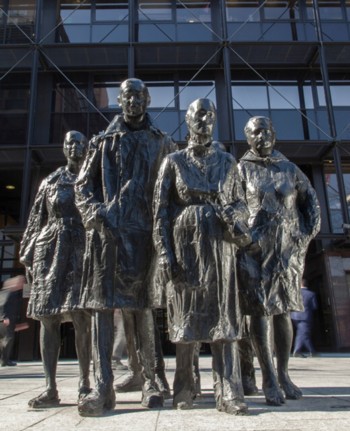
But, when I got home I checked out the website mentioned in the sign in the ground under the sculpture, the sign that I had photographed, and when I did, I got quite a shock. I was confronted by this:
These city commuters are facing the cares and stresses of their lives with a degree of stoical optimism, even heroism, that their cousins in my photograph conspicuously lacked. Urban drudgery may defeat lesser beings from foreign lands, but Britain can do it! We shall prevail! Final victory over financial services industrial monotony will be ours!
I actually had to study the above two photographs quite carefully before being entirely convinced that they are both of the same thing. Are there, I wondered, several versions of this sculpture, in different places? I slowly worked it out. These are the same statues, in each photograph. But the photo at the website was taken by someone crouching down, very low, and perhaps even lying on the ground (which means, for instance, that at least one of the figures at the back is entirely blocked from view). The figures are not on a pedestal, as both photographs make entirely clear. But this other photographer makes them look as if they are.
Particularly significant, as I say, is the matter of eye contact. In my photograph, the commuters dare not look at me. Instead they look downwards. This is why they look so defeated, so ashamed even. But in the website photo, they are looking straight at the camera, and although not happy exactly, they seem proud of what they are doing, and confident that they can face any challenges life presents them with.
The lighting is different, and that does make a difference. But mostly, the difference is in the angle of vision.
The point of this posting is not that the angle you see things from makes a difference. Most of us know this. My point is that, when it comes to the particular matter of human statues, it can make a very big difference, far bigger than I, at least, had realised, until I spent those minutes checking these two photos to be sure that they were of the same thing.
What, I wonder, might be the effect of photographing war memorial statues, statues that are on a pedestal, from a position of vertical equality, or even slight superiority? Suppose, while photographing the figures at the centre of the recently unveiled memorial to Bomber Command, that I had somehow raised myself up to their level, or even somewhat above that level. Might my photographs have looked different in their psychological atmosphere? Would the figures suddenly have seemed less heroic, less like the masters of their fate and more like the victims of it that many of them must surely have felt?
If so, it would appear that pedestals are an even more significant part of our civilisation than I had realised.
[A]ll law-enforcement agencies really believe they need more powers. But, when they say that, they should be completely ignored. Not criticised, not accommodated, just disregarded.
The sincerity is beguiling but it’s meaningless. “Help us to do our jobs better,” the police implore. “We can see the good we could do if you let us.” They almost certainly can. But they can’t see what it would cost society in lost freedoms.
– David Mitchell, in an article that is so sharp it is quite hard to pick out the best quote. Read the whole thing.
Andrew Mitchell, the government enforcer, allegedly calls a policeman a “*u**i** pleb”. George Osborne, the finance minister, boards a train with a second class ticket and proceeds to sit in first class. MPs, of all parties, are found to be scamming the taxpayer by owning one house and living in another – no, I don’t understand how the scam works either.
So, why are we getting so many scandals now? Is it because this is a particularly bad time for it? I don’t think so. My guess is that the amount of obnoxious behaviour by politicians is more or less constant over time. The variable is the press.
Older readers, and those with a fascination for history, will remember the spectacular collapse of the Conservative government in the mid-1990s. Originally elected in 1979, for over 10 years there was an almost complete absence of sleaze stories. About the only one I can think off the top of my head was Dennis Thatcher’s use of No.10-headed notepaper. And then, all of a sudden, in about 1992 they all started coming out: cash for questions, three in a bed, secret love children, more cash for questions, affairs with actresses. Every day a new scandal.
As I said, it seems improbable that Tory MPs were for 10 years purer than the driven snow and then, all of a sudden, dropped all principle like it was a form of radioactive waste. No, what happened was they had always been acting like this; it was just that now the press started reporting it. And why now (or, is it then?)? Because of Black Wednesday. Black Wednesday – Britain’s forced departure from the European Exchange Rate Mechanism (ERM) in September 1992 – had demonstrated in the clearest possible terms that the government didn’t know what it was doing when it came to the economy. At that moment the press got angry. So long as they believed that these people knew how to ensure prosperity they were prepared to turn a blind eye to the odd peccadillo. But now they realised that they had been hood-winked. After that any Conservative was fair game.
Now, Cameron’s government has not had an ERM moment as such. But then again, it has never demonstrated any great degree of competence. Faced with the greatest economic calamity in living memory (or the Second Great Depression as Brian likes to call it) it has drifted and the press has started to notice. The feeling of hoodwinkedness and corresponding anger is now fully fledged. I unconfidently predict a stream of scandals until Cameron leaves office.
To be sure, all governments since the invention of papyrus have had cause to fear leaks, and all modern British governments have known that after 50, or 30, or 20 years most official paper will be released to the public. But when these documents were generated, their authors knew – or thought they knew – that, in principle, they were secure until that release. Their premature disclosure could not be ordered by an information commissioner or tribunal. Without such security, there can be no honesty. It is simple: if you fear your private communication will be laid before the world, you will write it quite differently, or not at all.
So the effect of FoI is to promote dishonesty and concealment. I pity any biographer of any prime minister from Tony Blair onwards. He or she will not be short of government paper. Thanks to the computer’s power of infinite reproduction and the advent of the email (to whose implications, by the way, FoI gave no thought), he will drown in material. Because of the cant in which modern administrative documents are expressed, words like “openness” and “transparency” will be spattered over thousands of pages. But there will be no such openness or transparency. The big decisions will all have been made in whispers in a corridor, or abbreviated in a text message. To find out what happened, the biographer will have to rely solely on the fallible memory of elderly ex-ministers and officials.
– Charles Moore
I preferred BSA when they made motorbikes.
– James P is one of many Bishop Hill commenters who is unimpressed by the activities of the British Sociological Association, who are trying to insert sociology into the CAGW debate. To make people believe in CAGW, with further doomed attempts along these lines?
A couple of weeks ago the government announced (with pens hovering over contracts) that it was prematurely ending the process for awarding the West Coast Main Line (WCML) franchise. This came after Virgin – the loser – initiated legal action to force the government to disclose why it had provisionally awarded the contract to First. During the process of preparing for the case the Government discovered that it had got its sums wrong.
We can argue that it shows that the government is incompetent. We can argue that it shows that Beardie is not a man you want to mess with. We can possibly argue that over-optimistic assumptions about the economy have a lot to do with this. And we can certainly argue that this creates a lot of uncertainty and this is a bad thing because train operators will not be able to make any plans.
But really this is wood for the trees stuff. The fact is that the government (or, to put it another way, the violent part of society) should have nothing to do with the railway. Decisions about the railway should be made by the market (i.e. the peaceful part of society).
Hence, we shouldn’t have franchising, or subsidy, or the split between the wheel and the rail. Yes, unbelievable as it may sound to the uninitiated, in Britain train operators are not allowed to own the track and track owners (or owner – there’s only one) are not allowed to run trains. Railways should be liberated from the state and allowed to stand or fall on their own merits.
My guess is that they will stand (or at least the WCML will). I’ve just returned from Japan where the railways were (mostly) liberated from the state 25 years ago. Trains are frequent, clean and modern. The main railways are profitable.
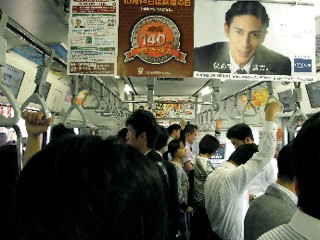
At this point people someone’s bound to complain that Japanese trains are overcrowded. What about all those people pushers? Every time I’ve been in Tokyo (this was my fourth trip) I’ve tried to find them and haven’t succeeded yet. True, most people have to stand in the rush hour, and from time to time things get very uncomfortable but much the same is true of London too. And for the same reason: fare control which depresses the price and increases demand.
Yamanote Line train somewhere between Shinagawa and Shibuya 0730, Thursday 11 October 2012:
From an auctioneers’ website:
lot details
lot no 305
description
A silver rectangular medallion, London 1977, applied with ‘WE FIX’D IT FOR JIM’ and ‘NATIONAL VALA 1977’, 4.2cm high, with a suspension loop, on a belcher link chain, the ring catch stamped ‘STER’
The National Viewers’ And Listeners’ Association (National VALA) was founded by Mary Whitehouse, CBE (1910-2001) in 1965.
Provenance: From the estate of Sir Jimmy Savile. OBE, KCSG, LLD (1926-2011)
It would be ridiculous to attempt to extract some moral from the existence of a medallion apparently issued by the National Viewers’ and Listeners’ Association, 1970s campaigners against obscenity, particularly obscenity on the BBC, and the late Jimmy Savile, 1970s BBC DJ and TV host, now alleged (credibly alleged, despite the inevitable swarm of bandwagoneers) to have been a sexual predator with no regard for gender, age, vulnerability or consent. Any competent hack could whip up two think-pieces with mutually exclusive morals in one hour flat and bank his cheques from the Mail and the Guardian in the morning.
It was just an odd thing I found on the internet.
Just to add to the oddity, the auction was held in Saviles Hall. It is no longer possible to Google for the origin of that name.
The medallion went for £220, somewhat below the estimate. Wonder what it’s worth now?
Yes, I think I am avoiding talking about the Savile case. You can remedy that below. The case, as opposed to the medallion, throws up so many questions and points for discussion that I was hard put to keep the number of categories for this post under half a dozen. Please bear the laws of libel in mind if referring to living persons.
We here all have our opinions about the relative merits of President Obama and Would-Be President Romney. Last night, I stayed up (again very late) to watch Debate Two between Obama and Romney, and that being so, I might as well say something about that here.
As I commented here in connection with that earlier event, the TV Umpire Lady in the Biden Ryan debate did Biden no favours by allowing Biden to behave like a graceless fool. The result of that media error of omission was an internet buzzing with compilation video of Biden behaving like a graceless fool.
Last night, or so it seemed to me, and more to the point to many others, the graceless fool was the TV Umpire Lady herself, a person by the name of Candy Crowley. She was the one interrupting, and telling Romney what was what and generally getting way, way above herself. The compilation videos in the next few days will be of her, rather than of either of the candidates saying or doing anything embarrassing, because last night neither of them did say or do anything embarrassing – well, not a lot and no more than usual. Both did their thing as best they could, so far as I could tell, Obama in particular being a great improvement on his performance in Debate One. Yes, Obama probably overdid his equivocating about exactly when he got around to calling the embassy attack pre-planned “terrorism”, rather than spontaneous film-criticism. But what jumped out at me was how Candy Crowley joined in on Obama’s side in such a big way, like some kind of tag-wrestler.
Like her predecessor in the Biden Ryan debate, Candy Crowley did the candidate she clearly favoured no favours whatsoever. Obama, despite himself doing okay, was made by Candy Crowley to look more like the geeky kid in the playground who needed protecting from one of the older kids, rather than any sort of President. Worse, Obama was being protected by a girl.
I was half watching the BBC, again, afterwards, to see what they would make of all this, and this time they seemed to have a total blind spot, perhaps because not having a blind spot would have involved noticing that the biggest loser this time around was one of their own. As I earlier reported, the BBC called the Biden Ryan debate fairly accurately and almost immediately. This time? Well, unkind phrases like “elephant in the room” spring to mind.
Because, when it comes to Candy Crowley, I really do mean big loser. I’m not running for electoral office and I can be as graceless as I like. Other unkind commenters on various Instapundit-linked blogs I read last night talked of “Jabba The Hut” being the moderator. That a woman used to be young and cute, but has now become rather fat, hence not so cute, and consequently revealed as never having been all that verbally fluent in the first place, ought not to matter that much. But as I have been emailing my as-of-now super-cute god-daughter, in connection with photos of herself that she has recently been sending me, such things do matter. Cruel but true. Candy Crowley made the US mainstream media look, last night, like a frumpy old has-been.
During the presidential election four years ago, US mainstream media bias was not nearly so obvious, because the US mainstream media, that time around, were telling a story with widespread appeal to regular Americans. Don’t vote for the doddery old coot! Vote for the cool black dude! But now, the times have become far scarier, and the US mainstream media are backing a President who has spent four years saddling himself with a record that he is entirely unable to boast about, against an opponent who looks and sounds like he was created in Hollywood by Hollywood’s finest bio-engineers to look and sound exactly like the perfect American President. And their bias is really showing. Politics, it has famously been said, is show business for ugly people. This does not now apply to Romney. Give him four years in the White House, and he will probably turn very ugly, especially when you consider how ugly the economic facts he will have to grapple with are now and are about to get. But as of now, Romney is pretty enough not merely to be President, but to be President in a movie.
So, the first debate was lost by Obama, the second one was lost by Biden, and the one last night, I reckon, was lost by The Media. 3-0 to Romney with one to go, or so I reckon. Because of all this, I continue to reckon that Romney is going to win big
But, what I reckon is only what I reckon, and what does it matter what I reckon? What actually matters is what the USA’s voters make of things. I want the result that I want in this election because I think that I want Romney to win, because I know that I want Obama to lose, and because I really want the US mainstream media to get a right old kicking. Will the voters oblige?
I have been reading the libertarian sub-Reddit lately. I recommend it. Interesting links are posted, discussion ensues, and thanks to the voting system, interesting comments float to the top. Such as:
Due process has now been reduced to a signal from a dog, which doesn’t even have to be documented.
And why did we do this? What cause was so noble that its pursuit justified the mutilation of our one protection against arbitrary punishment? Oh yeah – protecting people from their own bad decisions.
This is from the discussion of a story from the Institute for Justice about police using an alert from a sniffer dog as an excuse to seize assets even if no drugs are found.
The Institute for Justice is “our nation’s only libertarian public interest law firm”. They have also taken an interest in eminent domain.
|
Who Are We? The Samizdata people are a bunch of sinister and heavily armed globalist illuminati who seek to infect the entire world with the values of personal liberty and several property. Amongst our many crimes is a sense of humour and the intermittent use of British spelling.
We are also a varied group made up of social individualists, classical liberals, whigs, libertarians, extropians, futurists, ‘Porcupines’, Karl Popper fetishists, recovering neo-conservatives, crazed Ayn Rand worshipers, over-caffeinated Virginia Postrel devotees, witty Frédéric Bastiat wannabes, cypherpunks, minarchists, kritarchists and wild-eyed anarcho-capitalists from Britain, North America, Australia and Europe.
|





Recent Comments