We are developing the social individualist meta-context for the future. From the very serious to the extremely frivolous... lets see what is on the mind of the Samizdata people.
Samizdata, derived from Samizdat /n. - a system of clandestine publication of banned literature in the USSR [Russ.,= self-publishing house]
|
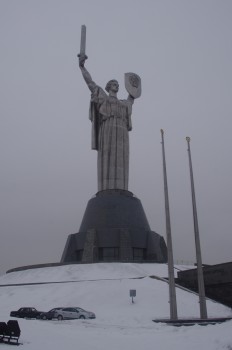 Kiev, Ukraine. January 2013. Kiev, Ukraine. January 2013.
This rather extraordinarily monumental statue stands on top of (and forms part of) the Museum of the Great Patriotic War in Kiev, Ukraine. The monument is officially named “The Mother of the Fatherland” but (perhaps curiously) is more commonly referred to as “The Mother of the Motherland”, and (perhaps less curiously) is sometimes referred to colloquially as “Tin Tits”. The museum commemorates the Soviet victory of the Nazis in World War 2. Although people in most countries of the USSR have rather ambiguous (at best) feelings about their Soviet past, the victory over the Nazis is quite reasonably seen as a good thing, and memorials to the war are still generally looked after and treated with respect. The statue itself is 62 metres tall. Including the base and building it stands on, the statue is over 100 metres above the ground, making it one of the largest statues in the world.
The statue sits upon a high hill overlooking the Dnieper River from its right bank, towards Kiev’s endless Soviet era suburbs on the other side of the river.
Enormous as this statue is, it is actually less grandiose than an earlier proposal. In the 1950s, there were proposals to built twin statues of Lenin and Stalin side by side, each approximately 200 metres tall – each significantly higher than the Washington Monument. Thinking about this in the past, I have thought that these statues would have been unspeakable abominations, and that the Ukrainian people were extraordinarily lucky to merely have the current, modest structure instead of this.
 Kiev, Ukraine. June 2009. Kiev, Ukraine. June 2009.
This evening, though, I am not so sure. Well, not entirely. Sure, they still would have been unspeakable abominations, but what a fine day today could have been had they been there. Imagine these gigantic statues of these evil men being pulled down, and the immense splash that they would have made as they fell from the top of the hill into the Dnieper, causing tsunami all the way to Dnipropetrovsk.
That would have been awesome.
“Mandela was a great man. The obvious reason was his courage and persistence in fighting against Apartheid. The somewhat less-obvious reason was his willingness to forgive. I’m assuming, of course, that the movie Invictus was relatively accurate in that respect. I remember sitting through the movie and being on the edge of tears for almost the whole movie, so moved was I by his willingness to forgive. A little bonus: His favorite poem, “Invictus,” has been my favorite poem since middle school. In some ways just as impressive, if not more so, was his willingness to learn at a relatively old age. He was a long-time socialist but, by the time he got out of prison, much of the world had learned that socialism didn’t work. He became persuaded of that and, although, as president of South Africa, he expanded the welfare state, he did not make a large move in the direction of socialism. His willingness to reject his wife Winnie’s violent ways was also impressive.”
– David Henderson.
I am sure there will be lots of appraisals of his life in the days and years to come; I have seen a few, mostly respectful (and one or two that are less so). As far as I can tell, Henderson’s is about the most accurate I have seen so far, for it focuses on essentials. A great man indeed. May he rest in peace.
President of the Adam Smith Institute Madsen Pirie is recruiting them even younger than Brian suggests in his previous post — in a way. He has written children’s books. I recently read Children of the Night.
My older son is only three, but I am keen to fill the house with books that he might like to discover when he feels like it. Whenever I read novels I worry about how the author’s worldview infects the fictitious world he has created. With Madsen Pirie I can relax, confident that his fictional universe will have sensible laws of economics and will not subconsciously implant socialism into my children’s heads.
Not only that, it is a very good adventure story. In genre it is a kind of steampunk — it has an outward appearance of fantasy but is really science fiction, which is the best kind of fantasy because it leads to an internally consistent and believable world. This leads to consistent and believable politics, which are never spelled out in exposition but form the backdrop to the action. And it is nearly all action, as makes sense for a children’s book, but there are many lessons.
On the origins of political power:
Shocking though the violence was, he was used to it. That was the way the world seemed to work. Those on high bullied and terrorised those below them.
On class and ambition:
“I do know this,” Quicksilver thought back, “that a wagoner’s son is destined to become a wagoner, and a nobleman’s son is destined to become a nobleman. But those with special talents can break free of this destiny and achieve things their parents could not dream of. Extraordinary things.”
In fact the protagonists are a poor orphan, a nobleman’s daughter who would rather be a pilot than a nobleman’s daughter, and an engineer dwarf, who all end up friends because of their differences.
On the intersection of economics and politics:
“It’s partly the cost,” Calvin replied. “There aren’t many places where people need to go up a mountain, and it would cost too much to lay miles of track and cable across open country.” He shrugged before adding, “And of course the Church limits the number of dwarf machines allowed into the Realm. They don’t want anything to upset the social order. That’s fine by us. We make the machines, not the decisions.”
On taxes:
“This stuff isn’t for sale anyway. It’s the share we have to pay to their high mightiness.” There was a real bitterness to his voice as he said it. “Who’s that?” inquired Mark, puzzled. “A far-off fat bishop who never set foot out of his abbey, and a far-off lazy lord who never did a day’s work in his life.” “You mean tithes,” said Mark, “a tenth for the church.” “A tenth?” Anderson laughed bitterly. “Round here it’s a sixth. And another sixth in taxes for using the land and sea which some noble calls his own.” Gene uttered a low whistle. “That’s a third gone before you start! Do they take a third of everything?” “Everything.” The word was spat out in bitterness.
On changing the meta-context:
We spread stories and provoke people to see the injustice of their rule, and to resent it.
There is also a problem with a fuel source that is mined by slaves. Many an author might have his characters fight against the slavery, and Madsen does, but he also has them realise the importance of the fuel, the suffering that its increase in cost would cause, and the possibility of a technological solution. This is a world in which technology offers hope and improvement despite its problems, rather than simply causing problems.
And there are murder mysteries, exotic flying machines, chase scenes, narrow escapes and double-crossings aplenty. It is all good, wholesome fun.
I always was an ageist and, despite now being quite aged myself, I remain one. In my case this now means that, when wearing my libertarian hat, I attach more importance to recruiting the next generation to the libertarian cause than I do to recruiting my own generation to it. It’s not that I am especially good at turning young people into libertarians, or for that matter at making young libertarians into better young libertarians. But, I try, and I especially admire those libertarians who do this better than I do. Luckily there are quite a few. I suppose the main thing I do to make libertarians and to make libertarians into better libertarians is to fly the flag for the thing itself, libertarianism, which by its nature appeals more to the young than do less excitable and exciting versions of free-market-inclined wisdom.
Oldies often moan about ageism, particularly when they are not that old and are still trying to get new jobs, to replace the jobs that ageist fiends have so cruelly snatched away from them. Oldies engaged in job hunting often find themselves competing with younger rivals, and finding that they are, to put it bluntly, past it.
All hiring decisions are a risk. A promising young recruit, if he (for “he” please read he-or-she from now on) works out okay, might then offer several decades of useful productivity, and even if he soon moves on to another enterprise or activity, you and your colleagues might still gain from having him in your network, for many years hence. An oldie, by contrast, will either be an immediate asset to your enterprise, or he won’t be an asset at all. This may be cruel, but that doesn’t change the fact that it is true. That much touted oldie quality, experience, can be very valuable, but only if it enables the oldie in question to contribute things of great and immediate value. In a crisis, a wise oldie may be just what you want, to fight, now, the fire that is raging, now. But if you are building for the future, as most hirers are most of the time, at least partly, youth and a potentially long future will often trump age and experience. Experience, the young will get. And in addition to not being so set in their ways and better tuned in to new technology, young people have something especially important that old people do not. They have quite long futures ahead of them. Unless there are major breakthroughs in the life-extension trade, a long future is not something that an oldie can ever have or ever acquire.
The enforced irrationality of compelling people to ignore such considerations, by passing laws, which force people (of all ages) to be less prejudiced against old people than they are inclined to be, is bound to cause many bad decisions and to prevent many good ones. Hirers should be allowed to decide for themselves between age and experience and the immediate future on the one hand and youth and the more distant future on the other.
Madsen Pirie is a notable recruiter and improver of young libertarians, in fact, I would say, he is one of the best recruiters and improvers of young libertarians in the world. Pirie featured in my previous posting here, which quoted from a piece by him about a speech he recently gave to some students at the University of Brighton. He does performances like this a lot, for university students, and just as often for teenagers who are still at school. I have lost count of the number of times that Pirie has said to me what I am saying here, far more eloquently than I am saying it. Get ’em young. The cumulative impact of Pirie’s now seriously impressive number of libertarian-decades doing this kind of thing (for he too became a libertarian when quite young) is beyond calculation, in terms of its benefits to our species and its future.
Last Tuesday evening, at the Adam Smith Institute Christmas party, I was able to observe some of the latest human consequences of Pirie’s labours over the decades, happily enjoying their Christmas drinks and each other’s vivaciously youthful company. It was a similar story only even more so at that Liberty League gathering I wrote about here earlier this year. A lot of the same faces were to be seen at both these events.
I have a goddaughter who is now an aspiring and decidedly glamorous classical/operatic singer. She is in London just now, auditioning to get into one or other of the two best London music colleges (fingers crossed, so far so good, blah blah). She went with me to this ASI Christmas party. She also was struck by the youth and intelligence of the majority of those present. She had a good time. She was impressed.
A couple of weeks ago I blogged about the beginning of the Zabern Incident. Well, now it’s got a whole load more serious.
There have been further incidents in Alsace. Mainly these have involved locals insulting soldiers and the soldiers reacting with extra-legal brutality but they haven’t been without their farcical side. In one incident, the participants in a court case managed to get caught up in riot and various judges, clerks and advocates found themselves spending a night in the cells. In another, Lieutenant Förstner, the 18-year old who sparked it all, went out on a shopping trip. Normal enough if you discount the escort of four soldiers with bayonets fixed.
And now it’s reached the floor of the Reichstag. And the Chancellor, Bethmann Hollweg, has lost a vote of confidence.
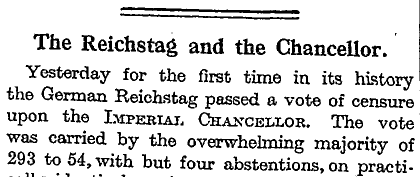 The Times 5 December 1913 p9 In a democracy (e.g. France which in this very week in 1913 has also no-confidenced its Prime Minister) that would mean it’s time for the Chancellor to pack his bags. But not in Imperial Germany. In Imperial Germany the Chancellor is answerable to the Kaiser not the Parliament. Democratically elected representatives can huff and puff as much as they like but they are not going to blow the Prussian Army’s house down. At least not for another 5 years.
This kinda sorta brings me on to an observation: the end of monarchy is a bloody and protracted affair. In England the process began in 1642 and was probably all over by 1700 and involved a couple of civil wars and a military dictatorship. In France it took about 80 years (1789-1871) and involved three revolutions, a terror and a twenty-year war. In Germany (at least the Western half) it lasted from 1914 to about 1948; in Russia from 1917 to 1989; in Spain from about 1920 to 1980. In each case millions died. Oh, and China of course (1911-1980).
The only exceptions I can find are Portugal (although that had a period of dictatorship) and Turkey (dictatorship again). Japan is almost impossible to categorise not least because you have to decide who you take as the monarch: the Emperor or the Shogun?
Getting back to Imperial Germany, the tragedy is that here we see them within touching distance of a proper, functioning democracy. So near and yet so far.
“The “rise of the four-car family”, as some media outlets are referring to it, exposes the hollowness of young adults’ claims that they can’t afford to move out. For here we have adults who clearly have pretty decent levels of disposable income – cars, after all, are quite expensive to buy and maintain – yet who insist on staying in the rooms they grew up in. So I don’t buy the newspaper claims that the rise of the four-car family is yet more evidence that Britain’s “cash-strapped youngsters cant’ afford to fly the nest”; it isn’t hardship that keeps loads of young adults at home, but cowardice, an unwillingness to do what just about every generation before them did: take a risk, leave home, suffer deprivations, live off Pot Noodles, and in the process gain something that money could never buy – a feeling of genuine moral autonomy.”
– Brendan O’ Neill
He’s got a strong point here (says yours truly who left home to live in student digs at the age of 18 and has never lived with his folks since apart from a period of one month during some professional training course I was on. In fact, when I stay with Dad for more than a few days I get cabin fever, love my father though I do).
I could not wait to leave home not because of any dislike of my parents, but because I just wanted my freedom even if that meant having to go without a few things. For some time I rented, and lived sometimes in shared accommodation with others that wasn’t always ideal, but it did mean that when it came to choosing to buy a house, my now-wife and I had a decent lump of capital saved up. I could have done this sooner in a less affluent part of London had I really wanted to do so, but the property market wasn’t right and renting made more sense. Getting a mortgage wasn’t the big deal for me that it seemed to be for a lot of my peers.
This may be a part of a process whereby people are putting off becoming “grown up” until later in their 20 and even 30s than used to be case. There are many drivers of this; official policy, after all, wants at least 50 per cent of school-leavers to go into higher education, when, arguably, that is too high and more should be getting into vocational training and work a bit sooner, and avoiding the drag of student debt. But O’Neill ought to also realise that affordable rental properties in places such as London, where much of the work is, is scarce, and much of the reason for that are our planning laws. It is a lot easier to boot out these adults from the nest when there is a realistic place for them to go.
In general, though, I think O’Neill is on the money and right to be scornful, although generalisations can be unfair on people who stay with their folks for entirely rational reasons (including looking after parents who might be infirm, etc). Quite what the longer-term impact on our society, even our politics, will be from a generation that did not fly the coop until its 30s is anyone’s guess. In the light of what Brian Micklethwait had to say recently about the ideas of Emmanuel Todd, it might be worth exploring the idea in more detail.
Madsen Pirie describes how he invited his University of Brighton audience to look at the world “through neo-liberal eyes”, rather than through the sort of eyes they are probably more used to using:
Others look at what is and compare it with a vision in their mind of what it might be. We are more empirical, comparing it to what was. Life expectancy about 150 years ago was about 30 years, and had been so for millennia. Now it is about 68 years globally, and higher than that in developed countries. We look at death to mothers in childbirth, and see it is now a tiny fraction of what it was even at the turn of the previous century. We look at infant mortality and see how that, too, is now a tiny fraction of what it was. Many of the diseases of the past have been conquered or controlled, and although there are new ones now that we live longer, we are in the process of controlling those, too. In the past most people battled to survive at subsistence level, whereas now we have more people above poverty and starvation than ever before in the history of humankind.
In other words we see things as being better than they were. Of course we can imagine a future which will be better than our present, but the empirical approach is to compare present with past, examine what made the difference, and attempt to do more of it. What made the difference was economic development and wealth creation, not the redistribution of existing wealth. It was opportunity, not equality, that drove progress, and we who support freedom want to see more of it, so that the future world will be as different from the present as ours is from the past.
I agree with everything there, except that very first sentence, about how “others look at what is and compare it with a vision in their mind of what it might be”, the implication being that we “neo-liberals” don’t do this.
I think it is truer to say that we do indeed think in exactly the empirical yet optimistic way that Pirie describes, but that we also compare what is with what might be. The difference is not that we look to the past and our opponents look to the future, but that we look more intelligently at the past than they do, and we also look to a different and better future.
I do not welcome, for instance, a future of “equality”, the sneer quotes there being because equality of the sort that is equal enough to satisfy the sort of people who demand equality will require someone to impose it, and that someone has to be unequally powerful to be doing such imposing. If you truly believe in equality, then you – you personally – will do what you can to improve the circumstances of those at the bottom of the heap. The poor will keep their freedom, thereby ensuring that whatever improvements you offer them really will be improvements. And you will not contrive these improvements by robbing richer people, because that will require you to be – unequally – powerful enough to do that, and there goes your precious equality. It will be equality that does not apply to you.
But just because I do not dream silly dreams of imposed equality, this does not mean that I dream no other dreams, dreams of freedom, dreams of progress, and yes, dreams of greater equality, that really is that, rather than just inequality that has been rearranged a little, in favour of new equalising rulers.
And nor does it mean that Madsen Pirie himself refrains from any such dreaming. He dreams – does he not? – of a future world that is – in a good way – “as different from the present as ours is from the past”. And he compares, as I do, that dreamed future with the present, to the present’s disadvantage.
When I were a youngling, fanfic was a despised genre. The internet has made it less despised, more common and apparently more nearly legal in a “don’t ask, don’t tell” sort of way. To quote the link from TV Tropes above:
No statement on the legality of fanfic has ever been given in American formal law or in its courts. Some argue that it’s a form of copyright infringement; however, see “Legal Fictions: Copyright, Fan Fiction, and a New Common Law”, and note the above precedents.
Authors often have conflicted reactions to fan fiction set in “their” universe, which sometimes leads to a Fanwork Ban. J. K. Rowling has largely embraced Harry Potter fan fic, albeit with certain limitations, for example, and Tamora Pierce advises aspiring writers that fan fiction can be a good way to hone one’s writing skills. By contrast, Sir Terry Pratchett acknowledges it exists and is cool about it, pointing out that everything works so long as people are sensible about it. He adds two caveats: anyone doing Discworld fanfic shouldn’t even think of doing it for money, and authors should take care not to put it where he might see it. George R. R. Martin, author of the epic fantasy series A Song of Ice and Fire, expressed his disdain for the practice, saying that “creating your own characters is a part of writing.” He’s even gone so far as to threaten legal action should he become aware of any fan fiction set in the Westeros universe. In contrast, writer/journalist James Bow makes a rather firm case for supporting fan fic, pointing out that it forms a stepping stone towards creating your own characters and setting. As far as media businesses are concerned, reactions have ranged from Archie Comics demanding immediate removal to Paramount Pictures taking some of the better Star Trek fanfics and having them published in print books.
My impression is that fanfic has become like music downloads, a tide that washes past all breakwaters of law or justice. What do you think? What do you recommend? Come on, out with it! – what have you written?
When plunder becomes a way of life for a group of men in a society, over the course of time they create for themselves a legal system that authorizes it and a moral code that glorifies it
– Frédéric Bastiat, Economic sophisms, 2nd series (1848)
But another story provided a fun distraction from all the hard work campaigning for tax cuts: it is the thirtieth anniversary of the first NOW! That’s What I Call Music album. There’s no bigger ‘Now’ fan than our Political Director Jonathan Isaby who has a complete set of all 86 albums! He spoke to Sky News and other TV stations about his collection.
– Matt Sinclair of the TaxPayers’ Alliance provides a little light relief, in the latest TPA mass email. (Link in the quote added.)
Recent comments by Boris Johnson about IQ and wealth inequalities have set alight debate.
There’s a double standard that has always confused me. Society is contemptuous of people who make their money using their looks – the celebrities and glamour models and reality TV show winners and so on – but impressed by people who make money using their brains. And yet the people who make money with their brains – whether they’re CEOs or scientists – are just as much winners of the genetic lottery as is any bosomy Page 3 girl or chisel-jawed Calvin Klein model. Why do we admire one, but mock the other?
Asks Tom Chivers.
My response is that there isn’t much difference; what I think is going on here is that people think looks are superficial, but brainpower isn’t, and that it is “deeper” in some way and therefore more deserving of respect. The question is a fair one: both our genetic inheritance in terms of brains and beauty are results of a biological and social lottery with some getting a lot and some getting little at all. The way to think about this in broader terms is that just as none of us in any sense “deserve” our looks, brains or muscles, so none of us do not “deserve” them, either. Also, if a person is born with great intelligence and this enables him to create wealth, he might not “deserve” it, but neither do those lucky enough to be born in a world containing this person, so they do not deserve the fruits of that wealth, nor do they have the right to seize it on some spurious redistributionist, Rawlsian grounds. (As in John Rawls, the egalitarian thinker who used the dodgy argument that lack of desert for inherited traits gave the State the right to seize the fruits of said, without pausing to think that the rest of humanity did not deserve that which had been seized, either.)
There can be no coherent notion of desert without the existence of a being who has the power to give out all these different qualities and abilities, and who has some sort of decision-making power that says A will get ravishing beauty, B will be ugly as sin but very clever, and Johnathan Pearce will be both fiendishly bright, good looking, and athletic (might as well get that out of the way). The premise, in other words, is wrong: “desert” has no meaning without such a belief. Existence, including what we got born with, just exists. (In other words, I think notions of desert in this sense are a hangover from belief in an all-powerful God or gods).
To put it another way, the whole edifice on which we choose to moan about the “unfairness” of different qualities of birth is built on sand. Far better, in fact, to focus on the notion that we all must have the freedom to rise as high as our abilities can take us, and to cultivate the moral and practical qualities to that end, and ensure governments get as far out of the way of this process as possible. And to remember that character, quite as much as how much brainpower you have, is important.
These ten quotes by Che Guevara are getting quite a mention around the blogosphere, and deservedly so.
David Thompson includes a link to them in his latest clutch of ephemera. Instapundit linked to them. And now I’m doing it here.
This is exhibit number five of the ten, picked pretty much at random, to illustrate the atmosphere of these ghastly pronouncements:
To send men to the firing squad, judicial proof is unnecessary. These procedures are an archaic bourgeois detail. This is a revolution! And a revolutionary must become a cold killing machine motivated by pure hate.
This posting is now at the top of this long list of Che Guevara postings here, but will surely sink downwards in the future, as we all continue to point out what a monster this man was.
|
Who Are We? The Samizdata people are a bunch of sinister and heavily armed globalist illuminati who seek to infect the entire world with the values of personal liberty and several property. Amongst our many crimes is a sense of humour and the intermittent use of British spelling.
We are also a varied group made up of social individualists, classical liberals, whigs, libertarians, extropians, futurists, ‘Porcupines’, Karl Popper fetishists, recovering neo-conservatives, crazed Ayn Rand worshipers, over-caffeinated Virginia Postrel devotees, witty Frédéric Bastiat wannabes, cypherpunks, minarchists, kritarchists and wild-eyed anarcho-capitalists from Britain, North America, Australia and Europe.
|
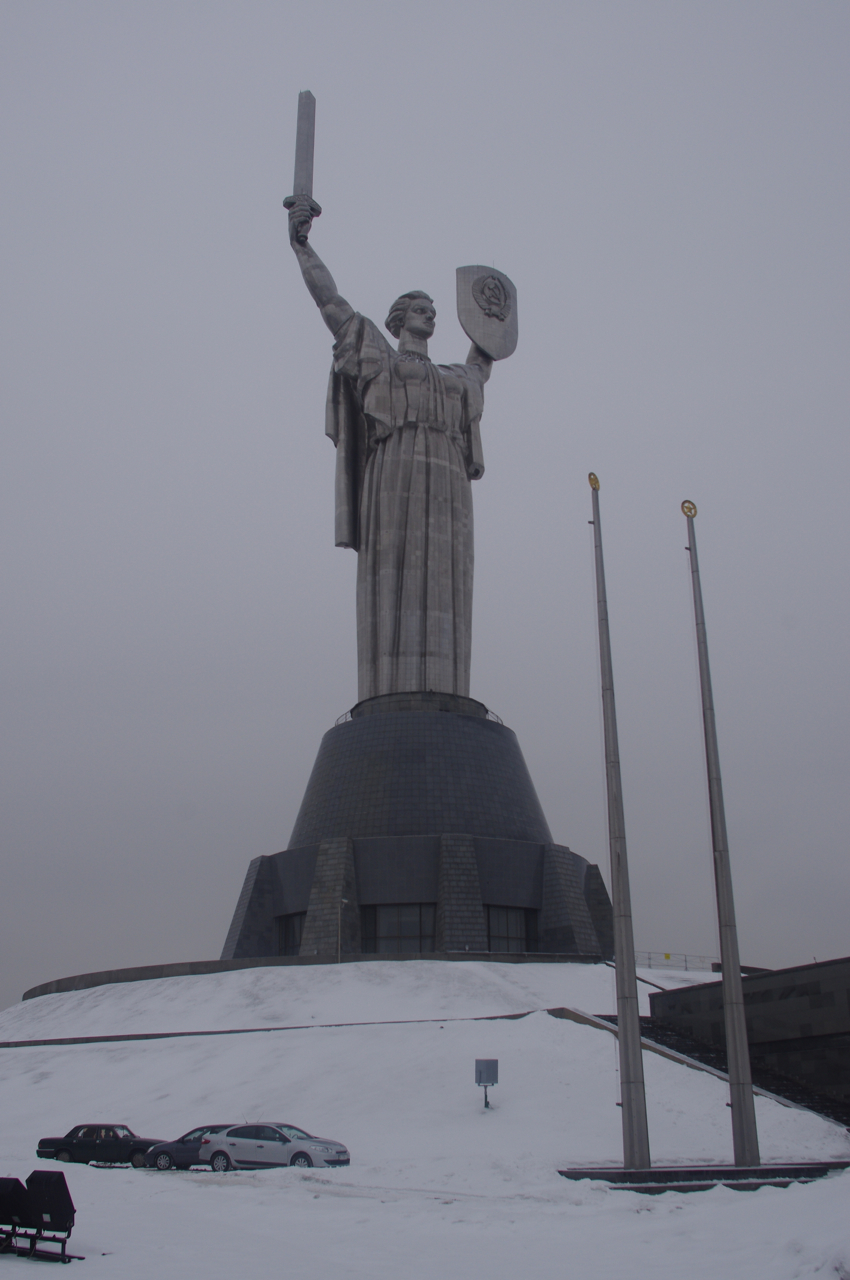 Kiev, Ukraine. January 2013.
 Kiev, Ukraine. June 2009.




Recent Comments