We are developing the social individualist meta-context for the future. From the very serious to the extremely frivolous... lets see what is on the mind of the Samizdata people.
Samizdata, derived from Samizdat /n. - a system of clandestine publication of banned literature in the USSR [Russ.,= self-publishing house]
|
We are now a week into the Sochi Winter Olympics. The opening ceremony was spectacular, apparently. (I stuck to my regular custom of watching nothing of Olympics opening ceremonies except for the march past of athletes from countries with names starting with the letter I). Many events have apparently gone smoothly, especially the indoor ice events taking place in the city of Sochi itself. There have been a couple of minor issues with individual sporting cultures coming up against strict Olympic rules – for instance the alcohol ban inside venues is said to be “against the spirit of curling”
At the other end of the outrageously expensively constructed road and outrageously expensively constructed railway to the outrageously expensively constructed resort of Krasnaya Polyana in the Greater Caucasus mountains, I am not sure that the snow events are going quite so well. Some of the downhill skiing looks a little slushy to me. Cross Country skiers have at timesbeen competing in T-shirts and shorts in temperatures of around 15 degrees Celsius, I am told. Ski runs in such hastily constructed places are seldom as good as in the most famous resorts of the Alps or the Nordic countries or Canada, and one senses a certain discontent. One can’t tell from the vapid commentary of the BBC coverage – and I suspect the vapid TV coverage in most other countries. Sports journalists and TV networks are too close to the organisers and too close to the sportsmen and too close to the IOC and wish to retain access to all these people and organisations in future to do much but gloss over these things, on the whole.
The odd piece of discontent is being reported. The Australian media is being rather franker than it would be if talking about, say, cricket. (This might have to do with Australia not being much of a winter sports power, and so having less to lose). Combine this with the interesting culture of the sport of snowboarding – arguments at previous Olympics about whether a ban on cannabis use was against the spirit of snowboarding do appear to have been resolved under the table in favour of the snowboarders – and we have found out the snowboarding halfpipe course is “f—king retarded”.
So it is probably fair to say that a huge amount of money has been spent on these games, the money has been filtered through a very corrupt Russian political and economic system and through the IOC, and venues that are good for the ice events and sort of okay for the snow events have been constructed, with the minor problem that it isn’t actually very cold in Sochi in February being a bit of a problem, as predicted.
What does this mean for the future of the winter Olympics?
The 2018 Winter Olympics are in Pyeongchang county in South Korea. Assuming that North Korea does not collapse or try to start a war between now and then, this will be straightforward, as these things go. A vast amount of money has been spent building new world class ski resorts at Alpensia and Yongpyong. These have largely been built already. They were built in anticipation of Pyeongchang winning the Winter Olympics. Pyeongchang also made unsuccessful bids for the games of 2006 and 2010, and has therefore been building for some time. There are already large financial black holes from the construction of these venues, but one cost overruns will be anywhere near as bad as have come from the highly corrupt race to get things built on time that took place prior to Sochi. Plus there have been and will be time for lots of test events to get the venues right. Of course, there are still highly expensive new highways and railways to be built, and a lot of indoor venues to be built for the ice events in the coastal city of Gangneung. As national pride is at stake, South Korean taxpayers will undoubtedly suffer painfully, but South Korea is a rich industrial democracy with competent people in charge. These games will likely go smoothly, but they will cost a lot – just not as much as Sochi.
The venue for the 2022 Winter Olympics has not yet been decided, but the IOC announced last year there were six final bidders: Stockholm (Åre), Sweden; Oslo, Norway; Krakow, Poland (Zakopane, Poland and Jasná, Slovakia); Almaty, Kazakhstan; Lviv, Ukraine; and Beijing (Zhangjiakou), China. [It has always been the case that the indoor ice events would be held in a city and the outdoor snow events in a mountain resort. In recent times the need for the city to be close to the resort has been relaxed somewhat, and I have listed the mountain resort(s) in brackets if it is a long way away from the official host city].
Sweden has already withdrawn their bid, and Norway appears to be close to doing so. The reason: they are seeing the immense expense and horrible shenanigans going on in Sochi. A little secret of the Olympics is that many of the the same people run it every time – the host city largely just picks up the bill. Once the event has ridiculous expenses and large amounts of outright corruption attached to it, this all comes with it to the next venue. Receiving kickbacks on construction projects becomes what it is all about.
Relatively uncorrupt places like Norway and Sweden look at this, and find that they want nothing to do with it. As great centres of winter sport, they have many of the right facilities already, meaning less scope for construction industry kickbacks. This means that for some of the IOC the fact that a country is already prepared for the Games is actually a negative rather than a positive.
Anyway, though, the point is that the two countries best able to host the games end up not being serious candidates.
As for the others: Poland and Slovakia would run the games just fine, but a fair bit of infrastructure and facilities would need to be built. Krakow is a lovely city. Zakopane is a lovely resort, and the Tata mountains are a suitable place for the games, even if the best downhill resorts are on the Slovakian side rather than the Polish side. (Some of the infrastructure construction would not be too counterproductive: Poland built lots of new roads, railways stations and airport terminals before the Euro 2012 soccer tournament, most of which were needed anyway and were part of Poland’s long term post-communist infrastructure modernisation). The Olympic games are not what money should be spent on in the present economic circumstances, though, and one also hopes that the richer countries of the EU are past paying for the Olympics to be held in the poorer countries of the EU (see Athens 2004). But with the EU, who knows?
So the others:
Lviv, Ukraine is far too poor and backwards a place to consider even before the present political turmoil in Ukraine. This is not going to happen.
Almaty, Kazakhstan is a hyper, oil money kind of place. The Olypics there Would be over the top and hilarious, and spending levels would be outrageous. This could be the IOC’s kind of thing, actually. As a positive, the Kazakh winter really is very cold, and the mountains around Almaty are spectacular. So in that way, this would be a good venue.
Then there is Beijing, China. Another Olympic games there would be all about prickly Chinese nationalism again. The Chinese would spend whatever is necessary to pull it off. Lots of clearing of poor people off the streets would occur before the games. Both of Japan and Korea have hosted the games before, which is always likely to get the Chinese riled up. An Olympics here might well happen. One does wonder about the outdoor snow events, though. China does not appear to have any culture of these kinds of sports whatsoever, and a mountain resort at Zhangjiakou would be a spectacular Olympic venue carved out of nothing that would likely become one of the great Olympic ruins in very little time at all, rather like the venues of the summer games of 2008. The Chinese have been doing well in the speed skating and figure skating events in Sochi, though,
My hunch is that the games will be given to Beijing, or perhaps Almaty. Helpfully, or not, the Russian government has endorsed the Chinese bid. Hopefully the Poles will have the good sense to simply get out of the way.
There is risk, though, in giving the games to cities and countries with dubious records on human rights and fragile politics far away from the homes of the sports in question. One day, one of these choices will go badly wrong, and the obvious countries to hold these Games may be so pissed off with the IOC that they me no longer be willing or interested in hosting.
If Beijing or Almaty does get the games, by 2026 it will be a long time since the Winter Olympics will have been held at any of the great skiing resorts of Europe or North America. This is a shame, really, as until recently the winter games has to some extent avoided the excesses of the summer games. Here was an event in which Norway was a superpower, and the sports were all fundamentally ridiculous, even by the standards of other sports. We may miss that.
Deference is encouraged by having to take it on trust that the obscure means something important.
– Mick Hartley quotes Jonathan Glover. Glover was writing in particular about Martin Heidegger. But as Hartley makes clear, this habit proved to be very catching, particularly in France.
See also the posting below, about the influence of German thinking.
Last Thursday, exactly a week ago, there were two speaker meetings occurring in London, both of which I wanted to go to, both addressed by Samizdatistas.
I picked the one at Christian Michel’s home, addressed by Philip Chaston, who talked about various efforts by English science fiction writers to talk up apocalyptic threats to mankind, such as climate threats and invasion threats of various kinds, by writing stories about such things actually happening. It was a very good talk. But because of attending that talk, I missed the talk given by Paul Marks to Libertarian Home that same evening, about the influence of Germanic thought upon the English speaking world.
My journey through tube-strike-deranged London to Philip’s talk looked like being – and in fact was – easier than the journey to Paul’s talk might have been, but I do confess that the biggest reason I chose Philip’s talk was my guess that Paul’s would soon be viewable on video. That guess has now been proved right. The talk only lasted a little over twenty minutes, and I highly recommend it. For those allergic even to that much video, Simon Gibbs has also appended some admirably detailed notes on what Paul said.
The big thing I want to add to what Paul Marks said is to emphasise the extreme importance of the subject he chose to talk about. Because of how the Germanic version of state-worship eventually turned out in the twentieth century, the Anglo-Saxon world has ever since been understandably embarrassed by how huge had been Germany’s intellectual and political influence upon it. The entire episode is well on the way to being forgotten by all but a few libertarians, of the Paul Marks variety. Yet for several decades, the military prowess of Prussia and then of the greater Germany that was assembled around Prussia, seemed to many like a crushingly effective argument for statism and against liberty. Even Germany’s World War One war effort, eventually an utter failure, was still a mightily impressive effort while it lasted. Both those who admired Germany’s intellectual and political notions and those who hated them believed such things to be necessary for national success. To put it another way, even those who hated Germanic political culture also feared it, and regarded it as something that simply had to be copied, rather as there was a similarly misguided little spurt of enthusiasm in the West for the methods of the Sputnik-era version of the USSR. But the urge to copy Germany went on for far longer and was far more strongly felt and defended and argued for. Germanic thought became dug into Anglo-American academia, for example, and the consequent intellectual poison has yet to be purged.
While most others prefer to forgot this story, we libertarians have everything to gain from keeping the memory of all this very much alive. We should all pay attention to the tale Paul told last Thursday, and be passing it on to everyone we argue with about both the attractiveness and the effectiveness of the freedom idea, in contrast to the kinds of ideas that deranged nineteenth and twentieth century Germany, and which are still deranging the world because of Germany’s earlier example.
“Company officials will be trapped in a catch-22. They can lay off as many people as they want because of Obamacare. But because they’ll have to swear to the IRS that their decisions had nothing to do with Obamacare, they can’t speak publicly about what’s happening. What a great way to silence the people who are on the front lines of dealing with Obamacare’s horrific effects.”
On the continuing delightful rollout of the Affordable Care Act in the US. Giving politically sensitive stuff to the Internal Revenue Service: what could possibly go wrong? Again, as many others have observed, the saga comes straight out of Ayn Rand’s Atlas Shrugged.
As for the way in which this whole disaster has progressed, perhaps one of the worst aspects has been how Obama has more or less junked any pretence at worrying about the rule of law to minimize the political damage to himself. But should any of this be surprising to anyone now? Tim Sandefur has some thoughts on the constitutional damage done by ACA, and Obama’s conduct before, during and since the passage of this legislation.
My reservation about the quote at the top is that surely any ban on stating why a person has been made redundant violates the First Amendment. It might be nice to see this issue tested. (Please try not to giggle at the back of the class.)
Yes, we want guns to shoot criminals who threaten us. Firearms are so readily available to them that we are really asking for nothing more than – in Guardian terms – equality and social justice between the criminal and non-criminal communities. We are not fussed how many criminals die, but that doesn’t make us uncaring because we also believe that many people would never become criminals if it could be made as risky as, say, being a victim of crime.
But we also want to deter the heavily-armed state. To break its monopoly of force. To keep it in its place as our servant by restoring its fear of us. We don’t believe there would be nearly as many smug Guardianisti telling us how to live our lives if every Englishman’s castle still had guns behind the portcullis.
– ‘Tom Paine‘
A $64.2m road built for the games leads to the “Science Centre Biosphere,” which Russian officials say will monitor climate change during the Olympics. The site consists of a ski lift, tennis court, snowmobile trail, two helicopter pads, and a 14-room alpine chalet”
– An infographic in (of all places) Mother Jones, reporting on the immense cost of the current Sochi Winter Olympics. Research in other places informs me that this private ski resort is of course Vladimir Putin’s dacha, or more correctly one of his many dachas. Apparently he was trapped there once and had to walk out after it became impossible to get helicopters in or out during a snowstorm. As it was obviously appalling for a man such as Putin to suffer such an indignity, it became necessary to spend $64 million on a road.
Disregarding the absurd plunder of Russian public money that these games represent, I personally rather love the Winter Olympics. Rich people from rich countries compete with each other at absurdly dangerous activities. I am often baffled as to why or even how some of these sports came to be invented, but they sure are fun to watch.
As I often like to say and to write, if I don’t regularly quote me, who else will? And once upon a time, I wrote (on page 4, left hand column, of this), in a paragraph about the many different ways there are to be an effective libertarian, this:
Or perhaps you contribute crucially to the cause simply by (a) calling yourself a libertarian when asked what you are but not otherwise, and (b) being a nice person in all other respects. By merely proving that libertarianism and decency can cohere in the same personality, you will be a walking advertisement for the cause, as I might not be.
Now I don’t want to accuse Frank Turner of regarding himself as a member of any sort of political team, any sort of promoter of a “cause”. He is first and last a musician and an artist, not “a libertarian”. But the more I learn about this man (and thanks to Google sending me emails whenever anyone mentions him I have been learning quite a lot about him lately), the more he strikes me as the living embodiment of the above notions. It’s not that he is incapable of arguing his political corner. Merely that, on the whole, he prefers not to, and just to get on with his work and his life.
Consider this Frank Turner interview piece by Anna Burn, published today by Cherwell.
Near the beginning, Burn writes of the “clear tension” between Turner’s “old, anarchist politics and his new libertarianism”. And at the end of her piece, she writes this:
“People have historically been quite rude about rock and roll as serious art,” he says. “To me rock and roll is proper art, but it’s also disposable art, it’s adolescent art. What’s great about rock and roll is that it’s music about being young and pissed on a beach and getting your first kiss and then dancing until dawn. Sometimes people want to make rock and roll into this high art and I love it because it’s low art. It’s almost a sort of Liechtenstien thing. It’s pop art.” He grins wryly, seeming pleased with the pun. “All my influences are rock and roll.”
And with that last declaration, we’re done. As we’ve been talking he’s been putting his coat back on so that he can dash down to catch a train to London and film his tribute to Pete Seeger for Newsnight. For a man who’s on his longest break from touring in seven years, he’s still remarkably busy, and yet he can still spare a few minutes to chat to a student newspaper.
As he runs down the stairs, I realise that this is why he is a true folk singer – he’s open to everyone prepared to engage with his work, and he makes it worth their effort.
Note the Pete Seeger reference. This is not a man who allows a thing like politics to get between him and an admired fellow musician. See also Billy Bragg.
A few weeks ago, when the weather was crap – as it still is – and I knew I’d be spending some evenings at home, I opened a box-set of DVDs to watch that classic Sixties TV series, The Prisoner, starring Patrick McGoohan. Many things have been written about this series, which in my view represents one of the best such shows ever made. Chris R Tame , the late UK libertarian activist, mentor and friend of mine, wrote a fine essay about this show in the early 1970s and I agree with every word of it. The show is intelligent, profound, thought-provoking, and now thanks to the wonders of digital remastering, looks as fresh today as when it was first produced. (So much so that it seems almost better than if it were made now.) I was born in 1966, roughly time the show was conceived, written and shot. Some Sixties series can look very dated today, however much fun they are (like the old Avengers with Diana Rigg, etc) but The Prisoner doesn’t. And boy, is it on-target now. In the age of surveillance cameras, nanny statist health campaigns, the Leveson recommendations on state regulation of the UK press, unaccountable quangos, the NSA, and the like, much of what is lampooned in The Prisoner is all too believable.
Some time after he made The Prisoner, and had gone back to live in the US, the country of his birth (he spent a large amount of his adult life in the UK), McGoohan had these thoughts about the show and why he made it. I wonder what actors are as emphatic in stating such a viewpoint today:
“I tried first of all to create a first-class piece of entertainment. I hope it rings true because here, too, I was concerned with the preservation of individual history….If I have any kind of drum to beat in my life it is the drum of the individual. I believe that to be truly an individual, mentally clear and free, requires the greatest possible effort. And I seek this individuality in everything I do – in my work and in my private life. It is not easy.”
It isn’t. The other day, I had a bash at UK journalist and controvertialist Peter Oborne for his claim that a game such as cricket should not be primarily about people having a fun time, of doing something that makes them happy as individuals, but because it helps obliterate the self, that is about a “duty” to a nation, or some Other. I don’t know much about McGoohan’s explicit political views, but something tells me he would have regarded Oborne’s bullying anti-individualism about something like a ball game with bemusement, if not contempt.
In all the years I have been reading old editions of the The Times I have never come across anyone advocating a European Union. Until the other day, that is.
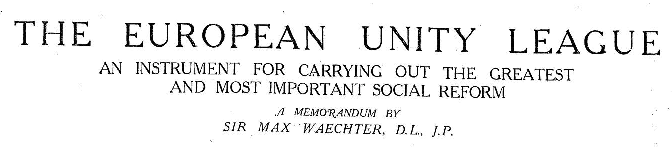 The Times 31 January 1914 p6
Annoyingly they are not entirely wrong:
If armaments could be greatly reduced, the savings effected would provide an abundance of liquid money to the great advantage of the people. Funds for industrial and commercial purposes would become plentiful.
Unless you piss it up the wall on a welfare state, that is. And on some things they are really on the money:
The nations of Europe and European civilisation itself threaten to break down under the military burdens. The people are groaning and muttering. Dissatisfaction is spreading apace. The tension is rapidly approaching breaking point.
The solution is a familiar one:
It is obvious that, if we wish to abolish war and the ruinously expensive preparations for war, we must deal with the fundamental cause of war. We must, therefore, above all, endeavour to abolish the disunion existing among the Great Powers and replace it by harmony and by a firm and lasting union.
I couldn’t help notice that then as today they seem to be extremely well-funded. I wonder how much a page in the The Times of 1914 compares with four pages in The Independent of today?
The paper money of the Soviet Republic supported the Soviet Government in its most difficult moments, when there was no possibility of paying for the civil war out of direct tax receipts. Glory to the printing press! To be sure, its days are numbered now but it has accomplished three-quarters of the task. In the archives of the great proletarian revolution, alongside the modern guns, rifles, and machine guns which mowed down the enemies of the proletariat, an honorary place will be occupied by that machine gun of the People’s Commissariat of Finance which attacked the bourgeois regime in its rear – its monetary system – by converting the bourgeois economic law of money circulation into a means of destruction of that same regime and into a source of financing the revolution.
– Bolshevik economist Evgeny A. Preobrazhensky, in his booklet entitled Paper Money during the Proletarian Dictatorship, published in 1920.
Quoted by Dominic Frisby in Life After The State (p. 92).
Sometimes with journalists, the pressure to write a column, and extract some broader, or deeper meaning, from an event can lead the writer into places where, to be kind about it, does not work to their advantage. Let’s take the case of Peter Oborne, who writes about the recent melancholy state of the English cricket team (it was hammered 5-nil in the recent Ashes tour of Australia). One of the consequences of this has been the sacking of the England coach, and now, it seems, the dismissal of one of its most recognisable players, Kevin Pietersen. Pietersen, or KP as he is known, is one of a long line of players who were not actually born in the UK (he was born in South Africa) but, by various routes, got himself eligible to play for the English national side. (His mother was or is British, as far as I know).
KP is known for being both a flamboyant striker of a ball, a great run-getter, but also someone who is not, in some eyes, a perfect “team player”. Words like “selfish”, “maverick” and “egoistic” get thrown around a bit. (As a libertarian, none of these terms strike me as particularly bad, but they are usually thought of as terrible in polite society.)
Oborne muses about all this, and he has some credibility in writing about cricket. A few years ago, he produced a book about Basil D’oliveira, who played for England, was a non-white, and who, hence, had problems in trying to play in South Africa. His story is one of how sport and apartheid endured a particularly torrid relationship. So, in general, you’d think that Oborne would be above writing nationalistic, ugly stuff about sports and games. Well, what to make of this:
The early history of Test cricket runs parallel with the fall of empires and the rise of the modern nation state. Test matches started in the 19th century, the great age of nationalism. Sir Don Bradman, the greatest cricketer who ever lived, was the symbol of Australian self-assertion against the mother country.
Quite possibly. Although let’s not overdo it.
Sir Frank Worrell, the first permanent black captain of the West Indies, was a vital figure in the liberation movement that spread through the Caribbean in the post-war era. According to the historian Ramachundra Guha, “one can read the coming into being of the nation of Pakistan” through study of the life of the nation’s first Test captain, Abdul Hafeez Kardar. All of these great men saw cricket partly as a sport, but more importantly as a way of serving their country. Cricket as a means of making money did not come into it. For many of them it was also a system of ethics.
Maybe true, although “serving ones country” is not what playing a ball game is about for me. My terrible “selfish individualism”, I suppose.
At the heart of the game was a highly developed concept of fair play. Players were expected not to cheat – for instance to “walk” if they were out. The authority of the umpire was respected. It was axiomatic that the individual should subordinate himself and his talents to the team.
A golden age, truly it was.
This set of propositions was linked to a powerful vision of the social order. It was assumed that men and women of exceptional gifts would devote lives of service to their community rather than further their own interests. It was recognised that extraordinary talents came by the grace of God and were not a mark of individual virtue.
Your life is not your own. You must serve the Collective. Your talents aren’t yours – they belong to the Collective. Okay, our Peter’s just really warming up now. There’s more:
The underpinnings of this vision have weakened. Religion, with its essential teaching about the unimportance of self, is no longer the force it was. In economic terms, cricket at the top level has ceased to be a form of national service. It should be viewed as another branch of the global entertainment business, dependent for revenues on giant TV conglomerates such as Subhash Chandra’s Zee corporation and Rupert Murdoch’s News Corp.
Cricket was a form of national service. Ah, so it was like being made to wear a military uniform, being sent off to strange lands to kill people when you’d rather do all that selfish individualist, money-grubbing, Sun-reading stuff instead. It is now about evil entertainment, not the misery of standing in a hot field. Murdoch, corporations…….
Sir Frank Worrell, AH Kardar, Don Bradman and England’s Colin Cowdrey were all manifestations of the mid-20th-century nation state, and all the social and moral obligations that went with it. Kevin Pietersen is just as surely a manifestation of the unqualified victory of neo-liberal market economics over the past two or three decades. Neo-liberals have little time for social institutions, are contemptuous of national borders, and dogmatically advocate the free movements of capital and people. They regard community, place and nation as worthless superstitions. Above all, they place the individual first.
If you believe in liberty as many “neo” liberals are, then by definition, it is about the freedoms of individuals. That doesn’t mean that people cannot and do not voluntarily associate and create clubs, with rules and standards, and sometimes fall out with people whom they don’t like, such as KP. It not the case that liberals don’t understand or respect institutions so long as those institutions operate by consent and don’t use coercive force.
In so far as Kevin Pietersen has any nationality, he seems to be South African. He was born and bred in South Africa, speaks with a South African accent and made his first-class debut for a South African team. He emerged as a cricketer in the most wonderful moment in South African history, when apartheid had gone and the country was building a multi-racial national team. Pietersen wanted no part in this new world. He got out as soon as he could, claiming that the positive discrimination necessary to help black cricketers stood in his way. Lack of loyalty has been his hallmark in English cricket. He moved first to the county of Nottinghamshire, then Hampshire, now Surrey. In the England team he seems to have been the repeated cause of division and bitterness. Eighteen months ago, Pietersen shared a century partnership with James Taylor, a 22-year-old debutant, at Leeds. At the end of the session Pietersen walked off the field with the South African players, leaving Taylor on his own. It later emerged that Pietersen was sending text messages to his South African opponents. In these he is said to have mocked the England captain, Andrew Strauss. Strauss, and not Pietersen, quit in the wake of that episode – a black day for English cricket.
A right wanker, then. Should have stayed at home.
I would argue, therefore, that there are important lessons to be learnt from the Pietersen debacle. We can acknowledge that open borders and free movement of capital – the key conceptions of neo-liberalism – have brought great prosperity and a certain vitality to Britain over the past quarter century. There is no mainstream political party that would like to risk scaring away Goldman Sachs or Ford Motors.
Scaring away foreign investors? I dunno, maybe it might be a good thing to give up all that ghastly consumerism.
But the wealth brought by international capital can be intensely damaging. It drives up values of houses so that ordinary, hard-working people can be priced out of the market. The impact of globalisation, especially through immigration, can make some British citizens feel that they are living in communities that no longer belong to them in a political system that no longer listens to them.
Make your mind up Mr Oborne. So free trade/movement etc brings prosperity, but it also “intensely damaging”. All those foreigners with their funny accents and so on buying “our” homes. This is classic “fixed wealth fallacy” in action (there seems no awareness on his part that that argument might logically lead for calls for, say, a quarter of the UK population to be deported or killed so as to cut house prices).
What does it mean to be British? Who makes our laws? Who, indeed, do we want playing for our national sports teams? These are all very difficult and dangerous questions. Like most people, I am not confident about the answer. As someone who has followed and loved the England cricket team for nearly 50 years, one judgment is easy. The England selectors made exactly the right decision in dumping Pietersen for repeated selfishness and disloyalty this week.
Well, as far as Mr Oborne seems to be concerned, he doesn’t want anyone playing for England who hasn’t been born here, which I guess would have ruled out many a previous England player. They were clearly mercenaries, “neo-liberals” who failed to understand that playing a game of cricket should be seen in the same terms as, say, joining the Brigade of Guards.
These are all very” difficult and dangerous” questions. Oddly, by the logic of Mr Oborne’s argument, the hero of his book would not have been allowed to don an England cap or shirt, since, well, just how “British” was he?
For the last hour as of 13.34 GMT, the Guardian has been running what it calls an ‘eco audit” asking readers to give their views on whether the destruction of ivory stocks helps save elephants as a species.
I was pleased and surprised to see comments running strongly in favour of the answer ‘no’. The first comment is typical:
It’s a stupid move. It just makes the price of contraband ivory go up and kills more elephants.
|
Who Are We? The Samizdata people are a bunch of sinister and heavily armed globalist illuminati who seek to infect the entire world with the values of personal liberty and several property. Amongst our many crimes is a sense of humour and the intermittent use of British spelling.
We are also a varied group made up of social individualists, classical liberals, whigs, libertarians, extropians, futurists, ‘Porcupines’, Karl Popper fetishists, recovering neo-conservatives, crazed Ayn Rand worshipers, over-caffeinated Virginia Postrel devotees, witty Frédéric Bastiat wannabes, cypherpunks, minarchists, kritarchists and wild-eyed anarcho-capitalists from Britain, North America, Australia and Europe.
|






Recent Comments