We are developing the social individualist meta-context for the future. From the very serious to the extremely frivolous... lets see what is on the mind of the Samizdata people.
Samizdata, derived from Samizdat /n. - a system of clandestine publication of banned literature in the USSR [Russ.,= self-publishing house]
I have posted very little recently from a century ago. This is because my main source, The Times, has become rather dull. You would have thought with hundreds of people being killed every day on three continents it would have lots to say but it doesn’t. Part of this is due to censorship. For understandable reasons, there is very little that the military authorities are prepared to make public. Another part of it is due to self-censorship. In wartime newspapers are extremely reluctant to criticise. Criticism is close to defeatism and defeatism is close to treason. Criticism can also carry a high price. A couple of months ago The Times criticised Lord Kitchener’s handling of munition supplies with the result that copies of the paper were burnt on the floor of the Stock Exchange.
Britain has to recruit, train and equip an army and until such time as she does there is very little she can do that’s going to make much of a difference. Even after she does these things it won’t make much of a difference because the army won’t have the experience to make itself truly effective.
So, actual front line reports tend to be all very similar. It’s all talk of our brave men, victories and heavy losses inflicted upon the enemy. Sure, the men are brave but it is difficult to cover up the fact that the frontline is hardly moving.
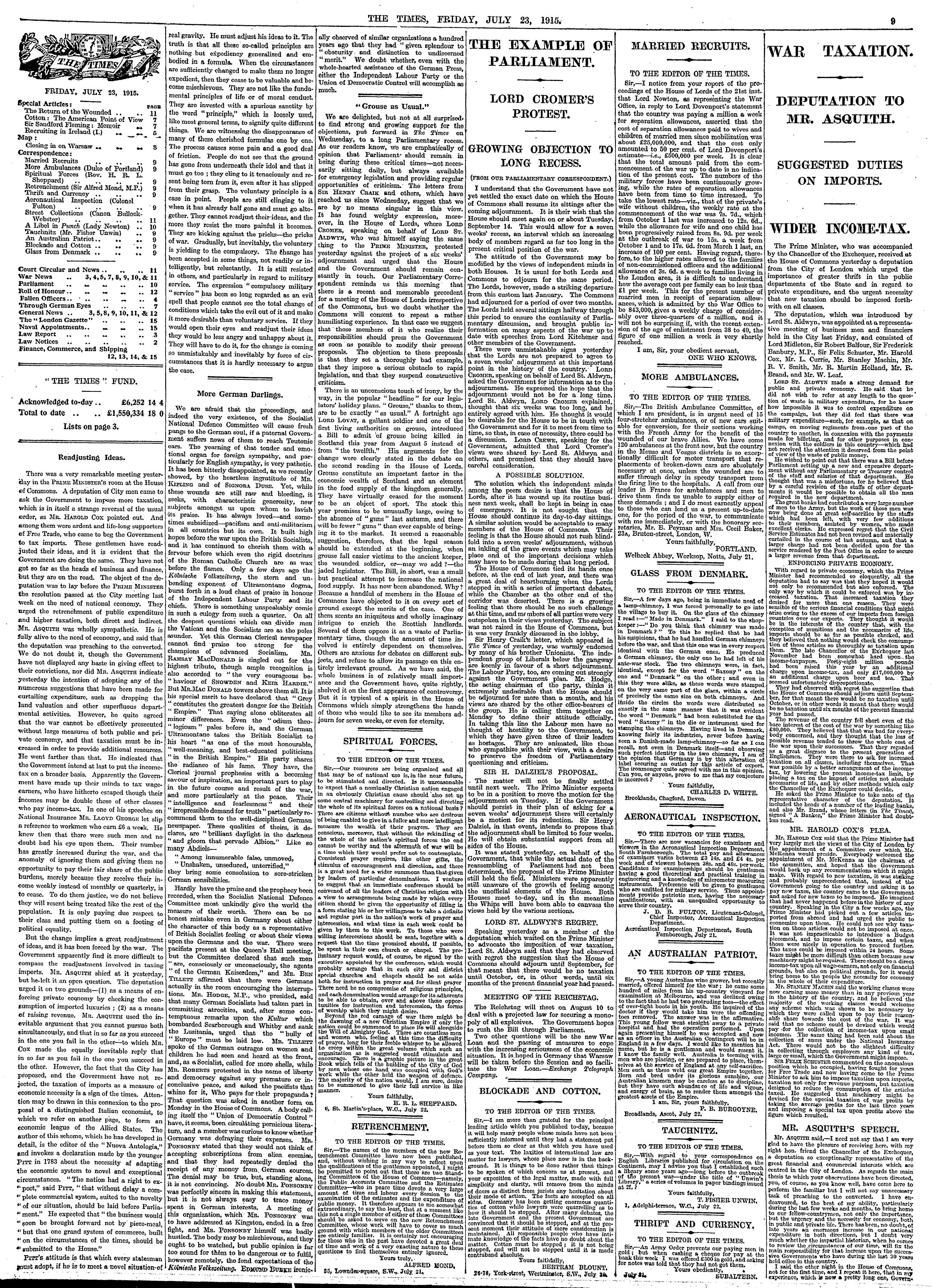
I was on the verge of giving up. My plan was to find a particularly egregious example of this sort of vapid war report and hang up my typing fingers until next year when things will get a bit more interesting. But occasionally you get an article that pricks your interest. In this case it’s a sentence: “Gradually, but inevitably, the voluntary is yielding to the compulsory”. It appears in a leader prompted by a bunch of City types asking the government – I kid you not – to increase taxes.
The sad thing is that it is true. Conscription will be introduced. Restrictions on the sale of alcohol are already starting to come in. Indeed, in some places it is already a criminal offence to buy a round of drinks. There will be rationing. Before long the Liberal Party will split and then wither away. Many liberals are giving up on liberalism altogether and becoming out and out socialists.
Before we condemn the war for this it is important to bear in mind that the voluntary principle was in big trouble well before its outbreak. The telephones had (effectively) been nationalised. State pensions and sick pay had been introduced. Many doctors found themselves working for the state. There were also the beginnings of unemployment benefit.
It’s all very sad – although not for The Times. The Times is all in favour of compulsion. Long before the war it was in favour of trade barriers or “imperial preference” (as it was then known) and national service. Ever since it has been campaigning for conscription and restrictions on the sale of alcohol. The paper is enjoying itself:
The truth is that all these so-called principles are nothing but expediency generalized and embodied in a formula. When the circumstances are sufficiently changed to make them no longer expedient, then they cease to be valuable and become mischievous.
The voluntary principle is a case in point. People are still clinging to it when it has already half gone and must go altogether. They cannot readjust their ideas, and the more they resist the more painful it becomes. They are kicking against the pricks – the pricks of war.
Nice, although it does beg the question if principles are bosh then what exactly does The Times think we are fighting for?
However, that is not to deny that this does rather put me in a bind. I think Britain was – perhaps I should say “Britons were” – right to fight the First World War. Willhelmine Germany posed a direct threat to Britain’s peace and prosperity. But do I really think the war could have been fought without compulsion? There are two questions here. After all, the British government existed long before 1914 and a government is nothing if not a mechanism of compulsion. So, could the war have been fought without any compulsion? and it could it have been fought without any extra compulsion?
I’ll deal with the second question and leave the first to the idealists. Could the men have been recruited? Large numbers of men signed up shortly after the outbreak of war and I have heard it said that conscription which was introduced in 1916 was not particularly successful. So maybe they could.
But could they have been equipped without a massive increase in either taxes or deferred taxes in the form of borrowing? That I very much doubt.
In the days before the welfare state there were all sorts of ways that funds were raised for “good” causes: friendly societies, public subscription and flag days were among them. There were all sorts of social pressures applied to get people to cough up. Not nice but a lot nicer than outright extortion via the tax system. Even so the amounts raised by the best-known funds were not spectacular. There was a fund created after the sinking of the Titanic and it raised a lot of money but nothing on the scale needed to fight a war.
It’s all very well sticking up for your principles but if a society that follows those principles can’t defend itself those principles are worthless. And if you abandon your principles in order to win what was the point of fighting in the first place? It seems to me that wars are often – if not always – battles of ideas. Oh, those ideas might be well hidden but more often than not they are there. War is often the ultimate test of political ideas. So, it seems a bit of cheat to go into war proclaiming a set of principles that you then abandon.
When it comes to expressing yourself, I am something of an absolutist. Unless said expressions involve violence, the default position must be in favour of allowing a person to do as they please. And so I found this interesting:
The film, My Freedom, My Right, made in partnership with the youth charity Fixers, features Clarke reciting a poem that recalls comments made to her because of her niqab. She also included other young people from marginalised communities, such as under-represented ethnic minorities who, she said, “rarely have their struggles highlighted in the media.
“I made the video to prove a point – I wanted to highlight that people who go through struggles and discrimination every day, but are rarely talked about by the media.”
She hopes the video will stop people “judging a book by its cover” and instead “treat people as individuals”.
Except that last line is completely wrong.
If a person wears a hijab… or a Nazi armband… I will indeed judge that particular book by its cover. The individual who dresses thus is not making a fashion statement, they are making a political statement (and Islam is a set of political values). Unlike a person’s race or national origin, a hijab… or a Nazi armband… tells me something profound, because it informs me about that particular person’s world view and their choices.
It is absurd to expect such a thing not to matter to others. If I am to tolerate a person wearing a hijab… or a Nazi armband… I must be equally free to non-violently express myself by stating my view that the things they represent are not just fine by me, and I think poorly of the people who wear them.
I support Joni Clarke’s right to wear what she wants, and to follow whatever crackpot religion she wants. And I hope Joni Clarke is equally tolerant and supports my right to have nothing to do with her, and have complete disdain for her political/religious values. I do not need or even want her acceptance or respect, I only want her tolerance, because that is all I am offering in return. But unless it is reciprocal, I am not even offering that, because tolerance of intolerance is cowardice (not to mention suicidal).
Ms. Clarke could of course find far fewer dissenting views from hers were she to live somewhere else. And as living under Sharia would not be a problem for her… well… just a suggestion, but I hear property in Raqqah is far less expensive than London.
Via Lindsay Perigo, a New Zealand-based writer, former radio current affairs fellow, and general stirrer. As he says, if you are not offended by all of this, something isn’t working.
Enjoy.
The Story of Admiral Nelson, Updated
Nelson: Order the signal, Hardy.
Hardy: Aye, aye, Sir.
Nelson: Hold on, this isn’t what I dictated to Flags. What’s the meaning of this?
Hardy: Sorry Sir?
Nelson (reading aloud): “England expects every person to do his or her duty regardless of race, gender, sexual orientation, religious persuasion or disability”? What gobbledygook is this, for God’s sake?
Hardy: Admiralty policy I’m afraid, Sir. We’re an Equal Opportunity Employer now. We had the devil’s own job getting ‘England’ past the censors lest it be considered racist. Strictly speaking, I shouldn’t be calling you “Sir,” Sir, but rather, “Person of Consensus-Based Enhanced Authority.”
Nelson: Gadzooks, Hardy! Hand me my pipe and tobacco.
Hardy: Sorry Sir, all naval vessels have now been designated smoke-free working environments.
Nelson: In that case, break open the rum ration. Let us splice the mainbrace to steel the men before battle.
Hardy: The rum ration has been abolished Admiral. It’s part of the Government’s policy against excessive enjoyment.
Nelson: Good heavens Hardy! I suppose we’d better get on with it, then. Full speed ahead.
Hardy: I think you’ll find that there’s a 4 knot speed limit in this stretch of water.
Nelson: Damn it man, we are on the eve of the greatest sea battle in history; we must advance with all dispatch. Report from the crow’s nest, please.
Hardy: That won’t be possible Sir. Health and Safety have closed the crow’s nest. No harness, and they said that rope ladders don’t meet regulations. They won’t let anyone up there until proper scaffolding can be erected.
Nelson: Then get me the ship’s carpenter without delay, Hardy.
Hardy: He’s busy knocking up a wheelchair access to the foredeck, Admiral. Health and Safety again, Sir—we have to provide a barrier-free environment for the differently-abled, wheelchair-mobile.
Nelson: Differently abled? I’ve only one arm and one eye and I refuse even to hear mention of the words. I didn’t rise to the rank of Admiral by playing the disability card.
Hardy: Actually, Sir, you did. The Royal Navy is under-represented in the areas of the differently-sighted and the differently-limbed.
Nelson: Whatever next?! Give me full sail. The salt spray beckons.
Hardy: A couple of problems there too, Sir. Health and Safety won’t let the crew up the rigging without hard hats. They don’t want anyone breathing in too much salt either. Apart from the racism inherent in its whiteness, it’s full of sodium. Haven’t you seen the Ministry of Health adverts?
Nelson: I’ve never heard such rubbish. Well, break out the cannon and tell the men to stand by to engage the enemy.
Hardy: The men are a bit worried about shooting at anyone, Admiral.
Nelson: What?! This is mutiny!
Hardy: It’s not that, Sir, it’s just that they’re afraid of being charged with murder if they actually kill anyone. There are a couple of Legal Aid lawyers on board, watching everyone like hawks.
Nelson: Then how are we to sink the Frogs and the Spanish?
Hardy: That’s “residents of France and Spain,” Sir. And actually Sir, we’re not.
Nelson: We’re not?!
Hardy: No Sir, the residents of France and Spain are our European partners now. According to the Common Fisheries Policy, we shouldn’t even be in this stretch of water. We could get hit with a claim for compensation.
Nelson: But you must hate a Frenchman as you hate the devil.
Hardy: I wouldn’t let the ship’s Diversity Coordinator hear you saying that, Sir—you’ll be up on Disciplinary Report for Hate Speech.
Nelson: You must consider every man an enemy who speaks ill of your King. That’s a matter of black and white.
Hardy: That’s “monarch-person,” Sir. And your point is controversial and problematic, Sir. Apart from “black and white” being offensive to people of colour, we must be inclusive in this multicultural age. Now, put on your Kevlar vest. It’s the rule. It could save your life.
Nelson: Don’t tell me, Health, Safety and Disability. Whatever happened to Rum, Sodomy and the Lash?!
Hardy: As I explained sir, rum is off the menu and there’s a ban on corporal punishment.
Nelson: What about sodomy?
Hardy: Good news there, Sir—sodomy is now compulsory.
The news story I recently wrote about a corrupt attorney general conspiring with the MPAA to take down Google has certainly caught the interest of our readers. Although the emails that Google recently obtained did contain some new information, many details of the conspiracy have actually been publicly available for a while. The Sony hack late last year revealed several emails that mention a strategy for movie studios to take on Goliath. It becomes clear from reading a few emails that Goliath is in fact a code name for Google.
Grab some popcorn! This is going to be fun, the vast monsters clash and lays waste to Los Angeles! What’s not to like?
Everything on [the Internet] is changing minute by minute, and the idea of establishing a level playing field, as if all bandwidth is homogeneous, is just ludicrous.
From the “it’s just a temporary emergency created by the need to suppress vicious anti-social elements, and we will restore things to normal after the crisis has ended” department:
I’m certain this new measure will finally end the reign of terror of the hoarders and restore food to Venezuelan homes.
Meanwhile, a word about toilet paper. The capitalist propaganda machine outside of the Bolivarist Paradise has been telling people that toilet paper is now largely unavailable for purchase in the country. But, does man really require toilet paper to be happy? A few centuries ago there was no toilet paper at all – indeed, mankind survived for most its history without toilet paper. The desire for toilet paper is simply a form of manufactured desire created by capitalist marketing and advertising – the production of a want in people for a product they don’t actually have a real use for. The creation of toilet paper despoils forests and the landscape, is unsustainable, and it is only to the good that Venezuela now leads the world in eliminating this scourge from our midst.
If you know for a fact that you won’t be able to buy Ribena if you shop at Tesco – for yourself or for your child – then shopping there might seem like an easy way of shopping healthily. Or maybe it’s just a simple PR move. McDonald’s salads were for some time the centerpiece of the company’s advertising, but were hardly less calorific than the burgers they were supposed to be a healthy alternative to.
Either way, as long as it’s just Tesco doing this, consumers can vote with their feet. My suspicion is that Tesco will lose money from doing this, and quietly reverse it after a few months, but the only way they can learn this sort of thing is by experimenting. As long as Sainsbury’s, Morrisons and plenty of other shops don’t follow suit, consumers will be only mildly inconvenienced.
The danger, though, is that the government uses this as a pretext to ban or tax sugary drinks across the board. This is a common sleight-of-hand used by the government, and we’ve seen seen it already this month: some firms pay their cleaners a living wage, so let’s make every firm pay all their workers a living wage.
The world in the 21st century is beset with economic fallacies that are, for the most part, modern versions of those that Bastiat demolished 16 decades ago. The answers to the vexing problems those fallacies produce are not to be found in proposals that empower bureaucracy while imposing tortuous regulations on private behavior. It’s far more likely that the answers lie in the profound and permanent principles that Frédéric Bastiat did so much to illuminate.
So we decided to do something to neutralise it. A group of friends and I laid a mattress and a bookshelf stocked with tomes on the housing crisis, inequality, gentrification, place-hacking and poverty atop some particularly vicious spikes on London’s Curtain Road. In the 1990s, it was the epicentre of a burgeoning artistic community that would eventually emerge as tastemakers in the visual and performing arts. We’re all aware that an artistic scene that gains any sort of appeal or traction is eventually leeched on, Death-Eater-like, by “property developers”. We saw these spikes as a direct assault on everything that makes us human. Anyone, for any reason, could end up on the streets with no home, no friends, no support. Sometimes you feel so unsafe where you are that sleeping on a ledge in east London comes across as the better option.
If some developers had their way, they’d commodify oxygen. To stop us having a society where it is acceptable to do that, we’ve decided to help out the best way we know how. We’re a loose collective of artists, journalists, academics, graduates and performers. We’re cultural producers. And with that comes the responsibility that what we make and share with the world highlights injustice and offers alternatives.
Many comments ask whether Ms Borromeo, a journalist and filmmaker, has made her own doorstep – or her own bedroom – available to the homeless. It is an obvious question. This does not stop it being a good one. I would imagine her own bookshelves are well stocked with “tomes on the housing crisis, inequality, gentrification, place-hacking and poverty”, so she could offer the free use of these as an additional incentive to make her own property a “more inclusive space where misfortunes of circumstance such as homelessness aren’t banned.”
On the other hand the capitalist vipers who own the Curtain Road premises probably regard the reading material left on their doorstep by Ms Borromeo and her preening chums (“The only good thing about living in austerity Britain is that through pushing us into a corner, the government and the money that controls it is unwittingly training up a generation of fighters. Some of us will kick and scream. Others will be by the ringside healing the wounded”) as a more effective deterrent than the spikes.
OK, this woman is a poseur. She isn’t a healer of the wounded, she just plays one in her own mind. I would give her a little more respect if I learned that her good deeds to the homeless included volunteering at homeless shelters or accompanying those charity workers and street pastors who make the rounds of those places where rough sleepers go every night. Or if I thought that she had spent even a moment thinking about the plight of the shop owner who sees her sales plummet because customers don’t want to push past the dosser on the floor to enter, or the premises manager who has to clean up the urine and needles every morning.
Yet it is possible to acknowledge the right of those put up these spikes to do so, and also have sympathy with the homeless. Ms Borromeo’s statement that “anyone, for any reason, could end up on the streets with no home” is the usual hyperbole (she need not worry about the chances of it happening to her), but it is true that things can go wrong for a person with surprising speed. There is probably at least one of your classmates from primary school who has lost everything, usually via drugs or alcohol. There are ways to help, but all of them have downsides. Homeless shelters, whether run by true charities or government funded, must themselves exclude some people. I would not be surprised or angered to learn that they make use of “access control” spikes themselves. If the shelters don’t exclude anyone – if they allow people to sleep there who are violent or predatory – then they destroy their own function as a refuge. The one sentence in Ms Borromeo’s article that rang true was “Sometimes you feel so unsafe where you are that sleeping on a ledge in east London comes across as the better option.”
So farewell, Yanis Varoufakis. You used to be Greece’s finance minister. Then you resigned, or were you sacked? You took control of the Greek economy six months ago when it was growing. Yes, honestly! Growth last year ran at 0.8 per cent, with forecasts of 3 per cent this year. The government had a primary budget surplus. Unemployment was falling. Until you came along.
Varoufakis was a product of British universities. He read economics at Essex and mathematical statistics at Birmingham, returning to Essex to do a PhD in economics. With the benefit of his British university education he returned to Greece and, during his short time in office, obliterated the nascent recovery. The economy is now expected to contract by 4 per cent this year — an amazing transformation. Greece’s debt burden has increased by tens of billions and many people have emigrated.
But Varoufakis is not alone. Plenty of other visitors to our universities have been influenced by the teaching here and returned to their countries to wreak havoc.
James Bartholomew, on the malign effect, as he sees it, of UK education. My problem with this article is that it is inevitably selective and I wonder, for example, what would happen if you randomly selected a group of postgraduates from UK universities, now living abroad in countries such as India or Singapore, and polled them on their economic and political views. It seems from entirely anecdotal experience that most graduates, especially in the liberal arts, tilt left; I am not sure about the leanings in economics today – although I get the impression that the ideas of Milton Friedman, Hayek, von Mises et al are still seen as quite “extreme”. But there have, for example, been pro-market lecturers at places such as the London School of Economics, for all its socialist origins: Lionel Robbins and FA Hayek, to take two examples. Arthur Seldon, one of the original men at the pro-market Institute of Economic Affairs – an enormously influential think tank in its time – was educated at the LSE, and I know quite a few LSE alumni who are pro-market.
So yes, during certain periods of UK history when socialism/collectivism was fashionable, the folk who came out of university often carried terrible ideas with them. Today, though, I think the problem is more about culture and philosophy. Post-modernism still exerts a big influence, for example, and the damage wrought is not always as easy to chart as with economics.
Of course, these points lead us back to that thorny subject of the PPE (politics, economics and philosophy) degrees which several UK politicians possess. The PPE is very much an exam crafted to give a sort of rounded set of subjects that an administrator/political leader was expected to understand, and I have no firm views about this sort of degree – there is no reason why having one cannot be a very thorough form of degree at all. But studying a subject does not seem to correlate a lot to understanding – the current UK government is led by a man with a PPE and it wants to push up the UK national minimum wage, a form of economic illiteracy, if supposed political cunning.
There’s nothing wrong with The Donald except that he’s a dishonorable, disgusting, opportunistic cronyist blowhard who has no problem getting the State to do his dirty work if all else fails, and maybe even if it wouldn’t. Either a liar or someone whose opinion depends on how the wind’s blowing, or both. Given a choice between Shrill and The Donald, one would have to wear waders that come up to the armpits to make it into and out of the polling place.
The Samizdata people are a bunch of sinister and heavily armed globalist illuminati who seek to infect the entire world with the values of personal liberty and several property. Amongst our many crimes is a sense of humour and the intermittent use of British spelling.
We are also a varied group made up of social individualists, classical liberals, whigs, libertarians, extropians, futurists, ‘Porcupines’, Karl Popper fetishists, recovering neo-conservatives, crazed Ayn Rand worshipers, over-caffeinated Virginia Postrel devotees, witty Frédéric Bastiat wannabes, cypherpunks, minarchists, kritarchists and wild-eyed anarcho-capitalists from Britain, North America, Australia and Europe.
All content on this website (including text, photographs, audio files, and any other original works), unless otherwise noted, is licensed under a Creative Commons License. Powered by WordPress & Atahualpa





Recent Comments