We are developing the social individualist meta-context for the future. From the very serious to the extremely frivolous... lets see what is on the mind of the Samizdata people.
Samizdata, derived from Samizdat /n. - a system of clandestine publication of banned literature in the USSR [Russ.,= self-publishing house]
|
… I have returned from Istanbul and never have I seen a city with more cats. And in spite of many being feral, they are well fed and friendly. One of these days I hope to see if there is some way to see a return of the smite cats to samizdata (long standing readers will know what I am babbling about).
So un-smittting should be a bit faster now.


→ Continue reading: New smite cats recruited…
One of my daily internet visits is to a site called Dezeen. Here I learn about lots that bores me, involving designers making small buildings shaped like boxes rather than ornamented, and about lots that interests me, including such things as much bigger and (to me) much more interesting buildings that are being dreamed of, built and celebrated.
On the matter of Brexit, Dezeen reported that the the overwhelming majority of “creatives”, in London and in the world generally, favoured and still favour Remain. These creatives were very angry when they learned that a majority of British voters did not share their views.
But Dezeen also had a recent link to a creative who sings a very different sort of ideological song to that sung by most of the kind of creatives whose work and opinions Dezeen reports on. I give you Patrik Schumacher:

Patrik Schumacher has written an opinion piece for Archinect, with these words at the top of it:
Brexit: a chance to roll back the interventionist state and unleash entrepreneurial creativity …
I have very little in common with the arguments of the Leave Campaign, and in particular reject the anti-immigration thrust of the Campaign. However, I welcome Brexit as offering an enhanced ability and chance to experiment with new policies that dare more economic freedom.
Later on in the piece, we read stuff like this:
I am convinced that the next prosperity potentials of our civilisation can only be explored and discovered if the straight jacket of the nanny state is gradually loosened and dismantled. (The bigger the scale of a country or block, the easier it becomes for the state to expand its scope. That’s why I favour small countries: they must keep their state action small in scope and cannot afford to erect trade barriers or impose heavy tax and regulatory burdens.) It’s time to roll back the state and for us to take the risk of giving more freedom and self-responsibility to us all, unleashing entrepreneurial creativity, organisational experimentation as well as individual aspiration and empowerment.
It’s those particular sorts of libertarian phraseology that I find so intriguing. “Roll back” the “interventionist state”. “Unleash entrepreneurial creativity”. “Nanny state”. “Heavy tax and regulatory burdens”. Above all the simple: “Economic freedom”. This guy is one of us. There really can be no doubt about it. He has been reading the same kind of stuff that Samizdata readers have read, in among training to be an architect and then working as an architect. Any libertarians who doubt the ability of libertarian ideas to spread beyond the confines of mere libertarians should read this piece, and rejoice.
Patrik Schumacher works for Zaha Hadid architects. The recently deceased Zaha Hadid was rumoured to be a very “difficult” woman to work for. Bossy. Opinionated. Highly individual in her behaviour and in her designs. I don’t know much about Hadid other than noticing when she recently died (at far too young an age for an architect). But if Patrik Schumacher was the sort of man she hired to do her bidding, I am starting to suspect that she too may have been some sort of libertarian, maybe in the closet, but maybe of the in-your-face variety.
There’s lots more I could say about this, but my basic point is: how interesting, and how encouraging.
This story suggests that there are some truly spineless people out there. A blogger and author, Ed Cline, has been ejected by his landlord because he isn’t particularly nice about Islam:
Readers will note that there is a new feature on this site, a PayPal button at the top or bottom of a new post, which anyone may use if he wishes to donate to my PayPal account to defray the costs incurred from my being evicted from my apartment of seven years because the landlady deemed me a mortal risk to her other tenants. Not because I was a physical menace to my neighbors, but because of what I wrote about Islam and Muslims. None of it flattering and none of it disinterested.
The situation, inaugurated when the FBI/NCIS paid me a visit on May 18th to inform me that my Rule of Reason site was on the radar of ISIS and other Islamic terrorist organizations, but that I was in no imminent danger. Thousands of Americans have been “targeted” by ISIS activists, or by wannabe terrorists. Their landlords or bankers have not told them to get lost. It is hard to ken the mentality of a person who would pretend that evicting me – an unprecedented event in my life – would somehow magically ward off any murderous Islamic mischief from her other tenants. I was instantly relegated to the status of a post WWII displaced person. I am currently “living out of a suitcase.” It has been a very stressful and costly experience for me. Not even several stories about the sheer irrationality of her actions have swayed the person I have not so fondly nicknamed, “The Bitch of Buchenwald.” As Daniel Greenfield noted in his article, the landlady acted, for all intents and purposes, as an agent of ISIS. There are scores, even thousands of her ilk in our federal, state, and local governments. Obsessed with not rocking the Islamic boat, though that boat has rocked with increasing frequency with hundreds of lives lost just in the West.
It is not my purpose here to say whether the landlord in question had a right to act in the way described (the landlord has not been quoted, so there may be other matters here, and it is only fair to make that point). It may well be that landlords in some cases state, in a rental agreement, that persons whose conduct might cause problems for neighbours etc can be evicted, although a lot depends on whether such “problems” are clearly defined, or not. For all I know, some rental agreements and rules in various places such as gated communities can be very tough. (I’d appreciate comments on that.) There may be a lot of expensive litigation and it sounds as if Mr Cline doesn’t have a lot of money. (People can help him out via Paypal.) A broader point, however, is that a man who hasn’t, as far as I know, committed a criminal offence is being turfed out of a rented flat because he is deemed a risk because of what he has written about Islam.
So in today’s West, and certainly Obama’s America, many authorities are determined to do what they can to play down the factor of Islamic totalitarianism as a key driver of violence and mayhem. But if a middle-aged man writes about this, or expresses bracing views on such matters, he can be thrown out of a home.
I can’t stand the man, but when you add up stories such as this, is there really any surprise that Donald Trump might be in the White House next January?
This paper explores racial differences in police use of force. On non-lethal uses of force, blacks and Hispanics are more than fifty percent more likely to experience some form of force in interactions with police. Adding controls that account for important context and civilian behavior reduces, but cannot fully explain, these disparities. On the most extreme use of force – officer-involved shootings – we find no racial differences in either the raw data or when contextual factors are taken into account. We argue that the patterns in the data are consistent with a model in which police officers are utility maximizers, a fraction of which have a preference for discrimination, who incur relatively high expected costs of officer-involved shootings.
– Roland G. Fryer, Jr
The National Bureau of Economic Research.
H/T, Commentary.
Flourish. Enter CAESAR; ANTONY, for the course; CALPURNIA, PORTIA, DECIUS BRUTUS, CICERO, BRUTUS, CASSIUS, and CASCA; a great crowd following, among them a Soothsayer.
It would be very easy for Theresa May to pleasantly surprise me, given that I fully expect her to be the worst Tory PM since Edward Heath. She is a known quantity: inept, unprincipled, had a nice word for Sharia law once, and is also authoritarian, which is a hell of a combination. What that means is she is tough, but only against soft targets.
And she voted the opposite way to the majority of Tory voters on Brexit.
The desperate need of left-wing journalists to see Obama as “pure” and “most successful” — to see him as they’ve reported him instead of how he is — is in part a result of the racial pathology of the left, its tendency to reduce people to their victim group. The notion that “the first black president” has been a failure would be, according to this way of thinking, a nasty slight against a race rather than, what it is, an indictment of bad ideas and their consequences.
– Andrew Klavan
Identity politics is, in my view, one of the great, if not the greatest, scourges of the age. It isn’t an exclusively left-wing phenomenon, either.
When I started writing this posting, the invaluable Guido Fawkes had, at the top of his invaluable ongoing list of “seen elsewhere” items, a link to a Conservative Home piece by David Davis MP, with a long title on top of it which includes the words A Brexit economic strategy for Britain.
It deserves to be quoted at length, so I will now do that:
… [L]eaving the EU gives us back control of our trade policy, and gives us the opportunity to maximise returns from free trade.
Because any deals currently settled are obtained by finding a 28 nation compromise, the EU is clumsy at negotiating free trade deals. That is why we currently only have trade deals with two of our top ten non-EU trading partners. This is incredibly important to us, as about 60 per cent of our trade is with the non-EU world. In fact, we sell as much to non-EU countries with which we have no trade agreements as we do to the EU.
The first order of business is to put that right. As the amicable statements coming from the US, Australia, China and India show, these countries are as keen to knock down trade barriers as we are.
Single countries, with the ability to be flexible and focussed, negotiate trade deals far more quickly than large trade blocs. For example, South Korea negotiated a deal with the US in a single year, and with India, which is notoriously difficult, within three years. Chile was even faster, negotiating trade deals with China, Australia and Canada in under a year.
The EU, by comparison, takes more than six years to negotiate trade deals; the deals which would most benefit us, such as those with Canada or the US, take even longer. And without the often conflicting requirements of 28 different countries to consider, deals negotiated by single countries tend to be broader and have more favourable terms on matters that are important to us, such as services.
So be under no doubt: we can do deals with our trading partners, and we can do them quickly. I would expect the new Prime Minister on September 9th to immediately trigger a large round of global trade deals with all our most favoured trade partners. I would expect that the negotiation phase of most of them to be concluded within between 12 and 24 months.
So within two years, before the negotiation with the EU is likely to be complete, and therefore before anything material has changed, we can negotiate a free trade area massively larger than the EU. Trade deals with the US and China alone will give us a trade area almost twice the size of the EU, and of course we will also be seeking deals with Hong Kong, Canada, Australia, India, Japan, the UAE, Indonesia – and many others.
So much for the “jump-start” bit. Now for my own additional argument that this could well happen very quickly.
→ Continue reading: How Brexit could jump-start the British economy – and do it very quickly
Bloomberg reports:
EU Banks Need $166 Billion, Deutsche Bank Economist Tells Welt
Europe urgently needs a 150 billion-euro ($166 billion) bailout fund to recapitalize its beleaguered banks, particularly those in Italy, Deutsche Bank AG’s chief economist said in an interview with Welt am Sonntag.
“Europe is extremely sick and must start dealing with its problems extremely quickly, or else there may be an accident,” Deutsche Bank’s David Folkerts-Landau said, according to the newspaper.
…Canadians.
The anti-Jacobite sentiment captured in an old verse of the National Anthem emphatically does not seem dominant today, despite Mr Murray’s moment of rebellion on the morning of the Scottish independence referendum.
It is not a silly question to ask what effect Andy’s second Wimbledon Championship victory will have on how people in the various parts of the UK feel about Brexit and the possibility of Indyref2.
The BBC has provided a reminder of the distant past, the early 1970s, when Ted Heath was Prime Minister and Mrs Thatcher was the Education Secretary. Despite a long feud between them after Mrs Thatcher’s rise to lead their party, Mrs Thatcher reportedly thought highly of Mr Heath.
‘…Baroness Thatcher eventually called her Tory predecessor “one of Britain’s greatest prime ministers”….’
Let’s see what the BBC has to say about that time:
Margaret Thatcher was Education Secretary in Mr Heath’s cabinet between 1970 and 1974. Although never close, they shared a commitment to free market policies.
As if. It is true that Mr Heath privatised Thomas Cook, a travel agency (it was nationalised during World War 2 after the German occupation of France as it had become French-owned by then), and some pubs in Carlisle. Yes, that’s right, the British Government had nationalised pubs around Carlisle during WW1, to ensure that munitions workers weren’t too drunk, and with the Kaiser safely in the past, the time was ripe for final privatisation of the remaining pubs came in 1971.
Perhaps every town should have a nationalised pub as a reminder of the ordeal of the drinkers of Carlisle, which effectively lasted a drinker’s lifetime. At a relatively small cost, we could have a live reminder of nationalisation in every town.
From 1972, the government began to change course.
A strike by the miners threatened coal supplies to power stations.
War in the Middle East in 1973 led to a sharp rise in oil prices, feeding inflation.
Inflation, that mysterious dragon that is scared off by high interest rates but which feeds on high oil prices, so the collapse of Bretton Woods and Nixon’s repudiation of the dollar/gold link had nothing to do with inflation, nor did wild printing of money.
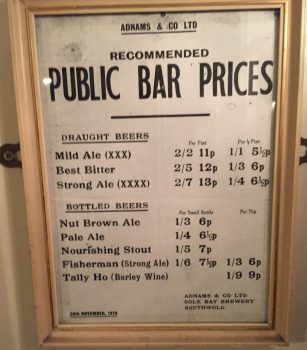
Here is a pub price list from the time of decimalisation, 30th November 1970: A pint of beer in the same pub now, even with gentrification, costs not 12 new pence but something in the region of £3.60p, a 30-fold price increase in nominal terms.
However, what did Mr Heath, one-time friend of Deng and Saddam, decide to do in the face of inflation, and demands for pay rises? Reminder, a great many people worked in nationalised industries, and their pay rates were ultimately political decisions. Furthermore, going on strike (i.e. refusing to work) was often seen as the way to muscle a pay rise out of the government, rather than a route to bankruptcy.
Heath, memories of wartime comradeship still fresh, did not want a confrontation with workers, nor, having grown up during the depression of the 1930s, was he willing to see unemployment rise in order to curb inflation.
Instead, he re-introduced government control of prices and pay.
So what happens if you control prices and pay? We are not told. Is it too obvious to need to be said, or are there still people who deny that price controls can lead to distortions? Why not look at Venezuela for a grim current example? (it’s OK, he’s doing it to curb inflation).
And this ‘trade-off’ between unemployment and inflation? That other mysterious relationship that is simply assumed to exist? How about seeing if a market can clear without distortions?
And note, there was no dispute at this point between Mr Heath and Mrs Thatcher over Europe, Mrs Thatcher was completely for membership of the European Economic Community.
In some ways, we have come a long way from the absurdity of the political consensus of the 1970s, yet the State still looms large as does the passing off of old economic fallacies as realities.
And what is Mrs Thatcher reported to have said of that time?
“In the years since, he and I have not always agreed on every political thing, but I was, and I’m proud to have been, a member of his government …”
Quite how Mrs Thatcher got her reputation is a mystery to me, but not how Roy Orbison put it.
I am away from HQ for a few days and looking out over the horizon I see this…

Where am I*?
This may cause a delay in un-smiting legit comments that get smitten/smote/smitted by the samizdata Smite-Bot.
* Not you, Jennings, you already know 😛
|
Who Are We? The Samizdata people are a bunch of sinister and heavily armed globalist illuminati who seek to infect the entire world with the values of personal liberty and several property. Amongst our many crimes is a sense of humour and the intermittent use of British spelling.
We are also a varied group made up of social individualists, classical liberals, whigs, libertarians, extropians, futurists, ‘Porcupines’, Karl Popper fetishists, recovering neo-conservatives, crazed Ayn Rand worshipers, over-caffeinated Virginia Postrel devotees, witty Frédéric Bastiat wannabes, cypherpunks, minarchists, kritarchists and wild-eyed anarcho-capitalists from Britain, North America, Australia and Europe.
|









Recent Comments