We are developing the social individualist meta-context for the future. From the very serious to the extremely frivolous... lets see what is on the mind of the Samizdata people.
Samizdata, derived from Samizdat /n. - a system of clandestine publication of banned literature in the USSR [Russ.,= self-publishing house]
|
If you are a fan of Watford, Aston Villa or Lincoln City or just football in general you will be shocked and saddened by the news of the death of Graham Taylor at the age of 72.
He was a remarkable manager. He took Lincoln City from the Fourth to the Third Division. He took Aston Villa from the Second Division to runners-up in the First. He took England to the 1992 European Championships and successfully kept them out of the 1994 World Cup.
But it was with Watford he had his greatest success. Teaming up with Elton John in 1977 he quickly won promotion to the Third Division. Shortly afterwards he gave a talk at my old school. In the Q&A one of the cheekier boys asked him when we would be in the First Division. How we laughed. It was unthinkable. Not going to happen. Taylor replied that if you aim for the ceiling your feet won’t get off the ground but if you aim for the sky then you may hit the ceiling. Four years later having smashed through the ceiling, roof and lower troposphere we were indeed in the First Division making monkeys out of the likes of Manchester United and Liverpool. [What’s changed? I hear you ask.] In 1983 Watford were the second-best team in the entire country. In 1984 they got to the final of the FA Cup.
For the benefit of North American readers unused to the joys of promotion and relegation the equivalent of all this might be the Montreal Expos winning the World Series or a Canadian team winning the Stanley Cup. Or, if you’re not interested in sport, somebody without political experience, a coherent philosophy, tact, media savvy or plausible hair becoming President of the United States. As I said: not going to happen.
Taylor even returned to Watford in the 1990s once again taking them from the Third to the First Division (or Premier League as it was by then known).
There were a number of secrets to his success. One was fitness: it was essential that his teams could keep going for the full 90 minutes. Another was the employment of the sublimely-talented John Barnes and the sublimely-passionate Luther Blissett at a time when many of the big teams were reluctant to field black players. Another was going back to the stats and working out that the traditional English long-ball game was by far the most effective. This was indeed fortunate as to attempt to pass the ball on the notoriously glutinous Vicarage Road pitch of the 1980s was to engage in cruelty to spherical objects.
On Saturday, Watford are playing at home. The club and fans will attempt to honour Taylor’s memory – many already have via the #thankyougt hashtag. But it will be difficult. Graham Taylor was a remarkable manager – and by all accounts – a true gentleman. Watford owes him a huge debt.
The Times reports,
The home secretary’s party conference speech proposing that companies compile lists of foreign workers has been declared a “hate incident” by police under crime recording policies that she has supported.
Amber Rudd’s remarks about tougher rules for immigrant workers and foreign students attracted fierce criticism at the Conservative party conference in Birmingham last October.
She said that the government would be “examining whether we should tighten the test companies have to take before recruiting from abroad” and ensuring that foreign workers were “not taking jobs British people could do”.
Joshua Silver, a physics professor at the University of Oxford, was so concerned that he reported the speech to police.
“I felt politicians have been using hate speech to turn Britons against foreigners, and I thought that is probably not lawful,” Professor Silver said.
Once he reported the speech, police were required to investigate.
West Midlands police have now written to the professor stating that the inquiry is concluded and the matter “has been recorded in line with the National Police Chiefs’ Council manual as a non-crime hate incident”.
The policy of blanket recording of all hate incidents was set out in 2014 by the College of Policing and backed by Ms Rudd last year.
I do not know whether Professor Silver’s motivation for reporting Rudd to the police was serious or satirical. Either way, it gave me a laugh.
Update: Apparently he was being serious. There is humour to be derived from his bout with Andrew Neil on BBC2’s Daily Politics, though I prefer my comedy to be less cruel. Kinder souls will hope that Professor Silver is remembered as the inventor of a type of low-cost user-adjustable eyeglasses – devices which might help millions of people – than for today’s embarrassing performance.
By the way, next time you read of the post-Brexit surge of reported hate incidents, remember the surge includes this.
From Instapundit (my emboldenings):
The miniature Perdex drones, different from larger, more common remotely piloted vehicles (RPVs) like the well-known Reaper and Predator, operate with a high degree of collective autonomy and reduced dependency on remote flight crews to control them. The large group of more autonomous Perdex drones creates a “swarm” of miniature drones. The swarm shares information across data links during operation, and can make mission-adaptive decisions faster than RPV’s controlled in the more conventional manner.
In a statement released by the U.S. Department of Defense, Strategic Capabilities Office Director William Roper said, “Due to the complex nature of combat, Perdix are not pre-programmed synchronized individuals, they are a collective organism, sharing one distributed brain for decision-making and adapting to each other like swarms in nature,” Director Roper went on to say, “Because every Perdix communicates and collaborates with every other Perdix, the swarm has no leader and can gracefully adapt to drones entering or exiting the team.”
Doctor Who fans will know exactly where this sort of thing leads:
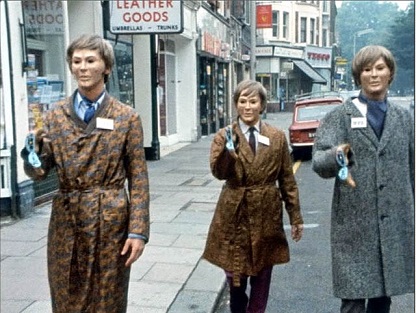
You have been warned.
It is nearly over. Obama has a few more days in the Oval Office, and then he is off, for what we cannot yet tell.
I left the following comment on a friend’s FB page, with some subsequent edits:
“A poor president on multiple levels. Trying to be generous, I am pleased he did not interfere with the expanding world of private space flight and certain other technologies that may affect lives for the better, but I am struggling to think of a very big positive development on his watch. He cannot even really claim credit for the economic recovery, since that has been largely a function of central bank money printing, the effects of which are uncertain; labour force participation has shrunk, which is one reason why the recovery hasn’t felt like one. The bailouts and stimulus package were, in my view, either a waste of money or a net drag on the economy. Debt levels remain scarily high. The fracking industrial movement took place despite, rather than because, of any policies he set out. He is hostile to entrepreneurs and the business ethic (“you did not build that”).
Race relations deteriorated on his watch, although not all of that can be laid at his door. The Solyndra fiasco highlighted the bubble around climate change fearmongering. The weaponisation of the IRS was an abuse of power, and Eric Holder’s tenure as Attorney General was littered with scandals, such as the Fast & Furious gun-running episode.
Mr Obama’s handling of foreign affairs has been inept, if not malevolent. He managed to alienate allies such as the UK, Poland and Israel, and was naive about enemies, especially Iran. The deal with Iran over nuclear issues is a joke. His intervention into the UK vote on Brexit, for example, saying that the UK would be put at the back of a queue in trade talks, was typical bullying, but also counterproductive. The decision to leave Iraq, come what may, was a mistake, although arguably, there was never a good time to do so. The horrendous procurement saga of the F-35 fighter suggests that some defence spending is as bloated as ever. The heavy use of drone strikes also did not square with a Nobel Peace Price image.
He even managed to shock continental Europeans by not sending a high-placed official to the official mourning for the Paris massacre of 2015, raising questions over how seriously he takes Islamist terrorism, and his attempt to criticise anyone for suggesting that Islam has a problem shows an alarming naivete, at best.
His use of executive orders, and clear unwillingness to negotiate unless on his terms, sets a bad precedent, and opened the opportunity for Trump.
It should be acknowledged that Mr Obama has done a great deal to raise the profile of golf. There is a saying that we should be grateful that we don’t get all the government we pay for. So perhaps it is good that this man spent as much time he did hitting small white balls. He is, however, unlikely to make the US Ryder Cup team in the near future.”
Labour leftists have never understood this basic fact: ordinary people don’t hate rich people. In fact they admire many of them. They don’t wince when they see a footballer and his WAG posing by the pool in Hello! — they think, ‘That looks like a nice life. Good on them.’ Corbyn bemoaned footballers’ pay as part of his proposal to enact a law preventing people from earning above a certain amount of money. Yes, a maximum wage. ‘I would like there to be some kind of high earnings cap,’ he said. It’s the worst idea a British political leader has had in years, and it reveals pretty much everything that is wrong with the left today.
First there’s the sheer authoritarianism of it. It will never come to pass, of course, because Corbyn’s footballer-bashing and bodged populism and general inability to connect with anyone outside of Momentum and the left Twittersphere means Labour won’t be darkening the door of Downing St for yonks. But that Corbyn is even flirting with the notion of putting a legal lid on what people can earn is pretty extraordinary. It would basically be a stricture against getting rich, a restriction on ambition, a state-enforced standard of living: you could be comfortable and middle-class, but not loaded. There’s a stinging moralism, too. Labourites complain about those on the right who look down on the ‘undeserving poor’, but what we have here is not all that different: a sneering at the undeserving rich, a prissy concern with the bank balances and lifestyles of those who’ve made a bomb.
– Brendan O’Neill.
In the UK, the expression “made a bomb” means “make a lot of money”. Of course, Corbyn, who is thick, might think that it means making an explosive device. Given his associations, the idea of people “making a bomb” might appeal to this man, if not for the same reasons.
If all the approved policies fail, but a disapproved policy looks like it might work, then the disapproved policy is what might very well end up being done. Discuss.
While you’re discussing that, allow me to throw in this titbit of news, from the Czech Republic, which I encountered in the Washington Post:
Now the country’s interior ministry is pushing a constitutional change that would let citizens use guns against terrorists. Proponents say this could save lives if an attack occurs and police are delayed or unable to make their way to the scene. To become law, Parliament must approve the proposal; they’ll vote in the coming months.
From the bit linked to in that paragraph, this:
… it is not always possible for the police to guarantee a fast and effective intervention and fast action from a member of the public could prevent the loss of many lives.
Indeed.
Spotting Muslim terrorists is hard because so many Muslims behave like about-to-be-terrorists that it’s hard to know which ones to pick on and stop. And when one of them does strike, it could be anywhere, and the government can’t be everywhere. Only people can.
One of the bigger long term impacts of Muslim immigration into Europe could prove to be an armed European citizenry. Discuss some more.
I would like there to be some kind of high earnings cap, quite honestly
– British opposition leader Jeremy Corbyn, who apparently wants the rich to get poorer more than he wants the poor to get richer.
Bella Caledonia is, or was, a magazine style website devoted to a far left vision of Scottish Independence. I lurked there often and commented seldom. When I clicked on the link http://bellacaledonia.org.uk/ this morning I saw a message abruptly announcing its closure, and when I visited it again just now I saw the “404 Not Found” message. (Update: the site is now back up, though its future is still in doubt.)
I hope that was just a glitch and they haven’t really taken the whole site down. However far from them I am politically, I can have nothing but sympathy with someone who has been writing for or commenting at a website for a decade and then finds it has all been wiped. I would cry if that happened here.
As someone interested in languages, I shall miss the writing in and about Scots. I shall miss the commenters. Some of them were refreshingly, some worryingly, far from the mainstream of politics. A feeling of kinship… I shall say no more. Above all I shall miss their clarity about what they wanted for Scotland.
Three years ago I was so struck by an essay by regular Bella contributor Robin McAlpine, director of the Common Weal thinktank, about his desires for press regulation in a future independent Scotland that I copied it to my clippings file. The title alone was an Orwellian masterpiece. It originally appeared at this url: http://bellacaledonia.org.uk/2013/03/19/real-freedom-sounds-like-many-voices/. Since that piece now seems to have vanished along with the rest of the Bella Caledonia archive, and since it is a mirror to the latest efforts by a Conservative UK government to end press freedom, I shall preserve it by posting it below.
I have put the phrase “Above all, this would require that titles other than the franchised ones would be banned” in bold, but other than that have made no changes. Here it is:
Real Freedom Sounds Like Many Voices
by Robin McAlpine 19TH MARCH 2013
“What we are actually having a debate about is the right of very, very rich people to control our society outside of any oversight or regulation …”
I have unburdened myself of the frustration I feel at the way I feel about how the media regulation debate has been covered in the Scottish press (here). Since then I’ve been contacted by a number of people who share my frustration but who want to know if there are other options for media regulation or other possibilities or arguments that are being censored in this debate. Yes there are – all of them.
→ Continue reading: Some things I will miss about the now defunct Bella Caledonia web magazine
Yesterday, at my personal blog, I expressed extreme gratitude to Christian Michel for letting me talk last Friday, at his home, on a subject which, when I first floated it to him, must have seemed very vague and vacuous, although judging by what he said about my talk afterwards, he was almost as pleased by it as I was.
Tonight, I will be attending another meeting organised by Christian Michel, partly out of gratitude for last Friday’s meeting. There is a London tube strike happening today, and I am pretty sure that Christian is now feeling a bit nervous about attendance, so I will make a point of being there.
The title of tonight’s talk is “The Collision of Fintech and Traditional Banking”. The speaker will be Sasha Karim. (I’m guessing that this is the Sasha Karim mentioned here.)
I am hoping that what Sasha Karim will say is, among other things, that, by radically lowering transaction costs and thereby making the life of a “financier” (formerly only available to ultra-clever (but not necessarily ultra-wise) people who had access to or who were attached by ultra-rich (but again, not always ultra-wise) employers to expensive machines in expensive buildings) “fintech”, aka the new world of financial transactions on mobile phones, now available to all people who are above dirt poor, is creating a world in which the old dream dreamed by the likes of Friedrich Hayek of denationalised money, can become a reality and rescue us all from the great catastrophe that has been governmentalised fiat paper currencies, of the sort denounced by another friend of mine, Detlev Schlichter. We shall see. But maybe I am being too optimistic, both about the talk and about the world. Concerning the talk, I will report further.
Hayek’s crucial little book on denationalised money has long been available on the www as a free .pdf download, but I only just found out that Detlev Schlichter’s book is now available as a free-to-download .pdf file also. Blog and learn.
 Shanghai, China. January 2016 Shanghai, China. January 2016
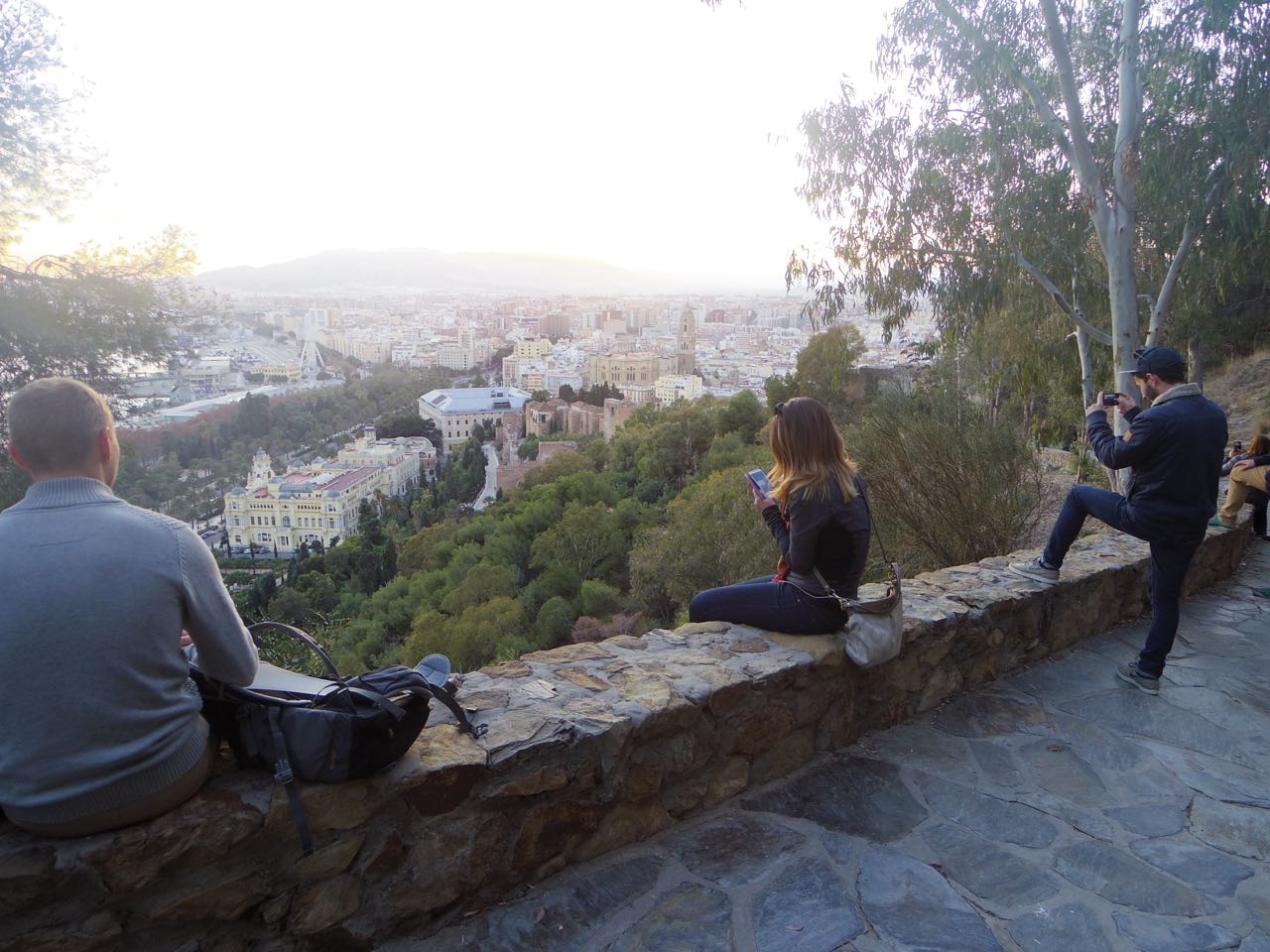
 Malaga, Spain. January 2016. Malaga, Spain. January 2016.
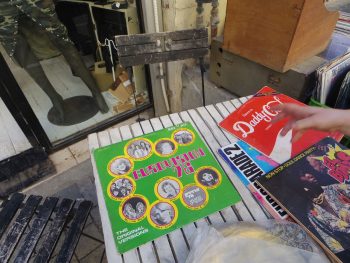 Jaffa, Israel. January 2016. Jaffa, Israel. January 2016.
 Evora, Portugal. February 2016 Evora, Portugal. February 2016
→ Continue reading: I am a little late. I have been busy
I meant to write in more detail about the grotesque perversion of natural justice embodied in the proposed Section 40 of the Crime and Courts Act earlier, but I was ill so I didn’t. Never mind. Guido Fawkes has covered the essentials here. That link takes you to a post on Guido’s site which contains a petition to the government. If you are from the UK, please consider signing it.
For an explanation of why I say that, see this from Michael Gove in the Times:
The Department for Culture, Media and Sport is considering whether or not to implement section 40 of the Crime and Courts Act 2013 and the period of consultation ends next week. If implemented, section 40 would require newspapers either to register with an approved regulator or face active discrimination in the courts.
The one regulator the government has so far approved, Impress, is funded largely by the former Formula One boss Max Mosley, a determined campaigner for restrictions on the press ever since a Sunday tabloid published disobliging details about his private life. Mr Mosley has assembled a team to run Impress who could never be mistaken for carefree libertarians.
Three of his board members support a campaign to starve The Sun, the Daily Express and the Daily Mail of advertising revenue. One board member has expressed his sadness that the Mail cannot just be banned, and the CEO of the organisation has shared social media posts comparing the Mail to Nazi newspapers and has decried its work as fascist. One does not have to admire every aspect of the Mail to recognise that its crusading journalism played a huge part in bringing the racist killers of Stephen Lawrence to justice. Nazi newspapers tend not to be big on opposing racist violence.
Gove too right wing for you? Try this article from the left-liberal David Aaronovitch in the same paper, which I quoted in this Samizdata post and unapologetically quote again:
Which brings me to the most important thing being considered by Ms Bradley. It goes by the tedious name of Section 40 of the Crime and Courts Act 2013 and is something that can be invoked, or not, by the government. It is, in essence, the stick that could be used to get newspapers and publications to sign up to the new state-approved press regulator, Impress.
What it says is that any publication not agreeing to be regulated by Impress will be subject to the costs of a legal action — even where it wins. Really. That’s what it says. Call the next Lance Armstrong a drugs cheat and even if he loses the case it will cost you hundreds of thousands. Well, no one in those circumstances would take the risk of running the story. These are not days in which newspapers make much if any money and the fastest way to bankruptcy would be to fall foul of Section 40.
Perhaps you are inclined to oppose the views of anyone writing for one of the Murdoch papers? Then read this piece and this follow-up from Roy Greenslade in the Guardian. There is no paywall at the G, so I will just link rather than quote any more than this:
In so doing, its [the lobby group Hacked Off] ideologues have placed their faith in the political establishment. They believe the charter is safe in the hands of MPs and peers and that the conditions that might lead to it being altered are highly unlikely.
But my lack of respect for what they call the media establishment (which, incidentally, is itself a mythical construct) is nothing like as great as my lack of respect for the so-called political establishment.
Added later: The Daily Mirror is another left wing paper opposing this measure: Do you want to gag the truth? Why new law will silence the free press.
In too much of a hurry to read all that? Guido’s earlier posts on this topic provide a quickie crash course. Here are enough to be going on with: (1), (2), (3), (4).
One last point. Quite apart from the danger to the freedom of the press, Section 40 would also set a precedent for using the attribution of court costs as a political instrument to apply pressure on bodies and individuals to do the government’s will. That corrupts the justice system itself.
Patsy Cornwallis-West was at one time mistress to the Prince of Wales, the future Edward VII. By the First World War she was a woman in her fifties married to a highly respectable retired colonel in his late seventies.
Her son, George, married one Jennie Jerome, mother of one Winston Churchill before marrying one Mrs Patrick Campbell. But that’s another story.
It would appear that Mrs Cornwallis-West was not entirely satisfied with her septugenarian husband and developed a “more than ordinary interest” in a young officer recently promoted from the ranks and recently wounded. When the young officer failed to reciprocate she started to pull strings. One of these strings was attached to the Quartermaster General.
Soon afterwards, the officer found that he had been transferred to another battalion. This may not sound like a big deal to you or me but it was clearly a huge deal to everyone involved at the time. My guess is that soldiers are deeply attached to their battalions especially when there’s a war on.
This was not the end of the matter. Questions were asked in Parliament and – I kid you not – a special Act – the Army (Courts of Inquiry) Act – was passed to create a committee to look into this one case (well, two actually, but the other one doesn’t concern us). The upshot was that the junior officer was exonerated, his commanding officer fired, Cornwallis-West censured and the Quartermaster General, ahem, informed of the “displeasure of the government”.
That such an effort could be made to secure justice in the middle of a war for a single subaltern who for all I know got killed anyway and may well not even have had the vote is staggering. And magnificent.
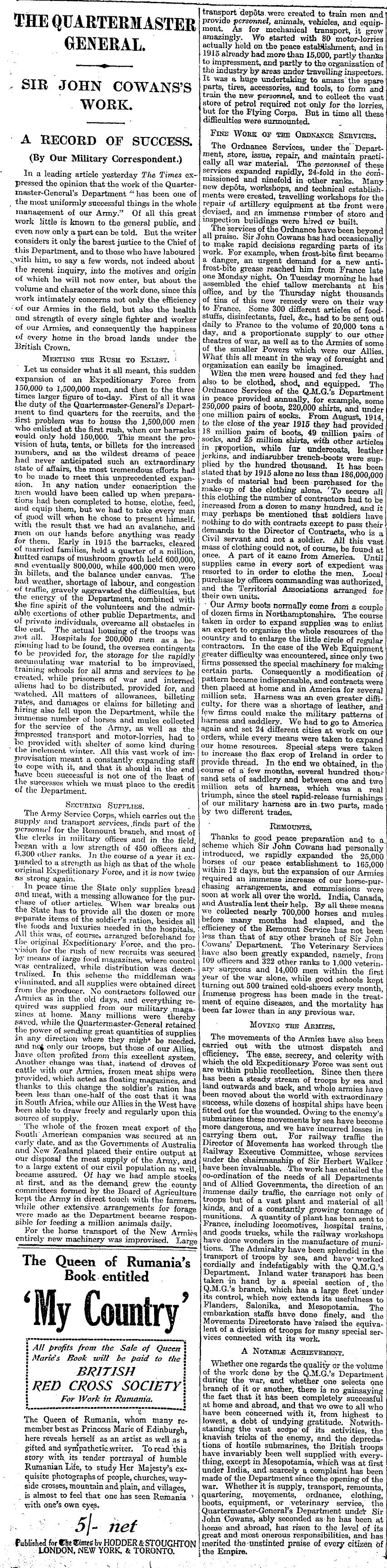
Which brings us on to the linked article. The Quartermaster General concerned was a chap called Sir John Cowans. The job he had in supplying the biggest army in British history was immense. And it would appear that he was very good at it. Clearly, scandal or no scandal, a lot of people wanted to keep him in his post. Hence (probably) this article from the Times Military Correspondent singing his praises.
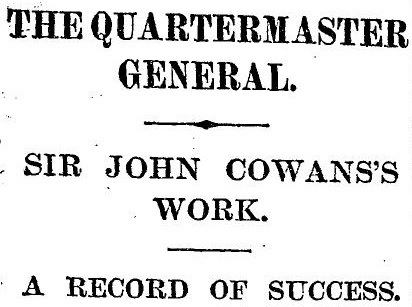 The Times 5 January 1917 p3 I particularly liked this bit:
For example, when the frost-bite first became a danger, an urgent demand for a new anti-frost-bite grease reached him from France late one Monday night. On Tuesday morning he had assembled the chief tallow merchants at his office, and by the Thursday night thousands of tins of this new remedy were on their way to France.
Justice was one thing but the heavens falling was another.
|
Who Are We? The Samizdata people are a bunch of sinister and heavily armed globalist illuminati who seek to infect the entire world with the values of personal liberty and several property. Amongst our many crimes is a sense of humour and the intermittent use of British spelling.
We are also a varied group made up of social individualists, classical liberals, whigs, libertarians, extropians, futurists, ‘Porcupines’, Karl Popper fetishists, recovering neo-conservatives, crazed Ayn Rand worshipers, over-caffeinated Virginia Postrel devotees, witty Frédéric Bastiat wannabes, cypherpunks, minarchists, kritarchists and wild-eyed anarcho-capitalists from Britain, North America, Australia and Europe.
|







Recent Comments