We are developing the social individualist meta-context for the future. From the very serious to the extremely frivolous... lets see what is on the mind of the Samizdata people.
Samizdata, derived from Samizdat /n. - a system of clandestine publication of banned literature in the USSR [Russ.,= self-publishing house]
|
I am slightly dazed and significantly bruised from my holiday in Austria, so this is just a quick catch up post.
The Serbian Authorities in Bosnia are up to their usual tricks and are driving out Croatian civilians from Drvar and Grahovo. Of course the outrage of the international community is strangely absent. What a surprise. These poor people are all ending up in accommodation around Knin. Having been through that myself, my heart goes out to them. At least none of them were killed. I wonder if these ethno-socialist morons in Republika Srbska realise they are in effect causing the colonisation of depopulated Serbian areas around Knin with pissed off Croats who are not going to be willing to move again? Pure genius.
On a seperate note, Yugoslavia agreed to vanish, at least in name. It will probably be called The Union of Serbia and Montenegro. Good riddance. I still think that Montenegro should try to engineer a ‘velvet divorce’ and go it alone.
I was also going to write about the latest EU regulatory madness but I am too sleeeepy!
There is no problem in the world today that could not be made much worse by a UN conference
– Mark Steyn
A real life Tellytubbie at work.
Update: Oops. It seems we sent so many visitors to the site that their server blew up. Amy has acquired more bandwidth and the cute little Tellytubby chap is available for viewing once more
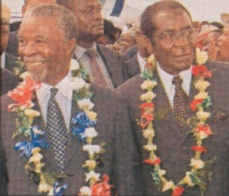
Todays newspapers give us two contrasting images. Thabo Mbeki, South Africa’s ANC leader smiling as he poses with his friend Robert Mugabe, Zimbabwe’s ZANU-PF leader, sticking by him in the face of world wide (but not African) criticism of Zimbabwe’s descent into collective nihilism.
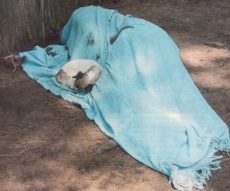
It also gives us a picture of the dead body of Zimbabwean farmer Terry Ford, murdered by Mugabe’s ZANU-PF thugs. It shows his distressed Jack Russell terrier, Squeak, who lay curled up next to his dead friend, refusing to leave his side.
And so now we read that Commonwealth Leaders meeting in London today will delay their ‘verdict’ on the farcical ‘elections’ in Zimbabwe and whether to suspend that country from the Commonwealth, a trivial matter of suspending a murderous tyrant from a trivial organization.
Yet clearly if the Commonwealth is serious about democracy then surely nations with governments which do not adhere to the social values of the majority of the Commonwealth must be expelled.
Therefore, I call on the Commonwealth’s leadership to expel The United Kingdom, Canada, Australia, New Zealand and India forthwith as being grossly unrepresentative of the murderous kleptocratic regimes which characterize the majority of the Commonwealth.
Next time they want a Foreign Aid hand out, let the murdering sons of bitches ask their good friend Thabo Mbeki for South African taxpayers money.
Update: Kill white landowners, kill black political opponents, destroy a nation’s economy and plunge it into a nightmare and what happens? Does the Commonwealth demand the overthrow of the tyrant and his government? No. Does the Commonwealth demand Zimbabwe’s expulsion whilst ZANU-PF remains in power? No. The Commonwealth has in fact decided to suspend Zimbabwe for one year. Read that again. ONE YEAR. The fact even this pathetic gesture has been so long coming is an indictment of the moral bankruptcy of the Commonwealth as an institution.
John Howard, the Australian Prime Minister stressed: “The committee expressed its determination to promote reconciliation in Zimbabwe between the main political parties.”
Reconciliation? Mugabe is a tyrant and murderer and any rational society should be urging that he be summarily put up against a wall, shot and then thrown in a garbage dump, not ‘reconciled’ with. Well I guess we should look on the bright side: things will not be so violent in Zimbabwe one year from now as all Mugabe’s opponents will either be dead or Mugabe will be hanging on the meat hook that he deserves by then.
In his debut film released later this week the deliciously un-PC Ali G gets elected as MP (Member of Parliament) for Staines and becomes involved in a plot to overthrow the Prime Minister. He presents his manifesto for a more ‘wikid’ Britain in Da State We Iz In published in the last Sunday Telegraph. In a rousing finale of this articulate document he answers the question of “Why should u change de world?” in a practical manner whilst keeping his eyes on the ultimate dream:
U should do it 4 your childrens benefit and for your unemployment benefit, your housing benefit and your disability benefit: try to increas dem as much as posible. I know it’s a dream but together lets try and make de place where we bring up our kidz to be as good as South Central LA…
Anyone fancy joining him?… I thought not, but it is a wikid larf. 
All pale compared to the horror of having the builders in. The mess, the noise, the frangible schedules, the trail of half drunk mugs of tea… In fact, the combination of slipping schedules and a partially dismantled house (and an illness in the family) has forced me to delay a brief business trip to Europe I had planned for this week. Inconvenient does not even begin to describe it.
I mentioned my views on ‘The British Builder’ to both Joanne Jacobs and Brian Linse when they were in London recently, intimating to them both on separate occasions that these sceptred Isles produce by far the greatest domestic affliction known to Western man since Attila the Hun remodelled much of Italy… but both Joanne and Brian quickly asserted that the British Builder’s American counterparts are even worse fonts of woe, calamity and ruined carpets, taking deposits and promptly taking on a strangely ethereal quality.
I remarked on this to a German associate of mine and he in turn dismissed both British and American claims with a wave of his hand, claiming nothing leaves more misery in its wake than the attentions of Westphalian interior decorators. Then an Irish friend of mine asserted that the Irish builders had amongst their ranks many who had been rejected by the paramilitaries for being too destructive and had thus ended up with careers in construction, joining and decorating where their talents had a more ready outlet.
I seem to be detecting a strange form of inverted nationalism at work here!
A free market in education talked about in London and Newcastle – and being done in India
On Saturday (March 16, 2002) I attended a day-long meeting (“Private education: the poor’s best chance”) at the Institute of Economic Affairs. This was one of two meetings (the other being in Newcastle) marking the launch of the E.G.West Centre For Market Solutions in Education, the Director of which is Professor James Tooley.
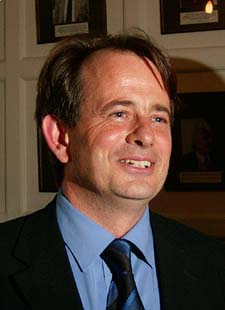 Professor James Tooley James Tooley is one of my favourite people. He has discovered a whole world of private sector educational success being achieved by the world’s poor, in places like India and South Africa, and is busily telling this story back to the world, hence the E.G.West Centre.
The final speaker in the morning was Fazalur Khurrum, President of something called the Federation of Private Schools Management, India, which is based in Hyderabad. The story he told was of a hubbub of small private schools in the Indian city of Hyderabad.
Before him was Dr Sugata Mitra, the Director of Research for the Indian free-market-education giant NIIT. He was the star performer of the day. NIIT can see the day fast approaching when it will have gone as far as it can in educating the kind of Indians who are easy to reach and can afford to pay individually serious money. What about the massed millions of India’s (and for that matter the world’s) seriously poor?
Dr Mitra talked about a fascinating project, in which he stuck an internet-connected PC in a wall, protected by see-through armour plating, in various Indian versions of the back of beyond, and awaited results.
A smart and adventurous poor kid sees the computer. He starts pushing buttons. Other kids assemble and join in. Their poor fathers and uncles watch from behind. Their poor mothers and aunts watch from a distance. (He showed some film of all this, and it was like watching a wildlife documentary, with different humans behaving in different, yet classically human ways.) Within a few days there were a cluster of computer literate children helping each other to have fun and find out about the world, and learning about computers. All this was done by the machine and by the juvenile punters. No “staff” were involved. Dr Mitra watched it all from his office in New Delhi, through a video camera, and by eavesdreopping on the computer. He calls this his “hole in the wall” project.
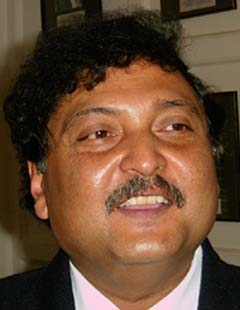 Dr Sugata Mitra I could go on. On Sunday I did, at unbloggable length, partly provoked by the embarrassingly boring British people who talked after lunch. The lunch only seemed free; they were the price. What they said wasn’t even fluorescent idiocy – that would have been interesting. It was just generic brand idiocy. For that you’ll have to wait until the Libertarian Alliance (by which I mean me) gets around to toning the insults down and publishing it all as an Educational Note.
A final point. A big reason why even very poor people prefer paying for private education in India is that this way their kids get a good start learning English. In Indian government schools, teaching English to children under ten – even teaching in English – is forbidden.
On Friday the DOD reported a successful midcourse impact of an Exoatmospheric Kill Vehicle (EKV) from Kwajalein with an ICBM launched from Vandenberg Air Force Base (VAFB). On this flight only actual system tracking components were used to control the EKV trajectory. The dummy warhead was picked out from the two decoy balloons.
This is another in a long series of engineering tests. Each test checks out certain capabilities and finds problems to be solved in the next. Earlier flights, for example, used simulated targetting data rather than the actual ground based targetting radar.
They seem to be making quite steady progress towards a working system, although such is some years away at present.
Lagwolf witnesses the Sith Parliament at work abridging civil liberties
I was involved in the pro-hunt protest outside of the Houses of Parliament today. It was a well behaved and good humoured protest which occupied the road outside the building. At 3pm sharp the protestors left the road and gathered in the protest area on Parliament Square or the nearest pub. Alas our efforts were rather less than effective and the parliamentarians voted to ban hunting. It is now up to the Lords to protect this quintessential English freedom.
The fact there are Conservative MPs who voted for the full ban is most distressing and deserve all the derision decent people can muster. That Ann Widdecombe MP voted to ban is telling of how the Tory party has members who do not believe is anyone else’s freedom besides their own. Her own dubious sexuality makes this more offensive. Her “do as I say not as I do,” mentality is most galling. I hope that any Tory MP who voted for this ban is deselected at the earliest opportunity. You either believe in freedom or your don’t. Anyone who voted for a ban on fox-hunting does not believe in freedom…full stop.
Lagwolf
Q: What do you call a Frenchman wearing sandals?
A: Phillipe Pherlop
Do politicians really say what they think? Or is their language forever circumscribed by the weight of office, the delicacy of diplomacy and the sensitivities of a fickle public?
If that is true, then maybe ex-politicians find they are invested with a freedom of thought and action denied to them during their careers. Vide the loud and clear message from Baroness Thatcher in her latest book ‘Statecraft’.
“The preliminary step, I believe, should be for an incoming Conservative government to declare publicly that it seeks fundamental renegotiation of Britain’s terms of EU membership.”
We all know what she said and we all equally know what she means. ‘Fundamental renegotiation’ is a polite term for ‘withdrawal’. I say this not because I am in the business of second guessing Baroness Thatcher but because there is no way to ‘fundamentally renegotiate’ the rigid terms of EU membership without excusing yourself from the club. Can we exclude ourselves from the ‘Acquis Communitaire’? If so, we are out and that’s that.
She is not the first person in Britain to suggest full withdrawal from the EU but, to my memory, she is the most high profile. Despite possessing nothing now except an honourary title, Thatcher’s legacy and image loom large over the British psyche for both those who loved and those who hated her. This book will not herald any change in current government policy but it is still important because there is a certain power in simply saying the unsayable. It is like prising open a rusty, bolted door so that others can all begin heaving against it in unison. Up until now, debate in Britain has revolved around whether or not we should adopt the Euro. Now the debate can legitimately move on to our entire place in the EU. Thatcher has said it, so others can say it too.
It may not be the end of the beginning or the beginning of the end but the cracks are starting to show, as evidenced by all the urgent scurrying (deliberate use of metaphor) around by various media, government and political poobahs to condemn, deny, rebut and dismiss her remarks.
So get your crowbars out, boys and girls, we’ve got some cracks to work on.
As the ever lengthening stalactite of side bar links was becoming unfeasibly long, I have moved a big chunk of them to a separate page. This new page is also full of juicy goodness and well work you visiting.
|
Who Are We? The Samizdata people are a bunch of sinister and heavily armed globalist illuminati who seek to infect the entire world with the values of personal liberty and several property. Amongst our many crimes is a sense of humour and the intermittent use of British spelling.
We are also a varied group made up of social individualists, classical liberals, whigs, libertarians, extropians, futurists, ‘Porcupines’, Karl Popper fetishists, recovering neo-conservatives, crazed Ayn Rand worshipers, over-caffeinated Virginia Postrel devotees, witty Frédéric Bastiat wannabes, cypherpunks, minarchists, kritarchists and wild-eyed anarcho-capitalists from Britain, North America, Australia and Europe.
|








Recent Comments