We are developing the social individualist meta-context for the future. From the very serious to the extremely frivolous... lets see what is on the mind of the Samizdata people.
Samizdata, derived from Samizdat /n. - a system of clandestine publication of banned literature in the USSR [Russ.,= self-publishing house]
|
People in the US, who take notions of Freedom of Expression and Private Property for granted, will be astonished by the latest steaming pile of wisdom to emerge from the clenched cheeks of our European would-be masters. Declan McCullagh reports:
The all-but-final proposal draft says that Internet news organizations, individual Web sites, moderated mailing lists and even Web logs (or “blogs”), must offer a “right of reply” to those who have been criticized by a person or organization.
With clinical precision, the council’s bureaucracy had decided exactly what would be required. Some excerpts from its proposal:
- “The reply should be made publicly available in a prominent place for a period of time (that) is at least equal to the period of time during which the contested information was publicly available, but, in any case, no less than for 24 hours.”
- Hyperlinking to a reply is acceptable. “It may be considered sufficient to publish (the reply) or make available a link to it” from the spot of the original mention.
- “So long as the contested information is available online, the reply should be attached to it, for example through a clearly visible link.”
- Long replies are fine. “There should be flexibility regarding the length of the reply, since there are (fewer) capacity limits for content than (there are) in off-line media.”
It’s pretty zany to imagine that just about every form of online publishing, from full-time news organizations to occasional bloggers to moderated chat rooms, would be covered. But it’s no accident. A January 2003 draft envisioned regulating only “professional on-line media.” Two months later, a March 2003 draft dropped the word “professional” and intentionally covered all “online media” of any type.
Read the whole article.
So what is the message to the EU I mentioned in the title? Simple:
We will not comply
We have a comments section on samizdata.net in which people can and do comment about what we write, but access to that comment section is at our capricious discretion. If we decide we want to IP ban someone or want to delete their remarks from our comments section because we think they are offensive, or even if they are not offensive but we just bloody well feel like doing it because we have a headache, then we bloody well will. This is our private property.
We are already hosted on a server in the USA and I am quite confident our hosters would tell the EU where they can stick any demands to yank us off the net because we decline to submit to political moderation of the form our free speech takes on our private property (i.e. the server space we rent from them). If we have to go entirely pseudonymous and log onto Samizdata.net in order to post via ‘dead drop’ servers rather than submit to EU regulation of how we manage the information on our blog, then that is exactly what those of us who post from within the rapidly emerging EU tyranny will do. We utterly reject political moderation of free speech in civil society. This is not about giving people a voice but rather about replacing social interaction (which is what true free speech is), with political interaction mediated and mandated by the state.
If these regulations become the law of the EU (as seems likely), we will not obey, we will not cooperate, we will not accept that anyone has a ‘right’ to reply on our blog. Do you think we have said nasty things about you and want to reply regardless of our unwillingness to let you use our comment section? Fine…go to blogger.com, sign up (for free), click on ‘create a new blog’ and voila… you have your own blog on which you can scream about how those mean old Samizdatistas ‘done you wrong’ to your heart’s content.
And if the EU says we have to let you comment… tough shit, it ain’t gonna happen. The people who write for Samizdata.net all now live next door to Samizdata Illuminatus, in Arkham, Massachusetts.

 
Having been involved in British libertarian circles since I was in my late teens about 18 years ago – god that makes me feel old – I have gotten used to the charge that the likes of us are crazed dogmatists. In Britain’s notoriously anti-intellectual culture, being interested in ideas, and worse, ideas which question the need for most of what governments do, is to be branded as a dangerous nutter. (Mind you, having read abusive comments directed at yours truly by various LewRockwell.com types, I feel almost quite moderate and middle-of-the-road these days.)
Step forward Aidan Rankin, who in The Spectator magazine, charges that eurosceptics within the Tory Party and among libertarian circles are the “new Trotskyists,” every bit as militant and dogmatic as the old left. In a way, that is a backhanded compliment of sorts because it shows that folk like Rankin are at least becoming aware of our existence, even though they prefer to construct straw men for the purpose of easy knock-down pieces rather than describe us more accurately. Anyway, let us fisk:
On Europeans and other issues the Tories are still impeded – not by indecision as in the recent past, but by an insidious ideological rigidity, a right-wing version of political correctness.
Huh? Really? Has the Tory Party, in recent years, called for, say, total withdrawal by this country from the EU? No. But to read Rankin you would assume that to be the case.
Public scepticism about the single currency is matched by the lack of public support for Eurosceptic campaigns. This is because even to sympathetic observers such campaigns appear so often to be bitter and bigoted.
He has half a point. I think the eurosceptic lobby would do better to focus on the essentially illiberal nature of the EU rather than on the fact that is being run by vile Frogs, etc. → Continue reading: Straw men
The UK government has been announcing a number of changes to the membership of its Cabinet recently. Topping the news billing was the resignation of Alan Milburn, the Health Secretary. He is a key Blair ally and who had fought tooth and nail to set up “foundation hospitals”, which were a very tentative step towards making the health service more flexible. (I stress the word tentative. The change is a zillion miles from what I would like – total privatisation).
He has gone, supposedly to “spend more time with his family”, to use the hackneyed expression, according to this report by Reuters. And yet that report by Reuters does not mention the significance of Milburn’s departure at all. Why not? Blair is in trouble at the moment for the shambolic state of our public services – sure to be a future election issue – and allegedly exaggerating the WMD threat in Iraq. A key ally of his has gone. You would have thought this fact would have been noted. It surely suggests that Chancellor Gordon Brown, who was at loggerheads with Milburn, has seen off a key rival.
Be interested to see what the estimable Stephen Pollard, who has been following this issue with customary rigour, makes of all this.
This article by Mick Cleary contains what is for me the best sporting quote so far of the new century.
To get it you have to get the setting. Last Saturday England played and very narrowly defeated the New Zealand All Blacks rugby team, in Wellington, New Zealand. Either side could have won it, but England did, and it’s only the second time that England have beaten New Zealand in New Zealand, the last time being in 1973.
The episode of the game that is already starting to be a rugby legend was the ten minutes early in the second half when two key England players, Dallaglio and Back, were off the field for ten minutes for infringements. New Zealand were encamped on the England line, and a New Zealand try looked like a pushover, literally, followed in all likelihood by another. Game over, in other words.
But for the next ten minutes the six remaining England forwards stood firm against the eight New Zealand forwards, and not only prevented a New Zealand try but contrived to get England up the other end and enable England goal-kicking wonder boy Jonny Wilkinson to kick yet another penalty goal. I can remember when eight New Zealand forwards would prevailed against twelve Englishmen. As I say, the stuff of legend. → Continue reading: What was going through Martin Johnson’s head? – a sporting reply to savour
British troops injured in war are being forced to pay for private medical treatment or join the long patient lists waiting for operations on the National Health Service. A staffing crisis in the Defence Medical Services (DMS) means that more than 10,000 soldiers – the equivalent of 15 infantry battalions – are currently not fit for frontline duty.
Large sections of the Army will be declared un-operational because of the number of troops waiting for surgery unless there is an emergency injection of cash. Commanding officers have been rationing the private treatment but the amount of money available to each unit for private healthcare is not enough to reduce the number of servicemen and women waiting for operations.
The Telegraph reports:
One soldier, who was injured on active duty in Afghanistan, has now been told that he faces a 12-month wait for a knee operation unless he is prepared to pay £2,000 for private treatment.
Another soldier who recently returned from Afghanistan after serving with the International Stabilisation and Assistance Force (Isaf) has been told that he will have to wait six months before he can see a specialist about his damaged ankle. He may then face a further year’s wait for an operation. He has, however, been advised that if he were to go private, he could see a specialist immediately and have the operation within three weeks.
In addition to the pain and inconvenience caused by the injuries, service personnel are “medically downgraded”, if the injury prevents them from carrying out their duties. They are unlikely to be able to undertake courses which are physically demanding and cannot be deployed on military operations. Their pay can decrease and they may be passed over for promotion until fully fit.
This is just one example of how Blair’s government is treating the armed forces. The undermining of the British military is a result of a profound distrust of it by the New Labour establishment, despite the fact that the armed forces are the only state entity that has consistently bailed the government out of its botched policies (foot and mouth crisis) and allowed Tony to play a world statesman (Afghanistan, Iraq).
Blair achieved a measure of uncritical popularity with the American public, due to his support of Bush’s determination to depose Saddam. He risked his job and support of his voters at home in order to do that. It may be commendable and we wholeheartedly supported his efforts that resulted in the liberation of Iraq. We did so without any delusions as to his statist convictions, in which near messianic zeal mixes with autocratic tendencies.
However, those on the other side of the Atlantic harbouring inflated opinions about Blair, and occassionally making preposterous comparisons of Blair to Winston Churchill or other great British statesmen, should examine the way their pet foreign leader behaves on the domestic scene. Let the Telegraph article be an eye opener to the true nature of the valiant Prime Minister Blair and his tightly led pack of ministers.
We at Samizdata.net do not trust the man further than we can throw him. So watch this space, we will be reporting on the latest development in Blair’s successful dismantling of other worthwhile British institutions.
 
Churchill Not Churchill
Here are extracts from a letter by Geoff Bean, an English dairy farmer, addressed to Steve Williamson, a “Special Enforcement Officer” of the agency in York. The York farmer bought builder’s rubble to make repairs round his farm, but received a letter stating that since his land did not have the benefit of a Waste Management Licence, this depositing of “waste” was in clear breach of the law and requesting that Mr Bean submit to a formal interview under the Police and Criminal Evidence Act (PACE) to “establish” his involvement in this unlicensed waste management operation.
I am in receipt of your pompous and ill-informed letter. How dare you write to me in such terms, as if you were addressing a common criminal.
The “waste” for which he had paid good money was about to be put to valuable use replacing the floor of a barn and resurfacing his farm tracks.
Were I a one-legged homosexual Afghan refugee/terrorist living on the welfare state, you and your ilk would not dare write in such a manner for fear of having all the human rights lawyers in creation round your necks, but as you are speaking to an honest, hard-working and overstressed Englishman, you appear to think you can behave like all too many of the vast and ever-increasing army of totally useless, non-productive, arrogant and bloody-minded officialdom, who are now only too successfully doing more damage to this once great and free nation than was ever achieved by Adolf Hitler.
Mr Williamson repeated that Mr Bean must submit to interview “under caution”. Mr Bean agreed to spare some of his valuable time to assist Mr Williamson in his “futile attempt” to justify his “bureaucratic red tape”, but reminded him that, since slavery in this country had been abolished, he would expect reimbursement at “£150 an hour or part thereof, plus VAT”.
That’s the spirit!
But rejoice ye not, since whether Mr Bean will face criminal charges for his breach of EU law, the agency cannot yet comment…
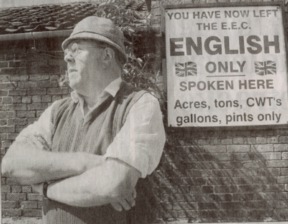
From Sunday Telegraph’s Christopher Booker’s Notebook
Update: If you think this is outrageous, you might want to share your thoughts with Mr Steve Williamson himself. And while you are at it, why not to cc his boss, the regional director Mr Andrew Wood. We have done a bit of research and think these email addresses will work, given the format of the Environmental Agency emails.
There appears to be no end in sight yet to the rioting and civil disorder in Iran which is now entering its fifth day:
“This is just like it was before the revolution,” she added, recalling months of unrest that toppled the U.S.-backed shah in 1979.
How very interesting. Meanwhile, and strictly in keeping with Western press policy, Islamofascist nutjobs are referred to as ‘Conservatives’:
Conservatives blamed unrest on a U.S. plot.
Times must indeed be bad for the Mullahs. Their tin-foil hats are starting to slip.
I don’t know whether we have just signed up to a new EU Constitution or not. Strange as it sounds, I truly have no idea. Judging from the opening paragraphs of this Telegraph report, it’s already a done deal:
To the strains of Beethoven’s Ode To Joy, the Convention on the Future of Europe proclaimed agreement yesterday on a written constitution for a vast European Union of 450 million citizens bringing together East and West.
Valery Giscard d’Estaing, the chair of the 105-strong body, held up a text that he said could be offered proudly to prime ministers next week as a permanent settlement for a free and democratic family of nations.
So is that it then? Are we now all Euro-serfs? Has the knot been tied, the deal been struck and all the irons shoved deeply into the fire? If so, well that was pretty sneaky of them, wasn’t it.
On the other hand, further down in the same article, there is room for doubt:
EU governments will have their chance to chip away at the 224-page text in an intergovernmental conference running from October to next spring, although Mr Hain said the essential architecture is now written in stone.
That sounds like there’s still room for an argument, doesn’t it? Though perhaps not much argument. More like wiggle room.
Well, I must confess I’m stumped. Like every other Euro-project it’s all camouflaged in double-speak and drenched in high-concept gobbledegook. Maybe salvation lies in the hope that possibly the EUnuchs don’t understand it either.
When I happened upon this website campaign, my first reaction was to dismiss it as a hoax. After all, in an age when political and civil discourse has been so debased by post-modern neurosis, the art of parody must respond by vaulting the high water-mark of absurdity in order to be at all effective.
But, because we live in such strange and discordant times, I have, upon further reflection, decided that the people behind reFlag are probably deadly serious. In their opinion, our Union Jack is too arcane, vulgar and embarrassing to be tolerated:
A number of countries around the globe have black in their flags to represent the colour of their people. It makes sense for the UK to have black and white in our flag, to represent the different races and cultures which make up the country at the beginning of the third millennium.
We haven’t conquered racism, nor many other forms of prejudice, but by changing the nation’s main emblem, we can reclaim the union flag from those who have hijacked it for their own ends, so that our flag reflects the diversity of the people of the UK.
So it’s out with the racist, old standard and in with the new symbol of ‘diversity’:

I don’t like it. And it certainly is not a flag to which I am going to rally any time soon or at all. Of course, one might argue that flag design is not an issue that should matter to any libertarian and that all national flags are constructs which can, and indeed do, change from time to time.
But that is to miss the point. The cause of my revulsion lies not in the symbol but in the creepy deconstructionist impulse that lies behind it (much of which is dressed up in corporate ‘re-branding’ jargon). The depths of this psychosis can perhaps best be judged by the breath-takingly hypocritical claim that the Union Jack has been ‘hijacked’ and they need to take it back. Take it back from whom, I wonder? From various obnoxious national socialists? From football hooligans? Or from the increasing numbers of quite reasonable and decent Britons who defiantly fly the flag in response to the sordid and sustained attempts of much of the establishment left to demonise it?
It is that latter group who are really taking the flag back and perhaps that is what the people behind ‘reFlag’ really fear the most. Maybe the trend they are so clearly desperate to stem is the growing general contempt for the dangerously balkanising agenda of the cultural marxists and an increased willingness to resist the tools of manipulation and social engineering through which it operates.
I cannot say for sure because there appears to be no indication on their website as to who these people are, who or what is behind them or how they are funded. So maybe it is a hoax and an elaborate one at that. Right now there may be some gang of wags guffawing in ‘ha ha gotcha’ hoots of laughter. But if it is not a hoax then perhaps these people should be flushed out into the open so that we can tell them, face-to-face, that what they are trying to do is not just silly it is dangerous. I think we should leave them in no doubt that they are vigourously fanning the very flames of conflagration that they purport to be seeking to avoid.
Or, maybe, they know full well what they are doing and conflagration is precisely what they want. Who can say?
In a Free Country update Telegraph shows how security imposed by the state, crowds out not only its citizens security awareness but that of its police force.
Would identity cards help police in Bradford, who are having difficulty finding a one-armed, hunchbacked dwarf with a limp and an Irish accent, in connection with a £10,000 jewellery raid?
If this useful combination of aural and visual clues is not enough to track him down, you might have thought a card would help. The history of ID cards shows the opposite – that police start to depend on them, as they have on security cameras, and give up on more traditional sleuthing tools such as, say, eyes and ears.
[…]
Police end up turning a blind eye to criminals, who develop an expertise for card fraud, and come down hard on absent-minded old ladies who leave them on the Tube. And one-armed, hunchbacked dwarves with limps and Irish accents find it easier and easier to blend into the crowd.
For those who feel like a little (slightly horrifying, but not especially surprising) insight into the French way of doing business, might I recommend reading this article from the Economist giving a detailed history of the various occasions in which Airbus Industrie have been revealed or alleged to have paid kickbacks in order to procure orders for their airliners. It is worth observing that to some extent the cause of the problem is the traditional structure of the airline industry, in which there have been a great many state owned carriers for which aircraft purchases have had to be approved by (very corruptible) government (or in some instances even military) officials. Airbus are by no means the first company to indulge in this sort of activity, but the enthusiasm with which they apparently have gone about it, and the apparent collusion and encouragement of the French government, are quite impressive.
A highlight
The Delhi court has a withering opinion of the help Airbus has given the CBI. It allowed Mr Wadehra to add Airbus’s Indian subsidiary to his action on the grounds that Airbus in France was not co-operating. Airbus told Mr Wadehra that French law forbade it from answering his questions. “[Airbus] sells its aircraft on their merits,” the firm insisted.
The court has castigated the CBI for its dilatory approach. It took the Indian authorities until 1995 to contact Airbus for information, only to be told that such requests should be routed through the French government. The CBI told Mr Wadehra, despite trying Interpol and diplomatic channels, it was not getting any help from the French government. The French embassy in Delhi in effect told Mr Wadehra to get lost when he wrote to ask why France was not co-operating.
(Link via Arts & Letters Daily).
And of course I am sure he does not particularly care what I think either. In an article titled Europe and Liberalism, he notes that Ramesh Ponnuru has praised him for changing his mind about the European Union.
Sullivan now thinks the European Union is not such a good thing as he once thought and both he and Ponnuru have finally noticed that having the EU completely swallow Britain is also not in the national interests of the USA. In fact that Americentric utilitarian observation seems to be the entire basis for their opposition to The Great European Project. Massive regulatory statism? Dramatic erosion of due process? Ever higher taxes? ‘Fortress Europe’ trade barriers with the rest of the world? Spectacular corruption? Higher unemployment? No… the reason to finally start glaring at the EU across the Atlantic is to preserve the UK’s ability to support the US in foreign policy matters and to work for US interests from within the bastions of Fortress Europe.
This narrow utilitarian argument seems to be what has brought Sullivan to stop being a cheerleader for the EU without much of a nod to the idea that maybe the EU is bad for Britain. So whilst I am happy to see a fairly influential commentator like Sullivan stop arguing Britain should embrace the EU even more deeply, he has nothing whatsoever to contribute to the British domestic debate on the subject. In fact, the stated views of Sullivan play to anti-American sentiments within Britain so harmoniously that I really wish he would just shut the f**k up.
To argue that the reason Britain should not allow its national sovereignty and identity to be submerged by Europe is because it does not suit the United States, is to put many of the people who dislike the EU in Britain in rather a quandary. Many such folks dislike the EU because British interests matter far more to them that those of the EU… and for exactly the same reason they are also highly suspicious of the USA, seeing it as subordinating ‘our’ interests to ‘their’ interests. For an example of anti-EU sentiments allied to deep and festering suspicion of the USA, you need look no further than Air Strip One. I see little value in Sullivan actively kicking the none-too-tight lid off latent anti-Americanism with statements like:
Keeping Britain both in the [United States of Europe] and outside of it militarily, diplomatically, and monetarily should become a prime U.S. objective in foreign policy. Without it, the United States could lose its most valuable military and diplomatic ally.
But the fact is almost no one who actually (in theory) gets a vote on the subject, not even Atlanticist enthusiasts like myself, think US interests are more than passingly germane when trying to argue against Britain sleepwalking to the gaping maw of that half-dead and half-mad leviathan called the European Union.
It seems Sullivan is no fan of the social/cultural Anglosphere meme. What with him being a party political right-statist (a Republican) and only a passing commentator on things like objective rights and moral philosophy, I suppose it is not all that surprising to read him taking a highly collectivist ‘American national interests’ view of pretty much everything, but then this is precisely why his views are of little value in any positive way to people outside his American national collective.
I would argue that the Anglosphere does exist as a cultural vibe, but it is something that can be made a great deal weaker precisely by attitudes like Sullivan’s. The underlying cultural basis for UK political support for US actions in Iraq sprang from these very real Anglosphere notions. Yet if I thought the United States government was working to keep Britain inside a United States of Europe (just not too far inside) for its own interests and at our expense, which is to say working against people like me who are calling for the UK’s complete withdrawal from the EU, then I would be bulk purchasing US flags to burn in demonstrations in central London… and if a relentlessly Atlanticist Anglosphere person such as me thinks that, one can only speculate what less pro-American segments of popular opinion might think.
If the US government wants Britain as an ally, fine. But if it wants to sacrifice individual British people as political cannon fodder to mitigate the effects of EU power? Want to know where you can stick that? I will continue to regard US civil society as having many admirable qualities and still feel an Atlanticist affinity to it regardless… but at that point the US government loses its ‘lesser evil’ status for me and becomes just another enemy on every level as the last basis for having incidental common goals vanishes.
|
Who Are We? The Samizdata people are a bunch of sinister and heavily armed globalist illuminati who seek to infect the entire world with the values of personal liberty and several property. Amongst our many crimes is a sense of humour and the intermittent use of British spelling.
We are also a varied group made up of social individualists, classical liberals, whigs, libertarians, extropians, futurists, ‘Porcupines’, Karl Popper fetishists, recovering neo-conservatives, crazed Ayn Rand worshipers, over-caffeinated Virginia Postrel devotees, witty Frédéric Bastiat wannabes, cypherpunks, minarchists, kritarchists and wild-eyed anarcho-capitalists from Britain, North America, Australia and Europe.
|





Recent Comments