We are developing the social individualist meta-context for the future. From the very serious to the extremely frivolous... lets see what is on the mind of the Samizdata people.
Samizdata, derived from Samizdat /n. - a system of clandestine publication of banned literature in the USSR [Russ.,= self-publishing house]
|
Communist leaders plan to amend China’s constitution to formally enshrine the ideology of Jiang Zemin, the recently retired leader who invited capitalists to join the Communist Party. Despite sweeping economic and social changes, the political status of China’s entrepreneurs is still ambiguous.
There have been no details of the possible changes although foreign analysts say they include the communist era’s first guarantee of property rights. Certain amendments are still needed to promote economic and social development, said the party newspaper People’s Daily. It said the changes were meant to cope with accelerating globalization and advances in science and technology.
Jiang’s theory, the awkwardly named “Three Represents,” calls for the 67 million-member party to embrace capitalists, updating its traditional role as a “vanguard of the working class” and for the constitution to formally uphold property rights and the rights of entrepreneurs.
As someone who has more than passing acquaintance with communism, I see this is as a big change indeed. Even under most dire oppression you cannot entirely stop people exchanging goods and services. And so it was in the countries of the former Communist bloc, although the private sector was not officially recognised, there were shades of grey in the ‘socialist worker economy’. Former Yugoslavia, for example, ventured furthest in its recognition of private enterprise and some semblance of property rights and in return relatively prospered. Also in practice, Poland and Hungary were kinder to their small landowners and tradesmen than the communist ideologues allowed.
Nevertheless, there was no question of formally acknowledging property rights and any form of private enterprise by governments whose grasp of economics was based entirely on Marxism. It was one thing to tolerate existence of non-state markets and even benefit from them, but changing their opposition to individual’s property rights, so firmly embedded in political systems that were barely surviving, would have been a political, ideological and social suicide. (As a matter of fact, not changing it amounted to the same, just by other means: No, no, no, comrade, let’s not play with this (freedom of the press, speech, travel, association, trade, property rights etc) it has sharp edges and will cut your wrists, let’s just circle round the drain together, holding hands and singing the Internationale…)
China’s development has been very different to that of Eastern Europe, politically and economically, although both were waving the Red Flag. The proposed change to the China’s constitution may amount to a symbolic amendment given that China’s entrepreneurs have driven its two-decade-old economic boom. But then, symbols can be very powerful.
With Mr Schwarzenegger throwing his hat into the ring of the California Governorship, I thought it was my aspiring libertarian duty to the spirit of freedom, to take in the Austrian candidate’s latest mega-movie, Terminator 3, Rise of the Machines. So I beat a warm and humid trail from a jet-engine air-conditioned hotel in the salubrious Euston area of London, to the fragrant Leicester Square, home to a million and one interesting smells emanating from the great hoi polloi of old London Town.
I managed to scramble about the last ticket sold, for the early evening performance at the Odeon cinema, and only managed to sit down and switch off my mobile phone ten seconds before the opening credits began.
So, first impressions? If there’s a Terminator 4, I’ll be back. (Come on, we’ve got to get these things out of the way when reviewing Arnie films. I’ll try to get all the others in as soon as I can, to ease the pain.)
Second impressions? To hell with what the literati London critics said about this film. I’m a lowbrow and I need regular jolts of science-fiction-style entertainment to get me through this rollercoaster we know as life. And Arnie films almost always do the trick (except for Twins, of course.)
In Terminator 3, Arnold once again delivers the goods. Can he really be 56 years old? I hope I have pectorals like that when I’m 56. Hell, I wish I’d had pectorals like that when I was 23. → Continue reading: Terminator 3, Rise of the Machines
CNET News.com reports:
Lawmakers in California have scheduled a hearing for later this month to discuss privacy issues surrounding a controversial technology designed to wirelessly monitor everything from clothing to currency.
Sen. Debra Bowen, a California legislator recently on the forefront of an antispam legislation movement, is spearheading the August 18 hearing, which will focus on an emerging area of technology known as radio frequency identification (RFID), a representative for Bowen has confirmed.
RFID tags are miniscule microchips, which already have shrunk to half the size of a grain of sand. They listen for a radio query and respond by transmitting their unique ID code. Retailers adore the concept, which enables them to automatically detect the movement of merchandise in stores and monitor inventory in warehouses using millions of special sensors. CNET News.com wrote about how Wal-Mart and the U.K.-based grocery chain Tesco are starting to install “smart shelves” with networked RFID readers.
According to Declan McCullagh of CNET News.com Proponents hail the technology as the next-generation bar code, allowing merchants and manufacturers to operate more efficiently and cut down on theft. The privacy threat comes when RFID tags remain active once you leave a store. That’s the scenario that should raise alarms – and currently the RFID industry seems to be giving mixed signals about whether the tags will be disabled or left enabled by default.
Further, unchecked use of RFID could end up trampling consumer privacy by allowing retailers to gather unprecedented amounts of information about activity in their stores and link it to customer information databases. They also worry about the possibility that companies and would-be thieves might be able to track people’s personal belongings, embedded with tiny RFID microchips, after they are purchased. Katherine Albrecht, the head of Consumers Against Supermarket Privacy Invasion and Numbering, a fierce critic of RFID technology says:
If you are walking around emanating an electric cloud of these devices wherever you go, you have no more privacy. Every door way you walk through could be scanning you.
Policy makers in Britain are also starting to ponder the privacy implications of RFID. A member of Britain’s Parliament has submitted a motion for debate on the regulation of RFID devices when the government returns from its summer recess next month.
My first reaction to this story was “Aha! Another reason to despise the UN and its tranzi fellow travellers! As if I needed one.” And indeed, there is plenty to despise in this story. It turns out that a thriving market in endangered animal skins has sprung up in Afghanistan to serve the demands of the UN and NGO personnel assigned there.
When I asked him if he had any coats made of snow leopard skin, he said no. But the reason was far from reassuring – he had sold out.
They have become so expensive for us – $500. Too expensive for Afghans but foreigners can buy them,” he said.
We have asked most of the foreigners not to buy these things and if there is not a market from the foreigners the Afghan people probably don’t need it,” [Afghan Environment Minister Yousef Nouristani] says.
“It’s the market created by the foreigners – particularly those who are working with the UN or other NGOs.”
The tooth-grinding hypocrisy of UN and NGO personnel flouting international law banning the trade in these skins is bad enough. The fact that most tranzis are also pious “movement” environmentalists is merely salt in the wound.
However, for dedicated libertarians, it raises one of the perennial dilemmas: what to do with wild animals? Laws restricting the harvesting and sale of wild animal skins, organs, meat, and whatnot would appear to run afoul of libertarian principles espousing free trade and free markets, and indeed the Afghan government is trying to reach the benchmark for protection of these animals set by, gulp, the Taliban.
The dilemma is sharpened in Afghanistan because the dire poverty of many people there puts their interests in direct conflict with protection of endangered species.
Snow leopards are most commonly found in north-eastern Afghanistan in an area known as the Wakhan.
I spoke to Ali Azimi, the author of a report on Afghanistan’s environmental problems, who has just returned from a 10-day trip to the area.
“I was struck by the abject poverty of the people,” he said. “Most can barely afford to have one meal a day.
“And the meal usually consists of a type of grass that grows in the Wakhan six months of the year. Six months it is snowbound.
“What they eat is what has been collected over the summer months – and it is a desperate situation for them. So they’re facing poverty and starvation in the Wakhan.”
This poverty and starvation is forcing people to hunt animals that would normally be the prey of the snow leopards – and the thousands of dollars that some people are prepared to pay for their skins is encouraging poachers to hunt these rare and beautiful creatures.
The long-term solution to these environmental issues is, of course, to raise the level of income and wealth in Afghanistan so that no one is forced to compete with wild animals for survival, and so that the “luxury good” of protected lands and species becomes affordable. In the shorter run (and in the long run as well) it is difficult to see how wild lands and, especially, wild animals can be protected from the tragedy of the commons without some form of state intervention, whether it is via market regulation outlawing the trade in animal products, the purchase and “protection” of lands, the regulation of hunting activity, or some variant or combination of all three.
Thanks to the inevitable and ubiquitous Instapundit for the first link to this story. Thanks also to (this hurts, folks) the BBC for originating the story.
We noted here earlier the controversial proposed appointment of a new Director of Public Prosecutions. Today’s Telegraph reports that Britain’s Conservative Opposition are continuing to making an issue of this:
The appointment of one of Cherie Blair’s “cronies” as the new Director of Public Prosecutions is a “matter of deepest concern” because of his work on terrorist cases, Michael Howard, the shadow chancellor, said yesterday.
Mr Howard suggested that Ken Macdonald was not fit to serve as the country’s top prosecutor because of his views on the motives of those charged with terrorism.
Mr Howard, a QC, singled out Mr Macdonald’s website at Matrix Chambers, where Mrs Blair works as a public law barrister, and his use of the phrase “political violence”.
A website? Yes, this one.
The website detailing Mr Macdonald’s work as a criminal lawyer says: “He is very well known for his work in cases where serious allegations of political violence are made against Irish republicans, Sikhs, Palestinians and Islamists. He is especially interested in fair trial issues arising out of recent anti-terrorist legislation in Britain and abroad.”
Although Mr Howard stopped short of suggesting that Mr Macdonald was sympathetic to the cause of terrorist groups, he said the concept of “political violence” was not recognised under English law.
This is an argument that will presumably divide White Rose readers along political lines. But it is very White-Rose-relevant, as I’ve been saying of a number of stories here.
Howard admits that if Macdonald hadn’t had that Blair connection he wouldn’t be making so much fuss. Fair enough. Neither would I. As it is, says Howard, the appointment should be closely scrutinised. Here’s what is probably Howard’s most telling punch:
“If you engage in that kind of scrutiny, you discover that this is a man who has no experience of prosecution at all. He’s never prosecuted a single significant case in his career.
If you want to get stuck into Michael Howard, the Telegraph also supplies the link to his website.
One of the more annoying things about modern large bookshops is that they divide the non-fiction books into a vast number of over-defined categories. This is not a huge difficulty if you are looking for a cookbook, or a book about trains, or a travel guidebook, as it is pretty clear what sections those books belong in. However, when we get to the social sciences things get hazy. If I am looking for (say) one of Ian Buruma‘s books on Asia (which are all worth a read, by the way), it is impossible to know whether the book in question will be on the shelves in “Asian History”, “Eastern culture”, “Travel writing”, “Sociology”, “Chinese History”, or one several other categories, even though if you look at all his books together they are clearly all have a very similar theme. It just does not fit into bookshop categorisation.
This is fine if you are looking for a particular book. You just ask at the information counter, they look it up in the computer and they tell you where it is and whether they have any copies. However, if you are trying to find it without help it can be close to impossible.
In any event, when I was wandering through my local branch of Books etc the other day, I found myself walking past a section I hadn’t noticed before, labelled “anti-globalisation”. That’s right, they had a section devoted to the works of Michael Moore, Noam Chomksy and the like. People who wanted to read such books can go straight to that section without having to be exposed to anything else. I’m sure they find this very convenient.
Even better, the bookshop encourages its staff to recommend books to customers. They even go to the trouble of giving their staff members little cards on which they can write down their recommendations and attach them to the shelves in the store. This is a good practice, as it may help readers find books and it also makes it clear that the booksellers are people who like to read themselves. But, even so, I had personal issues with the anti-globalisation recommendations.
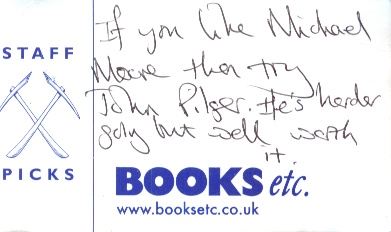
Ugh.
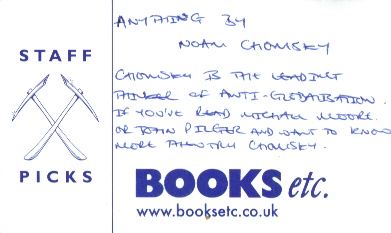
Save me.
Seriously, I suspect that the number of people who have read Michael Moore and are not already aware of the existence of John Pilger and Noam Chomsky already is small (or perhaps I overestimate them). I think recommendations like this are better when they refer people who have read something well known to something that is both rather more obscure and also good. And Pilger and Chomsky are not especially obscure, however much I might wish it were so.
However, in the chance that there might be anyone walking through the bookshop who might have discovered Michael Moore but not Pilger or Chomsky, I thought I had a duty to save them from this (and also there was a Samizdata post in it). Therefore, although it was a bit naughty of me I removed the little cards from the shelf and walked out with them. (Yes, okay, technically I stole them. However, sometimes the ends do justify the means).
As I was walking out of the shop, it struck me that it would be kind of cool to get a few of the blank cards, write out a few book recommendations of my own, and then attach them to the shelves. However, when I thought about it some more, I realised I didn’t need anyone to supply me with a stock of blank cards. For I have the miracles of modern technology at my disposal, and I could produce some of my own. I could go back into the bookshop and leave something like this.

Or perhaps this.

The fun could be never ending. → Continue reading: Globalisation, bookshops, and the Anglosphere
In the factory where I work we have been given magnetic swipecards to enter and exit the factory through the new security gates. The main point of these security gates is to protect the car park, which was targeted by a gang of thieves late last year. They do a good job- it’s going to take a fair effort to get in the carpark now. The carpark is also monitered by a security camera.
Some of the lads have made joking remarks to the effect that we are now ‘inside’; as if it was a prison environment, but no one really objects, as we all want our cars to be there and in one piece when we finish our shifts.
Some other employers though use far more extensive surveillance in their working areas. I used to work in an internet datacentre, and the company that operated it had security cameras operating over every part of the centre where our customers might go. These cameras recorded everything on magnetic tape. Part of my job in the Network Operations Center was to monitor these cameras for anything that might be a security breach.
There was one camera that covered the front door to our building which faced the street. This was by far the most interesting camera, as the datacentre was just around the corner from Crown Casino, a huge entertainment complex in Melbourne. Nothing livened up a dull nightshift as watching throngs of drunks, strays and vagabonds doing their thing at 5am.
There was one time, when I was safely on dayshift as it was, when the cameras recorded an assault right outside our building. As I remember it, the fellow who was on shift called the police and volunteered the tape to help identify the assailant.
This raises the issue of privacy. While it might be reasonable to help the police in dealing with a criminal offence, there were other times and other scenes that, while not criminal, might well have been of interest to a wider viewing audience, and would have been of great embarrassment to the participants, who were not aware of the well hidden camera.
Private companies operate transport services and many sports stadiums have cameras strategically placed to film the public. I wonder about what rights and obligations these private entities have to protect the privacy of the people that they film.
I think that Big Brother is big enough and doesn’t need any little helpers.
The always interesting Victor Davis Hanson chimes in this morning with a warning about the ongoing conflict with Islamist barbarians. His message: it is highly unlikely that the barbarians can win this war, unless we hand them a victory:
Western societies from ancient Athens to imperial Rome to the French republic rarely collapsed because of a shortage of resources or because foreign enemies proved too numerous or formidable in arms — even when those enemies were grim Macedonians or Germans. Rather, in times of peace and prosperity there arose an unreal view of the world beyond their borders, one that was the product of insularity brought about by success, and an intellectual arrogance that for some can be the unfortunate byproduct of an enlightened society.
Such smug dispensation — as profoundly amoral as it is — provides us, on the cheap and at a safe distance, with a sense of moral worth. Or perhaps censuring from the bleachers enables us to feel superior to those less fortunate who are still captive to their primordial appetites. We prefer to cringe at the thought that others like to see proof of their killers’ deaths, prefer to shoot rather than die capturing a mass murderer, and welcome a generic profile of those who wish to kill them en masse.
We should take stock of this dangerous and growing mindset — and remember that wealthy, sophisticated societies like our own are rarely overrun. They simply implode — whining and debating still to the end, even as they pass away.
Like Mr. Hanson, I believe that it is a conceit, a fatal mistake, to treat a war as a court proceeding, and to try to apply peacetime norms in a wartime environment. The danger with the new era of ‘asymmetrical warfare’ is that the threat is much more nebulous, making it that much more difficult to confine the wartime dispensation. We have already seen plenty of ‘slop’ in the US, as the Justice Department is already using its ‘anti-terrorism’ powers to go after pornographers, drug dealers, and so forth.
The dilemma is quite real, and I don’t see any easy answers other than eternal vigilance combined with bloody-minded realism. In other words, pretty much what has preserved the spirit of liberty through past crises.
Yesterday I had an interesting experience. I watched a lawyer at work. It was David Carr. We were due to dine together but he had some work to finish with some people who were setting up a business. David was crafting a contract that the business would be using. It got complicated. What exactly is meant by this? If so-and-so fails to provide that, who exactly pays? The point was: not the people David was helping.
Afterwards I talked about this with David, and he said, yes, it’s the job of a lawyer to look ahead and try to see the pitfalls, and to clarify exactly who is obligated to do what in circumstances which nobody wants beforehand, but which may nevertheless crop up. Lawyers aren’t paid to take you to court. They’re paid to spare you the horror of ever having to go to court. What if? – What if? – What if? � they ask. What if the world price of marble doubles, and your Malaysian contractor simply can’t supply marble at the price he originally and in good faith promised, but upon which the winning design depends for its aesthetic and price superiority? What if there’s a hurricane and the factory is wrecked? What if the ship sinks? Who, then, is obligated to do what, and to pay for what?
This reminded me of my late father, who used to behave exactly like this if any of us were going on a journey of any complexity or expense. What if? � the train is late and you miss your connection. What if? � you get ill. What if? � the car breaks down. What if? � a meteorite from outer space lands nearby.
I made that last one up, because of course we used to tease my Dad about this habit of his. We all took a ruggedly entrepreneurial attitude to future hazards. Dad, we’ll worry about that if it happens, okay? We’ll climb over any barriers in our path as and when we get to them, but we won’t waste our energy worrying about what we can’t possibly hope to anticipate. It’s a holiday. Enjoy yourself. Well, he would reply, don’t come running to me if that meteorite hits!!! � blah, blah, blah, big family row, just when we were supposed to be having holiday fun.
My Dad, like David, was also a lawyer. But he was a litigator, or barrister as we call that here, and maybe because he therefore did the arguing, and later in his career the judging, when the waste matter had already hit the fan, rather than the duller commercial job of preventing the need for all that, I had never quite connected his pessimism with him being a lawyer. I had just thought that my Dad was simply a pessimist, and that the lawyer bit was coincidence.
But lawyers, I was reminded, after watching David at work yesterday are paid to be gloomy. They are paid to see bad things coming, and to concoct complicated documents to take care of everything beforehand. And although my Dad may not have spent his life writing such documents, he did spend his life looking at them, and noting which ones solved the problem he was trying to deal with, and which ones didn’t.
Like David, my Dad was a devotee of the precautionary principle, and my Dad was a moralist and David is a moralist, and I don’t just mean in their Sunday best pronouncements about World Affairs, but in their daily lives. You must (moral issue) look ahead, and see bad things coming, and have a plan ready. Letting bad stuff hit you when you aren’t ready but could and should (moral issue) have prepared for it is bad (moral issue). David yesterday, and my Dad always, was trying to do the right (moral issue) thing. Neither of them were just sneaky lawyers who wanted to tie people up in legal chewing gum for the mere sneaky sake of it, just for the profit and the pleasure of it. And I don’t believe that most other lawyers are any more deliberately wicked than David or my Dad.
It is widely noted that (a) legislatures and parliaments everywhere are crawling with lawyers, and that (b) laws and regulations of ever increasing volume and complexity are piling up like there’s no tomorrow, to the point where for millions of people there aren’t going to be any tomorrows of remotely the kind they were hoping for. What’s going on? What are all the lawyers doing wrong, and why? → Continue reading: Pessimism, precaution and the nature of the lawyer threat
…that can be found over on www.bureaucrash.com
Which reminds me of my favourite picture of Che Guevara, that achingly cool totalitarian pop icon…
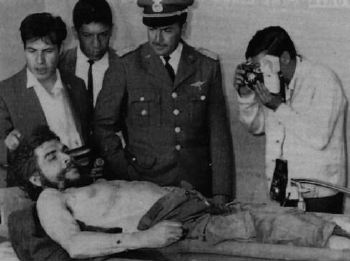
As you sow, so shall you reap
And so, as Jack Bauer ends his ordeal without any sleep, any trips to the bathroom, or any visible form of food other than sporadic liquid snacks sucked at the wheel of the latest stolen car (Sorry Sir, we have to take your vehicle), I wonder to myself…
What the heck am I going to do on Sunday nights, for the next six months?
Is 24 the only program currently on television, which is in any way worth coming home to watch, of an evening? And now it’s not on again, until Season 3, what’s the point of that glassy tube in the corner of the room? Perhaps I should replace it with a neverending loop of The Simpsons?
I won’t spoil 24’s ending, for those with wills of iron who’ve videoed the last episode, and who’re watching it later, except to say the script writers could’ve spent a little more time working on some of the slushier last-reel dialogue. However, except for this single forgivable rewriting lapse, I’ll be there for Season 3, propped up with a glass of Californian red, a cheese board, and a syringe full of adrenaline for heart-stopping emergencies.
OK, so it’s Federal US agents, paid for with coerced taxes, and the US government cabinet is populated with dimwits, fascists, and believers in Medicaid, but what a series! And what a body count! Is Kiefer Sutherland going to be the first James Bond born on the wrong side of the Atlantic? I don’t know, but whatever the weather, and if he can’t do a proper British accent, he’d certainly make a great Felix Leiter, or an excellent villain. (And with a Scottish surname, like Sutherland, surely he can cut the Connery-esque mustard?)
So, as I wander into the night, to prepare for another week teaching 26 people the joys of learning Perl (oh, those lucky people!), I also wonder how close to the knuckle the next series can go? It got really razor-blade sharp this time, with calls for leaders not to go to war against Middle East countries without really conclusive evidence (were you watching there, in Barbados, Mr ’45 minutes, Niger Yellowcake’ Blair?), but Season 2 is going to be a hard monkey to slap. However, I have faith.
Go, Kiefer baby, go!
The attitude of most people like me, who live in London, is that civil liberties are only of interest at present if they will blow very cold air at you. Nevertheless, I can just about sit long enough next my computer (equals fan heater) to tell you that these people (“Unpersons – a British group-blog focusing primarily on UK, EU and Anglosphere affairs from a free-market laissez faire perspective” – they got started last month) seem like they are going to be good and of interest on the civil liberties front. They have a “civil liberties” category, and if you click on that you get good stuff, although of course everything they say won’t suit everyone here (e.g. guns etc.).
Their latest is a discussion of how a DNA database of spit spat at British Railway staff is being talked about.
|
Who Are We? The Samizdata people are a bunch of sinister and heavily armed globalist illuminati who seek to infect the entire world with the values of personal liberty and several property. Amongst our many crimes is a sense of humour and the intermittent use of British spelling.
We are also a varied group made up of social individualists, classical liberals, whigs, libertarians, extropians, futurists, ‘Porcupines’, Karl Popper fetishists, recovering neo-conservatives, crazed Ayn Rand worshipers, over-caffeinated Virginia Postrel devotees, witty Frédéric Bastiat wannabes, cypherpunks, minarchists, kritarchists and wild-eyed anarcho-capitalists from Britain, North America, Australia and Europe.
|






Recent Comments