We are developing the social individualist meta-context for the future. From the very serious to the extremely frivolous... lets see what is on the mind of the Samizdata people.
Samizdata, derived from Samizdat /n. - a system of clandestine publication of banned literature in the USSR [Russ.,= self-publishing house]
|
Nowadays the gadgetry available even to quite non-rich people is advancing at a hectic rate, and the people in the shops selling these gadgets can’t keep up with it. The very thing that makes you want to go back to the shop to ask them how the hell it works is the exact same reason why they can’t help you. They can’t keep up with what’s in all their boxes any more than you can quickly work out what’s in your box. If the bloke in Dixon’s was smart enough to explain all the nuances of digital radio or Norton anti-virus software, he wouldn’t be working in Dixon’s, now would he?
So what do you do? Read the manual? Yes, but only as a last resort. The real trick with new technology is to watch what your friends are using, and if it works, get one of those yourself. That way, any new discoveries made by any of you about whatever it is can become common knowledge for the entire group of you. You can also share things like discs and data cards. This is how standards emerge in the free society. They aren’t imposed. People buy them, by buying what their friends also have. And people are being smart. Other things being equal, which they often are, get the same stuff as your mate down the road.
I mention this now because a user group may be starting to form in my little bit of the blogosphere, around one of the Canon range of digital cameras, the Canon PowerShot A70. → Continue reading: Buy the Canon PowerShot A70 and explain it to me – that’s what friends are for
Given the appearance of some gloomy prognostications round here today I think it appropriate to shed a little light on what I consider to be a much under-examined issue.
Damien Thompson writes in the Telegraph about the triumph of feeling over thinking:
How many people in Britain do you think work as “counsellors” of one sort or another? Ten thousand? Fifty thousand? According to Frank Furedi, professor of sociology at the University of Kent, the actual figure may be closer to half a million, though no one can be sure. What we do know is that the number of mental health professionals has more than quadrupled since 1970, and that the ranks of registered psychotherapists were swelled by more than half between 1997 and 1999.
A new priesthood? Arguably, I suppose. But I have yet to be convinced that ‘psychotherapy’ is anything except institutionalised quackery.
Never before have so many people been dependent on some form of therapy. Night after night, our televisions instruct us to pick up the phone “if you have been affected by any of the issues in this programme”: the message is that every difficult experience requires expert help. We must all raise our “awareness” – of stress, low self-esteem or some recently identified personality disorder.
We must all raise of ‘awareness’ of this worrying trend towards mental and spiritual incontinence…
Government, social workers and charities work tirelessly in this cause. It costs money, of course, since awareness-raising requires special training; and, despite ritual denunciations of underfunding, it is usually forthcoming. In a recent disbursement of National Lottery money earmarked for health, 25 per cent went to advice and counselling schemes; only six per cent was allocated to research charities.
…and the vested interests that actively promote it.
Thanks to media willingness to spread “awareness” of previously undiagnosed emotional illness, prophecies of mental anguish tend to become self-fulfilling. People learn to be stressed (which is not to say that their unhappiness is not real).
The BBC works particularly hard at cultivating therapeutic anxiety. Last Tuesday’s Woman’s Hour opened with the alarmist statement that “one in five young people rates stress as unbearably high most of the time, and the claim is backed up by a number of organisations”.
The thing that BBC supporters seem unable to grasp is that antipathy towards that organisation is driven not just by its lockstep soft-left bias but also by the vanguard role it has arrogated unto itself in disseminating and propogandising this kind of grotesque agenda.
Yet, like the state socialism of the postwar years, the detailed management of emotion requires a formidable apparatus of bureaucratic inspectors. No government can hope to build such a structure on its own: it requires entire professions (such as the police, post-Macpherson, or the BBC) and large sections of the public to submit willingly to ideological control. That is how totalitarianism works.
That is exactly how is has worked. Nor is this class-interest driven programme of gradual infantilisation a transient or trivial matter. It isn’t about ‘caring’ its about controlling and manipulating. It isn’t about ‘help’ its about dependence. It isn’t about more humanity its about less humanity. In the final analysis, it is all about the sleep of reason and the sleep of reason will, sooner or later, breed monsters.
A couple of weeks ago, non-resident Samizdatista Alice Bachini pointed to this Telegraph piece in praise of supermarkets in general and the Tesco chain in particular, which explains that supermarkets help us to save time and money, make life easier (particularly for women), and provide a tremendous range of stuff much easier to buy at all sorts of odd hours if necessary, that Tesco provide a fine online service for people who want it, and that all round these are really good things and should be applauded. (Oddly enough, my fellow Samizdatista Jonathan Pearce wrote a similar piece between my starting and finishing this piece). Now this is a good article – it even takes a brief time out to denounce the Common Agricultural policy as evil – and on the whole I couldn’t agree more. However, there is one important issue that the author (Alice Thomson) missed. Midway through the article, she says the following
Supermarkets are always accused of sacrificing quality for quantity. Actually, because they buy in bulk and have a rapid turnover, it often means that their fruit is fresher than their competitors’. At Tesco yesterday, I counted six varieties of autumn apples, four from Britain.
Because they have such huge buying power, they can also take a gamble on exotic produce. The old corner shops were great for a packet of cigarettes, but they’d never have sold fresh basil. Supermarkets have made us more rather than less adventurous.
The result is entirely true. Supermarkets today contain a great many more lines than was the case a couple of decades ago, particularly fresh foods. But she is wrong about the reason. The reason why supermarkets are able to provide so much better products is not about buying power. It is instead almost entirely about the benefits that have been obtained by supermarket chains developing complicated computer systems to handle their logistics.
I will return to this, but for now a digression into economics. → Continue reading: Why supermarkets are good, and what this has to do with the productivity paradox
The Free State Project is a group in the USA looking to get at least 20,000 liberty oriented activists to move to a single state in the USA so that they can have more political impact somewhere rather than be lost in the sea of Republican and Democrat statists by being scattered across the country.
And the result of the vote to see which part of the USA they would all move to is… New Hampshire.
Godspeed to you all. I shall be watching this project with great interest.

The Adam Smith Institute has assembled a group of economic forecasters to prognosticate about the British Economy. Their findings aren’t yet up at the ASI site, but the latest ASI email Bulletin helpfully sums up their findings, thus:
Gordon Brown has sown the seeds of his own destruction. At this rate he’ll soon have to put the economy in his wife’s name.
There are bad times just around the corner. Will there be better times around the corner after that corner? I live in hope.
More creepy Big Blunkettry, this time from Scotland (on Sunday):
EVERY secondary school pupil in Scotland is to be issued with an ID card bearing his or her name, age and address, under a controversial government scheme branded last night as an assault on privacy.
The ‘entitlement cards’ will be issued to 400,000 12 to 18-year-olds from March next year and will be used for a range of services including school meals and leisure centres.
Nice trick. Get a card, or go hungry.
But the scheme – which has already been piloted in Aberdeen – was condemned yesterday as a cynical ploy to introduce national identity cards for adults by the back door.
The bit of this Scotland on Sunday story that did most to threaten my digestion was this:
An Executive spokesman told Scotland on Sunday that the scheme, officially called ‘Dialogue Youth’, would see 400,000 cards given to all Scotland’s 12-18 year olds. The spokesman said they would not be compulsory.
Dialogue Youth. Puke. And they won’t be compulsory. It’s just that if you don’t carry one, you won’t be able to do anything or buy anything.
A new Sainsbury’s supermarket has opened near where I live in Pimlico, central London. Very good it is indeed. Just about every food obtainable that I would ever want plus lots more. I made my first trip the other day and it triggered off some thoughts about what these big food chains represent in our culture.
First off, the customers looked genuinely excited, cheerful. It may seem weird that in an age of abundance where we take such things for granted, but the opening of this store seems to have created quite a buzz in the area, rather like the opening of a multi-plex cinema. Shopping for many people is an extension of leisure activity rather than just about the utilitarian business of buying food for the table.
The neo-Luddites in our midst claim to despise all this. Supermarkets, they say, force smaller shops out of business and these big stores’ buying power squeezes the margins of suppliers. To the first charge, I say that if small stores are indeed being forced under, it has more to do with the burdens of regulation and tax which necessarily weigh more heavily on small firms than on larger, more established ones. And secondly, the increased buying power of large stores is indeed a fact, but that also means the consumer gets to benefit. And a big store’s brand-name visibility means the owners of the business have to fret constantly – and they do – about product quality. Let’s face it, if you buy a tin of beans from Megastore Inc and it turns out to poisonous, then think multi-zillion quid lawsuit. If it is bought from Uncle Fred Cornershop, probably not.
And a final point. Supermarkets, it seems to me, have played a considerable part in the liberation of women from traditional household chores, and hence made it easier for women to leave the home and go into work. If we had no superstores and only small stores, then shoppinig would take much, much longer, and hence put even more of a strain on family life where most couples have to be earners out of financial necessity.
Of course the anti-globalistas are none too keen to focus on the essentially conservative, dare I say, reactionary nature of what their hatred of big business means. No reason for us to be shy, however.
Right, off to explore the wine counter.
The third post by Our Man in Basra about his observations from both Iraq and the West, to which he has now returned.
I have noticed that most Westerners tend to form one of two opinions about the situation in Iraq and about what we should be doing. One opinion is what I would call Idealistic. Iraqis are human beings just like us and so deserve democracy and freedom just like us. Therefore we should give them these things, as soon as possible. This viewpoint seems to be held by Americans who do not work with actual Iraqis, and by many libertarians.
The second opinion, which I shall call Realistic, is that the Iraqis are fundamentally different people to us. They have a different culture, a different religion, are basically untrustworthy, and uncivilised. They like stealing from and killing each other. They need a brutally authoritarian regime to keep them in order, and basically we are wasting our time trying to teach them anything else. This point of view tends to be held by those who deal with Iraqis day-to-day and is most acutely felt by ex-Idealistic Americans who simply cannot understand people who, instead of repairing their country, trash it.
The problem with the Idealistic theory is that Iraqis have been traumatised by thirty five years of brutal kleptocracy. They have no experience or understanding of what democracy, or even freedom, actually mean. For example, the end of Saddam’s rule in Basra was taken by most Basrans to mean the end of traffic rules as well, so they now drive like suicide bombers.
This is similar to what occurred in Central Europe after communism. Most people had little understanding of what a free market meant. They tended to think that capitalism meant a free license to rip off your customers. They also expected that the coming of freedom would mean instant wealth like in the West. They took a while to realise that it meant the freedom to build yourself wealth like in the West. The same is true, but twenty times more, in Iraq. At least the Central Europeans had a past history of civil freedom, and neighbours to learn from. None of this is true for the Iraqis.
The Realistic viewpoint, on the other hand, is intrinsically, if unconsciously, racist. There are objective differences between Iraqis and Westerners due to Islamic faith and tribal traditions. But these are not genetically encoded and impossible to change. In fact there are aspects of both Islam and of tribal traditions that are perfectly compatible with democracy and freedom. And indeed, the argument that Iraqis are lazy and stupid simply does not reflect the facts to be seen on the streets of Basra. You can see Iraqis driving cars that are little more than steering wheel, engine and a few road tires, but they keep them moving. They may be destroying their own infrastructure, but they show incredible determination and inventiveness while doing so.
What astounds me about both viewpoints, which are held by many intelligent people, is how absurdly simplistic they are. Iraqis are for the most part rational people, whose behaviour can be rationally explained. They react rationally to the environment they are in, which includes their experience under Saddam and their fear of his return. It may not make sense to give them complete democracy and freedom immediately and this point was made to me often by Iraqis, who insist that we should not try to govern Iraq with Western laws. They keep saying that Iraqis are different and need a strong fist.
But to suggest that Iraqis cannot learn to operate in a free and capitalist society is absurd. The problem here is the time scale. Neither viewpoint seems to take account of what of the blindingly obvious – you cannot rebuild the entire Iraqi society in a matter of months. The war ended at the end of May and we have only had four months so far. The reconstruction of Germany after World War II took about a decade.
Having been in Basra for some months, I am convinced, as are most Iraqis, that it will be a rich and prosperous city somewhere around five to ten years from now. As long as Iraqis have security from Ba’athists and from the neighbouring states, they will achieve this themselves. But with the French manoeuvring to give the UN political primacy in Iraq, the question is not: will Iraq be rebuilt, but who will get the credit?
The great gift of cash (fiat currencies included) is the anonymity it affords the bearer. Nobody but the bearer knows just how much cash he has. Nobody knows how much may have been earned, paid, spent, saved or transported.
But that is all about to change:
Dogs trained to sniff the ink on bank notes are being used for the first time on trains to detect criminals carrying large amounts of illicit cash.
The “currency dogs” have already been used successfully by Customs and Excise at ports and airports, where they have detected more than £800,000 in mainly drugs cash, and are now being targeted at mainline train routes into London.
So the dogs will miraculously detect ‘criminals’. Is this Trial by Canine? Do the sniffer dogs have to prove their case on a mere balance of probabilities or is proof beyond all reasonable doubt required? Will there be Defence Dogs standing by to rebut the charges?
And how is anyone supposed to know that the cash is ‘illicit’? Unless, of course, all cash is presumed to be illicit. Given its hitherto undetectable properties I can think of why certain institutions would insist on precisely that assumption:
However, those caught with such volumes of cash, even if not criminal, are likely to be investigated by tax authorities. Customs sources said they will only seize cash in cases of £10,000 or more.
It is the logical last piece of the jigsaw. What with the Money Laundering Laws and the War on Tax Havens, I reckon that the lockdown is pretty near to completion.
There is little doubt there has been a perceptual disconnect between the reports from the hotel bar in Baghdad and those of virtually everyone else on the scene. The difficulty for someone sitting a long distance away is to judge who really is the more accurate.
Lazarus Long, or more accurately his creator Robert Heinlein, said “If it can’t be expressed in figures, it is not science; it is opinion.”
Earlier this month I decided to take a closer look at the relevant figures. I’ve been tracking the results on a day by day basis ever since. As it is now the end of the month, I am publishing my results.
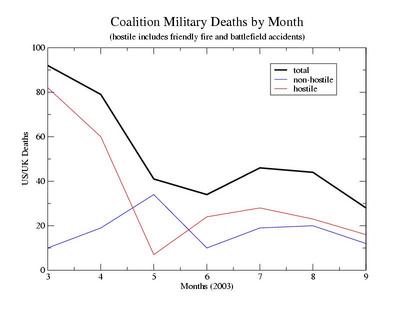
D.Amon, all rights reserved, may be used with attribution to Samizdata
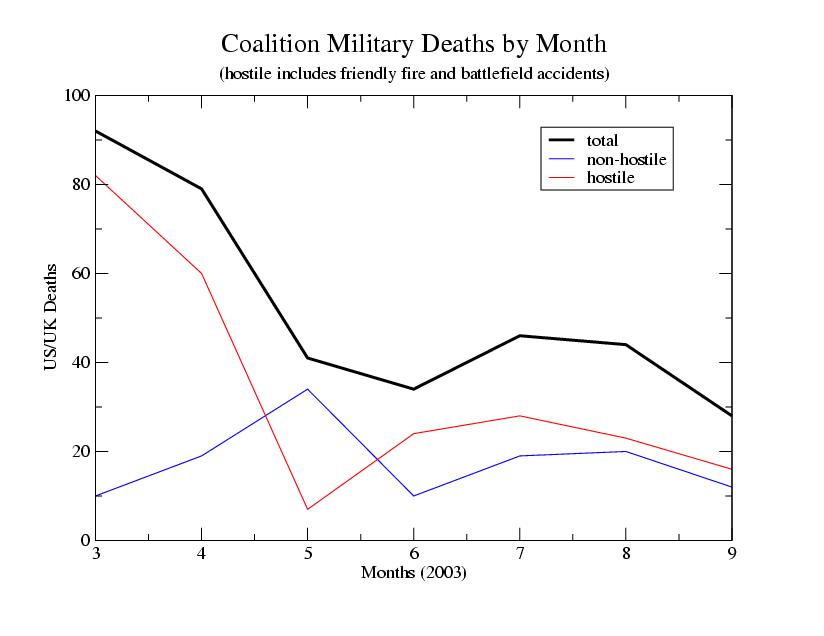
The graph is rather striking in its clarity. There are three phases visible. March and April are quite obviously the period of major combat. The second is May; combat deaths plummet to almost nothing while the accident rates skyrocket. The third period is one of minor combat. Accident rates fall drastically but combat deaths climb to a minor peak before tailing off slowly. At present the combat death rate is running an almost insignificant amount over the accident rate.
My interpretation of the graph is:
- March and April are clearly the period of major combat.
- May is a postcombat month. Remnants of the regime are dispersed and disorganized. There are a lot of dangerous ordinance laying about. Soldiers are tired, ease up slightly and have more accidents because of it.
- June through the present is a period of low intensity conflict. One can read the state of the opposing forces in the short-lived secondary peak followed by a long tail off. That tail-off is their journey into oblivion.
It will be interesting to see if the end comes with a bang or a whimper. One could imagine a last desperate and suicidal offensive by the remaining Saddamites. Alternatively, if Saddam is calling the shots and is taken out of the picture the remnants might just quit and go elsewhere. The most likely scenario – in my opinion – is an exponential tail-off in as the remnant forces are killed or captured
Worrying words from Blair’s conference speech:
“And in a world of mass migration, with cheaper air travel, and all the problems of fraud, it makes sense to ask whether now in the early 21st century identity cards are no longer an affront to civil liberties but may be the way of protecting them.”
I don’t mind him asking the question, I just wish he’d listen to the answer.
I think our attitude toward America should change … we have a chance, in America, to be the moral leadership of America. The problem is when? It will happen, it will happen [Allah willing], I have no doubt in my mind, Muslims sooner or later will be the moral leadership of America. It depends on me and you, either we do it now or we do it after a hundred years, but this country will become a Muslim country. And I [think] if we are outside this country we can say ‘Oh, Allah destroy America,’ but once we are here, our mission in this country is to change it.
– Abdul Rahman al-Amoudi, a prominent American Muslim leader
|
Who Are We? The Samizdata people are a bunch of sinister and heavily armed globalist illuminati who seek to infect the entire world with the values of personal liberty and several property. Amongst our many crimes is a sense of humour and the intermittent use of British spelling.
We are also a varied group made up of social individualists, classical liberals, whigs, libertarians, extropians, futurists, ‘Porcupines’, Karl Popper fetishists, recovering neo-conservatives, crazed Ayn Rand worshipers, over-caffeinated Virginia Postrel devotees, witty Frédéric Bastiat wannabes, cypherpunks, minarchists, kritarchists and wild-eyed anarcho-capitalists from Britain, North America, Australia and Europe.
|





Recent Comments