We are developing the social individualist meta-context for the future. From the very serious to the extremely frivolous... lets see what is on the mind of the Samizdata people.
Samizdata, derived from Samizdat /n. - a system of clandestine publication of banned literature in the USSR [Russ.,= self-publishing house]
|
In the Australian state of New South Wales, which includes the city of Sydney, the number of pub licences is finite, and by all reasonable measures too few. Pub licences in Sydney trade like New York taxi plates, and sell for hundreds of thousands of Australian dollars. Because existing licences are so valuable, pub owners are extremely hostile to any competition that would reduce the value of their licences. Therefore, there is very strong resistance to increasing the number of licences and hence the number of pubs. Also, restaurant liquor licences are highly restrictive. Diners may not buy alcoholic drinks in a restaurant unless they “intend to dine”, and they may not drink alcoholic drinks in a restaurant while standing up. If these restrictions were relaxed, there would be little difference between restaurants and bars and pub licences would lose some of their value. The pub lobby therefore opposes any change, and a succession of state governments have given in and have not changed the law.
Of course, if a pub licence costs several hundred thousand dollars, it is necessary for pubs to make a decent return on this investment, and therefore in Sydney there are essentially no small pubs. Pubs are mostly large and fairly soulless. The sort of small, cosy pubs with character that are everywhere in England are mostly absent. And this is a shame.
As it happens, I was today in Canberra, Australia’s capital city. Although the city is entirely surrounded by the state of New South Wales, it has a similar status to Washington D.C. The city sits in a jurisdiction called the Australian Capital Territory (ACT), which is not part of any state but which constitutionally speaking is entirely the responsibility of the federal government. (An ACT government does exist, with powers somewhere in between those of a city government and a state government, but it does so entirely at the pleasure of the federal government).
One thankful consequence of this is that the liquor and pub licensing laws of the state of New South Wales do not apply in Canberra. In Canberra it is not necessary to pay hundreds of thousands of dollars for a pub licence, and small pubs are possible. As it happened, I met up with a friend. Knowing my fondness for good beer, the friend took me to a nice cozy little brew pub, that served seven or eight different beers brewed on the premises. There was a hefe-weizenbier (not as good as what I would drink in Germany, but still quite good), a Kölsch style lager, three or four English style cask conditioned ales, and more. It was possible to brew all these beers and sell them on cozy little premises that catered to a clientele that liked that sort of thing. It was nice.
But in Sydney such a thing cannot easily exist. And it is all to protect rent seeking vested interests. Sydney has a huge number of restaurants serving excellent food of every kind imaginable, and is one of the finest cities in the world in which to eat. But as a place to go out for a drink, it leaves something to be desired. Canberra does not have this problem. (To be fair, Melbourne does not have this problem either). And this is entirely due to the difference in regulation.
The ‘fraudster’ meaning, of course, Jacques Chirac. The new president of the European Central Bank is M. Jean-Claude Trichet and buried away at the foot of an old news report is this gem:
Mr Trichet’s nomination was made possible earlier this week when he was cleared of involvement in the Credit Lyonnais banking scandal in the 1990s. He was one of nine men on trial for their part in the affair, which culminated in a €31bn ($33.7bn) bailout by the government.
That is more than £21,000,000,000! For one bank. Nine people. I can just hear them: “Bah! Nick Leeson! “Betsygate” indeed! You English drive your minis with your Benny Hill and your Michael Caine, stealing a few gold bars in Milan and think you’re so marvellous! Hah!”
The Crédit Lyonnais bank ‘affair’ included a massive fraud including loans being made to friends of the late president François Mitterand. At least one of them got a few months in jail to my knowledge. A concerted effort was made to delay the appointment of a new ECB president until M. Trichet’s problems could be dealt with. Ironically, the French verb for to cheat is tricher which is pronounced exactly the same as our new Euro bank president’s name. A very suitable friend for M. Jacques Chirac. The president whose unofficial re-election campaign slogan was Vote for the fraudster, not the fascist! but who has avoided judicial processes by virtue of presidential immunity from prosecution. So much in common for them to talk about.
Now let us assume that M. Trichet were the innocent victim of devious bank subordinates who stole £21,000 million. Personally, I find such a degree of stupidity fantastic: the guy could scarcely have enough brain cells to know how to breathe. Is this really the calibre of executive to put in charge of an EU institution?
A couple of other things worry me. What did the other European leaders think they were doing when none of then vetoed the appointment of Trichet? Perhaps Mr Blair really is a closet hater of the euro – I hope so. And if the currency markets are not dumping euros for US dollars before M. Chirac’s friends get their pillaging underway… what do they know about what the Federal Reserve guys are up to?
I do believe that Tom Watson was the first serving Member of Parliament to set up a blog. If that is the case then he deserves to be congratulated for his initiative and originality.
However, his latest project, of which he appears most proud, is rather less praiseworthy for it appears that Mr.Watson has been instrumental in passing new laws on the sale and use of fireworks:
West Bromwich East MP Tom Watson, who helped push the new law through the House of Commons, said today: “While these new powers will not be in force for this year’s fireworks season, I’m delighted and also relieved that the Government is so determined to come down hard on the misuse of fireworks.
My worry when the Fireworks Act became law was that it could take years for the Government to put the powers into practice. The fact that the zero tolerance approach will come into force as early as next month is a great victory for the thousands of people in Sandwell who have sent in letters and signed petitions calling for a crackdown.
They are sick and tired of the misery and disturbance caused by fireworks going off late at night in the early hours. They are sick and tired of fireworks being used as toys and even weapons by teenagers. And they are sick and tired of fireworks so loud that their neighbourhood often resembles a warzone.
The time has come for this to stop. We will now have the powers to deal with the problem and I hope that the police and local authorities will make full use of them.”
As best as I can tell, the thrust of the new regulations is to prohibit sales of fireworks to people under the age of 18 and to make it a criminal offence to set off fireworks late at night. On the face of it, they are not wildly unreasonable measures. There are already all manner of restrictions on the retail capacity of minors and setting off fireworks in the wee small hours is a genuine nuisance for people who are trying to get a decent night’s sleep.
But the question here is not so much ‘what’ as ‘why’? → Continue reading: A damp squib
Courtesy of COMUSNAVEUR Security Staff, via my sources I received the following warning:
You are advised that hotel room keys that look like a credit card will contain personal information, including:
- Customers (your) name
- Customers partial home address
- Hotel room number
- Check in date and check out date
- Customers (your) credit card number and expiration date.
- In Europe, passport numbers are also frequently recorded onto the cards.
When you turn them in to the front desk your personal information is there for any employee to access by simply scanning the card in the hotel scanner. An employee can take a handfull of cards home and using a readily available scanning device, access the information onto a laptop computer and go shopping at your expense. Simply put, hotels do not erase these cards until an employee issues the card to the next hotel guest. It is usually kept in a drawer at the front desk with YOUR INFORMATION ON IT!
You should always destroy the card. NEVER leave it behind in the room and NEVER turn them in to the front desk when you check out of a room. The hotel will not charge you for the card.
I suspect the constant trench warfare in American politics over abortion is somewhat mystifying to our overseas observers, and I think abortion poses some real philosophical problems for libertarians stemming from the unanswerable question of when a “fetus” becomes a “person.” Those issues aside, this David Frum blog entry is full of wisdom, not only on abortion, but on the dangers of ideological absolutism in matters political and social.
Now let me say right off: I am not pro-life. I think abortion ought to be legal for the first 12 weeks of a pregnancy and available to protect the health of the mother during the weeks thereafter. I don’t see this as a matter of fundamental human rights, so much as one of accommodating reality. I can’t defend Roe v. Wade as a legal decision, and I would be very glad to see abortion become much more rare than it now, but if the law attempts to suppress abortion entirely, it is the law that will fail, rather than abortion that will disappear. Please don’t email me about this: I have thought about this issue just as hard as you have, and I’m not going to change my mind.
But precisely because I believe in accommodating the realities of abortion, I think those on the pro-abortion side need to acknowledge that the no-concessions approach of the organized abortion lobby is catastrophically mistaken. Abortion rights would be much more secure if they were confined within reasonable limits that squared better with the conscience of the nation.
→ Continue reading: Accommodating reality
For those who missed it, Instapundit is having a go at the Chinese authorities and…Walmart. November 7th is the anniversary of arrest of Liu Di by plain-clothes police. No charges have been made and she has not been heard of for the past year. Petitions have been started, in China, with people putting their real names to them and being arrested for that themselves. This is the story:
Until the authorities tracked her down a year ago Friday, she (Liu Di) was one of the most famous Internet web masters in China. A third-year psychology student at Beijing Normal University, Ms. Liu formed an artists club, wrote absurdist essays in the style of dissident Eastern-bloc writers of the 1970s, and ran a popular web-posting site. Admirers cite her originality and humor: In one essay Liu ironically suggests all club members go to the streets to sell Marxist literature and preach Lenin’s theory, like “real Communists.” In another, she suggests everyone tell no lies for 24 hours. In a series of “confessions” she says that China’s repressive national-security laws are not good for the security of the nation.
But since Nov. 7, 2002, when plain-clothes police made a secret arrest, Liu has not been heard from. No charges have been filed; her family and friends may not visit her, sources say; and, in a well-known silencing tactic, authorities warn that it will not go well for her if foreign media are informed of her case.
It is largely the attention of the Western media and public that keeps dissidents afloat and their oppressor in some sort of check. Those who are visible beyond the barrier erected between the oppressed and the outside world tend to fare marginally better. At least they get publicity for their sacrifice and if the campaigning on their behalf is persistent enough, they may even get out of whatever hell-hole communist officials put them in. The thousands (in China probably an order of magnitude larger) ‘small’ human tragedies go unnoticed just as they did in communist Russia and Eastern Europe.
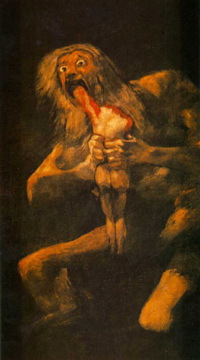
Looking back at the Cold War days it seems incomprehensible that such horrors could be tolerated next door to Western civilisation and capitalist liberal democracies. Marxism and communism – top candidates for the most barbaric and inhuman ideologies – have absolutely no redeeming features, whether in practise or in theory. Not only they create a living hell for ‘ordinary people’ but they bring destruction to those who perpetrate it. Communism, time and again, produces monstrous regimes that like Saturn devour their own offspring.
And for those who believe that letting China ‘evolve’ out of its totalitarianism is the best way forward, this conclusion is not an optimistic one.
…the Chinese security and police are regularly told to crack down. There may be exceptions, as when the daughter or son of a high party member or rich family gets in trouble; or when there are excesses of youth.
But these are exceptions. The rest – labor activists, upstart college students, journalists, writers, intellectuals, professors, dissidents, religious believers with too much spunk, those who stand out in a too-public fashion or attract too much attention – are warned, or arrested. In this reading of China, free expression is not improving in the short- and midterm.
Despite some changes of style, more arrests are taking place, and ordinary Chinese are still strictly censoring themselves.
It is the pressure from the outside that can have the greatest impact on what happens in totalitarian regimes. Glenn Reynolds thinks that challenging Walmart is a way to increase it. Well, that’s good enough for me.
1. noun. A blog (depreciated).
2. noun. A hybrid blog/website, featuring website features such as a conventional on-line company brochure (for example) but also incorporating a blog in a sidebar as a supporting feature on the same page.
(coined in this context (usage 2) by Adriana Cronin)
A kind reader sent in a link to the debate on ID cards that took place yesterday in the House of Commons. Judge for yourselves:
Mr. Simon Thomas (Ceredigion): Let me say at the outset that I am opposed to ID cards, both in principle and on grounds of practicality. To put it at its most brutal, I do not believe that the best way of remembering, as we do this week, those who gave their lives for freedom is to introduce the sort of society that would have had Saddam Hussein drooling. The apparatus of totalitarian repression depends on knowing who and where every citizen is and was, and which God they worship. The Government may have dropped the God bit, but the potential for all the rest remains.
…
At the moment, we balance privilege with responsibility. It is a privilege to drive a car, and it is a responsibility to pass a test, hold a driving licence, tax a vehicle and so on. It is a privilege to enter another country, but a passport is needed. Other forms of identity, including credit cards, party membership cards such as my Plaid Cymru card and parliamentary photo passes, are mere conveniences that we can opt to use. An ID card system tips that scale and reduces citizen to cipher. It forgets that the Government should be subject to the people and instead makes the people subject to the Government. The central tenet of freedom—for people to be able to move around as they please, live where they please and do want they want, as long as they do not harm others—is reduced to a nannying, bullying attitude that the Government must know where people are and what they are doing.
…
I would like to tackle the Government’s arguments head on. However, as I said earlier, the Government have not presented a unified argument in their discussion of a national ID card. They have been as convincing as they have been consistent. We were told first that ID cards would deter international terrorism and political violence; next that they would enable the Government to end benefit fraud; and then that they were the panacea that would stop illegal immigration, asylum troubles and illegal working in the UK. The Labour Government, much like the Tory Government in 1995, have used any justification for the introduction of ID cards. It is a clear example of a solution in search of a problem.
Hear, hear, hon. Ladies and Gentlemen. It is worth reading the whole thing.
In contemplating where things stand regarding the threat of terror attacks on our homes from radical islamic groups, we have tended, perhaps understanderbly, to overlook sources of trouble closer to home. An article
in the wonderfully revamped website of the American Spectator, a conservative leaning journal, describes the aims and methods of extremist environmental groups. It makes for worrying reading.
Like their better-known terrorist brethren who hate America and its capitalist system, ELF undertakes actions it knows will have no direct consequence beneficial to its stated goals. It merely looks to inflict harm, hoping that will cow people into living in teepees and biking to work. ELF members are sustained by hate against infidels who don’t share their extremist religion, and are eager to commit violence against their “enemies.” So far that violence has been targeted against property, but as the more radical members come to realize that burning down a few houses and vandalizing SUVs aren’t accomplishing anything, and fueled by their demonizing rhetoric, violence against people is not far off.
There is no great surprise in this. Witness what happened to the staff working for the Huntingdon Life Sciences business. Witness the constant vandalism of genetically modified crops. If you are in the grip of an ideology that holds “nature” and its creatures as inviolable, and believe that all sentient creatures have “rights” then it is perhaps inevitable that some folk are going to resort to physical violence to get their way.
As Virginia Postrel noted on her blog some time ago (cannot find the exact article, I am afraid), we need to hear from mainstream green lobbies about how much they deplore violent acts. So far, I have heard diddely squat from any such group on this matter.
I do not believe I am being hysterical in suggesting that it is only a matter of time before quite a few folk are going to get killed by enviro-nuts. There is not much we ourselves can do apart from show vigilance. However, what we can and must do is to constantly challenge their ideology and continue to champion the achievements of reason, science and technology that have lifted us up from the swamps. These nutters would have us return whence we came.
For as long as Marxists continue to evade responsibility for the atrocities that their own atrocious opinions unleashed upon this planet during the twentieth century, then for so long will be necessary and desirable for anti-Marxists to go on attacking Marxism. For as long as it is seriously being argued that Marxism was innocent, or worse, that it should even be encouraged to rise again from its grave, then the rest of us should continue to stamp on that grave.
One of the best such stampings I’ve recently read – although it is more of an elegant and civilised application of the light roller, as if at a cricket match – is a piece by Anthony Daniels in the October 2003 edition of New Criterion, entitled History by other means.
His reflections are provoked by a trip to Cambodia, and by the uneasy feeling that all that charm and grace might merely be a mask for the horrors that erupted during the ghastly reign of Pol Pot. He reflects upon a writer called Vickery, who plays down the Marxist aspect of what happened in Cambodia, and plays up the Cambodian aspect of it all he can. → Continue reading: Nothing to do with ideology?
Tony Blair’s official spokesman has made an announcement about Big Blunkett’s plans to introduce compulsory national Identity Cards for innocent British citizens. The statement is confusing and seems to be an attempt to patch over the splits in Cabinet.
According to the statement, Ministers have agreed in principle that there would be major benefits to such a scheme. However they have also agreed that the practical issues are immense. Of perhaps most interest is this sentence:
We will legislate to enable the scheme to be introduced and plan on the basis that all the practical problems can be overcome but we will reserve the final decision on a move to compulsion until later this decade.
That could be seen as a victory for either side.
So long as this enabling legislation is in place the threat of compulsory National Identity Cards will remain. We must make it clear to the government that proceeding any further down this road will lose them the next election.
Cross-posted from The Chestnut Tree Cafe
The Cabinet domestic affairs sub-committee met yesterday to consider Big Blunkett’s plans to introduce compulsory national Identity Cards for innocent British citizens.
The plan has split the Cabinet with Gordon Brown, Jack Straw and Patricia Hewitt said to be amongst those opposing Blunkett.
According to reports in today’s media, the meeting was “acrimonious”, “savage” and a “bloodbath”.
Incidentally, the BBC have launched a new website iCan for campaigners. If it takes off, it could generate a lot of exposure. I’ve started a campaign against ID cards.
Partially cross-posted from The Chestnut Tree Cafe
|
Who Are We? The Samizdata people are a bunch of sinister and heavily armed globalist illuminati who seek to infect the entire world with the values of personal liberty and several property. Amongst our many crimes is a sense of humour and the intermittent use of British spelling.
We are also a varied group made up of social individualists, classical liberals, whigs, libertarians, extropians, futurists, ‘Porcupines’, Karl Popper fetishists, recovering neo-conservatives, crazed Ayn Rand worshipers, over-caffeinated Virginia Postrel devotees, witty Frédéric Bastiat wannabes, cypherpunks, minarchists, kritarchists and wild-eyed anarcho-capitalists from Britain, North America, Australia and Europe.
|





Recent Comments