We are developing the social individualist meta-context for the future. From the very serious to the extremely frivolous... lets see what is on the mind of the Samizdata people.
Samizdata, derived from Samizdat /n. - a system of clandestine publication of banned literature in the USSR [Russ.,= self-publishing house]
|
These simple truisms go a long way to explaining MP & blogger Tom Watson‘s support for passing laws regarding the use of fireworks. On his blog, and on this blog in our comments section, the Honourable Member of Parliament for West Bromwich East calls for more regulation and makes it clear that fireworks will simply be banned if that does not produce the desired effects. And yet when talking about an incident in which a woman was injured by some idiot throwing a firework he himself notes:
Granted the little thug that conducted this assault was breaking existing laws
�and then proceeds to ignore that fact from then on. I do not know Tom Watson personally but I heard him speak in Houses of Parliament and he seems both affable and reasonable for a politician. But as Brian Micklethwait’s article today says regarding the ‘problem’ of obesity, it is only to be expected that a person whose salary depends on passing more laws to, well, always insist on passing more laws.
The United States, for all the many, varied and egregious flaws in that constitutional republic, has at least managed to some degree to place whole sections of civil society off-limits to the law making Tom Watson’s of the world. For example free speech is largely protected against erosion in ways that have not proved to be the case in Britain with the advent of so called ‘hate speech’ laws.
In so many ways it is where the USA has managed to constrain regulatory democracy from intruding wherever vox populi wishes it to, and the resulting politicizations of social interactions that entails, that its vast economic power and admirable civil virtues spring. Similarly it is where the United States has departed from those principles (RICO, civil forfeiture, IRS reversal of burden of proof, etc.) that things have gone very badly wrong.
And therein lays the problem at the heart of modern democratic states: so much of society has been made amenable to literal force (i.e. political action) that it makes little difference in the long run who is in control of the democratic means of coercion, the end result for civil liberties and several ownership (including self-ownership) will be the same. Face it, in Britain there is little to choose between Tory Michael Howard and NuLabour David Blunkett when it comes to which of them has abridged more civil liberties whilst serving as Home Secretary. Likewise, Janet Reno may have presided over the mass murder of a bunch of wackos in Waco, Texas, but is anyone really going to claim John Ashcroft is not continuing the process of shredding the much vaunted Bill of Rights?
The problem is the whole meta-context of seeing as axiomatic that politics is always acceptable just so long as it gets the imprimatur from a plurality of the politically engaged. Until enough people are willing to look to the moral basis of a law and simply refuse to accept the legitimacy of laws just because they are laws, we will always have politicians singing their siren song for your votes to empower not you, but themselves, by offering to solve your every problem with more laws. It is not enough to just not vote for them, you must find innovative ways to not cooperate with them.
Government is not reason; it is not eloquence; it is force.
Like fire, it is a dangerous servant and a fearful master.
-George Washington
Assuming all goes as promised I am to be on the Jeremy Vine radio show at about 12.30 pm today, i.e. in about an hour and a half from now as I write this, on the subject of the latest suggestions/proposals/outrages of the Food Standards Agency.
“Doing nothing is not an option,” said Sir John Krebs, the agency’s chairman, yesterday. Childhood obesity was “a health time bomb that could explode”.
By 2010 “it could cost £3.6 billion a year and be a significant factor in the ill health of thousands of people and their families”, he said.
Well, I suppose it you are Chairman of the Food Standards Agency, then “doing nothing” is indeed not an option. I mean, imagine it:
Sir John Krebs, Chairman of the Food Standards Agency, today said that doing nothing was an option, and in his opinion the best one.
“Yes, it’s true” said Sir John, putting his feet up on his big new desk and drawing on his cigar, “that I’m paid a big fat salary, I have this handsome new architect designed award winning office and have more and more people reporting to me every day, but the conclusion we’ve all reached is that on the food front, things are, you know, really not too bad. There’s very little starvation. Some people are getting too fat, but we can rely on advertisers to tell them they’re ugly, and food faddists to write books to get them to go on diets. Plus, there’s a most welcome trend nowadays which should obviously be encouraged, of employers refusing to hire fat people because they frighten away the customers. So our recommendation is, relax everybody. There’s no need for any new laws or campaigns or anything, so far as we can see. The really fat people will die prematurely, and the rest won’t. It’s taking care of itself. Frankly, the only slimming down I’d really suggest would be of this organisation. Have a slice of cake.”
Doesn’t quite work does it?
It sucks.
Really, really sucks.
Mark Steyn has a equally damning review of the film in this week’s Spectator (no link, I am afraid) where he also has no time for the portentous, and pretentious, manner in which everyone speaks:
“I’m afraid hope is an indulgence I don’t have time for”. Or maybe “Indulgence is a hope I don’t have time for”. Or “time is a hope I don’t have indulgence for”. Makes no difference. It’s modular furniture.
Oh, and plenty of cod theology, just like in the last one…
The only good moment in the film is during the fight between Neo and Agent Smith who angrily and hatefully asks Neo the big WHY. Why does he fight him, why does he fight at all?! Himself, other people, duty, honour, or even something as insipid as love? The answer is Because I have a choice.
And. you. dear reader. have. a choice. of not. going. to see. the film.
Greg Nemitz has opened his case in a Reno Court. He publicly declared a claim to Eros and sent NASA a bill for parking its probe on his property. Since he has not received payment, he has taken the next logical step.
I know… it sounds crazy: but ‘crazy like a fox’ is a more accurate way of viewing it. Greg has carefully followed legal steps on claims of ownership. He can now force the issue into the court systems. It is his feeling law already on the books is a perfectly reasonable starting point for extraterrestrial land claims and property rights.
It is not that Greg wishes to be the first extraterrestrial parking magnate. He is out to force ‘the system’ to make determinations on questions it doesn’t particularly want to face. If the courts make statements about what conditions are required for such claims, he will have met his victory conditions.
I wish him luck.
Today is Remembrance Sunday and I am watching the Cenotaph ceremony in London. The military band just finished playing Rule Britannia and I remembered, time and again, what an amazing and powerful piece of music it is. Arrogance, defiance and a vow of no submission. It is not a piece of imperialist propaganda, as our transatlantic brethren are prone to conclude about anything British that smacks of national pride, but a cry that represents the desire to defend hundreds years of history and common heritage. It vows that Britons shall never be slaves. Not the country, not her rulers but Britons. And it rings true on this day, when we remember those whose lives were sacrificed to preserve the values that united Britain and her society against her enemies during the First World War and against the totalitarian evil sweeping the world during the Second World War.
Yesterday I was arguing hotly (off-line) against the very meaning of the Remebrance Day. It made me angry to think of so many individuals and their aspirations so cruelly and so pointlessly extinguished. Pointlessly, because the war was the result of the European states doing their ‘worst’ on the international scene. The state’s only legitimate role is to protect its citizens, but the First World War was sparked off by political horse-trading and petty international diplomacy that had nothing to do with the lives of those who were called upon to die on the European states’ playground. The British state let its people and soldiers down, by a strategy that counted lives by a heap. Today’s ceremonies are a far cry from the undignified deaths of the millions on the battlefields, in the trenches, they do not remember the mud, the corpses, the fear, pain and despair.
And it makes me angry to see the politicians taking on their most pious and sanctimonious expression for such occassions, men who have never known and would never understand that kind of sacrifice but are in a position to send others to it. Their expression contrasts with that of the veterans, whose eyes look beyond the memorials to their memories. And I suppose that is why I join the two minute silence and remember that those who died did not die for nothing. Their memory may have been hijacked and the truth tainted but that makes it all the more important to keep that memory alive.

Yesterday, a group of Australian (and other) bloggers and readers got together in the Three Wise Monkeys pub in central Sydney. Beer was consumed, impassioned conversation was had, a little rugby was watched, and although Tim Blair was not present due to being on his annual drive across America, a good time was had by all.

Jason Soon, Sasha Castel, and Craig Gaynor appear to be curiously inattentive to the Samizdatista present

Tim Lambert begs Scott Wickstein to let him know where he got the shirt

Scott and Tex get into the sort of bonding that was unfashionable amongst Australians until quite recently
→ Continue reading: Australians do what Australians do
The Guardianistas are worried. Very worried.
In a fit of anxiety I can only describe as an accute attack of ‘foodophobia’, they publish two articles on the same day, one of them claiming that young people are too fat:
The child obesity epidemic caused by poor nutrition and lack of exercise is creating a looming health crisis, with average life expectancy expected to drop for the first time in more than a century.
And the other one claiming they are too thin:
Anorexia nervosa has the highest mortality rate of any psychiatric condition – the Eating Disorders Association estimates that 18 per cent of sufferers will not survive. They are usually highly intelligent, gifted young females aged between 15 and 25, but with a perfectionist disposition that drives them to starve themselves.
Honesty, of course, but if we promote the notion that ‘thinliness is not just next to godliness, it rates way, way above it’ and run pictures of stick-thin models, we are doing just what the experts warn us against: we are influencing vulnerable young minds.
Good grief, what is wrong with all these youngsters? Either they are human blimps or they are walking skeletons. Why can’t they just get it right?
What is a caring, concerned person to do??!! The government must get them to eat less….no, wait!…the government must get them to eat more!…oh, it’s a nightmare, I tell you, a nightmare.
The Drug ‘War’ continues to dement US society in new and innovative ways that even a cynic such as myself find hard to credit. This is truly staggering:
Gun-toting police burst into a South Carolina high school, ordering students to lie down in hall ways as they searched for drugs. The commando-style raid has parents questioning the wisdom of police tactics. The raid occurred Wednesday at Stratford High School in Goose Creek, S.C. Surveillance video obtained by CBS Affiliate WCSC in Charleston shows the police waving their guns and searching lockers as students lie flat on their stomachs or sides. The school’s principal defends the dramatic sweep, caught on the school’s surveillance tape. Police came into the school with guns at the ready, ordered all students to lie on the floor and then handcuffed anyone who apparently didn’t comply quickly enough.
I am sorry, but some square headed jerks in blue shirts start waving guns around a bunch of children who are just going about their business at school, and it is reported that parents are “questioning the wisdom of police tactics”? Questioning the wisdom of police tactics? To quote that wit and sage Eddy Murphy, get the fuck outa here. I would be looking for some heads-on-spikes if a child of mine was subjected to that sort of treatment. How this incident has not resulted in angry mobs in the streets throwing rocks is beyond me. What does it take to really piss these people off?
So… attention all parents in Goose Creek: are you starting to have second thoughts about the wisdom of entrusting your children to state ‘care’ yet? Unbelievable.
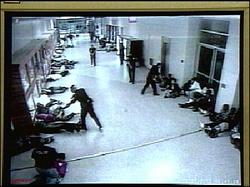
And now class, today’s important lesson:
The state is not your friend.
Any questions?
via Catallarchy.net
This is big. I mean it is really big. It is so big I had to take time from paid work to pass it along.
A small entrepreneurial company, Changing World Technologies, has just extended the Petroleum age to infinity. That’s right. We aren’t going to run out of oil. Ever. To top it off, we won’t be adding more carbon to the atmosphere – we will just be recycling the same carbon stocks over and over again. Even better: we can tell OPEC to go rotate because fuel imports will become a thing of the past.
Does this all seem like fantasy? It did to me when I first heard about it, but the more I read the more convinced I am. The technology takes any carbon based waste, and I do mean any carbon based waste and turns it into high quality oil, water and some minerals at 85% energy efficiency. 15% of the output supplies enough energy to run the process. It’s not hype and vu-graphs either. They’ve got a real pilot plant going up beside the Butterball Turkey plant in Carthage, Missouri. Oil from turkey offal.
They estimate the US could supply all of it’s oil needs from recycling. It’s not a technology likely to get buried either. The large oil companies can phase into the new technology with hardly a dropped dividend.
It is also of interest for the ‘Small is Beautiful’ crowd and those of us in the Space settlement community. The technology scales both up and down. If you live in the middle of the Australian outback, you can chuck your shite and animal carcasses into the hopper on one end… and fill up the old diesel RV from the other fifteen minutes later.
Julian Simon is giggling in his grave.

Carthage, Missouri Commercial Plant at Butterball Turkey factory is operational.
Photo: Changing World Technologies
The economic, strategic, social and libertarian implications of this are huge. I’ve not the time to write down the mass of thoughts whirling around in my head right now, but I am certain I can depend on our literate readership to expand on the possibilities and write them up for me. See you in comments when I’ve some spare time!
One of our readers has pointed out this article about the current status of the venture. The first plant is online and others are now funded and in planning.
In Zimbabwe, things are just getting worse and worse:
An estimated three million Zimbabweans are seeking sanctuary in neighbouring South Africa, while 400,000 have gone to Mozambique. Anything from 10 to 20 per cent of the Zimbabwean population have left their homes to seek job security and wages in neighbouring lands.
Trains, buses and lorries have been used by the South African authorities to deport 498,321 since the crisis began in 2000, according to official figures, although it is believed that only one in six illegal immigrants is caught.
Even desperately poor Mozambique is now attracting Zimbabweans. Thousands have streamed over the mountainous eastern border into Manica province, hoping to be paid in any currency other than the Zimbabwean dollar.
Ironically, many black Zimbabweans are leaving for Mozambique to work on farms being run by the same white farmers kicked off their land by Mr Mugabe.
Zimbabwe may hate the white farmer, but scores have been welcomed into Mozambique by the authorities keen to lure agricultural specialists, especially in the tobacco sector.
Botswana, too, has also been inundated. A rare African economic success story, it is now under threat from hundreds of thousands of illegal immigrants. It is dramatic proof of the regional chaos caused by Mr Mugabe’s chaotic rule.
So is anything being done about this horror story? According to Zimbabwe “Information” Minister Jonathan Moyo, something is being done:
“Britain, America, Australia … and New Zealand are truly and seriously committed to regime change, they seek a regime change in Zimbabwe,” he said.
“They are pursuing it through acts of economic sabotage and they use weapons of mass deception, (under the cover of) instruments of democracy, human rights rule of law, good governance, to sound reasonable,” Moyo said.
“They steal our foreign currency earnings, they attack even our own currency to the point of saying it’s scarce, to blame the government, to seek regime change, and they drive the parallel market,” he told top government, economic and civic officials seeking solutions to the economic malaise.
We can hope, I suppose. But you get the feeling that although lots of people know what’s going on out there, nobody important in the world has this horror story near enough to the top of their to-do list for anything to be done about it at all soon. Only when, having destroyed Zimbabwe itself, the Mugabe regime destroys itself, as it presumably will when there’s nothing else left to destroy, will this horrible chapter in human affairs draw to a close.
The final paragraph of this second story, originally from Agence France-Presse, is a classic of Gallic gallows humour:
The two day conference convened by government and business heard yesterday that Zimbabwe’s economy was being undermined by contradictory and ineffectual government policies, corruption, greed and the country’s negative image abroad.
Yes how true. Government policy isn’t being imposed nearly firmly enough. If government officials were murdering people selflessly and ungreedily, instead of how they’re doing it now, and if Zimbabwe could shed its negative image abroad, all would be well.
What would happen if the Sahara Desert went communist? – For fifty years nothing, then a shortage of sand. Remember that old joke? Well, have a read of this, from the BBC earlier in the week:
Saudi Arabia has reportedly imposed strict border checks to enforce a ban on the export of sand.
There are fears that the growing demands of the construction industry could lead to a shortage in the desert kingdom.
The Arab News newspaper reports that neighbouring Bahrain needs to import large quantities of sand for reclaiming land from the sea.
Demand is also expected to grow as the process of reconstruction in Iraq gathers pace.
Although sand remains plentiful in Saudi Arabia, construction experts say the high costs of bagging and transporting make exploiting it difficult.
Experts have told the newspaper that if a mechanism could be devised to move sand from the vast desert region known as the Empty Quarter, it could be a very profitable proposition.
As the paper points out, there is more sand in the kingdom than oil.
Cement is also in high demand, the report says, with many cement factories having to expand their production capabilities to meet domestic demand.
We speculated here that if the Americans went into Iraq they could then put pressure on Saudi Arabia. Now the American plan is revealing itself. “I know it sounds crazy, but guys, here’s the plan. We’re going to suck all the sand out of the place. We’ll have them over a barrel.”
To be more serious, I guess the thing about about sand, compared to oil, is that sand can’t, unlike oil, be controlled. Oil extraction requires expensive infrastructure manned by a highly skilled workforce. Once it’s out of the ground, it can still then be stolen and smuggled, but until then, it’s the possession of the resident power structure. But sand “extraction”? Anyone can do that.
Like some undead creature from a B-movie, the festering Political Compass refuses to lie down and die.
I have not changed my views of this daft test one jot. Hand me another sharpened stake.
|
Who Are We? The Samizdata people are a bunch of sinister and heavily armed globalist illuminati who seek to infect the entire world with the values of personal liberty and several property. Amongst our many crimes is a sense of humour and the intermittent use of British spelling.
We are also a varied group made up of social individualists, classical liberals, whigs, libertarians, extropians, futurists, ‘Porcupines’, Karl Popper fetishists, recovering neo-conservatives, crazed Ayn Rand worshipers, over-caffeinated Virginia Postrel devotees, witty Frédéric Bastiat wannabes, cypherpunks, minarchists, kritarchists and wild-eyed anarcho-capitalists from Britain, North America, Australia and Europe.
|





Recent Comments