We are developing the social individualist meta-context for the future. From the very serious to the extremely frivolous... lets see what is on the mind of the Samizdata people.
Samizdata, derived from Samizdat /n. - a system of clandestine publication of banned literature in the USSR [Russ.,= self-publishing house]
|
Champagne is a French drink and so it seems only right that the French have a right to find other uses for their bubbly then drinking or exporting it. There is always a possibility of holding a few bottles ransom to make your employer give in to your demands. Striking is so last year, mon cheri.
Angry workers at a French champagne manufacturer are threatening to dump large loads of champagne in a protest over the uncertain future of their firm, Bricout-Delbeck. Noel Sainzelle, a worker from the CGT trade union was heard yesterday:
We’re fed up and we’re determined. If recent mistakes are not corrected, we will destroy some of the stock.
Way to go. That really is going to help the company that employs you.
Reuters reports that staff at Bricout-Delbeck have seized six million to seven million champagne bottles and 800,000 bottles of the firm’s not yet fully manufactured wine stock, estimated to be worth about 200 million pounds. Several dozen workers at the company in the eastern French champagne producing region have already destroyed 300 litres of not fully manufactured stock.
The champagne apocalypse hangs on a court decision on the firm’s future in November. Bricout-Delbeck was purchased by a U.S. group earlier this year for the symbolic sum of one euro, but was declared bankrupt in April. Market leaders Moet-et-Chandon and Vranken-Pommery then launched a new plan for the firm, offering to take on 95 of the 133 employees and some stock and production facilities. The firm’s previous owners have appealed the plan and a court decision is due on November 13. The delay and uncertainty sparking the protest by staff.
I do not have more detail about the ‘Champagne Affair’. I appreciate the distress of the employees over their future and their right to protest. However, ruining the business of the company that they work for strikes me a bit short-sighted and ultimately self-defeating. But who knows, if they fulfill the threat, the vintage may become extraordinarily expensive due to its rarity. Markets work in mysterious ways…

Fresh British data shows corporate Britain suffered a 10-year record level of bankruptcies in the third quarter of this year, as this article explains. However, before assuming the worst, a good question to always ask when reading stories like this is – how many new business starts were there over the same period? And you know what, after a lot of searching around on Google and elsewhere, it is mighty hard to come up with reliable data. (I would be grateful for help thereon).
But it matters in knowing what the figures are. Because, as the American business writer George Gilder noted more than a decade ago in his excellent book, Wealth and Poverty, if a country has a lot of bankruptcies, it does not necessarily mean an economy is in trouble. So long as bankrutpcies do not outstrip new company formation, there is no problem. In fact, having a lot of bankrupticies is, paradoxically at first sight, a healthy sign. It means folk are taking risks, trying ideas. Some of those gambles will go splat. But even then the sounds of firms hitting the ground with a thud generates knowledge for the rest of the economy. Or to borrow from Karl Popper, bankruptcies are like falsifying a theory in science. You still learn from when an idea is challenged and proven not to work.
So, the latest figures maybe cause for concern. What we really need to know is whether, in Blair’s corporatist and ever more highly-taxed Britain, the animal spirits of entrepreneurs are given full rein.
And I can guess what you good readers out there think of that!
It seems likely that we will soon see a resolution of the government’s prosecution of Martha Stewart. Aside from the leaks from the negotiations regarding a possible plea deal, the most reliable of all possible omens has been sighted: Barbara Walters will conduct one of her patented powder-puff interviews with Martha.
From day one, I have been saying, based on my rusty recollections of securities law, that the feds have no case for insider trading against Martha because she is not an insider. I was delighted to read this article confirming my suspicion that the whole Martha Stewart thing has been an abuse of power by headline hungry New York lawyers and DC regulators.

You have regulators continuing to apply a legal theory on insider trading that has been repeatedly rejected by the courts, and which is ungrounded from any public policy other than class envy. You have prosecutors skipping over a whole raft of more culpable people to target Martha because they know they will get better headlines from attacking her.
It is interesting to note that, even under their rejected and discredited overbroad theory of insider trading, the feds were unable to put together a case against Martha, and are not pursuing insider trading charges.
What, then, is Martha being charged with?
The most serious criminal charge against her is not perjury or insider trading but securities fraud, based on the fact that she denied to the press, personally and through her lawyers, that she had engaged in insider trading. This was done, the feds say, not for the purpose of clearing her name, but only to prop up the stock price of her own publicly traded company, Martha Stewart Living Omnimedia. In other words, her crime is claiming to be innocent of a crime with which she was never charged.
The whole disgusting saga reads like a textbook example of abuse of power by regulators and prosecutors.

I doubt the BBC particularly wants my off-the-cuff attempt to pee in their iCan pool and I really look forward to goading Johnathan Miller into setting up an anti-TV licence campaign on iCan. However with the Cambridge Women in Black we see an example of exactly the sort of campaign the BBC had in mind when it set up its strange vaguely bloggish monstrosity. They state:
Cambridge Women in Black are holding silent vigils to protest against the ‘war on terror’. We are women of all ages and from all walks of life who oppose the use of violence. We are wearing black to show that we mourn all victims of terrorism and war.
In March 2003 the UK and US governments again attacked the people of Iraq, who have already suffered extensively from war and more than a decade of devastating sanctions. Cambridge Women in Black are here to show that we believe that more violence will not bring security and peace. We call on our government to stop creating yet more misery and hatred.
Note that the woes of the Iraqi people are not due to decades of Ba’athist mass murder and repression but are from the war and sanctions… sanctions during which large palaces and grandiose mosques were constructed in Iraq. Still, I do not suppose I should hold that against the ‘Cambridge Women in Black’ because after all, they state they are mourning “all victims of terrorism and war”… and never said anything about the victims of national socialist tyranny.
story via The Daily Ablution
The Times reports that plans for compulsory national identity cards were put on ice yesterday when the Government delayed a decision on a mandatory scheme until “later this decade”.
Although David Blunkett got the go-ahead for a draft Bill proposing a voluntary scheme in this year’s Queen’s Speech, it will only give the Government powers to build a database using information from passports, driving licences and residents’ permits.
The decision is a blow for both the Home Secretary and Tony Blair. The Prime Minister has invested considerable political capital in the project, saying that Britain has to have compulsory ID cards in the future.
However, after weeks of fierce negotiations, mostly at John Prescott’s Domestic Affairs Committee, the opposition of Cabinet heavyweights led by Jack Straw and Gordon Brown proved too difficult to overcome and a fudge was agreed.
In an unusual step, the Cabinet issued a statement after its weekly meeting yesterday. “In principle Cabinet believes that a national ID card scheme can bring major benefits,” it said. “In practice, given the size and complexity of the scheme a number of issues will need to be resolved over the years ahead.”
The Government would proceed “by incremental steps”. First there would be legislation to set up a scheme, “but we will reserve the final decision on a move to compulsion until later this decade”.
Oh great, so we have some time to spread the word. I would not shut down your iCan campaign against identity cards just yet, Trevor. There is also Big Blunkett’s ‘voluntary’ database that should cover 80 per cent of the population, five to six years after the programme gets under way. Also, Mr Big Blunkett does not want to let go of his scheme and insists that it is phased in, with passports and other official documents acting as a first wave of the programme.
It is far from over yet.
In the Australian state of New South Wales, which includes the city of Sydney, the number of pub licences is finite, and by all reasonable measures too few. Pub licences in Sydney trade like New York taxi plates, and sell for hundreds of thousands of Australian dollars. Because existing licences are so valuable, pub owners are extremely hostile to any competition that would reduce the value of their licences. Therefore, there is very strong resistance to increasing the number of licences and hence the number of pubs. Also, restaurant liquor licences are highly restrictive. Diners may not buy alcoholic drinks in a restaurant unless they “intend to dine”, and they may not drink alcoholic drinks in a restaurant while standing up. If these restrictions were relaxed, there would be little difference between restaurants and bars and pub licences would lose some of their value. The pub lobby therefore opposes any change, and a succession of state governments have given in and have not changed the law.
Of course, if a pub licence costs several hundred thousand dollars, it is necessary for pubs to make a decent return on this investment, and therefore in Sydney there are essentially no small pubs. Pubs are mostly large and fairly soulless. The sort of small, cosy pubs with character that are everywhere in England are mostly absent. And this is a shame.
As it happens, I was today in Canberra, Australia’s capital city. Although the city is entirely surrounded by the state of New South Wales, it has a similar status to Washington D.C. The city sits in a jurisdiction called the Australian Capital Territory (ACT), which is not part of any state but which constitutionally speaking is entirely the responsibility of the federal government. (An ACT government does exist, with powers somewhere in between those of a city government and a state government, but it does so entirely at the pleasure of the federal government).
One thankful consequence of this is that the liquor and pub licensing laws of the state of New South Wales do not apply in Canberra. In Canberra it is not necessary to pay hundreds of thousands of dollars for a pub licence, and small pubs are possible. As it happened, I met up with a friend. Knowing my fondness for good beer, the friend took me to a nice cozy little brew pub, that served seven or eight different beers brewed on the premises. There was a hefe-weizenbier (not as good as what I would drink in Germany, but still quite good), a Kölsch style lager, three or four English style cask conditioned ales, and more. It was possible to brew all these beers and sell them on cozy little premises that catered to a clientele that liked that sort of thing. It was nice.
But in Sydney such a thing cannot easily exist. And it is all to protect rent seeking vested interests. Sydney has a huge number of restaurants serving excellent food of every kind imaginable, and is one of the finest cities in the world in which to eat. But as a place to go out for a drink, it leaves something to be desired. Canberra does not have this problem. (To be fair, Melbourne does not have this problem either). And this is entirely due to the difference in regulation.
The ‘fraudster’ meaning, of course, Jacques Chirac. The new president of the European Central Bank is M. Jean-Claude Trichet and buried away at the foot of an old news report is this gem:
Mr Trichet’s nomination was made possible earlier this week when he was cleared of involvement in the Credit Lyonnais banking scandal in the 1990s. He was one of nine men on trial for their part in the affair, which culminated in a €31bn ($33.7bn) bailout by the government.
That is more than £21,000,000,000! For one bank. Nine people. I can just hear them: “Bah! Nick Leeson! “Betsygate” indeed! You English drive your minis with your Benny Hill and your Michael Caine, stealing a few gold bars in Milan and think you’re so marvellous! Hah!”
The Crédit Lyonnais bank ‘affair’ included a massive fraud including loans being made to friends of the late president François Mitterand. At least one of them got a few months in jail to my knowledge. A concerted effort was made to delay the appointment of a new ECB president until M. Trichet’s problems could be dealt with. Ironically, the French verb for to cheat is tricher which is pronounced exactly the same as our new Euro bank president’s name. A very suitable friend for M. Jacques Chirac. The president whose unofficial re-election campaign slogan was Vote for the fraudster, not the fascist! but who has avoided judicial processes by virtue of presidential immunity from prosecution. So much in common for them to talk about.
Now let us assume that M. Trichet were the innocent victim of devious bank subordinates who stole £21,000 million. Personally, I find such a degree of stupidity fantastic: the guy could scarcely have enough brain cells to know how to breathe. Is this really the calibre of executive to put in charge of an EU institution?
A couple of other things worry me. What did the other European leaders think they were doing when none of then vetoed the appointment of Trichet? Perhaps Mr Blair really is a closet hater of the euro – I hope so. And if the currency markets are not dumping euros for US dollars before M. Chirac’s friends get their pillaging underway… what do they know about what the Federal Reserve guys are up to?
I do believe that Tom Watson was the first serving Member of Parliament to set up a blog. If that is the case then he deserves to be congratulated for his initiative and originality.
However, his latest project, of which he appears most proud, is rather less praiseworthy for it appears that Mr.Watson has been instrumental in passing new laws on the sale and use of fireworks:
West Bromwich East MP Tom Watson, who helped push the new law through the House of Commons, said today: “While these new powers will not be in force for this year’s fireworks season, I’m delighted and also relieved that the Government is so determined to come down hard on the misuse of fireworks.
My worry when the Fireworks Act became law was that it could take years for the Government to put the powers into practice. The fact that the zero tolerance approach will come into force as early as next month is a great victory for the thousands of people in Sandwell who have sent in letters and signed petitions calling for a crackdown.
They are sick and tired of the misery and disturbance caused by fireworks going off late at night in the early hours. They are sick and tired of fireworks being used as toys and even weapons by teenagers. And they are sick and tired of fireworks so loud that their neighbourhood often resembles a warzone.
The time has come for this to stop. We will now have the powers to deal with the problem and I hope that the police and local authorities will make full use of them.”
As best as I can tell, the thrust of the new regulations is to prohibit sales of fireworks to people under the age of 18 and to make it a criminal offence to set off fireworks late at night. On the face of it, they are not wildly unreasonable measures. There are already all manner of restrictions on the retail capacity of minors and setting off fireworks in the wee small hours is a genuine nuisance for people who are trying to get a decent night’s sleep.
But the question here is not so much ‘what’ as ‘why’? → Continue reading: A damp squib
Courtesy of COMUSNAVEUR Security Staff, via my sources I received the following warning:
You are advised that hotel room keys that look like a credit card will contain personal information, including:
- Customers (your) name
- Customers partial home address
- Hotel room number
- Check in date and check out date
- Customers (your) credit card number and expiration date.
- In Europe, passport numbers are also frequently recorded onto the cards.
When you turn them in to the front desk your personal information is there for any employee to access by simply scanning the card in the hotel scanner. An employee can take a handfull of cards home and using a readily available scanning device, access the information onto a laptop computer and go shopping at your expense. Simply put, hotels do not erase these cards until an employee issues the card to the next hotel guest. It is usually kept in a drawer at the front desk with YOUR INFORMATION ON IT!
You should always destroy the card. NEVER leave it behind in the room and NEVER turn them in to the front desk when you check out of a room. The hotel will not charge you for the card.
I suspect the constant trench warfare in American politics over abortion is somewhat mystifying to our overseas observers, and I think abortion poses some real philosophical problems for libertarians stemming from the unanswerable question of when a “fetus” becomes a “person.” Those issues aside, this David Frum blog entry is full of wisdom, not only on abortion, but on the dangers of ideological absolutism in matters political and social.
Now let me say right off: I am not pro-life. I think abortion ought to be legal for the first 12 weeks of a pregnancy and available to protect the health of the mother during the weeks thereafter. I don’t see this as a matter of fundamental human rights, so much as one of accommodating reality. I can’t defend Roe v. Wade as a legal decision, and I would be very glad to see abortion become much more rare than it now, but if the law attempts to suppress abortion entirely, it is the law that will fail, rather than abortion that will disappear. Please don’t email me about this: I have thought about this issue just as hard as you have, and I’m not going to change my mind.
But precisely because I believe in accommodating the realities of abortion, I think those on the pro-abortion side need to acknowledge that the no-concessions approach of the organized abortion lobby is catastrophically mistaken. Abortion rights would be much more secure if they were confined within reasonable limits that squared better with the conscience of the nation.
→ Continue reading: Accommodating reality
For those who missed it, Instapundit is having a go at the Chinese authorities and…Walmart. November 7th is the anniversary of arrest of Liu Di by plain-clothes police. No charges have been made and she has not been heard of for the past year. Petitions have been started, in China, with people putting their real names to them and being arrested for that themselves. This is the story:
Until the authorities tracked her down a year ago Friday, she (Liu Di) was one of the most famous Internet web masters in China. A third-year psychology student at Beijing Normal University, Ms. Liu formed an artists club, wrote absurdist essays in the style of dissident Eastern-bloc writers of the 1970s, and ran a popular web-posting site. Admirers cite her originality and humor: In one essay Liu ironically suggests all club members go to the streets to sell Marxist literature and preach Lenin’s theory, like “real Communists.” In another, she suggests everyone tell no lies for 24 hours. In a series of “confessions” she says that China’s repressive national-security laws are not good for the security of the nation.
But since Nov. 7, 2002, when plain-clothes police made a secret arrest, Liu has not been heard from. No charges have been filed; her family and friends may not visit her, sources say; and, in a well-known silencing tactic, authorities warn that it will not go well for her if foreign media are informed of her case.
It is largely the attention of the Western media and public that keeps dissidents afloat and their oppressor in some sort of check. Those who are visible beyond the barrier erected between the oppressed and the outside world tend to fare marginally better. At least they get publicity for their sacrifice and if the campaigning on their behalf is persistent enough, they may even get out of whatever hell-hole communist officials put them in. The thousands (in China probably an order of magnitude larger) ‘small’ human tragedies go unnoticed just as they did in communist Russia and Eastern Europe.
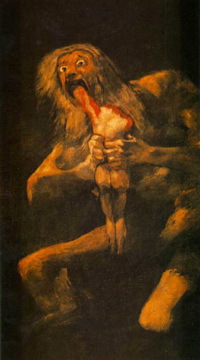
Looking back at the Cold War days it seems incomprehensible that such horrors could be tolerated next door to Western civilisation and capitalist liberal democracies. Marxism and communism – top candidates for the most barbaric and inhuman ideologies – have absolutely no redeeming features, whether in practise or in theory. Not only they create a living hell for ‘ordinary people’ but they bring destruction to those who perpetrate it. Communism, time and again, produces monstrous regimes that like Saturn devour their own offspring.
And for those who believe that letting China ‘evolve’ out of its totalitarianism is the best way forward, this conclusion is not an optimistic one.
…the Chinese security and police are regularly told to crack down. There may be exceptions, as when the daughter or son of a high party member or rich family gets in trouble; or when there are excesses of youth.
But these are exceptions. The rest – labor activists, upstart college students, journalists, writers, intellectuals, professors, dissidents, religious believers with too much spunk, those who stand out in a too-public fashion or attract too much attention – are warned, or arrested. In this reading of China, free expression is not improving in the short- and midterm.
Despite some changes of style, more arrests are taking place, and ordinary Chinese are still strictly censoring themselves.
It is the pressure from the outside that can have the greatest impact on what happens in totalitarian regimes. Glenn Reynolds thinks that challenging Walmart is a way to increase it. Well, that’s good enough for me.
1. noun. A blog (depreciated).
2. noun. A hybrid blog/website, featuring website features such as a conventional on-line company brochure (for example) but also incorporating a blog in a sidebar as a supporting feature on the same page.
(coined in this context (usage 2) by Adriana Cronin)
|
Who Are We? The Samizdata people are a bunch of sinister and heavily armed globalist illuminati who seek to infect the entire world with the values of personal liberty and several property. Amongst our many crimes is a sense of humour and the intermittent use of British spelling.
We are also a varied group made up of social individualists, classical liberals, whigs, libertarians, extropians, futurists, ‘Porcupines’, Karl Popper fetishists, recovering neo-conservatives, crazed Ayn Rand worshipers, over-caffeinated Virginia Postrel devotees, witty Frédéric Bastiat wannabes, cypherpunks, minarchists, kritarchists and wild-eyed anarcho-capitalists from Britain, North America, Australia and Europe.
|





Recent Comments