We are developing the social individualist meta-context for the future. From the very serious to the extremely frivolous... lets see what is on the mind of the Samizdata people.
Samizdata, derived from Samizdat /n. - a system of clandestine publication of banned literature in the USSR [Russ.,= self-publishing house]
|
India has closed the deal for the purchase of the ‘Admiral Gorschkov’, a Cold War era Russian aircraft carrier. It is expected this ship will come into service with the Indian Navy around 2008, just in time for the retirement of the INS Viraat, their current aircraft carrier.
It is quite interesting that there is a continuing armaments relationship between the Russians and India, despite the seismic geopolitical changes of the last decade. An untutored alien landing for the first time on Earth would make no sense of it. The roles of the US and the USSR in that region should be reversed, Russia should be partnered with the alternating military dictatorship and semi-democratic kleptocracies of Pakistan and the US with India, the oldest liberal democratic state in Asia.
Relations between nations have layers within layers and oft-times deep and conflicting historical roots, I am aware of some of the public history of the region, but cannot help wondering if there is a bit more to it, an unspoken geopolitical undertext.
India has centuries of liberal European traditions behind it. It is also not likely to change very much even under severe pressure. Generations would come and go before the paperwork for change was properly submitted, checked, authorized and filed. In a Cold War world the risk of India actually going Red was rather slim and thus of less worry than perennially unstable Pakistan.
Pakistan borders China and is within spitting distance of Russia across a ultra thin panhandle of Afghanistan. The region is wild and uncontrolled and right in the hotspot is the contested Kashmir Province. Given the location and the consistant interest in access to the oil and southern oceans shown from Tsarist through Soviet days, Northern Pakistan was absolutely ripe for fun and games with the KGB. It seems obvious checkmating this move was of far more Realpolitik value than telling the Indians how much we admired their history.
With the end of the Evil Empire, much of Geopolitics changed, but the full extent of the re-alignment of interests in this part of the world did not really click into place until September 11th, 2001. Islamic fundamentalists were already a clear and present danger to the Russians. Nutcases don’t even have to board an airliner to get to Moscow. They can drive there. After 9/11 they were also top priority to the US.
Over the last century or so, the Russians have ticked off a lot of people on their borders and they know it. They’ve done a far better job at this than the US… so it is somewhat in their interest for the US to take the brunt of whatever direct ire is caused by sorting out the problems. Otherwise they would have to deal with it, and given their level of success in Afghanistan and Chechnya, I would not have much hope for solutions from that direction.
From the Russian viewpoint, it is ideal if the US stabilizes Pakistan and acts as the lightning rod for fundamentalist ire; meanwhile they help arm India so that in the worst case, a fundamentalist takeover of Pakistan, India can keep Pakistan occupied and looking away from Russian territory.
The Russians see the regional problems up front and personal; they are damned pretty much whatever they do and aren’t very good at building stable liberal democracies. They haven’t even worked the bugs out of their own yet. The US is somewhat less at risk from the downsides of action in the region since it is far, far away and bordered by oceans and democracies. Not that such is a total protection. It just means the crazies have to expend more energy and more resources to carry out their attacks. To put it bluntly, the US stands to lose a smaller number of cities to the fundies than would Russia.
So there is method to this madness. You just have to sit a moment in everyone’s chair and ask ‘what’s in it for me?’
The Director-General of the BBC, Greg Dyke, has now resigned.
Mr Dyke’s decision to step down came 20 hours after BBC Chairman Gavyn Davies resigned following the Hutton Report.
An emotional Mr Dyke told BBC staff at their central London headquarters: “I don’t want to go. But if in the end you screw up you have to go.”
What with Gavyn Davies gone and now Mr Dyke, the corporation will hopefully be a bit less ‘hideously white’.
…is that so many people are astonished that a paragon of the establishment like Lord Hutton should take the view that whatever the government’s ministers say should be presumed to be correct whilst that of mere journalists, even those working for the state owned media, should be assumed to be dissembling.
Did anyone seriously think the outcome would be otherwise?
I realise this is The Story Of The Moment, but simply cannot get that worked up over the difficulties of institutions of which I have such low regard to begin with.
“God made the 20th Century to teach us that the notion that things work better when experts plan them is a fallacy. It’s a pity that a hundred-million or so had to die to illustrate the lesson. But now we got it. Right?”
– John Weidner
Glenn Reynolds has an article on the rapidly escalating Nano-War of Words. The technological possibilities outlined 25 years ago by Dr. Eric Drexler have the poor spin doctors (like Mr. Modzelewski) and a number of other Johnny-come-lately’s in the science world all bent out of shape.
It is, after all, not Dr Drexler’s fault lesser minds are jealous he got there first and rightfully will have his name in the history books as the Father of Nanotechnology. Whether he is correct in detail or not is irrelevant. The fact his detractors will not even debate him without veering off into ad-hominem attacks rather than meet him fairly on the field of equations shows the serious weakness of their position.
I will make no absolute claim that a Drexler Assember/Disassembler is buildable. Neither will I accept claims backed up by bluster and lack of experiment that such is impossible.
And yes, I do know Eric. Quite well in fact.
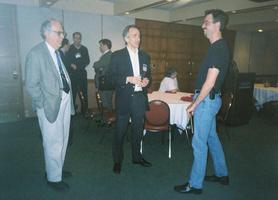 Dr. Eric Drexler (center) with Dr. Peter Vijk (left) at
the May 2003 National Space Society conference in San Jose, California
Photo: Copyright Dale M. Amon, all rights reserved
Brian reminds us that if Dr Kelly’s death was embarrassing for the BBC and the British government, the capture alive of Saddam Hussein is potentially very embarrssing for the French President Jacques ‘the Crook’ Chirac.
Following his story, I decided to check out TF1, the major TV channel, to see what coverage – if any – there was about the Bagdad story. It certainly is not front page news in Paris.
For good reason…
One of the leading stories in France today is the report of an investigative judge into the sale of frigates by what was then Thomson-CSF to Taiwan in 1991. Under the ethical trade (!) clauses in this 14 billion French Franc contract (about 1.9 billion US dollars), if it were proved that bribes had been paid, the guilty party would have to pay damages of up to 600 million US dollars.
The government at the time was the Socialist Party and the prime minister would probably have been Pierre Bérégovoy, who committed suicide by firing an indeterminate number of bullets into the wrong side of his head shortly before being called to appear in court on charges of channelling public funds into the bank accounts of most of his Socialist buddies, or arch-crook Edith Cresson, she of the dentist-gigolo hired at the European Commission who called English MPs a bunch of public-school homosexuals. I forget which.
Naturally the damages will all be paid by the French government, i.e. the taxpayers. The notion that the political party or the politician that stole the money should be held somehow responsible? Where would it end…
“Corruption scandal? Which corruption scandal?”
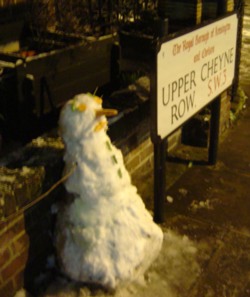
I took this photograph of a street in North London earlier this evening (with a camera-phone, hence the poor resolution).
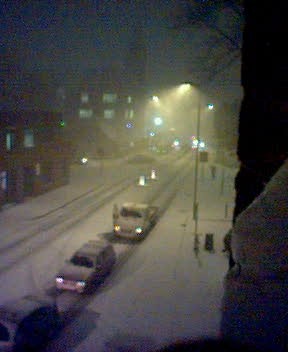
The snow that the weather forecasters have been threatening us with for the past week or so has finally swooped down with a vengeance (well, by London standards anyway).
But as I gazed out of window at the swirling storm, I was struck by an interesting idea. You see, due to my meticulous and detailed observations over many years, I have concluded that snow seems to occur during periods of very cold weather. And, by coincidence, these periods of very cold weather are also marked by a dramatic decline in the number of lurid ‘global warming’ stories appearing in the British press.
Conversely, during periods of very hot weather said ‘global warming’ stories make a sudden and almost miraculous re-appearance.
Are these two phenomena linked in some way? Is this a clue to the existence of as yet unseen and mysterious forces that science has, hitherto, been wholly unaware of? I shall continue with my research in the hope that more will be revealed.
Sitting in London and watching the New Hampshire primary is a strange experience. The ‘Republicrats’ have a disgraceful advantage built into the US election process with different laws applying to their candidates than for those of other parties.
For British readers it is as though the Liberal Democrats had to get up to three or four million signatures on a petition to be allowed to appear on the ballot paper, as opposed to the £150 fee and a copy of the party’s constitution to the Electoral Commission and 6,590 voters to sign nomination papers for the whole country.
The good bit about primaries, which have no equivalent in the UK, is that the remote suited class gets a sustained exposure to public opinion, before the voters have to choose which licensed thief to put in charge. In Britain, all the Democrat nominees would be elected to Parliament, however extreme or daft their ideas, because of the way that candidates are appointed. Those that failed to win an election would stand a good chance of being appointed to the House of Lords for life or made the director of some welfare agency. → Continue reading: Primary colours
In a Reuters interview (not available yet on the Web) with Luigi Spaventa, the former head of the Italian stock market watchdog, Consob, he says stock markets should refuse to list firms such as stricken food group Parmalat whose ownership structure spreads into murky offshore centres, such as the Cayman Islands.
If a stock market is allowed to run its own affairs, then of course there is nothing wrong in it banning a would-be listed firm on the grounds of its ownership structure. But it is surely a different matter when it comes to a government regulator telling investors that a firm is so dodgy that they cannot put their own wealth into it via an exchange. Surely caveat emptor (“let the buyer beware”) applies here.
In any event, I wonder if crossed the mind of this old regulator that one key reason why so many firms domicile their business affairs in offshore centres is to avoid the crushing taxes imposed by European nation states?
I think Samizdata’s readership is ahead of me already on that one.
No… not some tedious article about race…
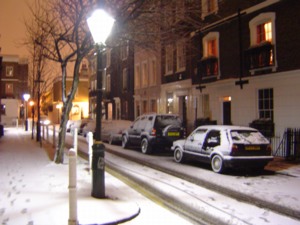
Perhaps the reason I find snow in London so fascinating is that it is both uncommon, little more than a dusting and very picturesque. I do not recall finding it so interesting when I lived in the United States, but that might have been because when it snowed, verily the skies opened and it tended to be a significant inconvenience! That said, New Jersey copes better with 3 feet of snow that London does with 3 inches 
Paul Smith is a man with a profound interest in driving and road safety. As a driver myself I, too, have a vested interest in these matters. Whenever I depart from point A I much prefer it to be overwhelmingly probable that I will reach point B with all my favourite limbs and organs in situ and functioning as nature intended.
The British government and its various agencies claim that they share this interest as well. Moreover, they assure us that the solution to the problem lies with forcing everyone to drive more slowly and punish those drivers who fail to comply. Hence the virus-like proliferation of the ‘GATSO’ or ‘Speed Camera’ which (just by complete coincidence I am sure) has also raised tens of millions of pounds for the public coffers from already over-taxed motorists who infringe blanket and arbitrary speed limits.
In response to the wave of discontent this has caused, the government, the police and the various lobbyists that support them, have doggedly stood their ground and explained that, yes, it is all very regrettable but the point of the GATSO’s is most assuredly not to raise revenue (no, perish the thought!) but merely to save lives. In other words, they are relying on the canard that freedom must be sacrificed in order to achieve safety.
Well, they are wrong and Paul Smith has made it his business to prove, publicly and beyond argument, that they are wrong. His website, Safe Speed, cuts a swathe through the cant and the piety:
We have never seen any credible figures that put road accidents caused by exceeding a speed limit at even 5% of road accidents. We object to speed cameras mainly because they fail to address the causes of at least 95% of road accidents. The Government claims of 1/3rd of accidents being caused by excessive speed are no more than lies according to the Government’s own figures.
I am shocked, SHOCKED I tell you!
Mr Smith has amassed a treasure trove of documentary, audio and video evidence that entirely discredits the myth that Tax Speed Cameras are anything whatsoever to do with either road safety or saving lives. In fact, so confident is Mr Smith in his own research that he throws down this gauntlet:
So here’s the challenge. We promise to publish here (in this box, on the first page of the web site) web links to any serious credible research that implies a strong link between excessive speeds and accidents on UK roads.
So if you are one of those people who thinks that the GATSO is a life-saver, you know exactly what to do.
In the meantime, more power to Paul Smith and his campaign for common sense and reason. When we eventually win this battle, the victory will be due in no small part to the dedication and integrity of people like him.
Cross-posted from Samizdata.net.
I am just watching the evening news that reverberates with the release of the Hutton report . It exonerates the government of lying about their 45-minute claim and pretty much damns the BBC.
- Editorial system at BBC was defective in allowing Mr Gilligan’s report to go to air without editors seeing a script
- BBC management failed to make an examination of Mr Gilligan’s notes of the interview with Dr Kelly
- There was a defect in the BBC’s management system relating to the way complaints were investigated
- BBC governors failed to investigate Mr Gilligan’s actions properly
Channel 4 were gloating relishing that the BBC is in “disarray”, “deep crisis” and words to that effect. They read extracts from the letter by the BBC Chairman who acknowledged that the trust the viewers had in the BBC had been undermined. I’d say! And add that it is not due to the Hutton report but by institutionally engrained bias and arrogance that one comes to expect from public institutions with no accountability. The BBC governors are admitting that the ‘procedure failed’ and are considering resigning en masse. Oh, the Chairman has already resigned. I think we will get over it.
Now Andrew Neil a BBC presenter, is complaining that Lord Hutton is an anti-journalist judge. Oh yes, the BBC never errs. And the government is not right either – look they still haven’t found any WMD!!!! The report favour the establisment, he keeps mumbling. I expect any minute they are going to lead him out to meet nice men with a lovely long-sleeved jacket.
The political impact of publicly unveiling just how political and biased the BBC is will be considerable. I am not sure that the result will be to our liking. The government is not going to disband the BBC but will call for a full-scale regulation and the license fee will become an even less conspicous form of taxation.
Update: This is such major news that I have been wondering whether any other news have been ‘buried’ today. I think I found it.
|
Who Are We? The Samizdata people are a bunch of sinister and heavily armed globalist illuminati who seek to infect the entire world with the values of personal liberty and several property. Amongst our many crimes is a sense of humour and the intermittent use of British spelling.
We are also a varied group made up of social individualists, classical liberals, whigs, libertarians, extropians, futurists, ‘Porcupines’, Karl Popper fetishists, recovering neo-conservatives, crazed Ayn Rand worshipers, over-caffeinated Virginia Postrel devotees, witty Frédéric Bastiat wannabes, cypherpunks, minarchists, kritarchists and wild-eyed anarcho-capitalists from Britain, North America, Australia and Europe.
|






Recent Comments