All the ‘idiotarians‘, Left and Right, both subscribe to the same fallacy: violence is the greatest evil, the state has a monopoly of violence, the USA is the most powerful state, therefore the USA is the home of evil, and all evil events have their roots in USA policy. The idiotarians stand to the responsible anti-statists (such as our host) as the Ku Klux Klan stood to the sensible American patriots. They are what happens when a principled objection to force hardens into a reflexive aversion. They end up condoning the worst crimes a state can commit, provided the state in question is not their own, and if the alternative is inflicting violence themselves.
– Michael Brazier, in a comment on a post at Armed and Dangerous
|
|||||
|
February 2nd, 2004 | 14 comments - (Comments are closed)
 Let me first of all state my basic position. I love America. There, I have said it. But I think there is a problem. I think the citizens of the United States are deluding themselves that they live in the ‘Land of the Free’. As I write this, in the downtown financial district of Boston Massachusetts, I am a hundred and fifty yards from the site of the historic Boston Tea Party, right here on the harbour lip of Fort Point Channel. In my opinion this site rates as one of the most significant places on Earth, third in my list of inspirational locations which I have personally visited, right behind Avebury and Stonehenge, and even creeping ahead of the Great Pyramid of Khufu. Yes, I am one of those obsessive libertarians. I really am that sad. Because in the future, when all of the current omnipotent state machines of the world have shrunk to nothing, this site in Boston harbour will be hailed as the Mohawk-dressed pinprick which first burst their bubble, the very point in space and time where the idea of the necessity of the state first started to die. 
Birthplace of a libertarian revolution But I fear we have a long road to travel before we reach that heady day, when the final Byzantine Emperor of the state is killed defending its walls of mediocrity, defending its rights to general taxation, and defending its monopoly provision of both justice and security. Because what I discovered, in Boston, admittedly in a state which ought to be renamed Taxachusetts, was a shock. → Continue reading: Letter from America – Land of the Free? February 2nd, 2004 | 28 comments - (Comments are closed)
Small Earthquake in Chile: Allende’s South America This paperback edition, published 1990, seems now to have been remaindered. It is very necessary to run through the history of this book. It was first published “towards the close of 1972” (p. 344), as “Allende stumbled from crisis to crisis, walking close to illegality”. What happened after that is given in a final chapter “The Deluge … and After”, pages 345 to 384, added in 1989. It is a little difficult to assemble all the events of the book into a context so hazy in my memory, to say nothing of remembering the situation in a number of South American countries as it was 31 years ago, with a last chapter added 14 years ago. Although the book is mainly about Chile, as the title implies, there are substantial chapters on Colombia and Bolivia, Peru is more than mentioned in passing and there is something about Ecuador. This leaves Brazil, Argentina, Uruguay, Paraguay and Venezuela unvisited and undiscussed. A feature of the 1970s, much less one of today’s, is the emphasis throughout the book on the population explosion. It is interesting to find that Horne’s only mildly exasperating companion and one of the book’s dedicatees, was Bill Buckley then-editor (I think) and certainly founder of National Review; his right-wing conservative views don’t greatly intrude. The other dedicatee is the charming, ever-helpful Nena, clever enough to become Director of Chile’s National Art Gallery just before the coup, and still be there at the end of the book (p. 346). What is important about Chile (and here everyone seems to agree) is that it was politically the most stable and perhaps the most prosperous South American state, not without its poverty-stricken peasants (like everywhere else) and marginalised Indians (like everywhere else bar Argentina, where they’d largely been exterminated), but with a functioning democracy, regular free elections (though only those literate could vote – not a bad idea), an enlarging middle class and a free, diversified press with a relatively large circulation. Perhaps its most unusual feature, for a Latin American country, was the fact that the armed forces (of which the army had the least chic) did not interfere in politics. Under these circumstances, what could seem more reasonable than a spot of land reform? Unfortunately, the person who took this on was Allende. Like most revolutionaries (though a fairly conventional politician originally and minister of health in 1940) he came from the middle class, a fact which still seemed to surprise his egregious friend and confidant, the nut-case intellectual Regis Debray, ex-friend of the defunct martyr Che Guevara, to whom he’d given just as bad advice. Allende’s rhetoric and nationalisation plans scared the middle classes, who left the country in droves. He intended to carry out most of his program within the country’s legal framework, which seems to have been sufficiently elastic to enable him to do so. However he, and apparently everyone else, expected this to provoke a clumsy attempted right wing coup, which he could then crush with “revolutionary violence” (p. 149). As for his democratic credentials, it is worth pointing out that he won the presidential election in a three-cornered contest with only a slender majority over the second of two other candidates to the right (36% to 35%), a situation reflected in the composition of the Legislature. Yet the impression given is that he was an improvisatory bourgeois amateur; such was David Holden’s estimate, which I must have read in Encounter in January 1974, an actor in love with a revolutionary part, rather than a serious leader who knew where he was going” (p. 357). → Continue reading: The Chilean disaster February 2nd, 2004 | 11 comments - (Comments are closed)
College student Lara Hayhurst was not prepared to let officials treat her little pet like Osama ‘fin’ Laden… Forgive the pun but the story is quite funny, well, mainly because she got away with it. February 2nd, 2004 | Comments are closed
Such are the huge disparities in economic, technological and military power and the prevailing trends that the ambition to create a unitary European state as a countervailing force to the United States is doomed, but its pursuit continues to the detriment of the economic and security interests of both North Americans and Europeans. Nevertheless, having endorsed the project for half a century, many Americans seem reluctant to withdraw their support. Some evidently believe that while their original expectations have been disappointed, the process of European integration is so well established that any reappraisal of US policy towards the EU would produce more problems than it would solve. That approach fails to take into account both the influence that the US could still bring to bear and the fragility of the political project now approaching fruition. In our view, the attempt to bring about ‘ever closer union’ will ultimately have to be abandoned, either as the mounting economic and political price of integration becomes more widely grasped, or because Europe’s supra-national institutions break down. Rather than wait for either to happen, the interests of the US would better served by a policy which sought to strengthen the position of those within Europe who recognise that the continent is proceeding down an historic blind-alley and wish to pursue other possibilities. It is surely time that American policymakers were more candid about the inevitable implications of particular EU measures. → Continue reading: Friend or Foe? What Americans should know about the European Union February 2nd, 2004 | 9 comments - (Comments are closed)
Salam Pax, who I have always rather enjoyed reading, has some quite interesting observations on how listening to American Armed Forces radio in Iraq strikes him. Having listened to American Armed Forces radio when I was in the Balkans, it does make me smirk in that kind of “I hear you, Bro…” sort of way. For me this sort of thing is what makes blogs so compelling… insights on how things effect people that no amount of watching CNN will give you. February 2nd, 2004 | Comments are closed
Yes, you read it correctly. Congressional leaders have met and shaken the hands of the very people who imprisoned American Embassy staff in 1979-80. I am sure you remember the evening news from that time: Day 120: America Held Hostage or the like, each day for the better part of a year. According to SMCCDI, an Iranian student group, Iranian Foreign Minister Kamal Kharrazi met with Sen. Joseph R. Biden Jr. (D-DE) and Mr. Mohammed Javad Zarif met with Rep. Robert W. Ney (R-OH) and Sen. Arlen Specter (R-PA) and others. SMCCDI claims these two men were among the students who took the entire US Embassy staff hostage. I hope you find it as appalling as I do. The only reason we should want to meet with these people is to hear a public apology. Afterwards we might consider talking to them… about a transition from Mullahcracy to Democracy. February 2nd, 2004 | 13 comments - (Comments are closed)
The BBC reports that Big Blunkett is proposing to introduce yet more draconian powers to lock up suspected terrorists without a fair trial. The new proposals are an extension of the current anti-terrorism laws rushed into being after September 11th. Those have already been condemned as creating “Guantanamo Bay in our own back yard”. The new proposals would see British citizens tried partly in secret and denied access to the evidence against them. They would also reduce the burden of proof from “beyond reasonable doubt” to “on the balance of probabilities”. Speaking on the Today programme, Senior lawyer Baroness Kennedy described the proposals as “a disgrace”. She went on to say:
Cross-posted from The Chestnut Tree Cafe February 2nd, 2004 | 11 comments - (Comments are closed)
This post is not going to be about “NASA screwed up, how come after 40 years we still have a space ‘program’ and not a space industry, NASA is drifting off focus and no longer has a clearly defined mission, etc.” I will leave it to someone else to write that column, because Rand Simberg (or our own Dale Amon) could do it a lot better than I could anyway. What I do want to talk about is: how the way information is organized and presented can make a difference in how it is received – and how bureaucracy can sometimes stand in the way of effective data organization and promote cluttered thinking. When we lost the Challenger in ’86, it should have been clear that it was unsafe to launch the shuttle on that cold January morning. NASA had plenty of data to suggest that it was not prudent to launch that day – the problem is that the data was not refined into a conclusive answer, but rather was shrouded by poor communication and bureaucratic ass-covering. Edward Tufte, professor emeritus at Yale and author of several brilliant texts on graphic design and the visual display of quantitative data, has made the Challenger accident a centerpiece of his traveling seminar. His exegesis of the Challenger disaster is available in his book Visual Explanations (Graphics Press, 2001). In hindsight, it was quickly determined what caused the Challenger to fail: the poor cold-weather performance of the rubber O-rings in the field joints that held sections of the solid rocket boosters together. In a memorable session of the Rogers Commission (the group that investigated the Challenger disaster) the late Richard Feynman, Nobel Prize-winning physicist, conducted a dramatic experiment. He affixed a C-clamp to a sample of O-ring material, dropped it into his glass of ice water, and then removed the clamp, revealing that the O-ring rubber lacked resiliency when cooled to 32 degrees Fahrenheit. (See photo below.) → Continue reading: Reflections on NASA’s grim anniversaries February 2nd, 2004 | 7 comments - (Comments are closed)
Michael Jennings has a fascinating posting up at his own blog about the introduction of colour photography, the point being that it was very gradual.
Michael goes on to say that perhaps the decisive moment in this story, if there was such a thing, was when colour television arrived on the scene in the nineteen sixties. That was when black and white rather suddenly came to seem old fashioned. That was when they stopped making black and white movies, even though they had been making some movies in colour for about a quarter of a century. But the titbit that got my attention was that bit about colour photographs taken in Russia over a hundred years ago, despite them not knowing how to print them on paper. Michael says he could not find any of these photos online. Can anyone in our ultra-knowledgeable commentariat do better than that? It would be fascinating to see such photographs, if they are anywhere to be seen. February 2nd, 2004 | 11 comments - (Comments are closed)
On this day one year ago, the crew of the shuttle Columbia died when their spaceship broke up during re-entry.
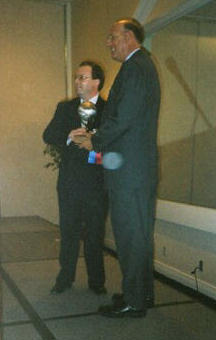
Barry McCool, father of Columbia Astronaut Willy McCool, February 1st, 2004 | Comments are closed
RyanAir has just lost a legal dispute with Bob Ross, a customer of the airline who suffers from cerebral palsy, due to the fact the airline did not supply him with a wheelchair for use within the airport at RyanAir’s own expense. The low cost air carrier was ordered to stop charging disabled passengers £18 ($33) for the use of wheelchairs the airline provided at Stansted airport as this was deemed to be in violation of the Disability Discrimination Act.
So what we are being told here is that because the unfortunate Mr. Ross has a terrible affliction, he can forcibly impose his costs on others who do not wish to bear them. In a civilized society, a civil society, people should feel that it is right and appropriate to assist those who are disabled. Enlightened businesses should seeks to cater to those with special mobility or other needs and it is right that social opprobrium be heaped on those who decline to do so. Yet Mr. Ross did not seek social opprobrium for RyanAir but rather the forcible appropriation of its resources. Yet why does a disability give anyone, no matter what unfair cards fate has dealt them, even a terrible affliction such as cerebral palsy, the right to legitimately help themselves to other people’s money by force? Whilst I think RyanAir’s policy of applying these charges was perhaps unenlightened (and certainly bad P.R.) to ‘quibble’ over the costs of a wheelchair, I fail to see by what right Mr. Ross is owed by force backed obligation a special charge on the resources of a company he elects to do business with. As the regulatory state, and those who make their living from it, work to replace more and more social exchange between people with mandated politically derived behavioural formulae, less and less people (and the companies run by people) will seek to do ‘the right thing’ from any sense what is reasonable and decent, and instead will merely do what is mandated by political processes. When people like George Monbiot and Peter Hain describe their visions of a total political ‘society’ (which is to say the replacement of social interaction by political interaction… the replacement of society with state), Mr. Ross is an exemplary product of that world view. Of course to some it would seem any criticism of a wheelchair bound person suffering with cerebral palsy is beyond the pale. But I prefer to think of Mr. Ross as a human with the same rights as myself, but not more just because he has less mobility. Yet it seems this man has not just the right to impose his needs on others but to say otherwise means the state will force you to compensate him to the tune of £1000 for hurting his feelings. I wonder when the Disability Rights Commission will take this to its logical conclusion and start going after people such as myself for airing such heretical views if they hurt the feelings of those who want to impose their needs on others? February 1st, 2004 | 31 comments - (Comments are closed)
|
   |
||||

All content on this website (including text, photographs, audio files, and any other original works), unless otherwise noted, is licensed under a Creative Commons License. |
|||||
Recent Comments