We are developing the social individualist meta-context for the future. From the very serious to the extremely frivolous... lets see what is on the mind of the Samizdata people.
Samizdata, derived from Samizdat /n. - a system of clandestine publication of banned literature in the USSR [Russ.,= self-publishing house]
|
The BBC is running a competition:
BBC News Online wants your nominations for the best political websites and blogs, preferably with a UK focus. We are looking for lively, thought-provoking sites that stimulate genuine debate, rather than just pushing a particular narrow viewpoint or agenda, but all suggestions are welcome.
I know of a political blog that is lively, thought-provoking and stimulates genuine debate. In fact, it must surely be a shoe-in for the title of ‘Best Political Blog’.
I would tell you the name but…modesty forbids.

I am past due to put on the record my prediction about the outcome of the US Presidential election. I know, I know, I should have posted this before the polling started to come out showing that Kerry, rather than getting the traditional post-convention bounce in support, may have actually lost ground during his big showcase last week. Actually, though, my views on how this race will turn out have been pretty well set for the past month or two. Honest.
The following should be taken with the enormous, bone-snapping, soul-crushing caveat that it is subject to events such as a major terrorist attack, aliens (the extraterrestrial kind) landing on the White House lawn, or the like.
In spite of lunatic Democrat optimism and polling that has shown Kerry with a small but consistent lead for months now, I think George W. Bush will be reelected. He will carry a (very small) majority of the popular vote, will lose no more than one state that he won in 2000, and will pick up a handful of states that he lost in 2000.
The Dems and their allies in the press have thrown everything they have at W, beginning in the 2000 election, through the Florida recount, and right up to the present day. They have nothing new left to attack him with, I am quite confident. The persistently partisan and anti-Bush media has managed to inure the public to bad news from Iraq or elsewhere. The Bush campaign has not really activated yet, on the theory that nothing they do before Labor Day will really matter. In short, Bush has tested the bottom of his market for approval and votes, and it is somewhere in the mid to high 40 percent range.
By contrast, Kerry and Edwards are still pretty unknown to non-political-junkie Americans, and the Republican attack machine has (wisely, from a tactical point of view) held its fire on these two. They have enjoyed months of positive coverage and a showcase convention. However, their support even among Democrats is not particularly strong – Edwards never won a primary, and Kerry is notable for not exciting the Democratic base. The Democrats, in short, have tested the top of their market for votes, and it is somewhere in the high 40 percent range.
With the race statistically tied, Bush has nowhere to go but up, and Kerry has nowhere to go but down.
The Social Affairs Units has a great new digital publication called How to Maximise Your Expenses: Advice to new Members of the European Parliament.
Funny? For sure, but read it and weep.
It is not difficult to sneer at the new King Arthur movie. One can sneer at its historical errors – for example where is the mention of Ambrosius Aurelianus, who even writers who believe in the existence of Arthur admit was the original leader of British (or Briton or Romano-British or whatever you prefer) resistance to the Germanic invaders (dividing people into neat tribes ‘Angles’, ‘Saxons’ and so on is harder than might be thought). And Ambrosius Aurelianus was certainly a leader of south west Britian (his centre of power would have been in areas like the Cotswalds – places like Cirencestor). Nothing ‘northern’ about him.
And one can sneer in simple film-story terms. For example if going north of Hadrian’s wall is so dangerous, why is there such a lightly defended villa (containing such important people) doing up there?
But to sneer is to miss the point. This is a very brave film.
For example to make the point that there were different sorts of Christian in Britain and that the ideas of Pelagius on free will and moral responsibility might have political importance is to touch on matters that most films seem to assume are well above the heads of the audience.
The avoiding of “all Christians good, all Pagans bad” or (more likely in a modern production) “all Christians bad, all Pagans good” is brave.
Also brave was the direct treatment of de facto serfdom in the late Roman Empire. Whilst formally free men, peasants had been tied to the soil (originally for reasons of tax collection) since the time of the Emperor Diocletian. The Emperor Diocletian (with his price controls and semi serfdom) did not rule Britain at first (there was great resistance to him in this province), but his writ eventually ran here. → Continue reading: King Arthur: a brave movie
The British government is advocating the vaccination of children against particular behaviours using the forthcoming array of pharmacotherapy vaccines. These would innoculate children against a host of behaviours that the government defines as anti-social: drinking, smoking, drugs, blogging and so on.
The article explains that “Doctors would immunize children at risk of becoming smokers or drug users with an injection” and that the program would operate in a way similar to the “current nationwide measles, mumps and rubella vaccination programme.” Further the authors reveal that “such vaccinations are being developed by pharmaceutical companies and are due to hit the market within two years.”
Developments like this are monitored by the Centre for Cognitive Liberty and Ethics, whose response was clear:
Richard Glen Boire, a legal scholar at the CCLE, believes that vaccinating children with “anti-drug” drugs would be “alarming and unlawful, and would signal the first time that neuropharmaceuticals were overtly used to enforce government policy.”
Aside from the human rights concerns, the UK plan raises serious health questions regarding the long-term effects of these drugs on the complex neurochemistry of the brain.
The CCLE warns that advances in the neurosciences will challenge the ability of individuals to maintain their cognitive freedom. Governments will redefine mental health to use drugs and other neurotechnologies in order to police and channel people’s behaviours.
(My thanks to Alex Ramonsky of the Entelechy Institute for alerting me to this issue).
The British government is advocating the vaccination of children against particular behaviours using the forthcoming array of pharmacotherapy vaccines. These would innoculate children against a host of behaviours that the government defines as anti-social: drinking, smoking, drugs, blogging and so on.
The article explains that “Doctors would immunize children at risk of becoming smokers or drug users with an injection” and that the program would operate in a way similar to the “current nationwide measles, mumps and rubella vaccination programme.” Further the authors reveal that “such vaccinations are being developed by pharmaceutical companies and are due to hit the market within two years.”
Developments like this are monitored by the Centre for Cognitive Liberty and Ethics, whose response was clear:
Richard Glen Boire, a legal scholar at the CCLE, believes that vaccinating children with “anti-drug” drugs would be “alarming and unlawful, and would signal the first time that neuropharmaceuticals were overtly used to enforce government policy.”
Aside from the human rights concerns, the UK plan raises serious health questions regarding the long-term effects of these drugs on the complex neurochemistry of the brain.
The CCLE warns that advances in the neurosciences will challenge the ability of individuals to maintain their cognitive freedom. Governments will redefine mental health to use drugs and other neurotechnologies in order to police and channel people’s behaviours.
(My thanks to Alex Ramonsky of the Entelechy Institute for alerting me to this issue). Crossposted to White Rose.
Alas, the burdensome and time-devouring task of keeping a humble roof over my head prevents me from exploring the blogosphere as much as I would ideally like to do. As a result, I suspect that there are stacks of interesting views and ideas that are simply passing me by.
So, praise be for the occasional lazy, hazy Sunday afternoon that affords me the opportunity to saunter through the Samizdata blogroll in search of tasty tidbits. Today, I stumbled across a very tasty morsel at ‘A Policeman’s Blog’ which (as the name indicates) is written by a serving British police officer.
Given the candour of his opinions it is easy to understand why he choses anonymity. Particularly when he says things like this:
As an NRA member (see link on sidebar) I’m in favour of liberal gun laws and I think it’s irresponsible of the state to take away an innocent person’s right to self-defence. As a Police Officer, I get tired of having to investigate crime that is unsolvable, yet has only occurred because the victim is weak and the perpetrator is a bully and knows he will get away with it.
To American readers, the British attitude to guns must seem very strange. On the one hand we want to ban law-abiding people from having guns, on the other hand it has never been easier for a criminal to obtain an illegal handgun. We worry about thugs and crime on our Council estates and at the same time refuse to give ordinary people the means to defend themselves and their property.
The Police have long since given up the traditional role of “law-enforcement” and have now become professional “evidence gatherers”. That’s not a problem for the Police, but it does pose a difficulty if you live in an area where you have a lot of crime. So who does the “law enforcement” nowadays?
Nobody.
That’s where widespread ownership of guns comes in. Together with sensible laws on self defence, guns have a habit of cutting through all kinds of complex arguments about the causes of crime. If I try and burgle your home, you might shoot me: that concentrates the mind. It also reduces reliance on the state and it makes people responsible for their own actions. Best of all though, it gives victims a chance against offenders, something they’ll never get if they involve the Police. All we do is “gather the evidence.”
Given the messianic zeal with which his superiors and their political masters have pursued (and continue to pursue) their policy of civilian disarmerment and compulsory passivity, it is uplifting to hear that at least one of their agents has managed to retain some common sense and a capacity for rational analysis.
But then this is a man who actually has to go in and mop up (quite literally in many cases I should think) the pitiful results of their boneheaded obduracy. Nonetheless it is still a testament to his strength of character that he has drawn the correct conclusions despite every fashionable injunction to the contrary.
We need more public servants like him.
…which explains the meagre output on the blog today. Not a ‘blogger bash’, just a party.
The excuse for this bash was the visit of American writer and journalist Nancy Rommelmann and her charming daughter Tafv
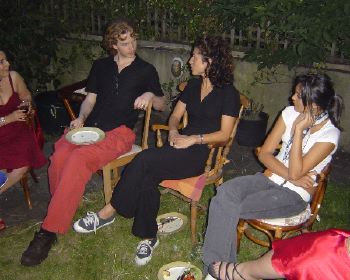
Nancy listens to a lecture on why she needs to drink more Pimms

Some of the guests were surprised to hear there was not going to be a Frisbee throwing contest
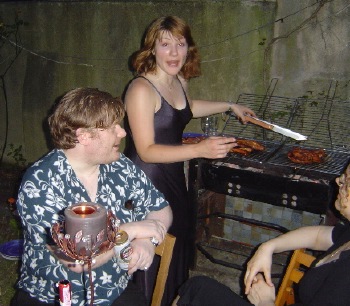
Antoine was astonished to see proof that there is indeed a martial art associated with barbeque tools

The Three Furies seems rather mellow after imbibing significant amounts of Pimms
We have no idea who these two people are but they just appeared out of the gathering gloom like apparitions and ate all the fish
David Carr may have given up cigarettes but he still likes a good cigar.
Here he is, pictured at my place on Friday night, pondering the enigma wrapped in a mystery smothered in something else which I have forgotten that is Russia. This was the subject spoken about by Helen Szamuely (co-author of this blog – here is her latest, posted this morning).
Click on David if you want him to be bigger.
The thing I find most unsatisfactory about the debate over gay marriage is the widespread misunderstanding about the law as it is presently configured.
Of course, I cannot speak about the law in other countries but here in Britain same-sex marriage is not illegal it is void. There is a world of difference in those two positions.
Allow me to explain. If two men (or two women) in the UK decide that they wish to wed then they are perfectly free to engage in any type of marriage ceremony they desire accompanied by confetti, bridesmaids and any number of drunken, embarrassing relatives reeling around the dancefloor while the band plays ‘Tie a Yellow Ribbon Round The Old Oak Tree’.
Nobody is going to a lift a finger to stop them nor will they ever be subjected to any form of official censure or arrest or prosecution. However, the state will not issue a licence for that marriage and, as far as the law is concerned, there was no marriage. It never happened, it does not exist and the participants remain as two single people. → Continue reading: Markets are a many splendid (and unsplendid) thing
No lesson seems to be so deeply inculcated by the experience of life as that you should never trust experts. If you believe doctors, nothing is wholesome: if you believe the theologians, nothing is innocent: if you believe the soldiers, nothing is safe. They all require their strong wine diluted by a very large admixture of insipid common sense.
– Lord Salisbury (1877)
Some time ago, Michael Jennings of this parish caused a stir by suggesting a way of subverting the leftist intent of the staff who decide what sort of books they recommend to customers at Britain’s high street bookstores. While strictly against the rules of property, I totally sympathised with Michael’s intent and his annoyance that the bookstore seemed to be run this way.
It has not got any better in the bookshop world, as far as I can tell (at least not in Britain. Things may be different elsewhere). Earlier this week I spent a quick lunchbreak wandering around the nearby Books Etc. store in Holborn High Street. After browsing through a fairly sparsely-stocked crime and general fiction section, I took a peek at the current affairs and history section. The history bit was okay, if not particularly impressive. But the current affairs section was in a different class. It might have been stocked by the sort of folk who write for the Democratic Underground or who think Michael Moore is a sort of latter-day saint. Books by Chomsky, Gore Vidal, John Gray (a pet hate of mine); Michael Moore, of course; then various authors I have not heard of before but the titles give the general gist: “George W. Bush and the Arrogance of Power”; Why Do People Hate America?”, and blah, blah, blah. Apart from one slim volume by noted scholar of Islam Bernard Lewis, it was a total washout.
Now what is going on here? Clearly, the folk who decide what books to sell and what books to publish presumably want to make money. I tentatively offer a few explanations: the impact of higher education and direct bias from bookstore staff. Dealing with the latter point first, I have found, while chatting to the folk who work in the stores, that most tilt to the statist left. Maybe they directly get to decide what is put up in certain parts of the store. With popular fiction, they have to stock Harry Potter and Nick Hornby like everyone else, but when it comes to politics, they get freer rein. That is my take anyhow.
But I also believe higher education has an effect on all this. The serious, non-fiction parts of bookstores cater for a perceived ‘high-brow’ market. Given that humanities departments, such as political and history ones, tend to tilt to the left in my experience, it follows that the main market for such books will tend to shift the same way. There is not – yet – a big market for non-fiction with a clear libertarian and conservative leaning.
In the Internet Age, of course, this may not matter so much. But as a bibliophile it bugs me to see the biggest high street bookshops stocking so much crud.
|
Who Are We? The Samizdata people are a bunch of sinister and heavily armed globalist illuminati who seek to infect the entire world with the values of personal liberty and several property. Amongst our many crimes is a sense of humour and the intermittent use of British spelling.
We are also a varied group made up of social individualists, classical liberals, whigs, libertarians, extropians, futurists, ‘Porcupines’, Karl Popper fetishists, recovering neo-conservatives, crazed Ayn Rand worshipers, over-caffeinated Virginia Postrel devotees, witty Frédéric Bastiat wannabes, cypherpunks, minarchists, kritarchists and wild-eyed anarcho-capitalists from Britain, North America, Australia and Europe.
|






Recent Comments