We are developing the social individualist meta-context for the future. From the very serious to the extremely frivolous... lets see what is on the mind of the Samizdata people.
Samizdata, derived from Samizdat /n. - a system of clandestine publication of banned literature in the USSR [Russ.,= self-publishing house]
|
To all French crypto-communists, syndicalists, marxists, trotskyites, leninists, stalinists, national socialists, socialist nationalists, primitivists, Trade Union dinosaurs, student activists, greenie nutters, neo-fascists, old fashioned fascists, quasi-crypto-troglodyte-Pol-Pottist-year zero-flat-earthers, looney tunes and enviro-goons… Merci Beaucoup!!!!
I could kiss every single one of you (but I don’t know how to say that in French).
Sport is going through an awkward transition phase just now, caused by the onward march of technology. During this phase, the problem is that the commentators often have technology to scrutinise and generally second-guess umpiring or refereeing decisions that are not available to the umpires or referees themselves.
This is quite natural. The commentators can afford to muck about with wild technological experiments. They can stick with them if they seem to add something to their descriptive and analytical efforts, and quietly discontinue them if they only confuse. And even if it takes them twenty minutes to come up with their techno-analysis, it is still worth them showing it to their viewers. But including technology into actual game officiating is a necessarily more cautious and cumbersome process. So there is bound, at any given moment, to be this mismatch between the techno-toys the commentators have, and what the umpires and referees have.
Trouble is, again and again, this technology makes fools out of the game officials. It makes chumps of the umps.
The other day, Liverpool won the European Cup. But would they have won it if the referees of the Liverpool Chelsea semi-final had been technologically assisted. Maybe that Liverpool goal would still have stood if the officials had been able to look at all that subsequent computerisation. But at least disgruntled Chelsea players and supporters would have known that the decision was based on a different interpretation of that information rather than on the opinion of people who were standing in entirely the wrong place to have a valid opinion on the subject.
Rugby, both league and union, already uses slow motion cameras to help them decide about contentious tries. Did his foot go over the side line before he touched down? Did he touch down properly? That kind of thing. (In rugby, unlike in American football, they do not call it a touch down, but you do actually have to touch it down.)
Cricket is the sport I know most about, when it comes to adjudication technology. And cricket is, and always has been, full of tricky decisions that the umpires have to make. Technology is slowly being introduced to help the umpires make fewer errors.
Cricket umpires already use slow motion cameras to decide about run out decisions. This is when a batsman fails (or does he?) to complete a run by reaching the line that matters before the fielders hit the stumps with the ball. And this has greatly improved these decisions. With their being less doubt, batsmen now get less benefit from it, but so what? These decisions are now clearly better.
A big problem remains, however, with LBW decisions. That’s “leg before wicket” ? when the ball strikes the batsman’s leg and would have hit the wicket. Or would it, question mark question mark, argument argument. There was a series not so long ago between England and South Africa which was settled in England’s favour with a series of highly dubious LBWs in the deciding match, and that kind of nasty-taste-in-the-mouth we-was-robbed stuff happens quite often. But at least that happened, as I recall, before the age of Hawk-eye.
Hawk-eye is the machine that tells us, as well as anyone or anything can, whether a batsman was out LBW or not. And although the ultimate truth of the matter is still hard to be sure about – because, after all, the machine is still only guessing where the ball would have gone, rather than measuring anything it actually did do – Hawk-eye looks pretty convincing to me. Put it this way. If I were a batsman being given out, or a bowler begging in vain for the verdict, I would rather that Hawk-eye was supplying the verdict rather than some one-eyed umpire.
The cricket commentators also have their “snickometer” to determine whether the ball has touched the bat while passing it or not, and in some cases to work out whether the ball touched the bat before hitting the pad, and therefore whether or not a batsman can be given out LBW. (If he hits it first, however gently, it is not out.) The Snickometer produces an output that looks like a voice analyser, and expert interpreters to tell what kind of noise that spike is, and exactly when it happened. So the Snickometer can really help, with things like snicked catches to the wicketkeeper.
But, although the commentators, and hence also all the TV viewers like me, have Hawk-eye and the Snickometer, the umpires, as yet, do not. Time and again, they give their instant verdicts, based only on what they just saw, at full speed, and then moments later (fewer and fewer moments as time has gone by) Hawk-eye and/or the Snickometer have given their verdicts. Often they differ. Invariably, the technologically aided decisions are more convincing, and often embarrassingly so. → Continue reading: The technology of sports adjudication
For what it may or may not be worth, Channel 4 News has just said that a leaked exit poll gives the Non side victory with between 53 and 55 per cent of the vote.
Meanwhile, the EU Referendum blog reports that it has read a document which explains that Non will not actually mean No:
In short, the authors conclude that, in the event of one or both countries voting “no”, the ratification process should be neither suspended nor abandoned. They assert that all member states have expressed a commitment to proceed with ratification by virtue of Declaration 30, appended to the Constitutional Treaty. Member states cannot unilaterally or collectively decide to change the ratification process.
Thus, member states which have not already ratified should continue with the process whence, once 20 members have done so, the matter should be referred to the European Council.
In the meantime, the authors caution that “the European Union must not remain paralysed”. Rather, they say, “it must continue and intensify its efforts to relaunch its policies, even by implementing in advance, where possible, the provisions of the Treaty that do not meet with open opposition”.
Thus, the considered response in the event of a rejection of the constitution should be “full steam ahead”. Member states should implement it even faster than they are doing already.
Very helpful. I wish I could be equally helpful in return on this question:
So what, precisely, do we have to do to stop this thing?
I read the EU Referendum blog in the hope of getting answers to questions like that. If they have to ask that, what is the chance that anyone else will have an answer?
The fact that large numbers of French people are going to vote against the ghastly EU Constitution because it favours too much free trade and does not isolate Europe from competition even more than it already does is almost beyond parody. That most British people will (if given the chance) vote against it because it does quite the opposite just shows that the notion of having both nations as part of the same political structure is truly unsustainable.
Similarly the idea that some doctors could call for sharp pointed kitchen knives to be banned without being widely ridiculed in the press for being evil totalitarians indicates that Britain too has some grave social and intellectual deficiencies amongst the media classes. For all their bizarre political notions regarding that big-statist’s charter called the EU Constitution, it is hard to see the French trying to ban pointed kitchen knives from people’s homes.
So what will it take to snap people back to reality? Or is it just too damn late for that and the only thing left is to get the hell out and leave the lunatics in change of the asylum?
Maybe that is exactly what the US needs too, an influx of liberty seeking (or at least sanity seeking) folks from Europe who have seen the reality of what happened to a culture when it allows all the things the Democrats (and quite a few big-state Republicans) want to do in the USA. Who knows, if enough of them get citizenship they might be around in time to help make sure that Hillary only gets one term in office. Shudder.
It seems like we are getting there. The serious press is starting to understand the threat posed by the nationalisation of personal identity dressed up as a populist system of “ID Cards”
This devastating quote appeared in an article in the New Statesman, house magazine of the British political left:
“Public opinion likes the idea of ID cards because it seems like the ultimate solution to all known problems,” says Brian Gladman, retired director of strategic electronic communications at the Ministry of Defence. “But actually, the way this bill is designed enables a police state. You’re not going to be allowed to opt out of having an ID card, the linked databases make detailed tracking feasible, and a system with this combination of complexity and scale is way beyond the state of the art. It won’t be reliable or safe. Anybody with access to the database will be able to target anybody. It’s horrendous what you’ll be able to do.”
One hopes the message is now starting to get through to Labour MPs, and they may find important other things to do rather than vote for the second reading (the first non-formal stage) in parliament.
A very small silver lining to the very large dark cloud that overshadows these violent times is that the war on drugs – that is to say the “war” on a particular form of unhealthy behaviour – no longer gets the prestige it once did. I think someone is feeling left out.
Police have claimed new successes in the war on drugs in central Scotland.
Officers have swooped on nearly 20 homes in the Falkirk, Stirling and Clackmannanshire areas in the past week as part of Operation Overlord.
They called it Operation Overlord?
According to the New York Times:
An American military inquiry has uncovered five instances in which guards or interrogators at the Guantánamo Bay detention facility in Cuba mishandled the Koran, but found “no credible evidence” to substantiate claims that it was ever flushed down a toilet, the chief of the investigation said on Thursday.
All but one of the five incidents appear to have taken place before January 2003. In three cases, the mishandling of the Koran appears to have been deliberate, and in two it was accidental or unintentional, the commander said, adding that four cases involved guards, and one an interrogator. Two service members have been punished for their conduct, one recently.
I am not sure if the service members that were punished had other things to answer for- the investigation is by no means complete, apparently.
However, I am curious if that was what they were punished for. Does the Koran have some special legal protection in the United States now?
Silicon.com reports that government wants them and the public too seems to be warming to the idea… The UK government is preparing to reintroduce legislation paving the way for its controversial biometric identity cards. The proposed legislation was dropped in the run up to the election but the controversial bill is set to be reintroduced by Home Secretary Charles Clarke on 25th May.
Speaking in the House of Commons earlier this week, junior Home Office minister Andy Burnham said ID cards will give the public a “highly secure” way of protecting against identity theft which costs the UK economy £1.3bn a year and that support for identity cards was running at around 80 per cent. This was due to growing awareness of identity fraud.
Early analysis of the scheme that is being developed has indicated that the benefits – including to the public sector in terms of cutting fraud and the improper use of services, and to the private sector in terms of cutting identity fraud – will, when the scheme is fully operational, outweigh its cost.
Research released earlier this week reveals 57 per cent of adults aged between 16 and 64 said the controversial ID card is either their first or second preference for protecting their identity. David Porter, head of security and risk at Detica, says the problem of electoral fraud is one issue which “throws the spotlight back onto ID cards” – most notably the problem of people voting in person with no required proof of identity.
So in order to stop identity theft that has very little to do with the ability to identify people correctly and more to do with the stupidity of people guarding their details, we are going to change the balance of power between the state and the individual. No prizes for guessing which way… And the central identity database is going to make it identity theft simpler, if you ask me as you’ll only have to fool one system.
This kind of thing used to enrage me. Then it got to the stage where it embarrassed me. Then it began to perplex me. But now, I am almost entirely resigned.
Go on, do your very worst. Bring it on:
A&E doctors are calling for a ban on long pointed kitchen knives to reduce deaths from stabbing.
A team from West Middlesex University Hospital said violent crime is on the increase – and kitchen knives are used in as many as half of all stabbings.
The researchers said there was no reason for long pointed knives to be publicly available at all.
Next: Doctors call for ban on opposable thumbs.
Having been subjected to some robust criticism for my occasional cyncism about the whole modern democratic process, I am actually a little peeved to discover that I am but a mere dilettante:
If the French and the Dutch reject the EU Constitution on Sunday and Wednesday, they should re-run the referendums, the current president of the EU, Jean-Claude Juncker, has said.
“If at the end of the ratification process, we do not manage to solve the problems, the countries that would have said No, would have to ask themselves the question again”, Mr Juncker said in an interview with Belgian daily Le Soir.
‘No’ is not the right answer, you see.
The whole bloody continent is heading for another war. Britain out now.
Sidenote: This Mr. Juncker chappie is the president of the EU? Hands up anyone, anywhere who has ever heard of him!
Whilst in Zürich on business, I was puzzled to see large teddy bears everywhere on almost every street corner in the centre of town and a veritable platoon of them in the Bahnhoff … there seems to be literally hundreds of them scattered around the city. It is certainly interesting but I have no idea why they are there. Does anyone know?
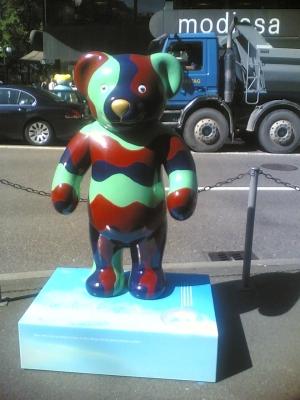



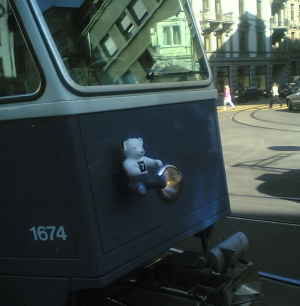
Interesting but… a bit perplexing Who says the Swiss have no sence of humour?
French voters go to the polls this weekend to vote on the European Union constitution, with polls so far suggesting that the “no’s” will narrowly win and shaft the wretched project, although one should never, ever under-estimate the ability of the political establishment to scare voters into saying “oui”. My hope, needless to say, is that the French vote against the constitution and throw a great big spanner in the works and prevent the creation of what will be, explicitly, a European superstate.
It is pointless at this vantage point to guess exactly what will be the impact on British political life if the French do nix the constitution. My rough guess is that Blair will secretly breath a deep sigh of relief, as will the Tories. I also think that the United States will also be glad about a no vote, although I am just guessing.
As Anatole Kaletsky writes in the Times today, the chronic underperformance of the euro zone economy is at the heart of much of that disenchantment (although other issues are important too).
Here’s a key graf:
The relative economic decline of “old” Europe since the early 1990s – especially of Germany and Italy, but also of the Netherlands and France – has been a disaster almost unparalleled in modern history. While Britain and Japan certainly suffered some massive economic dislocations, in the early 1980s and the mid-1990s respectively, they never experienced the same sort of permanent transformation from thriving full-employment economies to stagnant societies where mass unemployment and falling living standards are accepted as permanent facts of life. In Britain, unemployment more than doubled from 1980 to 1984, but conditions then quickly improved. By the late 1980s it was enjoying a boom, the economy was growing by 4 per cent and unemployment had halved. In continental Europe, by contrast, unemployment has been stuck between 8 and 11 per cent since 1991 and growth has reached 3 per cent only once in those 14 years.
He has a point, although I am struck by the fact that in France, much of the hostility to the constitution is coming not from pro-free marketeers, as is the case in many respects in Britain, but from those who fear that the process will open up France’s high regulated, high-tax economy to the icy winds of laissez faire. The ironies abound.
Of course, the fact of mere voters saying no to the EU juggernaut is unlikely to deflect the mixed assortment of deluded idealists, crooks, place-seekers and sundry camp-followers from trying to advance their aims. But a delicious irony would it be if the land of Bonaparte, de Gaulle and Asterix puts a major block in their path.
|
Who Are We? The Samizdata people are a bunch of sinister and heavily armed globalist illuminati who seek to infect the entire world with the values of personal liberty and several property. Amongst our many crimes is a sense of humour and the intermittent use of British spelling.
We are also a varied group made up of social individualists, classical liberals, whigs, libertarians, extropians, futurists, ‘Porcupines’, Karl Popper fetishists, recovering neo-conservatives, crazed Ayn Rand worshipers, over-caffeinated Virginia Postrel devotees, witty Frédéric Bastiat wannabes, cypherpunks, minarchists, kritarchists and wild-eyed anarcho-capitalists from Britain, North America, Australia and Europe.
|





Recent Comments