We are developing the social individualist meta-context for the future. From the very serious to the extremely frivolous... lets see what is on the mind of the Samizdata people.
Samizdata, derived from Samizdat /n. - a system of clandestine publication of banned literature in the USSR [Russ.,= self-publishing house]
|
There is an excellent article by Michael Totten, who is currently blogging from Iraq, about what quite a few people think is the inevitable end result: partition into three (or at least two) separate entities. It is interesting to see the facts on the ground seem to back up the view that we already have a de facto independent Kurdistan.
An Islamo-fascist Southern Iraq is not such a great outcome but an independent Kurdistan would seem to have much to commend it.
I really have no problem with that and wrote something on the subject myself called: to hell with nation building, lets see some nation wrecking!
You may have already heard this but I laughed out loud when I came across this: an officer involved in Dick Cheney’s recent difficulties is called Captain Kirk.
Phasers off, gentlemen.
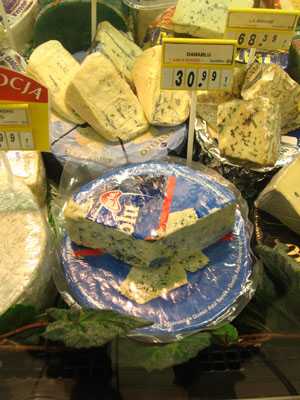

It seems that despite their pathetic limp wristedness in some parts of the world, Carrefour’s solidarity with the Islamic and Egyptian community does not stretch very far, as they are happily selling Denmark’s splendid cheese here in Warsaw.
This still does not make me like them very much (although they are generally a well run business). It does lead to a question, which is what happens when a boycott and a buycott collide? Given that they stock it, is it okay for me to buy Danish cheese from Carrefour. Obviously it is better for me to go and buy the Danish cheese from a different shop down the road, but what if I can not?
Such is the dilemma I face as I head for the airport and the flight back to London from Poland.
I do so agree with what Madsen Pirie, who is now guest blogging at the Singleton Diet, says about mustard:
Second breakfast consisted of a croissant with the rest of the honey-roasted ham, this time with Florida mustard and fresh orange juice. After it came black coffee. As you might gather, I like mustards, pretty well all of them, wholegrain, English, Dijon, French, Florida, and so on. I even regard sausages as just an excuse for mustard.
I have a jar of Tesco wholegrain mustard on the go right now, and very tasty it is too. I also often eat meat just to eat mustard, but I never really spelled this out for myself before, so I am grateful to Madsen Pirie for doing this for me.
The Singleton Diet, as already reported here, started out as occasional Samizdatista Alex Singleton blogging about what he was eating. The idea was for him to get slimmer. But after a while, Alex got fed up with blogging every day or even every few days about his dietary intake, and the Singleton Diet faded. (Whether Alex is now any slimmer, I am not sure, but I rather think he is.)
But now, the Singleton Diet has sprung to life again, with Madsen Pirie as a guest writer. I think this is a really good idea. Who wants to blog about everything they eat for ever? Almost nobody, and if anyone did, who would want to read that for ever? But a succession of different eaters is another matter entirely.
As regular Samizdata readers will know, if you have a pro-freedom attitude towards the world you will always have lots to complain about. But the economic rules and institutions that we favour have also poured forth a Niagara of good news, and in no area of life is this more true than in the matter of food. Thanks to the farmers and especially to the food retailers, we – especially we who live in London, as Alex Singleton, Madsen Pirie, and I all do – now have a world of exciting and exotic food products to choose between and to enjoy. What better way could there be for a man like Madsen Pirie, one of the most notable of London’s freedom mongers of recent decades, to demonstrate that he is capable of enjoying life and not just of proposing improvements for and regretting the derangements of it caused by others, than for him to do a spot of food blogging? It should be a lot of fun.
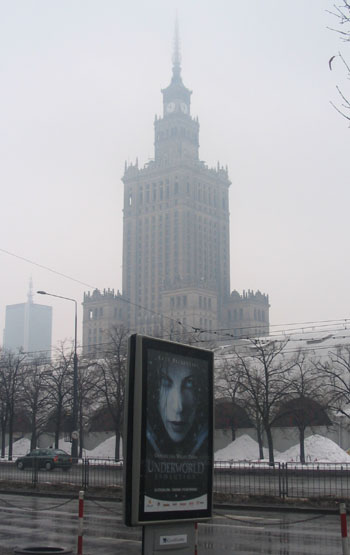
If anyone (or thing) is looking for a heaquarters from which to run the centuries old war between Vampires and Lycan, I do think the building is perfect, however.
(For people who are wondering, the building is the Palace of Culture and Science in Warsaw, built in 1953-5 as a gift from the people of the Soviet Union to the people of Poland).
Properties that twenty years ago were inhabited by collectivised Bulgarian peasants can now be purchased by anyone, thanks to the magic of the Internet.
Ideal for, erm, renovators!
I have been ‘on the road’ again since a few days after the New Year. Travel may seem exciting to some, but it does wear you down when you do it week after week. This is especially true when planning is impossible and you cannot say with any certainty which of several jobs will be next in line. You just adapt and make your arrangements on the fly.
That said, constant travel does lead to unexpected adventures and misadventures. I would count losing my glasses going through security in Toronto among the less exciting and more expensive of these. Although there are some weeks more to go on this jaunt, the event which most stands out happened before I even got out of the UK at the start of January.
Due to contract signings running late a couple layers up the food chain from myself, travel arrangements for my usual January gig backstage at the big Healthcare investment conference in San Francisco were last minute. Translation: they were so late the flights were almost unaffordable so I was booked on a simply ridiculous connection. I left Belfast on an evening flight which dropped me in Heathrow just as the airport closed up operations for the night. My New York flight was first thing in the morning… so I got to sit up all night in the main terminal.
Well, my slogan is “Have Laptop, Will Travel”, so after some help from friendly airport staff to move some seats closer to an electric outlet, I settled in for a long, long night of work. Time crawled by. Over the top of my screen I idly noticed a gaggle of armed police wander by and hassle a couple black teens whom I think were also waiting for a connecting flight.
One of the cops walked towards me. I naturally assumed he was going to act as a friendly face to London’s major airport; perhaps commiserate on my bad luck in being stuck there over night; or possibly warn me to beware of this, that or the other.
I was wrong. He planted himself in front of me in his best “Clockwork Orange” intimidation posture and proceeded to tell me I was guilty of theft. I looked at him blankly. Theft of services. I was plugged into the airport’s electricity. He quoted a section number I was purportedly violating. As I have lived in Belfast through troubled years, I know how to deal with this sort. You smile and you verbally give them squat to grab hold of. They want to provoke a response that will let them play cop.
This fellow was very obviously tired, bored and looking for someone to take it out on. I, being one of the few persons in the terminal was ‘it’. He went on. Not only was I ‘stealing services’. I was in violation of… of…. HEALTH AND SAFETY REGULATIONS! I did not have appropriate authorization from the Airport declaring my laptop was safe for use with their AC sockets, and if I were to get electrocuted they might be liable!
I quietly studied the hole in his head.
He ranted on that I was still stealing power as he talked. Actually I was concentrating on keeping up a fake smile and non-threatening eye contact so as to avoid serious trouble. I was also dumbfounded, but I snapped out of it and casually reached over and unplugged. Slowly. I was not quite sure of the stability of this character and he was, after all, an armed member of a society in which only his sort are armed.
With the offending laptop unplugged and as he had utterly failed to provoke any sort of lese majeste remark from me, there was little more he could do. He sternly told me he would let me off with a warning and then retreated and joined his cohorts. They had remained some distance away throughout. Backup I suppose. I might well have been armed with sharp verbs and poisonous nouns for all they knew.
The previously hassled white robed African teen was not far away and as our trooper stormed off we caught each others eyes. I shook my head. He wryly smiled back. Wordless understanding passed between us.
Welcome to 21st Century London.
Mick Hartley yesterday blogged, in response to this, about the slippery slope that the smoking ban is towards the top end of:
My point isn’t that there’s no truth in this. Of course there is. We know nicotine is addictive, never mind the whole nervous what-to-do-with-my-hands-in-this-tense-social-situation stuff which adds to the compulsion. But when you start going down this road, where do you stop? The more we find out about neurology and psychology the more we discover all these compulsions and genetic predispositions and all the rest of it, and behaviour which used to be seen as a matter of moral choice gets therapeutised as a manifestation of some syndrome or other. Antisocial bastard? He’s got mild Asperger’s Syndrome. Greedy pig? A compulsive eating disorder. Arrogant sod? Narcissistic Personality Disorder. Carry on and ultimately, at some level where Buddhism meets neurophysiology, maybe all our decisions are illusory, and the active responsible agent who’s supposed to be making all these personal choices just disappears.
Great stuff, but I’m not sure that I entirely agree. If this was indeed the slippery slope involved, I would be with Mick Hartley in wanting us to stay at the top of it. But I don’t think it is. I think the smoking ban is about pollution, and about the way that pollution is seen as not being a property rights issue, but instead as a criminal assault issue. Blowing smoke at someone is now seen as like stabbing them. The result is similar; it just takes a little longer. Next on this slippery slope are not individual behaviours, like being a greedy pig, so much as other smoke-belching activities, like driving cars and airplanes, with the rules of what exactly constitutes “smoke” being ever more tightly written.
After all, smoking has been turned from a mere habit into a crime by this ban. And crimes are all about the individual responsibility of the criminals who commit them. I do not hear anyone saying that smoking is an illness, the way they do about drinking alcohol too regularly and too much.
You can argue, and I do argue, that “passive smoking”, like smoking itself, is something you do, and consent to doing, by being near smokers rather than keeping away from them, which you can do if property rights are allowed to operate, and to create areas where smoking is forbidden by the property owner. As Mick Hartley says, in circumstances like that,: “you turn around and go elsewhere”.
But what about people who are obliged, in various degrees, to consort with smokers? Does the fact that a battered wife “consents” to being abused (by not earlier abandoning the abusive relationship) excuse the abuser, when the battered wife finally gives up on the relationship, and calls in the police and presses charges? And what about children raised by smokers? Is that not like beating them every day for no reason? That is the parallel that we now find ourselves arguing about.
And if the argument is that cars and airplanes stink up the entire planet, nobody has anywhere to go to escape from that kind of repeated assault, if that is what it is. So there is no consent argument against banning those nozious practices. Collectivists love pollution, because pollution often is collective, that is, hard to avoid.
So if you want to apply the “what next?” argument to the smoking ban, think noxious fumes, and also things like evil electrical effects from phones, power stations, heaters, carpets, etc. Actually don’t. Don’t give them ideas.
Where neurology arguments might push us down a slope is in those areas and arguments where it is said that this or that crime should actually be less of a crime than it is now. Things like small robberies committed by the unemployed, by ethnic minorities, or by the physically handicapped, etc. Then, I think that Mick Hartley’s argument would be spot on. But smoking is not that kind of issue at all. Not at the moment anyway.
Andrew Sullivan, reminds me why I was a fan of his blog from the off and remain one:
Leave aside the issue of mob violence for a moment. No moderate Muslim or “sensitive” Westerner is defending that. What of the non-violent request: that one faith be granted its taboos, that Western culture must abide by them, that the law be reformed to protect religious faiths from blasphemy or offense? It seems to me that we should indeed avoid gratuitous insult of Islam, and Christianity, or any faith. But it is a complete delusion to believe that the major source of our problem today is something called “Islamophobia.” No: the problem is terrorism and tyranny propagated under the banner of Islam. Without that, no Danish cartoon could have been conceived of, let alone published. That is the real and far more blatant blasphemy. If 10,000 angry Muslims had marched in London after the bombing of a major mosque in Iraq, I’d be impressed. But they didn’t. Until they do, the West has nothing to apologize for. The Muslim world needs to take the beam out of its own eye, before it removes the speck from the West’s.
Reuters reports that the hunting with hounds is more popular than ever despite the move by parliament last year to outlaw the hunting of foxes with hounds. (Incidentally, foxes are increasingly a problem in the cities as they scavenge for food. I used to live in Clapham and the place was full of them).
It makes me wonder about whether the vote by MPs this week to ban smoking in public places, including private members’ clubs, will be easily enforced. Let’s hope it meets the same fate as the anti-foxhunting measure. I say this as someone who does not smoke or hunt on horseback (despite being a Suffolk farmer’s son, hunting with hounds never appealed, although I have shot the odd bunny rabbit from time to time).
I attended the Emergency Event at the London School of Economics which was publicised by Perry earlier this week entitled “Freedom of Speech: Who cares what Muslims think”. There was a very small but vocal contingent of Samizdata supporters, agreeing with Claire Fox’s defence of the freedom of speech. The excellent chairman of the debate between Claire Fox and Sajjid Khan was fair and impartial.
Many of the Muslims who commented during the debate stated their pain at the publication of the cartoons. It was clear that, despite the long period in time from the initial publication of the cartoons to the demonstrations, Muslims argued that this was a trespass upon the sacred. It was hard to gauge whether this reaction stemmed from belief or obligation, as the orthodox approach to the cartoons had now been established.
Whilst Claire Fox located recent infringements and restrictions on free speech in the developments of left-wing politics from the 1970s, especially political correction and speech codes, Sajjid Khan said that there was a sphere of the sacred surrounding Mohammed. No person should ridicule, publish or draw Mohammed. In the first instance, non-Muslims should practice self-censorship in this regard, but the preferred tool for policing the sacred sphere was the law. He stated that respect for Islam would join other shared goals such as social justice and taking my money to care for the poor. Khan criticised Blair but he was quite clear that he did not want to change the system itself, only those who pulled the levers, so that respect for Islam would become a legitimate objective of a democratic society.
Claire Fox argued that it was possible to hold a dialogue between Muslims and those whose default position supported liberty. This was not true in the debate. Our values are incommensurable as many Muslims clearly support using the law, if changed, to coerce my freedom of expression. The law would be used to prevent me from freely expressing myself on the subject of Mohammed, if I chose to do so, and rights of trespass on the sacred space would surely be decided by Muslims themselves, not by me.
It is a depressing conclusion, since I had hoped that there could be common ground here on shared notions of liberty. That will not stop me trying, since this is one of the most important issues that we face. What matters is how individuals, whether Muslim or non-Muslim act, not those who would speak for or bind us all into simplified collectives called Islam or the West.
UPDATE
Adloyada argues that Sajjid Khan is, in fact, a member of Hizb ut Tahrir and presents compelling evidence.
Sajjad Khan, a prominent member of Hizb who runs classes on the group’s ideology and has delivered speeches at the group’s congresses, said: ‘Most of our members are graduates who work and pay taxes. Very few of them are unemployed or rely on state benefits.’ A finance and IT specialist, he said he had worked for a number of large companies, including Tesco.
Khan certainly did not declare this affiliation.
Those who have a superstitious aversion to nuclear power on the grounds that “the waste will be radioactive for thousands of years, man!” really ought to learn to ask, ‘what?’ and, ‘how much?’
Medical (and industrial) use of radioisotopes is happily accepted (or at least ignored) by the same people. Medicine is good. Industry is hidden in a black shade of ignorance. But power stations are bad. Like the Bomb.
This rather misses that medical materials can be very dangerous. Those “thousands of years” for power waste also indicate lower specific activity. Is a long period of mild, static, buried, danger really a thing to have nightmares about, when really fearful stuff is to be found loose at the end of the street?
Perhaps this story will lead to better public understanding:
The Oxfordshire-based company was transporting part of a piece of cancer treatment equipment, which had been decommissioned at Cookridge Hospital in Leeds, to the Sellafield complex on 11 March, 2002.
But a “plug” was left off a specially built 2.5 tonne container to carry the contaminated material on a lorry.
Mark Harris, prosecuting for the Health and Safety Executive, said: “Through pure good fortune no-one involved in the removal, containment and transfer of the source may have been directly exposed to the radiation beam.
“The risk of such exposure was undoubtedly present – at Cookridge, during the journey and at Sellafield.”
He said detected radiation at Sellafield was between 100 to 1,000 times above what would normally be considered a very high dose rate.
Mr Harris said it was beyond the capabilities of normal hand-held monitoring equipment.
Even discounting the doom-mongering approache of HSE prosecutors, this is a pretty alarming incident. But the chance of its changing public attitudes, or even inspiring curiosity about risk, is close to zero. We may get a small addition to the towering mass of safty-anxiety, but a sense of proportion? Never.
PS. Remarkable don’t you think, that the BBC story I cite is illustrated with, not a picture of a container lorry or a piece of radiotherapy equipment, but a glowering shot of Sellafield. The place where the danger was discovered and made safe is made the villain. The ‘Sellafield baa-d’ habit of mind – look, it even has the capitalist word “sell” embedded in it, what could be more damning? – cannot be eradicated by what RCD calls “pesky facts”.
|
Who Are We? The Samizdata people are a bunch of sinister and heavily armed globalist illuminati who seek to infect the entire world with the values of personal liberty and several property. Amongst our many crimes is a sense of humour and the intermittent use of British spelling.
We are also a varied group made up of social individualists, classical liberals, whigs, libertarians, extropians, futurists, ‘Porcupines’, Karl Popper fetishists, recovering neo-conservatives, crazed Ayn Rand worshipers, over-caffeinated Virginia Postrel devotees, witty Frédéric Bastiat wannabes, cypherpunks, minarchists, kritarchists and wild-eyed anarcho-capitalists from Britain, North America, Australia and Europe.
|






Recent Comments