We are developing the social individualist meta-context for the future. From the very serious to the extremely frivolous... lets see what is on the mind of the Samizdata people.
Samizdata, derived from Samizdat /n. - a system of clandestine publication of banned literature in the USSR [Russ.,= self-publishing house]
|
‘Stoatman’ from ‘Zuid Holland’ writes in with a remarkable bit of hypocrisy from the Human Rights Industry
Amnesty International, as part of its ongoing struggle for universal human rights, is looking to employ a Discrimination and Identity consultant for its Dutch branch.
The Discrimination and Identity team consists of three paid and two volunteer positions and is concerned with influencing government policy and societal views regarding discrimination on grounds of skin colour, ethnicity, religion, gender, and sexual orientation. … In this position you will develop policy and strategy in the field of Discrimination. This includes research into discrimination, and the development and organisation of lobbying regarding the fight against discrimination in the Netherlands. You will also be responsible for the development and implementation of actions and campaigns concerning discrimination worldwide and in the Netherlands
Before you dust off your CV which bulges with non-jobs in local government and crack open the Dutch taped course, there is just one problem before you can claim your £21-26k salary:
Considering the composition of the team, we are seeking someone from an ethnic minority group
Has it reached the stage now that such discrimination has become so mainstream that nobody even bats an eyelid to such brazen hypocrisy?
(hat tip – The Amazing Retecool)
If you are in Oxford on Saturday and want to join a protest against animal rights extremists, check this out. The Research Defence Society blog has more, as does the Social Affairs Unit and Laurie‘s own blog.
For those of you who are following Michael Totten’s interesting Middle Eastern adventures, he has written about one of the more interesting religious groups in that part of the world.
I am just as keen on universal civil liberties as the next Samizdatista, however I must concede that the case of India vis-à-vis the Danish cartoons made me briefly question my blanket commitment to the freedom of the press. I yearn for a major Australian newspaper to have the stones to print these cartoons in self defence and defiance, however I would argue that any editor of an Indian publication who allows them to be published is astonishingly irresponsible, given India’s history and continuing record of bloody communal violence. If these cartoons found their way into a publication with a moderate degree of circulation, the question would not be “will there be deaths?”, but “how many?” Upon reflection, I certainly do not believe that government censorship is the answer, however it is marginally more justifiable there than in any other nation I can think of. Because of this, it is crucial that Indian editors exercise their judgement wisely – and not publish the cartoons. Hopefully there will come a time when India is not the exception (regarding this issue) amongst countries governed by the rule of law.
I should mention that I have huge faith in the wisdom of Indians.
In 1982, Disney released the movie Tron, the first film incorporating large amounts of computer graphics. (Actually it only included about 15 minutes of actual graphics. The rest of the film was drawn art designed to look like computer graphics, whereas today’s films are often full of computer graphics being used to look like more naturalistic things). The film was not successful at the box office, possibly because as well as being made by computer nerds, the film was also about computer nerds, and what might be referred to as the Silicon Valley culture was at that point extremely marginal, particularly in pop cultural terms. (Having said that, the film was set in Los Angeles, but I will forgive it that). However, for those of us that saw it, the film was rather mind blowing. It became a tremendous influence on many people working in computer animation and special effects today, and on people who were inspired by that technological culture in general. When these things did become mainstream, many of the people who were behind the scenes were people who had loved Tron.
However, the people who made Tron itself generally did not prosper from it. The film was too far ahead of its time, and Hollywood did not know what to make of it or what to do with the people who had made it. In what now seems staggering given that this is possibly the most groundbreaking film ever made from a special effects point of view, the film did not receive an Academy Award nomination for Best Visual Effects. This was partly because the film was perceived as a failure, and the academy doesn’t often reward failure, but it also had to do with a peculiarity of the Academy Awards nomination process, which is that (usually) the people who nominate films in a particular category are those who have been nominated in that category before. In 1982 “Special Effects” meant mattes (ie drawn artwork) and models. Using computer graphics was seen almost as “cheating”, and as a minimum an entirely different thing from what members of the Visual Effects branch of the Academy did. So, no nomination. (Things have changed since then. A couple of years ago I made an observation to another blogger that Master and Commander had excellent effects, and in response I was told that they were “not special effects”, because it was done with models in a tank in Mexico rather than with computer graphics.
To many people today, “special effects” means computer graphics, and that is that). That said, Master and Commander does use some computer graphics, just nowhere near as intensively as, say, The Lord of the Rings). However, as far as I am concerned Master and Commander does use special effects, computer based or not, and in fact it uses them dazzlingly, as I felt that a 19th century ship in the Royal Navy was really like that. Getting this kind of thing right is breathtakingly hard, which is why that film a couple of years ago deserved the visual effects Academy Award. But (although it was nominated) it didn’t get it. (It did win a very well deserved Academy Award for cinematography, however).
If Tron had been nominated for an Academy Award when it was released in 1982, it might or might not have actually won. And this may even have been fair. It would have been up against Blade Runner, possibly the greatest achievement ever in matte based special effects. However, although that film was nominated, it didn’t win either. (Steven Spielberg’s E.T. The Extra-Terrestrial won). Such once again is the academy’s reluctance to give awards to movies not perceived as successes. But in retrospect the lack of a nomination was a travesty.
And as sometimes happens in Hollywood, it has been decided to acknowledge retrospectively that it was a travesty. Gary Demos, who was largely responsible for the computer graphics in “Tron”, has been awarded an honorary Academy Award this year. This may be ultimately unimportant and trivial, but it is nonetheless about time.
Perry de Havilland wrote in this post that
all insulting behaviour (short of actual incitement to violence), blasphemy and ‘holocaust denial’ laws are an intolerable abridgement of freedom of expression and must be abolished, now!
Why is incitement to violence an exception? When a violent act is committed, why should a citizen capable of standing trial be able to claim that they were incited as some kind of mitigating circumstance? Is there not a legal expectation in nations respecting the rule of law that an adult capable of standing trial is a thinking, responsible individual? And thus, if said individual claims to have been ‘incited’ to violence, surely the point is that at some stage that person has decided to physically remove the rights of another. Grandma’s favourite scold – “if someone told you to jump off a cliff…” – applies in spades.
I cannot see how an ‘incitement to violence’ is any different to racist ‘hate speech’ – something that is censured but not censored by most supporters of liberal values. Surely a liberal believes that personal responsibility is central pillar of liberty. Criminalising incitement to violence further divorces personal responsibility from individuals, thus further justifying the existence of an overmighty State.
Incidentally, I am sure I am not the only one who would like to know further details of Perry’s run-in with David Irving.
Interesting how these things get around. The word of these amazing photos of Mexico City got to me from him, who got it from him, who got it from him, who apparently found them here, which is where, for me, the trail went cold.
The picture Patrick Crozier chose to reproduce is particularly extraordinary. Talk about ‘fake but real’. Something to do with how the guy photoshops the pictures to make things clearer, I am guessing. I often do the same with shots I take from airplanes.
Architecturally, I think this is particularly bizarre. There are times, may the God Who Does Not Exist forgive me, when I yearn for a violent revolution in sleepy little Britain, just so that the planning permission (i.e. non-permission for almost anything remotely interesting except when the government wants it) system collapses, and people could build, in Britain’s still overwhelmingly green and pleasant land, whatever crazy thing they liked. Just as a for instance, why are there not more castles built nowadays, with cylindrical and pointy towers?
Mind you, extraordinary things are still being built in Britain, by the sort of people who are still allowed to do such things.
Clive Davis approvingly quotes a book by a fellow called Rod Dreher, a “crunchy conservative” (whatever that is) who is, we are told, a passionate environmentalist, a disliker of suburban sprawl, shopping malls (oh, the vulgarity!), television (ditto), McMansions (huh?) and other regrettable features of consumerist, dollar-obsessed America. Instead, this fellow, who sounds rather like an American Roger Scruton (of whom I am an admirer, at least in parts) is a fan of government restrictions and regulations, and mentions the case of the U.S. Pacific Highway, left pristine and free of crass development by land-use regulations.
There is nothing actually all that new in conservatives embracing controls on development. The very word, conservative, is based on the desire to conserve and protect what exists from the new. During the Industrial Revolution, conservatives like the Poet Robert Southey railed against what they saw as the ugliness of industrialism and the associated sprawl. (Some of the dislike was also based on snobbery and fear of an pwardly mobile and undeferential middle class). The trend has continued. It was that perfect symbol of cuddly English fogeyism, Sir John Betjeman, who took potshots at suburbia, penning one of his most famous verses about that place to the west of London known as Slough. (The former Poet Laureate asked Hitler to bomb it).
What is so striking is how unoriginal and old-hat all this sort of thing is. More interesting to me, however, are those writers who do not imagine that shopping malls or mock-Tudor mansions in Surbiton deserve our scorn. Virginia Postrel has recently written approvingly of a book actually describing sprawl rather than automatically condemning it.
And let’s face it, most of us, particularly those with children, live in suburbs or are moving there. It is a conceit, I reckon, of people who have no children, and who do not need the space, to take potshots at those who have decided to leave the supposedly hip inner city. It remains a mystery to me why the desire of people to live in a bit of space and comfort drives certain intellectuals nuts. Maybe it is the garden gnomes.
At the same time Jyllands-Posten in Denmark is valiantly establishing that freedom of expression is a core western value and that the right to say what you will does indeed include the right to say what some people may find offensive… a court in Austria has in effect sided with Islamic extremists by sentencing ‘historian’ and fantasist David Irving to three years in jail for upsetting Jewish sensibilities by making preposterous claims about the Nazi Holocaust.
Am I the only one who sees the sickening irony of protecting Jewish feelings ending up giving aid and comfort of Islamic bigots who want to prevent the publishing of anything they find offensive? I can just hear them now: “Oh, so upsetting the Jews gets you thrown in jail but anyone can upset the Muslims…”
Dr Romain, rabbi of Maidenhead Synagogue, said: “I welcome yet another public rebuff for David Irving’s pseudo-historical views, although personally I prefer to treat him with disdain than with imprisonment.”
And that, Rabbi, is the sign of a mature and freedom loving disposition. What a pity that more Muslim clerics do not take such a view when their sensibilities are offended and their community starts howling for the state to ban offensive remarks as Austria has done in the case of David Irving. Had Jyllands-Posten been an Austrian rather than Danish newspaper, it would be hard to make the argument that there was clearly a legal right to offensive (and therefore free) expression.
And before people in the USA get too smug, this is not just a European issue. Let me ask you this: do you support making burning the US flag illegal? If so, then clearly you agree with the Muslims that free speech does not include the right to offend people.
Time to clean house: all insulting behaviour (short of actual incitement to violence), blasphemy and ‘holocaust denial’ laws are an intolerable abridgement of freedom of expression and must be abolished, now!
Update: Stephen Pollard and Oliver Kamm have broadly similar views.
Look, I have got a cold coming on. I do not really want to post about this. But, for the record (and because this is Samizdata, dammit! We may not be able to stop the passing of liberty but we of all people should toll the bell) David Irving should not be jailed. Historical opinions, however deluded and malevolent, should not be criminalised.
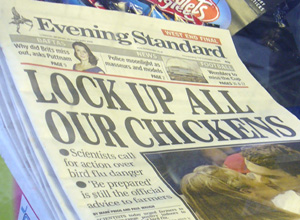
A year ago, a headline like this was pure comedy. And this Evening Standard headline that I snapped last night even now has a slightly comic, Carry On Farming feel to it.
Alas, bird flu seems to be getting rather serious.
Governments thrive on infectious diseases, because only governments, or institutions that are very hard to distinguish from governments, can contain them. Which is why I always suspect that such “pandemics” (pandemic seems now to be the regular word for an “epidemic”) tend to be somewhat exaggerated. But if I were a politician, I would never dare to say such a thing.
The 2012 London Olympic Games could be hit by electricity blackouts as energy supplies fall off, according to a poll of scientists and other eminent folk in this story by the BBC. Well, pole vaulting and javelin throwing have not been done in the dark before, but I guess it might have a certain novelty.
Seriously though, how should one take these jeremiads about impending shortages to electricity generation? This excerpt from the BBC story makes it clear that many analysts believe that solutions must embrace technologies including nuclear power:
All 140 respondents to the survey said that the best way to ensure energy security for the future lay in a diversified mix of electricity generation, including renewables, coal, gas and nuclear
This story of a few days ago suggests the opposition Tories might, in their quixotic desire to appear Green, ditch the nuclear option. This seems rather ironic given that some figures in the environmentalist movement have started to embrace nuclear energy as a way to cut carbon emissions (while not being blind to the problems of nuclear waste disposal and the large capital outlays involved in building nuclear powers stations).
I am an agnostic on nuke energy. If it can, in a free market, hold its own compared with other energy sources, fine. But given the vital importance of electricity to our modern, information-age economy, it is madness to tempt disaster by shutting down options now.
|
Who Are We? The Samizdata people are a bunch of sinister and heavily armed globalist illuminati who seek to infect the entire world with the values of personal liberty and several property. Amongst our many crimes is a sense of humour and the intermittent use of British spelling.
We are also a varied group made up of social individualists, classical liberals, whigs, libertarians, extropians, futurists, ‘Porcupines’, Karl Popper fetishists, recovering neo-conservatives, crazed Ayn Rand worshipers, over-caffeinated Virginia Postrel devotees, witty Frédéric Bastiat wannabes, cypherpunks, minarchists, kritarchists and wild-eyed anarcho-capitalists from Britain, North America, Australia and Europe.
|





Recent Comments