We are developing the social individualist meta-context for the future. From the very serious to the extremely frivolous... lets see what is on the mind of the Samizdata people.
Samizdata, derived from Samizdat /n. - a system of clandestine publication of banned literature in the USSR [Russ.,= self-publishing house]
|
The world is becoming a very disturbing place. I never thought to find myself in full agreement with the lefty journalist John Pilger – whose name was turned into a verb by the late Auberon Waugh: to pilger, to utter whining, systematically-slanted, effusions blaming western capitalism for all the trouble in the world. Yet here he is in The New Statesman this week:
The Legislative and Regulatory Reform Bill has already passed its second parliamentary reading without interest to most Labour MPs and court journalists; yet it is utterly totalitarian in scope.
It is presented by the government as a simple measure for streamlining deregulation, or “getting rid of red tape”, yet the only red tape it will actually remove is that of parliamentary scrutiny of government legislation, including this remarkable bill. […]
Those who fail to hear these steps on the road to dictatorship should look at the government’s plans for ID cards, described in its manifesto as “voluntary”. They will be compulsory and worse. An ID card will be different from a driving licence or passport. It will be connected to a database called the NIR (National Identity Register), where your personal details will be stored. […]
The ID card will not be your property and the Home Secretary will have the right to revoke or suspend it at any time without explanation. This would prevent you drawing money from a bank. […]
A small, determined and profoundly undemocratic group is killing freedom in Britain, just as it has killed literally in Iraq. That is the news. “The kaleidoscope has been shaken,” said Blair at the 2001 Labour party conference. “The pieces are in flux. Soon they will settle again. Before they do, let us reorder this world around us.”
Meanwhile Michael Moorcock writes in The Spectator on becoming American, of his unexpected admiration for the “constitutional fundamentalism” of Ron Paul and how:
I have a feeling that Americans will be putting their house in order rather sooner than the British, because once the People realise there is a problem, We are usually surprisingly quick to fix it.
Given the passivity of our own rather less sovereign people, and the sanguinary noises from all quarters, I do not find myself as hopeful.
I was talking to a civil engineer friend of mine today. I asked him what he knew about the vulnerability of underground facilities, such as those rumoured to be under construction in Iran as part of their nuclear programme. He told me that one does not need to go that deep underground to make such facilities impervious even to a surface level nuclear strike. The flipside is that once you get inside the underground caverns, it is fairly simple to demolish them. If Iran’s nuclear programme is made up of significant subterranean facilities, any effort to end the programme using military means will require a ground offensive of some kind. A concerted air offensive is not going to be enough – bodies on the ground will be necessary to infiltrate and destroy the facilities.
Assuming the intelligence about Iran’s underground laboratories is correct, thoroughly disarming Iran will require more than the easy solution we saw used against Serbia in 1998/99. It remains to be seen whether the United States has the stomach for another ground war in the Middle East – a war they would probably fight alone or in concert with Israel as a (very) junior partner. Under such circumstances, it is hardly surprising that some are questioning American resolve on the issue. Unfortunately, the possibility of Iran successfully acquiring nuclear weapons is far from remote.
I remember, on either September 11 or 12, 2001, in a conversation about the war, I predicted that we would not get out of the current unpleasantness without nuclear weapons being used.
While the strength of my belief in this prediction has wavered a bit over the years, it has now hardened into near certainty.
Read it and weep.
Additional thoughts:
There is no chance whatsoever that the Americans will end the Iranian nuclear threat by preemptive military action. The threshold for certainty and “imminence” has been set too high, the political consequences for waging “preventive” or “preemptive” war have been made too dire, for American politiicans by the last five years of relentless dishonesty and fecklessness in the American media and political scenes.
The Iranian mullahs will get their nukes, (and sooner than the ten years generally bandied about in the media). Once they have them, they will be immune from diplomatic and military pressure. The odds that they won’t use one, either directly or by proxy? Nil.
There remain two interesting questions: Who will they nuke, and what will we do about it?
I doubt they’ll hit Israel, for all their bluster, because Israel is the one country that is certain to launch a massive counterstrike. There are lots of easier targets for them. There probably won’t be any need to nuke Europe – the descent of that continent into dhimmitude will most likely be satisfactorily accelerated by the mere presence of nukes in Iran. I wouldn’t be surprised if the mullahs chose Baghdad or possibly the Iraqi oil port as their first target, to get the Americans out of their face and off their borders.
No one but the Americans will be in a position to respond to the Iranian nuclear attack. Whether we respond in a meaningful way depends on whether whoever happens to be the leader of the US on that day will have the fortitude to nuke them back. The odds of that are rather small, I fear, and once the mullahs have used a nuke with impunity, they will do it again and again. Why not? Is there any reason whatsoever to believe that their behavior of the last 30 years will change for the better once they obtain the combination of more leverage and immunity from real consequence provided by nuclear weapons?
George W. Bush in free fall.
Nudge with cursor as necessary.
The excellent Tim Blair notes a Telegraph article reporting that
European governments should shun the phrase “Islamic terrorism” in favour of “terrorists who abusively invoke Islam”, say guidelines from EU officials.
I have no doubt many hours were spent workshopping that one.
The First Test between Bangladesh and Australia is going right down to the wire, and the final day’s play tomorrow will see a very tight finish. There is a good chance that Bangladesh might pull off one of the biggest upsets in Test cricket history. Australia need 95 runs to win, with only two established batsmen left, and six wickets in hand.
In truth, Australia are fortunate to even be in the game at all, because they were comprehensively outplayed in the first two days of this Test match. Needless to say, this state of affairs has caused plenty of amusement for English cricket fans and other wicked folk.
But regardless of the result, this match has been, to use a cliche, good for the game. It comes as the editor of Wisden Cricketer’s Almanack has released his latest offering in which he takes a small minded view of the game and denounces the ‘globalisation’ of cricket. The way in which Bangladesh were rushed into playing Test cricket was misguided and done for the wrong reasons, but the game is slowly but surely taking a foothold in the country, in terms of playing success.
That is good for cricket. It is even more good for Bangladesh, one of the poorest countries in the world. Bangladesh is famous for being poor, having lots of disasters, and not much else. When the Champions Trophy one-day International cricket tournament was held in Dacca in 1998, one observer said to a shocked editor of Wisden Cricketer’s Almanack that the event was the most positive event in the country’s history since Independence.
With the football World Cup two months away, there may well be quite a bit of tut-tutting in the media about how sport and nationalism are a dreadful combination. And there is something to that. However, I think that sport and national pride, which is something else entirely, is a positive thing. No matter what actually happens tomorrow, the future of Bangladesh cricket looks bright, and I think that is a wonderful thing.
It has been a relatively quiet year so far in Australian politics, with the main story being an investigation into a scandal involving the Australian Wheat Board, which was accused of paying huge bribes for wheat contracts to Saddam Hussain’s Iraq. The political controversy relates to what the government knew about it and what it did about it.
It seems that the government did not know very much about it, and did absolutely nothing about it. The Cole Enquiry that has been formed to investigate this matter and Prime Minister John Howard will testify tomorrow. I have generally taken the view that the enquiries have been a political circus and conducted for partisan reasons, so I’ve not followed it very closely. Other people have taken a greater interest, and have come to different conclusions. However I still feel that this matter is more a case of cock-up rather then conspiracy.
I got thinking about the case from a different angle though, about the bribes. The fact that bribes needed to be paid at all for a straightforward commercial transaction is a shocking indictment of the regulatory stranglehold Saddam Hussein and the UN had placed on Iraq. This is small beer compared to the literal stranglehold that the tyrant kept his people under. But bribery is a natural part of things in so many parts of the world, in various and many degrees. It is by no means restricted to ‘third world’ countries either. But it occurred to me that the more you need to bribe agents of the state to get anything done, the worse the control the state has over the economy, and is a passable indicator of real, as opposed to nominal, economic freedom in a society.
Chronicling the poison spreading through the British system is a bizarre alienating experience. One feels like one of HP Lovecraft’s narrators. The horror is unnamable; we lack the words to describe what is happpening; but horror it is. The independent souls of individuals and institutions are being inexorably, ineluctably, supplanted by something dark and destructive, mirroring and subordinate to the great evil beneath Whitehall.
Look here, if you dare. You may wish to comment on that site.
Jim Murphy MP offers up a chorus in The Times’ Public Agenda section:
Have we done enough to ensure that the children of today are not left behind tomorrow? The answer is surely no.
One way of doing this is by empowering service users through offering a choice of service and providers.
Measuring people’s experience of their local environment, school or the criminal justice system -and acting on it – is also key to securing improvement. In measuring satisfaction, however, we must ensure that we don’t hear again only from the already socially mobilised.
So we have more to do.
But we can achieve this only through greater co-operation. That’s why I welcome the Future Services Network, a partnership between the National Consumer Council, Acevo and the CBI. An important development, it will help to ensure that citizens are at the heart of all policy. That’s all of the people all of the time.
No word of the incantation has discernable meaning. But the effect on this reader was to make him feel suddenly icy, hollowed-out; and the floor beneath him appeared to heave and writhe with snakes.
Zeyad, one of our favorite Iraqi bloggers needs to raise money to attend CUNY’s School of Journalism.
If you have enjoyed his postings, consider giving him a hand.
Patrick Porter, a recent reinforcment for Oxblog, noted the other day that writing history is not as easy as it looks. He was referring to the recent practices of US historians, writing about US social practices of the past that have political implications for today.
Cynics have long known that ‘history is written by the winners’, but the 20th century showed that history could be used and abused to fight political battles that are in dispute. Unlike more traditional readers, I myself have no objection to writers of history using their works to advance an agenda, so long as they are upfront about what that agenda is. Much value can be gained by looking at an old question with the different view that a blatently political or social agenda can provide, regardless of whether or not I agree with that agenda. As a blogger writing for Samizdata.net, it should be obvious that I do have an agenda of my own- the advancement of liberty and against statist values. Given the nature of this blog, that hardly requries disclosure on every post.
The benefits of this are obvious- the reader knows exactly what the intellectual meta-context I am operating from, and can read into what I write to take from my writing what they will. I think that is far more honest then pretending an objectivity that I can not in all honesty claim.
I was moved to remark on this subject not by any historical event, but by a series of historical novels, Colleen McCullough’s Masters of Rome series. For those that are not familiar with these six novels, Colleen McCullogh has novellised the fall of the Republic of Rome and the rise of Julius Caesar, based on the best historical information that she possesses, and uses her writer’s talent to ‘fill in the gaps’. While not to everyone’s taste, I have enjoyed the series and they have sparked in me a great deal of curiousity about classical history. However, I must raise the objection that McCullogh seems far too partisan towards Julius Caesar then seems to be reasonable. At times in the later novels, one is left wondering if this is not hagiography. What is the agenda here? Or is it just that with my libertarian meta-context, I have too much objection to someone who was ‘Dictator’?
Borders finally got around to responding to me… with the same form letter as I have seen elsewhere:
Dear Dale,
Thank you for your expression of concern about our decision not to carry the issue of Free Inquiry magazine featuring cartoons depicting Muhammad. Borders is committed to our customers’ right to choose what to read and what to buy and to the First Amendment right of Free Inquiry to publish the cartoons. In this particular case, we decided not to stock this issue in our stores because we place a priority on the safety and security of our customers and our employees. We believe that carrying this issue presented a challenge to that priority.
We value your thoughts and sincerely appreciate that you invested your time to tell us how you feel about the issue. I can assure you that our management team gave careful deliberation to this decision and considered all sides of the issue before reaching this conclusion. As always, we are interested in customer feedback about our choices and while we know you do not agree with our position, we hope you can understand the challenge of balancing the needs of our customers, employees and our communities.
I hope that this information is helpful. If you should have any other questions or comments, please don’t hesitate to contact us.
Sincerely,
Borders Customer Care
http://www.bordersstores.com
I have responded:
Yes, I’ve seen this form reply posted on other well read blogs.
There are young americans dying overseas to fight these scumbags. You do not even have the guts to stand up against them on your own turf. By folding you endanger others. You prove that threats work.
You are, to use old fashioned terminology, lily livered cowards with yellow stripes down your back a mile wide and you are being called out on it.
Get some backbone. There is more to life than avoiding risk. Your life has to stand for something.
Borders does not stand for anything except cowering in a hole praying it will be left alone… for a little while longer.
Yes, it is indeed their right to be cowards. It is likewise my right to call them on it.
More official exhortation from the British state. This a poster on the underground.
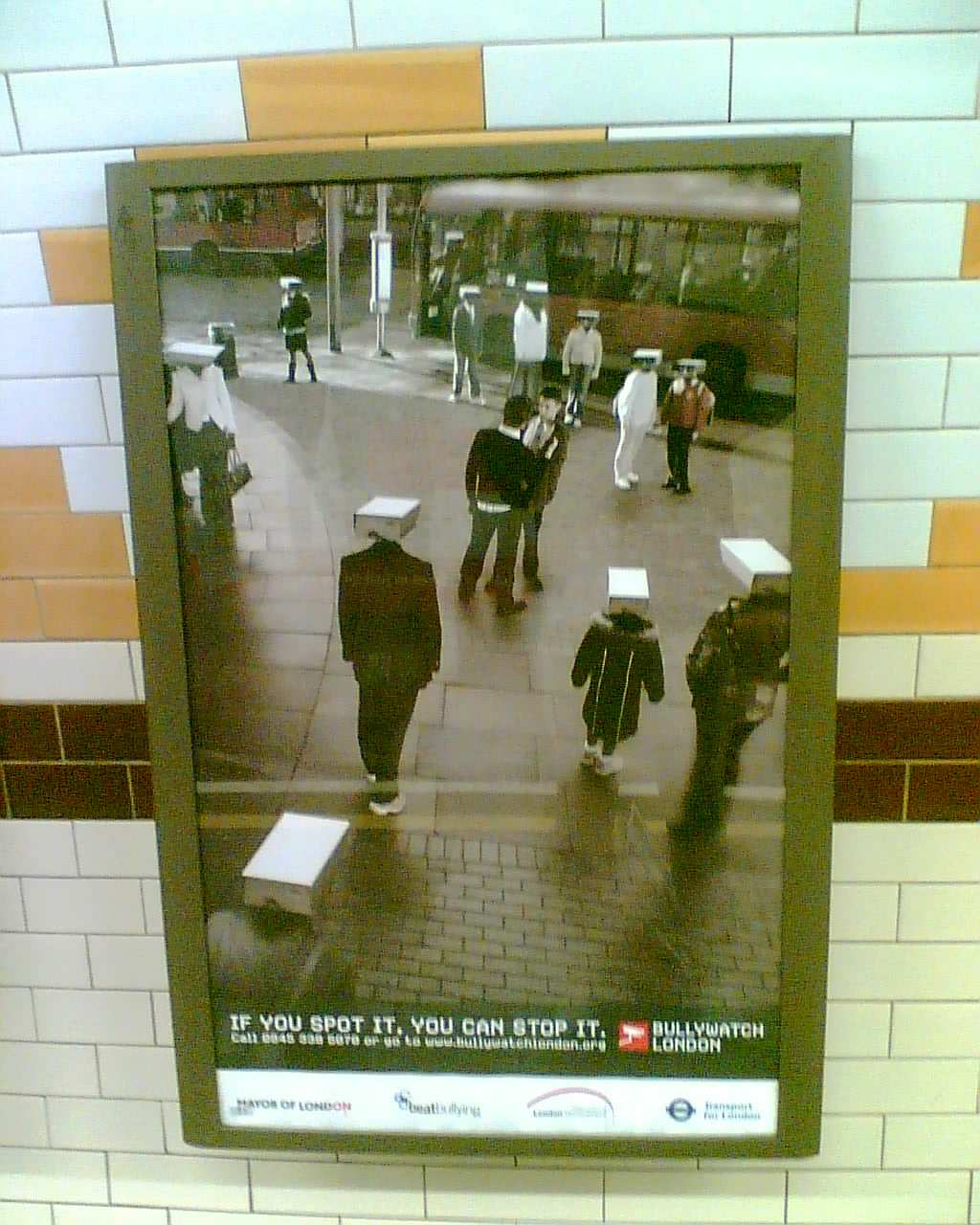
Quite an interesting case, I think, because it isn’t the standard minatory approach: Do X as the Y agency demands, or get a big fine. This has the superficially laudable object of preventing children from bullying one another.
You may think (I do) that it ought to be unnecessary to urge people to protect children against bullies, and that this is not a suitable topic for state propaganda – that most adults could be counted on to intervene as a matter of ordinary humanity. But that reckons without the passivity and inanition fostered by 60 years of welfarism, and 30 years or so of ‘child protection’ doctrine under which speaking roughly to a little boy (let alone touching him), makes one the wickedest of criminals. You might have to work on people these days to get them to do something.
But plainly that isn’t the object of the exercise here. This ad doesn’t encourage people to stop bullying. For all the empty vapourings about ‘active citizenship’ (See here for an example of the Government propaganda on that topic that is churned out by notionally independent organisations), nothing may undermine the dependency culture. What this campaign is for is to get people to report incidents they think might be bullying to the authorities. There is a website and a subsidised telephone line for you to do so.
It is obviously impossible that this could help the unfortunate smaller boy. One has to conclude that isn’t really the point. The point is to get members of the public to adopt official attitudes, and engrain them by providing a mechanism to rehearse, to act out, concern. It is for to prove you are a compliant member of society by watching others carefully and reporting deviant behaviour. The state will deal with the problem, however minor, however fleeting, however apparently amenable to personal decision.
I don’t think that this is a deliberate, explicit project. I think it is a natural outcome of the cultural assumptions of those who commission such ads. We are not just supposed to love the surveillance camera, but to identify with it. The ideal citizen is a passive tool that reports back as requested; that fits in with the total bureaucracy’s demand for record.
For those of us – left and right – who still hold to the western liberal tradition of individual moral responsibility, this is a sickening, vertiginous conception of social life. The life of ants, not human beings. For those who are broadly conservative communitarians – right and left – who would like embedded institutions, direct relationships and personal responsibilities to dominate, likewise. The possibility that we may – all taken together – be in the minority should be a source of terror.
Secure beneath the watching eyes? Not in the slightest, me.
|
Who Are We? The Samizdata people are a bunch of sinister and heavily armed globalist illuminati who seek to infect the entire world with the values of personal liberty and several property. Amongst our many crimes is a sense of humour and the intermittent use of British spelling.
We are also a varied group made up of social individualists, classical liberals, whigs, libertarians, extropians, futurists, ‘Porcupines’, Karl Popper fetishists, recovering neo-conservatives, crazed Ayn Rand worshipers, over-caffeinated Virginia Postrel devotees, witty Frédéric Bastiat wannabes, cypherpunks, minarchists, kritarchists and wild-eyed anarcho-capitalists from Britain, North America, Australia and Europe.
|





Recent Comments