We are developing the social individualist meta-context for the future. From the very serious to the extremely frivolous... lets see what is on the mind of the Samizdata people.
Samizdata, derived from Samizdat /n. - a system of clandestine publication of banned literature in the USSR [Russ.,= self-publishing house]
|
Many moral questions are tricky, requiring complex theories and difficult judgements… but many more moral issues are really very simple when you look at them clearly. Manditory mass medication is one of those simple issues. I am as keen as anyone else to not see epidemics of infectious disease and in the case of such, I take the view that it is rather like why you have states to fight against foreign armies: a collective threat to everyone can sometimes only be faced by a government acting collectively. However very few things fall into this category, but infectious disease is one which indeed does – a collective threat that can only be defeated collectively. So yes, I am all for property rights but that does not include having a malarial breeding swamp on your property next to mine or infecting everyone’s water supply with some nasty bug.
Birth defects on the other hand, are not a ‘collective threat’ and so taking folic acid to avoid certain birth defects is the responsibility of anyone who does things likely to get them pregnant. So when Max Pemperton writes an article in the Telegraph opposing government plans to force bakers to add folic acid to bread, you would think I would be supportive of him, right? Well no.
In his article Folic acid is not the best thing since sliced bread he goes into a great song and dance about the pros and cons to various groups in the population of adding folic acid and whilst he does talk about civil liberties, he is mostly just making a utilitarian argument of net-benefit. He ends with saying “It’s certainly a complex moral dilemma”… and that completely fogs the issue.
No, it is actually a very simply moral dilemma: does anyone have the right to alter my body chemistry to benefit other people when my body chemistry poses no threat to anyone else (unlike if I have smallpox, for example). The question (does the state have this right?) and the answer (no) are not complex at all. If women want to avoid neural tube defects in their children, they should take folic acid. Making me take it as well will not help and is none of anyone elses damn business.
Few things are as impermanent as medical theories of ‘what is best’, so the utilitarian argument is utterly irrelevant. As it happens I take folic acid pills for a medical condition so I have nothing against the stuff myself but that does not change the fact the state has NO moral right to medicate me in such a way and anyone who trusts the state to pick ‘what is best’ for your health and make it a force backed law really needs to take a look at the state’s history of screw-ups and ask themselves is this is an institution which should have the right to mess with your personal body chemistry.
Australia’s flagship national broadsheet, The Australian, published an article today sporting the title Cut to the bone: working poor on the rise. To illustrate this terrible phenomenon, the Oz article provides the example of Vicki and Terry Rawiri, who
[by day] worked at the supermarket, while at night Vicki, 42, weighed carcasses and Terry, 43, classified as a labourer, worked as a slaughterman.
And even then they could barely afford the gruel, you might surmise. Well – not really. This pitiable couple
were trying to get ahead by paying off the mortgage of their $365,000 [about 150 000 GBP] home in Cowra in eight years
Your heart bleeds, no? The sacrifices abject poverty forces one to make! Leaving aside the horrors of working hard to pay off one’s mortgage quickly, the article goes on to quote a survey filled with anecdotal evidence of the plight of Australia’s poor; how they cannot afford to drive registered cars, thus risking the law’s wrath in unlicenced wrecks, how they can only find $20 to go to the movies if it comes out of the food budget. Well, here’s some anecdotal evidence that I have gathered in my travels – I once worked at a very large and very busy liquor store in an especially low socio-economic suburb in Perth. The poor may not be able to drive a registered car or spend $20 on a movie, but rest assured that a large chunk of them generally have quite a lot of money to spend on alcohol. Putting that aside, the tough luck stories of a few are not borne out by hard economic data from the Australian Bureau of Statistics pertaining to the poor in the aggregate:
over the period from 1994–95 [to 2003-2004], there was an estimated 22% increase in the real mean income of both low income people and middle income people and 19% for high income people
→ Continue reading: Australia’s working poor: a tragic case
Matt Welch has written a farewell lament in Reason on what he describes as the demise of warblogging. He harks back to the explosion of the grassroots media after 9/11 when many Americans found that their assumptions about the Middle East and terrorism were turned upside down. From this development, he defined the warblogger as a writer who transcended old partisan divides due to the defining event of a terrorist threat to the homeland.
“What do warbloggers have in common, that most pundits do not?” I enthused. “I’d say a yen for critical thinking, a sense of humor that actually translates into people laughing out loud, a willingness to engage (and encourage) readers, a hostility to the Culture War and other artifacts of the professionalized left-right split of the 1990s…a readiness to admit error [and] a sense of collegial yet brutal peer review.”
Man, was I wrong.
Now, Welch has acquired a new job on the Los Angeles Times, and argues that the political blogging movement has reinforced partisan politics rather than bridging this supposed gap. Yet, the developments that Welch cites to bolster his thesis are disparate and amenable to alternative interpretation. He argues that the “current-events bloggers” have taken a strident approach to particular issues within the Culture War:
The Culture War, which seemed to take a back seat to the genuine article in those traumatized days of late 2001, has come back with a vengeance, with current-events webloggers taking a central role in the hysterical Red/Blue scrums over Terri Schiavo’s comatose body, Janet Jackson’s exposed nipple, and the pressing national security issue of whether people of the same sex should be able to obtain a marriage certificate.
His other examples are the inability of the blogosphere to create a permanent alternative to the mainstream media, like the Pyjamas website and the use of bloggers to galvanise activist support, especially within the Democratic Party. Welch does also emphasize that weblogs are now far more useful for the dissemination of knowledge and the procurement of differing viewpoints on particular issues. But he still views the development of warblogging as a lost opportunity:
But as I look back at December 2001, and prepare to hang up the blogging fun of Reason’s Hit & Run for the stodgier print pages of the L.A. Times, I can’t shake the feeling of nostalgia for a promising cross-partisan moment that just fizzled away. Americans are always much more interesting than their political parties or ideological labels, and for a few months there it was possible for readers and writers alike to feel the unfamiliar slap of collisions with worlds they’d previously sealed off from themselves. You couldn’t predict what anyone would say, especially yourself.
To which the answer is: if you just look at blogs from the political perspective, it will appear more partisan, as activists have established and learned how to use these tools to their advantage. More importantly, many of those who blog on current events have strong and individual voices ranging over a wide spectrum of subjects. Warblogging did not run into the sands or fade away. After a while, bloggers preferred to jaw-jaw on more than just war.
It appears the premature shutdown of the Falcon 1 engine was caused by a pad processing error. A pipe fitting was loosened by an experienced technician while working on the avionics. I would really not want to be in his shoes today.
You can read more details here.
 Engine fire is visible shortly after launch, just above the nozzle. Photo: SpaceXPS: This definitely had more serious consequences than the time my extremely souped up MGB backfired through the carburator and set the air filter on fire…
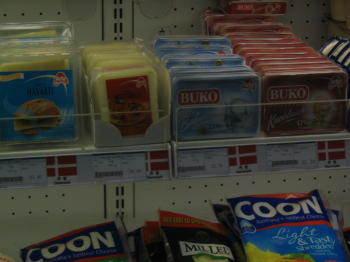
Commenters in my last post have asked me exactly what I was talking about when I stated that I found many “Danish cheeses that would be illegal in Europe” in a Chinese supermarket. Although it is actually possible to figure out what I was talking about from a careful study of the top photograph and perusal of Samizdata‘s fine archives I shall, none the less, explain myself. In truth, I was being slightly misleading.
The European Union has in recent years adopted laws (based on earlier French laws) adopted “Protected Designation of Origin” and “Protected Geographical Origin” laws concerning the names of foodstuffs, which state essentially that if a food product is supposedly characteristic of a certain place of origin, then the particular name of that foodstuff can only be used on products made in that place, and usually also made in a particular way (subject to vast books of regulations) in that particular place. Sometimes that product name is the name of the place (eg Edam cheese must come from Edam in the Netherlands), and sometimes it is not(“Camembert” cheese must come from Normandy). Nobody seriously objects to laws that make the origins of products clear, and make it illegal to genuinely attempt to deceive about where a product came from, but these laws are notable for their overreach. In many cases, the attempt has been made to regain control over names which became generic decades or centuries ago, and it has also become illegal to use these names desciptively in any sense. (You cannot say “This cheese resembles camembert” or even “This cheese does not resemble camemert” on the label). Ultimately this has ended all about being protectionist with respect to small numbers of producers.
Having adopted these laws inside the EU, the European Union’s agriculture directorate (sometimes also known as “The French”) has attempted in trade negotiations to have similar laws enacted internationally, using the argument that “We are good citizens within the EU and respect these laws and the rights of producers (blah blah blah), and therefore they should be respected internationally too. Their attempts to have such laws adopted within the WTO have largely involved their being told to get stuffed, principally by the Americans, but they have had some success in bilateral negotiations with smaller countries (eg Australia) that want to trade with the EU in agricultural products.
However, there has been a split between northern and southern Europe on this. A large number of these PDOs and PGOs have been adopted in southern Europe (particularly France and Italy) but there has been much more reluctance to adopt them in northern Europe, where farmers and producers have been reluctant to accept the large amount of regulations that has come with them. For instance, the producers of stilton cheese considerd participating, but ultimately decided that protecting the word “stilton” would reduce the flexibility of their businesses sufficiently that it was not worth doing so, although they did actually (and somewhat idiotically) adopt “Blue Stilton” and “White Stilton” as protected phrases. In the “screwups” department, the producers of Newcastle Brown Ale did apply to have the name protected, and then discovered that it was technically illegal to use the name “Newcastle Brown Ale” for beer brewed in their new brewery across the river in Gateshead.
None the less, northern European countries have (with a bit of grumbling) gone along with these laws, and products on supermarket shelves have been relabeled.
But, as I discovered in China last week, they only do what they have to. → Continue reading: More on Danish dairy products and illegal cheeses
Nice to see that those superannuated rock legends, the Rolling Stones, brushed aside the dictates of Chinese censors and bashed out some of their naughtiest tunes at a concert in China. Mind you, I cannot really see these guys going on much longer.
One consequence of the recent Danish cartoon saga has been that wherever I have travelled to recently, I have found myself in supermarkets seeking out Danish products, just to make sure that stores and customers are still offering and buying them, and that any supposed boycotts of Danish products are not working. My perception arriving in a Chinese supermarket last week was that the Chinese don’t give an <expletive> about whether anyone has drawn cartoons of the prophet Mahommed, and so I was expecting I might see a pack of two of Lurpak on the shelves or something like that. And I did.

The representation of Danish products was actually excellent, with lots of cheeses as well, including many that would be illegal in Europe. However, when one looks carefully at that picture, one discovers something much more interesting. Look at that word in the top right hand corner of the butter label.

So, there is clearly no problem. Eating this fine Danish butter is cleary fine with Allah. Nothing to worry about then.
The Economist magazine, about which James Waterton wrote a few days ago (it is getting a new editor), has an interesting cover article ‘Soft Paternalism’, chronicling the growing trend of governments to devise ways to make people behave in certain ways, usually in order to meet some supposedly desirable objective, such as losing weight, saving for a pension and so forth. I do not think the Economist hits the issue nearly hard enough but I absolutely love the picture associated with the article.
I rather like this quotation in the final paragraph:
Private virtues such as these are as likely to wither as to flourish when public bodies take charge of them. And life would be duller if every reckless spirit could outsource self-discipline to the state.
Some people, including libertarians, are a bit hard on the Economist, which often veers away from its historical attachment to free markets, liberty and limited government. I occasionally find its tone condescending but on the whole that magazine is a force for good. Let us hope that under its new editor, the Economist continues to beat the drum for classical liberalism in an era when liberty is all too often on the back foot.
Israel has a new defensive system for vehicles called ‘Trophy’, now under evaluation by the US military. I first heard of it yesterday when I came across a demo video on Fox News under the category ‘Nation’ (hurry and see it before it goes away!)
I did not uncover anything else about it until this afternoon. It appears the system is a tiny version of an anti-ballistic missile missile. The incoming RPG (or whatever) is tracked by radar and knocked out of action by what looks to me to be a kinetic energy impact kill to the head of the incoming round by a very fast little short range rocket.
What I find interesting in the Fox News video is the way the explosion plume spreads out as if the incoming hit a non-physical wall.
Also see this General Dynamics report.
Many thanks to one of our commentariat for figuring a way to link to the Fox News video!
A government is a body of people usually notably ungoverned.
– Derrial Book, the Shepard in Firefly episode War Stories
The decision reached today on US immigration policy (as a compromise on Bush’s guest worker scheme) sounds… confusing. Not to mention expensive. Three categories of illegal immigrant, each slighly more illegal than the last…. What does it mean to be a little bit legal? Is that logically similar to being a little bit pregnant?
I tend to agree with Coyote in Arizona, who is tired of defending his borders:
To answer my premise that “immigration should be legal for everyone” with the statement that “it is illegal” certainly seems to miss the point (it kind of reminds me of the king of swamp castle giving instructions to his guards in Monty Python and the Holy Grail) The marginally more sophisticated statement that “it is illegal and making it legal would only reward lawbreakers” would seem to preclude any future relaxation of any government regulation.
A lot of attention is being paid to the question of whether or not allowing immigrants in the US to seek legal status after arriving illegally constitutes an amnesty program. Seems to me of little import what one calls it. Of far more concern to me is the fact that institutionalizing a drawn-out state of official limbo as an added feature of an already drawn-out immigration process is just a bureaucratic nightmare waiting to happen.
Shall we play “name that unintended consequence”? In this case, my guess is that, just like social welfare programs, this program could create a separate class of pre-citizens working into a de facto state of indentured servitude, having bartered rights for opportunity.
Any government that creates a legally sanctioned secondary class of citizen, even if that status is temporary, is headed for trouble. By definition, you cannot make a market of ‘inalienable’ rights. And a scheme that trades citizenship for labor is nothing but a fancy breed of feudalism.
The black market in labor, where individuals strike illegal deals over gardening, harvesting, sewing or childcare, may or may not be ethical, depending on your personal philosophy, but it is voluntary in a way that government-created and government-regulated secondary labor markets cannot be.
I so need to go and drink football and watch beer.
A Samizdatista, who shall remain nameless, explaining his priorities for the day. I myself have been guilty of a few slips of the tongue. Explaining my vices to an Australian blogger, I admitted that:
I drink like a train and smoke like a fish.
My doctor agrees that I should be smoking like a fish, and he has a point. Meanwhile, I will now remove my foot from my mouth.
|
Who Are We? The Samizdata people are a bunch of sinister and heavily armed globalist illuminati who seek to infect the entire world with the values of personal liberty and several property. Amongst our many crimes is a sense of humour and the intermittent use of British spelling.
We are also a varied group made up of social individualists, classical liberals, whigs, libertarians, extropians, futurists, ‘Porcupines’, Karl Popper fetishists, recovering neo-conservatives, crazed Ayn Rand worshipers, over-caffeinated Virginia Postrel devotees, witty Frédéric Bastiat wannabes, cypherpunks, minarchists, kritarchists and wild-eyed anarcho-capitalists from Britain, North America, Australia and Europe.
|





Recent Comments