We are developing the social individualist meta-context for the future. From the very serious to the extremely frivolous... lets see what is on the mind of the Samizdata people.
Samizdata, derived from Samizdat /n. - a system of clandestine publication of banned literature in the USSR [Russ.,= self-publishing house]
|
We seem to have become practically as theocentric at the higher levels of the administration as these people we’re waging war against. It makes me kind of uncomfortable.
– Christopher Buckley, interviewed in the Sunday Times Magazine
He’s talking about the US; but there are some discomfortingly morally aggressive Christians in charge on this side of the pond, too.
Best joke of the World Cup so far. Italy versus Ghana. An Italian gets an early yellow card for a nasty tackle, treading on the guy’s ankle. As Ghana’s Essien hobbles to his feet and we are shown the replay, John Motson says:
Yes, that’s the one FIFA want stamped out.
Not to say cracked down on.
It is now nearing half time, and although there have been no goals, it has been what they call end to end stuff. Ghana could well surprise. What have I said? Italy score! Someone called Perlo. Sorry, Pirlo. Earlier Toni nearly scored for Italy, and deserved to, slamming it against the underside of the bar with the Ghana goalie well beaten. Half time: 1-0 Italy. More goals to come surely, unless everyone gets heat exhaustion.
Earlier in the day, the first really crazy game. Japan 1-0 up over Australia with hardly any time to go, and I have to go out on an errand. Fine by me. You do not want to be sitting next to a computer (i.e. a fan heater) all day in this weather. And it must be far too hot out there in Germany for anything much to happen before the whistle. Out and about, only moments later, I hear yelling in a pub, look in, and find the Anglosphere celebrating Australia’s third goal.
What will Michael say?
Next up for the Aussies: Brazil. No worries.
Just spoken at vloggercon on the net neutrality panel. It was organised and chaired by the guys from blip.tv – Charles Hope and Mike Hudack, who was recently on PBS NOW programme debating the issue. The panel discussion was heated at times and only reinforced my opinion that this is one of the most important issues affecting the future of the internet these days. The points below reflect my position:
- The telecoms and cablecos are heavily regulated and their cries for free market are false. The industry is already warped and the argument against net neutrality based on the desire to keep government out of ‘markets’ is misplaced.
- The distinction between consumer and user is gone. It is in fact the ‘content’ produced by many individual vloggers that put the social media cat among the old media pigeons. The media industry has smelled the wealth of content and feels the urge to control it.
- A network that is heavily regulated and not very innovative is being used as a model of control and regulation for a network that is amazingly open, innovative in a historically unprecedented manner. So the government is imposing regulation from a closed and cumbersome industry to an agile and dynamic space.
- Nothwithstanding all of the above, net neutrality legislation is not the answer – it is more like ‘casting out a devil with the devil’. There is no fundamental understanding of the internet as a space, marketplace, world or a frontier (for more on this see Doc Searls’ article on Saving the Net). The debate should not be about the internet as a sum of pipelines and wires and content and packets delivered across an infrastructure. It should be in terms of protecting the space in which the individual has been empowered and the emergent benefits of interactions among those individuals that are having an increasingly sociall impact.
There was more but this is what I can think of whilst sitting in the middle of vloggercon still in full flow.
Update: In the heat of the moment, I forgot to mention my ‘solution’ – deregulate telecoms and cablecos so we have something resembling a real competition at the pipelines and wires level. Then the pipeline takers will not have a case to control content and what goes through. Susan Crawford sums it up well:
Think of the pipes and wires that you use to go online as a sidewalk. The question is whether the sidewalk should get a cut of the value of the conversations that you have as you walk along. The traditional telephone model has been that the telephone company doesn’t get paid more if you have a particularly meaningful call — they’re just providing a neutral pipe.
cross-posted from Media Influencer
However this time it is nice to hear of Islamic extremists killing themselves in ways that do not involve blowing themselves up on a bus in London or in a pizzeria in Israel in order to murder a bunch of civilians. More of this and faster please.
Good to see the stalwarts of the entertainment industry still have it in spades.
(Seen on Manolo’s Shoe Blog. Manolo also seems to have a fetish for a certain German entertainer.)
Rubicon: The Triumph and Tragedy of the Roman Republic
Tom Holland
Little, Brown, 2003
One of the great joys of my teenage years was hearing, with titles and composers attached, the very same classical music core repertoire that I had first been exposed to in my infancy. So that’s what that is, I would cry out with joy, as yet another familiar tune would finally identify itself as whichever overture or symphony or concerto it was. Lost chord after lost chord, found.
Reading Tom Holland’s Rubicon has been a similarly joyous experience.
After my infancy of listening to the BBC Third Programme, there followed an expensive education during which I absorbed only bits and pieces of what was being said. I emerged from this education with a fairly thorough understanding of the Bible and its various contents, even as I became ever more unconvinced by its claims. Geography and post-1066 English history were a solid enough basis for further reading and learning. But when it came to the ancient world, the pieces of the puzzle were too few to join up, the fragments of the picture too closely associated with the grind of being made to learn Latin and Greek, which for me never really got beyond word games. I recall being awarded ninety eight percent for a “Latin verse” exam. Even then, I knew that my achievement, such as it was, had nothing to do with poetry. As far as ancient Roman history was concerned, most of what I emerged with from my Latin lessons was a jumble of mysterious names, such as Labienus, Cotta, Vercingetorix, Jugurtha, Mithridates. Much was made in my Latin lessons of Rome’s subjugation of Britain, but only a vague version even of that really stuck.
At some point I acquainted myself with an approximation of the Hannibal story, with its epic crossing of the Alps, its equally amazing massacres of various legions at Lake Trasimene and at Cannae (216BC), and later Hannibal’s defeat, in 202BC at Zama, which was the one where Scipio Africanus left gaps in his line for Hannibal’s elephants to charge uselessly through.
Later on, further pieces of the puzzle landed on the still largely empty table. Shakespeare’s Julius Caesar, for instance, and then Anthony and Cleopatra. I devoured Robert Graves’s I Claudius and Claudius The God, but mostly because of the evil Messalina’s exploits and because of all the gladiatorial gore. Not that long ago, I finally watched the movie Spartacus all the way through. More recently, I got hooked on Rome, the recent TV soap opera. But I missed the beginning of that, and was never really sure where the boundary was there between fact and fiction. (Verenius? Pullo? Still don’t know about them.) But it was still only bits and pieces. More big names had piled up in my head, like Crassus (Laurence Olivier in Spartacus), and I now knew rather more about Pompey (Kenneth Cranham in Rome). But I only caught these personages in the middles and ends of their careers. Given that Pompey’s career ended in defeat at the hands of Caesar, how did he get to be called Pompey Magnus, Pompey the Great?
For me, the joy of reading Rubicon is that the blanks have at last been filled in. Joy may seem an odd word to describe reading about events which involved so much suffering and disaster, both to Romans and to their enemies. But now that it has all happened, we might as well enjoy it. It would have been no fun to have been in a legion at Carrhae (53BC), say, where the career of Crassus came to its abrupt and appalling end, but me having a grand old time learning about it all isn’t going to make things any worse for anybody. And I really did enjoy this story. At no point while reading it was I ever bored or tempted to skip things. Seriously, it has been a long time since I have read a book with such rapt attention to what it was saying, with so little attention to what page number I had reached, and with such genuine disappointment when it stopped. → Continue reading: Tom Holland fills in my ancient Roman blanks
The BBC commentators were as doom-laden as usual for our one nil victory over Paraguay. But it was a useful victory and Lineker needs to listen to what Sven actually says.
But, watching the Italian Job afterwards with my friend and a bottle of Maltese Red, one could see how times had changed. In 2008, the coach transporting the gold to Geneva would have been decked out in white and red.
And I know the Mini chase scene would not work with this pattern…
I am in San Francisco right now with Adriana, who will be speaking on net neutrality at Vloggercon tomorrow with her Samizdata co-editor hat firmly affixed. Today, we will be attending Techdirt Greenhouse with fellow Samizdatista Hillary Johnson.
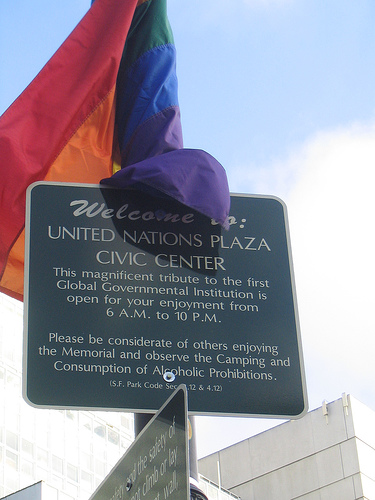
Upon arrival yesterday, Adriana and I went for a wander and took in the, er, sights. We passed by UN Plaza, where I snapped this nauseating image:
On the same pole, there is a sign warning vagrants not to peddle without a permit. Still, I would have loved to have taken a snap of the sign that Perry de Havilland and I spotted while driving around in San Francisco last year, which featured a beaming Asian-American woman with the following in bold letters:
Paying taxes really pays off!
Whenever I am in San Francisco, I cannot help but think of the great Ken Layne, who wrote in 1998:
San Francisco is truly the foulest place on earth. The nation’s most expensive city features $2,000 moldy little apartments, a filthy broken-down transit system, tens of thousands of bums on the dole, the nation’s worst newspapers, year-round crappy weather, and a local government that’s truly of and for the people. That’s because the people here are total idiots.
We are actually quite enjoying the weather, but the rest sounds about right to me.
This takes some beating for an alarming sub-header for an article:
As Wednesday morning dawned, northern Norway was hit with an impact comparable to the atomic bomb used on Hiroshima
Blimey! At least it happened in the middle of nowhere rather than downtown Oslo.
Still, we all know it was really caused by George Bush capitalism McDonald’s global warming!
After a few months of rather dodgy weather, summer has at last arrived in London. The evenings are long, the weather is warm, and the mood is good. It is a lovely time to be outside in the beer garden of a nice pub, with a pint of Kölsh lager or something similar. It would be nice to perhaps spend some of the weekend following up on this: sitting in a pub, watching a little sport perhaps on a TV in a quiet civilized audience somewhere.
Unfortunately, it is a slow weekend from a sporting point of view. International cricket has been going for a month or so. England have already played a three test series against Sri Lanka in which the cricket was rather variable, both sides playing well at some points and quite badly at others. (The eventual 1-1 drawn series was a fair result). There are some one day internationals coming up, but the international season doesn’t get back into full swing until England’s test series with Pakistan commences on July 13. In English domestic cricket, Australia’s cricketing genius on the field and A class idiot off it Shane Warne is playing brilliantly as captain of Hampshire, clearly determined to improve on the second place in the County Championship that the county achieved last season when Warne was largely absent due to being off playing for Australia.
And of course, the peace of the true sporting fan is going to be horribly distracted by the fact that the soccer World Cup is being played for the next month.
In the first few weeks of my first stay in England in 1991, I found that English people would utter the words “Nineteen Sixty Six” into all kinds of conversations, usually spoken in hushed tones remniscent of some sort of religious rapture. I found this deeply peculiar, and after it happened four or five times I finally asked one of these people what had happened in 1966, because the English kept bringing it up in this odd way. The response I got was initially disbelief that I was asking this question (the same sort of disbelief that I would get later when I revealed that I was not intimitely familiar with British politics or minor British television personalities of the early 1970s), and when it was figured out that I was serious it was explained to me that Britain had won the World Cup in 1966, and they were still getting joy out of this. I found this kind of sad, but I let them keep it up. I had had some idea that the English (and indeed other Europeans) had some sort of affection for this game.
Then, as now, I could not treat any of this with even the remotest seriousness. As to why Europe and many other parts of the world are so preoccupied with this stupid game that is disdained by all real men, I have no idea. People kick around a round ball and seldom score goals, but spend an awful lot of time falling over and pretending to be injured. Meanwhile, spectators fight out three thousand years of European ethnic disagreements in the stadium. I am unable to even regard it as a sport. I cannot take it seriously enough even for that.
And the lead up to a major tournament like the World Cup is so ridiculous. Rather than declaring themselves to be chavs by wearing a backwards Burberry baseball cap plus three gold chains and an iPod shuffle outside their shirts as they would in normal circumstances, people declare themselves to be chavs by attaching four England flags to the outside of their cars. It is really awful. The newspapers are full of nothing but the tournament. Conversation is about nothing else. The pubs become full of rowdy people who get aggressive when England (inevitably) lose. I just want to sit outside and drink my pint in the sun, but I cannot.
The most I can hope is that it will be over fast. For that reason I hope that England loses every game 10-0, in order that they are eliminated as quickly as possible and my summer can get back to normal. For the sake of God Almighty do not let England win the stupid tournament. The prospect of them being obnoxious about it for the next 40 years is so horrible that I would have to leave the country. If Sven-Goran Ericsson could also conclude his career as England manager by getting into a bizarre sex scandal with Wayne Rooney, that would be an added bonus. While on that, I would also like to see the Italians eliminated quickly, and hopefully in some really embarassing fashion. When they were elimiated by South Korea in the 2002 tournament they went on to demonstrate that they were the worst losers in all of human history, and I would like to see this again.
As for the event in total, I hope that the United States win it, ideally by beating France in the final. That would be the best possible outcome, as the Americans wouldn’t actually care, the French and the English would, and we would be spared any nation at all from being obnoxious about it for the next three decades, as would be the case in the event of any other winner.
Sadly, my own nation seems to have lost the kind of civilized attitude held by the Americans. Australia have qualified for the World Cup for the first time in 32 years. On the previous occasion when Australia qualified (in 1974), they were given a parade down the main street of Sydney before heading off to Germany for the tournament. On that occasion the team was heckled and whistled at by bystanders for playing a girls’ game, but sadly that sort of attitude is now gone. Australians are watching the tournament with interest, although they wouldn’t pay much or any attention to soccer on any other occasion. Somehow they think that since much of the rest of the world cares about this idiotic event, they should too. I can’t imagine that things in Australia are as bad as here – for one thing I don’t think our bogans will be attaching multiple Australian flags to their white Ford Falcon utes, which is something. However, people are, sadly, watching. I don’t really care one way or another if Australia do well, although in truth they are in quality so far from the decent soccer sides that if will be a good result if they score a goal in the tournament. That said, I rather wish the Australian media left the event in the obscurity it deserves.
For Australians’ mind should be focused, and they should be thinking about something much more important than this trivia. There is an actual sporting event taking place at the end of the year, and this one does matter. The shame of Edgbaston must be expunged. The Ashes must be regained.
Here is a sight calculated to warm the hearts of anyone who has been bitten by the state’s fetish for surveillance.
Here is a telling quote from a recent Observer article about violence between (South) Asian and Somali schoolchildren in Birmingham:
‘This issue arises because it is a high density area,’ said Farrukh Haroon, a project worker at the YIP. ‘Communities are scrapping for scarce resources …’
Here is another:
‘It is complicated – there is not one pattern, not one trend and not one answer,’ said Simon Blake from the National Children’s Bureau. ‘But we have to bust these myths about who gets the best housing and how resources are allocated.’
Sorry, Mr Blake, but myths with a core of truth are hard to kill. Communities will always “scrap” for government resources because they are correct in their belief that if group A gets more of the pie then group B gets less. Scrapping, with or without bricks and broken bottles, is an excellent way to get more pie. Nor is it wise to hope for a day when resources are no longer scarce; in most of the country the economy is more sovietised than many countries that not so long ago were actually part of the Soviet bloc. If you will forgive an earthy metaphor, an economy based on drinking one’s own urine can only go on so long.
Laban Tall, commenting on the same article, congratulates the Observer for having finally discovered that not all racism is white on black. I am a good deal more optimistic than he that multi-racial – and even, to some extent, multi-cultural societies can be made to work. Just not where there is socialism.
God help us if the world ever becomes one multi-cultural society under socialism, as it looks as if it might. I forsee a future of low-level suppurating conflicts that never heal because the reason for their existence never goes away.
We have had a foretaste. A recent report that examined the causes of the riots in Burnley five years ago says that the government handing out “regeneration” money in the 1990s created rivalry and anger that helped create the conditions for the riots.
“Positive regeneration had an unintended side effect,” the report says. “Ironically, it contributed to social fragmentation by increasing neighbourhood rivalries …
You know what they say: first you screw up. Then you screw up again in the same way again to prove that it really was a screw-up first time round. You guessed it: Burnley’s problems in 2006 are to be dealt with by handing out regeneration money. But fear not!
Regeneration programmes now cover wider areas and are based on themes, rather than simple ward boundaries.
Themes. Assuredly these themes will make all well and no one will whisper that some communities are more thematically challenged than others and hence are getting more than their share.
However, never let it be said that government always screws up in the same way. Sometimes government screws up in new ways.
Elevate East Lancashire, one of the government’s nine housing market renewal pathfinders, is working – sometimes in the face of opposition from furious homeowners – to demolish inner Burnley’s too many terraces and provide sites for commercial builders to create new homes.
It does not say whether those “furious homeowners” are black, white or brown. It does not matter. Whatever colour their skins they will be embittered by having their homes taken from them for the greater good – the greater good of other people – and in a place blighted by regeneration it takes but the weight of the feather to tip the balance from general bitterness into racial bitterness.
|
Who Are We? The Samizdata people are a bunch of sinister and heavily armed globalist illuminati who seek to infect the entire world with the values of personal liberty and several property. Amongst our many crimes is a sense of humour and the intermittent use of British spelling.
We are also a varied group made up of social individualists, classical liberals, whigs, libertarians, extropians, futurists, ‘Porcupines’, Karl Popper fetishists, recovering neo-conservatives, crazed Ayn Rand worshipers, over-caffeinated Virginia Postrel devotees, witty Frédéric Bastiat wannabes, cypherpunks, minarchists, kritarchists and wild-eyed anarcho-capitalists from Britain, North America, Australia and Europe.
|





Recent Comments