We are developing the social individualist meta-context for the future. From the very serious to the extremely frivolous... lets see what is on the mind of the Samizdata people.
Samizdata, derived from Samizdat /n. - a system of clandestine publication of banned literature in the USSR [Russ.,= self-publishing house]
This I wrote elsewhere in a discussion about politics and public opinion:
‘Courting the anger of small out-groups in order to prove himself to a broader public as acting bravely in the “greater interest” is such an established and successful Blairite technique that they are all at it: Cameron goading the right into denouncing him; Brown picking up Trident as a touchstone guaranteed to infuriate Lefties. Blair himself appears to have internalised technique as policy, believing that if he is irritating civil libertarians and better lawyers it is a sure sign he is in the right.’
And I think I was correct. Blair’s destruction will follow, as he is already starting to broaden the principle to include the rest of his party and the public. “I don’t care what you think.” is not a sustainable position for a politician.
It does surprise me that no mainstream commentator appears to have spotted that this is what Brown is doing over Trident, positioning himself as trustworthy to the general public by prompting a group hate from the sandal-wearing left (whom the public definitely do not trust) while reserving his position on the more important matters of domestic policy that he might wish to change.
The Europeans mess up once again. We look at them playing power politics without a powerful hand or a sense of bluff. It takes some level of incompetence to have the Chinese do to you what you tried to do to the Americans:
Today, the Chinese are attempting to do to the Galileo system the same thing that Europe tried, and failed, to do to the US. China has registered with the ITU its intent to use frequencies that are as close to Galileo’s as Galileo’s were planned to be to GPS 3. The speculation is that this is the Chinese response to the European refusal to allow China into the charmed circle of senior Galileo management.
Drinking from Home posts two Reuters pictures (CORRECTION: one Reuters picture and one AP) of a woman lamenting the destruction of her home by the Israelis. Different dates, different homes, same woman.
I am proud to announce the launch of the brand “spanking” new adults-only Samizdata site. You can expect the following from the Samizdatistas at our new, saucy digs:
The “Rugmuncher” Samizdata people are a fomping bunch of sinister and heavily creamed globalist illuminati who seek to infect the entire world with the wad pulling felching enters of personal liberty and several property. Amongst our many screws is a sense of humour and the titty fucking intermittent use of British spelling.
And you thought us such a pedestrian bunch! Viewing by subscription only. Paypal is on the left.
Over on Media Influencer, Adriana has an article called Wikiality, discussing both the rise and rise of Wikipedia and just how badly some commentators misunderstand what Wikipedia is and is not. The issue is not “can bogus content end up on Wikipedia?” (yes, it can) but rather “does it get discovered and corrected?”
Just as bloggers can write any old cobblers they want about some subject, does that mean nothing on blogs can be trusted? No, because not only are blogs generally quite open about where they are coming from (i.e. their ‘biases’), unlike MSM with their untenable claims to be ‘unbiased’, when a blog makes some questionable assertion it is subject to an army of peer reviewers who will pull apart inconsistencies and errors. Moreover the more influential the blog, the quicker and harder errors or fanciful interpretations of events are pounced on in the comments and (more importantly) on other blogs.
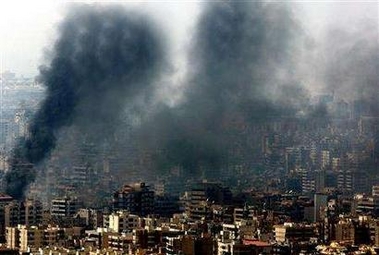
The rapid retraction of a photoshopped image of ‘Beirut burning’ being offered for sale by Reuters just a few hours ago indicates that the era of the deference for the purveyors of The News is well and truly over. Peer review, it is not just for blogs and wikis anymore.
Following a precision strike by bloggers from around the world, the mainstream media’s reputation can be seen going up in photoshopped smoke in Lebanon
A modest contribution to the debate between the media and bloggers… Thanks to Jon Stewart for pointing out yet another way in which the credibility and professionalism are the flavour of the day. Obviously.
The astonishingly skewed reportage relating to the Middle East, and the reactions to it on the internet, reminds me of the reportage in the aftermath of 9/11 and how that changed the way a great many people understood how news is reported. The reaction to ideologically or commercially motivated massaging of facts in the mainstream media, which claimed to be objective reporting, is what more or less created the pundit blogosphere as we know it today.
The spotlight is once again on the reporters and networks who accept staged ‘photo-opportunities’ and rebroadcast them as factual ‘news’ (suitably edited). It is on the journalists who report every single Lebanese casually as ‘civilian’ even if they are members of Hezbollah (true but completely misleading). It is on the reporters operating within Lebanon under close Hezbollah direction and yet not adding a disclaimer to their reports pointing out this. It is on major western news agencies selling obviously photoshopped images of the aftermath of Israeli bombing.
Of course not every journalist allows themselves to be used in return for a ‘sexy’ story, as this July 30th article shows…
THIS is the picture that damns Hezbollah. It is one of several, smuggled from behind Lebanon’s battle lines, showing that Hezbollah is waging war amid suburbia. The images, obtained exclusively by the Sunday Herald Sun, show Hezbollah using high-density residential areas as launch pads for rockets and heavy-calibre weapons. Dressed in civilian clothing so they can quickly disappear, the militants carrying automatic assault rifles and ride in on trucks mounted with cannon. The photographs, from the Christian area of Wadi Chahrour in the east of Beirut, were taken by a visiting journalist and smuggled out by a friend.
So why is that not ‘front page’ news on the BBC or the hilariously named ‘Independent’? Could it be because it suggests that what the ‘Zionist entity’ has been claiming all along might actually be true?
To quote the movie Network, “We’re mad as hell and we’re not going to take it any more”. We can fact-check your ass.
For those who missed this in the Samizdata comment section a few days ago, take a look at this and make of it what you will.
Horray for Hollywood Pallywood. Truth is all in the editing it would seem.
Update: And that applies to still images as well. Reuter’s has its ‘Dan Rather moment’ as a picture of the aftermath of an Israeli airstrike is proven to be a Photoshop ‘enhancement’
I’ve been re-reading the report of the House of Commons Science and Technology Committee – Identity Cards Technologies: Scientific Advice, Risk and Evidence in preparation for an interview this evening. It is full of wonderful sarcasm couched in parliamentary politeness, and I recommend it to you, if you care to understand how Britain is governed and/or have a taste for black comedy. MPs are as much bemused spectators as the rest of us.
Nobody knows what the Home Office is up to, because it refuses to tell anyone – even select committees – any more than it can get away with. It does have 180-odd people now working on its Identity Cards programme. But I begin to wonder if they themselves know what they are about…
In case you think I am exaggerating, this is from section 30 of the report:
In written evidence, Microsoft said that “the current phase of public consultation by the Home Office has primarily focused on issues of procurement”. Jerry Fishenden [NTO for the UK] from Microsoft elaborated that “every time we came close to wanting to talk about the architecture, we were told it was not really up for discussion because there was an internal reference model that the Home Office team had developed themselves, and that they did not feel they wanted to discuss their views of the architecture”.
One of the pleasures of living in Texas is the vigorous gun culture – I have never lived anywhere else where people talked as openly in any setting about guns and shooting. We are also blessed with a reasonably sane concealed carry permit (you can qualify in one day of training) and self-defense laws.
Having availed myself (along with my wife) of said permit, we are currently acquiring some hardware. Since my wife has what can be a longish walk to her car from her office, near a neighborhood that isn’t as savory as I would want, we outfitted her first with a dandy little 9. She already has a solid piece of German metal (my wedding present to her; romantic, no?), but it was a little too solid to lug around.
Personally, I’m a .45 guy – I like a pistol that says “puts big holes in people”. My current hogleg could hardly be less portable, and there is a surprising dearth of truly portable .45s. Thank goodness Kahr finally came out with companion for the wife’s piece.
One of my sillier pastimes is doing the Radio Times crossword, the easy version. And last night I was stumped by one of the clues, and had to look at the upside down crib to learn the answer. And the answer was an outrage.
The clue was “Lack of fairness”. Even when it was blank blank E blank U blank L blank T blank, I still did not get that the answer was “INEQUALITY”.
Which is, as I say, an outrage. Fairness is absolutely not the same as equality, and under cross-examination, everyone – everyone – will admit this. Should a murderer be treated in an equal way to someone who commits no crimes at all? Of course not. Well, yes, of course, it would not be fair to treat murderers equally, but even so, equality, roughly and readily, still, sort of, means fairness. The principle is established, conceded, and then promptly forgotten. But I say that the murderer/good person contrast applies in a modified way to many other less outrageous, yet assumed completely fair, proposals for an equal outcome. What about people who work very hard, compared to people who do the same kind of work, but somewhat less diligently and effectively? Is it fair for those two to get exactly the same pay? Again, no. Equality is one thing and fairness is something quite distinct and different. Sometimes, as when dividing up scarce biscuits at tea time, an equal outcome makes the most sense. But when more is at stake and more needs to be taken into account, well, more is at stake and more needs to be taken into account.
An argument to the effect that people who do unpleasant manual labour for a living deserve, on the grounds of fairness, to be paid more than people who work in nice clean, sweet-smelling offices, is at least using the idea of fairness in a reasonable way. But notice that this argument is likewise not about equality. It is being claimed that it would be fair for the unpleasant (as it were) manual labourers to be paid more than the occupiers of comfortable offices. So this argument isn’t saying that fairness equals equality either.
My answer to this claim is that it might well, in some ways, be fairer for shit shovellers to be paid more than office drones, but that, at any rate in an approximately free society and free economy, it is not typically a good idea for people to be paid what a third party decides that they deserve. The world works better if people are paid whatever an employer freely agrees to pay them. Imposing ‘fairness’, whether defined (fatuously) as equality, or defined in some other far more reasonable way, is a bad idea. (Not least because those imposing this ‘fairness’ must clearly by unequally powerful, or they would not be able to make their decisions stick.) But that is a different argument.
Richard Ehrlich asks whether the present vogue for celebrity chefs such as Jamie Oliver, Gordon (“the F-word”) Ramsay, Delia Smith, Nigel Slater, et al, is really based on any solid, honest talent. It is a good point he makes and there is no doubt a fair amount of flim-flam in some of the phenomenon. Even so, I think his article leaves a slightly sour taste (‘scuse the pun). Celebrity chefs may, even in a marginal way, have helped improve the quality of cooking or opened people’s eyes and hence their tastebuds to foods they would otherwise have never thought of before. It is also, let’s not forget, a part of the growth of “middle-class” habits among the population. Shortly after the war, there was nothing like this, except for drab government documents telling us how to make do on rations. Then along came Elizabeth David, the first proper celebrity cook who revolutionised British cooking by advocating the delights of Italian and French food. And we are all the better off for it.
Celebrity chefs may annoy some folk and in some cases do not deserve their fame, but at least they seem to contribute something to the sum total of human happiness. Which is no mean feat. If Nigella Lawson wants to invite me over for supper, I am hardly going to turn her down (I hope my wife is not reading this).
UPDATE: apologies for some spelling snafus in the original.
The Samizdata people are a bunch of sinister and heavily armed globalist illuminati who seek to infect the entire world with the values of personal liberty and several property. Amongst our many crimes is a sense of humour and the intermittent use of British spelling.
We are also a varied group made up of social individualists, classical liberals, whigs, libertarians, extropians, futurists, ‘Porcupines’, Karl Popper fetishists, recovering neo-conservatives, crazed Ayn Rand worshipers, over-caffeinated Virginia Postrel devotees, witty Frédéric Bastiat wannabes, cypherpunks, minarchists, kritarchists and wild-eyed anarcho-capitalists from Britain, North America, Australia and Europe.
All content on this website (including text, photographs, audio files, and any other original works), unless otherwise noted, is licensed under a Creative Commons License. Powered by WordPress & Atahualpa





Recent Comments