We are developing the social individualist meta-context for the future. From the very serious to the extremely frivolous... lets see what is on the mind of the Samizdata people.
Samizdata, derived from Samizdat /n. - a system of clandestine publication of banned literature in the USSR [Russ.,= self-publishing house]
|
This pretty much explains the political situation in a nutshell. Serial commenter Pommygranate is writing about Britain but the same could probably be said about almost any western country to varying degrees: the state simply bribes people to vote for a bigger state by making them dependents.
His solution is an interesting notion.
But turkeys will still not vote for Xmas. Some on the right of the blogosphere are calling for voting restrictions for those who depend on the state for a living. Draconian indeed, but it may be the only way round this particular Catch 22.
Things would have to get very bad for that to be politically possible but is is a good idea. I quite like the idea “you can either work for the state and live of other people’s money or you can vote, but not both”. Not a chance that would happen any time soon but it is a damn fine idea nevertheless. In truth I suspect many people would be happy to make that choice as voting is hardly some blessed sacrament. If so many people do not really care about liberty, are they really so attached to voting? I wonder.
Gervase Markham, who blogs at Hacking for Christ, works for the Mozilla Foundation, a non-profit “dedicated to promoting choice and innovation on the internet”. He writes about his recent encounter with a UK Trading Standards officer:
They had encountered businesses which were selling copies of Firefox, and wanted to confirm that this was in violation of our licence agreements before taking action against them.
I wrote back, politely explaining the principles of copyleft – that the software was free, both as in speech and as in price, and that people copying and redistributing it was a feature, not a bug. I said that selling verbatim copies of Firefox on physical media was absolutely fine with us, and we would like her to return any confiscated CDs and allow us to continue with our plan for world domination (or words to that effect).
Many people would find the official’s reaction to that surprising; but they do not call them disruptive technologies for nothing. The woman replied:
“If Mozilla permit the sale of copied versions of its software, it makes it virtually impossible for us, from a practical point of view, to enforce UK anti-piracy legislation, as it is difficult for us to give general advice to businesses over what is/is not permitted.”
As Carlo at Techdirt writes:
It’s unclear exactly what role the Mozilla Foundation plays in enforcing the UK’s anti-piracy laws, or exactly why they shouldn’t be allowed to license their software however they want, just to make things easier for some civil servants. If nothing else, it merely indicates how deeply ingrained people’s preconceived notions about software “piracy” are. And it’s disappointing that a government officer whose job it is to enforce copyrights can’t seem to get their head around the idea that there is another way to license software than how most entrenched developers and companies handle it.
Disappointing? Yes. Surprising? Not really.
Crossposted from the Engagement Alliance
I am feeling less of a lone loony than I did. After a decade of my saying the key thing wrong with the demon eyes campaign was that the slogan ought to have been: ‘New Labour: Old Danger’ because the electorate should not have the purported newness reinforced, more and more people in the chattering classes seem to be accepting that there is a danger. Even such fringe lefty agitators as Clifford Chance LLP have offered severe warnings about the Legislative and Regulatory Reform Bill. Too late?
The War on Liberty may never end, but it became a general action only in the 90s – just about the time, the Wall being down, and the net routing round borders and censorship, we free-lifers had begun to feel we were winning. Now I find I am doing my bit with NO2ID and we are gearing up for a ten-year campaign. Grand constitutionalist coalitions are being proposed left, right, and centre (which I’m sure are meritorious). The differences between Peter Hitchens and Mark Thomas begin to be indistinguishable when the establishment is of the extreme centre…
What worries me is that this ferment is still superficial, a speck of mould on Mr Blair’s Horlicks. It concerns the tiny minority of the population that reads the serious press, say 10% – and of those only the avid followers of politics, maybe a quarter of that. The readers and writers of blogs are fewer still, and more introrse.
The mass of the population of Britain is nescient, complacent, and has no interest in the abstractions of liberty, or the threats from power assumed only to be threats to others, to bad people. Many people are happy to claim the status of an ‘ordinary’ person, with “nothing to hide, nothing to fear” from officialdom, while being paradoxically susceptible to fears of everything else. Passively concerned with material welfare, security against virtual risks, and gossip, they graze and are milked as the livestock of the state.
This is Foucault’s concept of governmentality in action. Not, pace his fans on the left, a neo-liberal order, but a post-liberal order in which the foundational institutions of liberalism – liberty and individuality, rule of law, the separation of private and public life, a civil society and a political sphere distinct from one another – have ceased to have a meaning for even the bulk of the middle-classes.
Where is the cattle-prod that will change the public mood?
If you are in Oxford on Saturday and want to join a protest against animal rights extremists, check this out. The Research Defence Society blog has more, as does the Social Affairs Unit and Laurie‘s own blog.
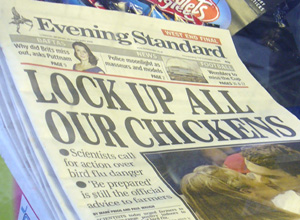
A year ago, a headline like this was pure comedy. And this Evening Standard headline that I snapped last night even now has a slightly comic, Carry On Farming feel to it.
Alas, bird flu seems to be getting rather serious.
Governments thrive on infectious diseases, because only governments, or institutions that are very hard to distinguish from governments, can contain them. Which is why I always suspect that such “pandemics” (pandemic seems now to be the regular word for an “epidemic”) tend to be somewhat exaggerated. But if I were a politician, I would never dare to say such a thing.
The 2012 London Olympic Games could be hit by electricity blackouts as energy supplies fall off, according to a poll of scientists and other eminent folk in this story by the BBC. Well, pole vaulting and javelin throwing have not been done in the dark before, but I guess it might have a certain novelty.
Seriously though, how should one take these jeremiads about impending shortages to electricity generation? This excerpt from the BBC story makes it clear that many analysts believe that solutions must embrace technologies including nuclear power:
All 140 respondents to the survey said that the best way to ensure energy security for the future lay in a diversified mix of electricity generation, including renewables, coal, gas and nuclear
This story of a few days ago suggests the opposition Tories might, in their quixotic desire to appear Green, ditch the nuclear option. This seems rather ironic given that some figures in the environmentalist movement have started to embrace nuclear energy as a way to cut carbon emissions (while not being blind to the problems of nuclear waste disposal and the large capital outlays involved in building nuclear powers stations).
I am an agnostic on nuke energy. If it can, in a free market, hold its own compared with other energy sources, fine. But given the vital importance of electricity to our modern, information-age economy, it is madness to tempt disaster by shutting down options now.
I have been ‘on the road’ again since a few days after the New Year. Travel may seem exciting to some, but it does wear you down when you do it week after week. This is especially true when planning is impossible and you cannot say with any certainty which of several jobs will be next in line. You just adapt and make your arrangements on the fly.
That said, constant travel does lead to unexpected adventures and misadventures. I would count losing my glasses going through security in Toronto among the less exciting and more expensive of these. Although there are some weeks more to go on this jaunt, the event which most stands out happened before I even got out of the UK at the start of January.
Due to contract signings running late a couple layers up the food chain from myself, travel arrangements for my usual January gig backstage at the big Healthcare investment conference in San Francisco were last minute. Translation: they were so late the flights were almost unaffordable so I was booked on a simply ridiculous connection. I left Belfast on an evening flight which dropped me in Heathrow just as the airport closed up operations for the night. My New York flight was first thing in the morning… so I got to sit up all night in the main terminal.
Well, my slogan is “Have Laptop, Will Travel”, so after some help from friendly airport staff to move some seats closer to an electric outlet, I settled in for a long, long night of work. Time crawled by. Over the top of my screen I idly noticed a gaggle of armed police wander by and hassle a couple black teens whom I think were also waiting for a connecting flight.
One of the cops walked towards me. I naturally assumed he was going to act as a friendly face to London’s major airport; perhaps commiserate on my bad luck in being stuck there over night; or possibly warn me to beware of this, that or the other.
I was wrong. He planted himself in front of me in his best “Clockwork Orange” intimidation posture and proceeded to tell me I was guilty of theft. I looked at him blankly. Theft of services. I was plugged into the airport’s electricity. He quoted a section number I was purportedly violating. As I have lived in Belfast through troubled years, I know how to deal with this sort. You smile and you verbally give them squat to grab hold of. They want to provoke a response that will let them play cop.
This fellow was very obviously tired, bored and looking for someone to take it out on. I, being one of the few persons in the terminal was ‘it’. He went on. Not only was I ‘stealing services’. I was in violation of… of…. HEALTH AND SAFETY REGULATIONS! I did not have appropriate authorization from the Airport declaring my laptop was safe for use with their AC sockets, and if I were to get electrocuted they might be liable!
I quietly studied the hole in his head.
He ranted on that I was still stealing power as he talked. Actually I was concentrating on keeping up a fake smile and non-threatening eye contact so as to avoid serious trouble. I was also dumbfounded, but I snapped out of it and casually reached over and unplugged. Slowly. I was not quite sure of the stability of this character and he was, after all, an armed member of a society in which only his sort are armed.
With the offending laptop unplugged and as he had utterly failed to provoke any sort of lese majeste remark from me, there was little more he could do. He sternly told me he would let me off with a warning and then retreated and joined his cohorts. They had remained some distance away throughout. Backup I suppose. I might well have been armed with sharp verbs and poisonous nouns for all they knew.
The previously hassled white robed African teen was not far away and as our trooper stormed off we caught each others eyes. I shook my head. He wryly smiled back. Wordless understanding passed between us.
Welcome to 21st Century London.
Reuters reports that the hunting with hounds is more popular than ever despite the move by parliament last year to outlaw the hunting of foxes with hounds. (Incidentally, foxes are increasingly a problem in the cities as they scavenge for food. I used to live in Clapham and the place was full of them).
It makes me wonder about whether the vote by MPs this week to ban smoking in public places, including private members’ clubs, will be easily enforced. Let’s hope it meets the same fate as the anti-foxhunting measure. I say this as someone who does not smoke or hunt on horseback (despite being a Suffolk farmer’s son, hunting with hounds never appealed, although I have shot the odd bunny rabbit from time to time).
Harry Hutton speaks for many, I am sure, when he says this:
It’s been a pretty good week for all you non-smoking, non-terrorism glorifying, pro-ID card tossers. All going your way at the moment, isn’t it? Must be feeling pretty pleased with yourselves.
For now you triumph. But you’ll get your comeuppance, you swine. That slippery villain is going to ruin us all. You think he doesn’t have plans for you too? You think that just because you don’t smoke or glorify terrorists you’re off the hook? Just wait. You’re gonna learn the hard way.
Personally I have never really bought in to this Blair-is-evil meme. Perhaps if I met him face to face I would feel differently, but to me he merely seems desperately eager to do good, but somewhat dim about how to actually contrive goodness, like a trendy vicar. Good at winning elections though, and making speeches, and doing Hugh Grant impersonations. The man knows his rhetoric, and if, at any time during the twenty first century, Blair were to step down from being the Prime Minister, I think his rhetoric will be sorely missed by the next government, assuming it’s Labour. Slippery, yes. But a villain? Not really. I don’t think so, anyway.
But whatever his motives may be, and however little he may have any deliberate plans to screw the non-smoking, non-terrorism glorifying, pro-ID card tendency, Blair, or the processes he has now set in motion, will still do this. But, he meant and he means no harm.
But feel free to disagree.
While you are still allowed to.
Mark Holland is on a blogging roll just now, and one of the more interesting things to be found on his blog earlier in the week was a link to and a big chunk of a speech made by Winston Churchill, on June 4th 1945, which I assume Mark to have found here. (Mark himself offers no link.)
Quote:
But, you will say, look at what has been done in the war. Have not many of those evils which you have depicted been the constant companions of our daily life? It is quite true that the horrors of war do not end with the fighting-line. They spread far away to the base and the homeland, and everywhere people give up their rights and liberties for the common cause. But this is because the life of their country is in mortal peril, or for the sake of the cause of freedom in some other land. They give them freely as a sacrifice. It is quite true that the conditions of Socialism play a great part in war-time. We all submit to being ordered about to save our country. But when the war is over and the imminent danger to our existence is removed, we cast off these shackles and burdens which we imposed upon ourselves in times of dire and mortal peril, and quit the gloomy caverns of war and march out into the breezy fields, where the sun is shining and where all may walk joyfully in its warm and golden rays.
Now I am not trying to say or even to suggest that what governs Britain now is what was meant in 1945 by “Socialism”. That hard-line root-and-branch government control of everyone and everything is a horror story has by now been well understood by all but a tiny few lunatics, if only because the promised economic benefits of such a system have all turned to dust and rust, in Britain and everywhere else where such Socialism has been attempted. Churchill’s team won that argument, even if this took rather longer than Churchill had hoped in 1945. But the book which prompted Churchill to say these things, Hayek’s The Road To Serfdom, paints a more complicated picture than just simple tyranny. Hayek also foresaw chaos, and an ever more desperate governmental effort to correct chaos, with even more chaos. And at the moment, governmentally induced chaos probably looms larger in our lives than governmental tyranny. But the means of inflicting a more self-conscious and deliberate tyranny at some future date are now pretty much all in place.
And, once again, the traitor in our midst is war. In 1945, it was the recently concluded war against Nazi Germany, and the warm glow of team spiritedness which that war gave off, for those who had good wars like formerly poor soldiers who had lived through victories (rather than those who had died during defeats), and like behind the lines enthusiasts for central planning. Now, it is the so-called War on Terror, which creates an atmosphere in which the Government does not demand or expect to know everything, but does insist upon its absolute right to know anything in particular that strikes it as important. And, now as in 1945, the British people, on the whole, do not object. Rather do they expect this, and complain only when the Government fails to keep an eye on things enthusiastically enough.
Heh. Who was that speaker again?
From an email circular promoting think-tank events around Europe:
London
21/02/06 Policy Exchange “Why the Agenda of the Future cannot be delivered by a person stuck in the Past” – William Hague MP, Shadow Foreign Secretary
RSVP: info@policyexchange.org.uk
Danny Finklestein has had a nightmare. About Britain becoming a despotic state. This one-time advisor to John Major (oh dear, we all make errors), even says this:
“But I have to admit that the legislation being debated in the Commons this week — the new ID cards, the smoking ban, the measure on the glorification of terror — has tempted me to take up smoking and start attending lectures about Hayek organised by earnest men with pamphlets in carrier bags.”
Nice patronising tone there Danny – I tend not to bother with carrier bags these days. Welcome to the concept of liberty and limited government.
|
Who Are We? The Samizdata people are a bunch of sinister and heavily armed globalist illuminati who seek to infect the entire world with the values of personal liberty and several property. Amongst our many crimes is a sense of humour and the intermittent use of British spelling.
We are also a varied group made up of social individualists, classical liberals, whigs, libertarians, extropians, futurists, ‘Porcupines’, Karl Popper fetishists, recovering neo-conservatives, crazed Ayn Rand worshipers, over-caffeinated Virginia Postrel devotees, witty Frédéric Bastiat wannabes, cypherpunks, minarchists, kritarchists and wild-eyed anarcho-capitalists from Britain, North America, Australia and Europe.
|





Recent Comments