We are developing the social individualist meta-context for the future. From the very serious to the extremely frivolous... lets see what is on the mind of the Samizdata people.
Samizdata, derived from Samizdat /n. - a system of clandestine publication of banned literature in the USSR [Russ.,= self-publishing house]
|
I am not recommending this because the Government wants to punish you, although it does, but because it is the only place you are likely to be allowed to smoke in peace for the forseeable future. The Home Office is not about to ban smoking in prisons.
But what about the health of non-smoking prisoners in the confined space? What about passive smoking by prison officers, whose workplace it is? N’importe. The tobacco allowance in prison is a means of control used by the authorities. Removing it would remove something of their capacity for arbitrary reward and punishment of individual prisoners. Plus withdrawing it would lead to riots, both acutely in fury at withdrawal, and chronically on losing the calming effects of nicotine.
So the lesson for prisoners in what Shami Chakrabarti calls HMP UK who do wish to smoke is plain. Threaten violence. You will either get your way as other aggressive sub-groups do, or be sent to the segregation block that is the officially acknowledged prison system – and there you may smoke all you like, provided you behave yourself.
If ever developments heralded the demise of the television licence fee, it is the ubiquitous spread of the digital media. Now that televisions have spread to the mobile phone, the BBC is not far behind. Whether it be on your PC or your phone, you must pay the pirates for the privilege of not watching them:
As the mobile industry debates the future of television on phones and other portable devices at its convention in Barcelona, there’s a warning closer to home that the new technology will still be subject to licensing regulations laid down in the 1904 Wireless Telegraphy Act.
TV Licensing, the body charged with collecting the £126.50 fee (rising to £131.50 on April 1), said that it doesn’t matter whether you are watching television on a PC, mobile phone or old fashioned cathode ray tube, you must be covered by a TV licence or face a fine of up to £1000.
“There is no difference between a mobile phone or a television or any other piece of electronic equipment used to watch live or as-live programming. You will need to be covered by a TV licence,” a spokesman for the body confirmed.
It can not be long now before even politicians see the abolition or curtailment of the BBC licence fee as a no-brainer.
MPs have just voted in favour of making it compulsory for Britons to have an ID card when they apply for a passport. Bastards.
Our home grown authoritarians plan to inflict yet more absurd measures which have nothing to do with defending ourselves against terrorism. ID cards would not have stopped a single terrorist attack in the UK: they are a control measure designed to make taxing and regulating people’s economic activities easier, nothing more. Yet because there is a genuine threat from Islamic terrorists, the government keeps trying to conflate ID cards with ‘doing something about terrorism’. As it is so obviously untrue, this issue makes a rather good quick and easy litmus test to detect people who are either complete idiots or barefaced liars (or both).
Moreover the intend to make ‘glorifying terrorism’ illegal is not just bound to backfire, it is a terrible idea on every level. You would think people in the dismal halls of Westminster would have learned to leave well enough alone given the comical absurdity of past attempts to ban terrorists saying things in the UK, which lead to such farcical situations as having Sinn Fein/IRA’s Gerry Adams’ voice being dubbed by other people’s voices to get around attempts to stop him airing his views. We need people to actually say what they think and the more vile they are, the more important it is to hear what motivates them.
Moreover does anyone seriously think people are attracted to actively support terrorism because of what they read in a mainstream newspaper rather than opinions closer to their every day life? It is a bit more complex than that and again you would think the experience of Ulster would have shown that when terrorists gain the support of a section of a society, all stoping their spokesmen from talking in the media does is prevent everyone else from understanding what they really think.
The BBC and mainstream media generally has followed the government line that there is a large pool of moderate Muslim opinion which does not support or sympathise with radical and intolerant Islamic views. I too have assumed this to be the case, at least in some measure, and yet as time goes by the theory is starting to look rather threadbare as if there really is a majority of moderates out there, they are more than just silent, they are almost invisible. The organisers of the demonstration yesterday in Trafalgar Square carefully choreographed the event to show the world a moderate face of muslim opinion standing hand in hand with a few dhimmis like Ken Livingston and select useful idiots such as Pax Christi and former KGB front man Bruce Kent. Yet it took less than 24 hours for one of the people behind the demo to reveal his true colours.
But any attempt to shut these people up with the law will not stop them saying whatever they want amongst their own community, unless the government plans to have multi-lingual spies reporting on what gets said in every single mosque and Arabic/Turkish/Kurdish/Pakistani social club in Britain. The only people who will no longer know what these guys really think will be the rest of us. And given that anyone who trusts the what the state says to decide who is and is not ‘the bad guys’ is a credulous fool, that is not a good idea to say the least. Yet again we see why freedom of expression is not just important, it is essential if we are to know our enemies as well as our friends.
The demonstration in Trafalgar square, supported by dhimmi-in-chief for London Ken Livingston, was clearly orchestrated to show a homogenised face of ‘moderate Islam’ for the world to see. An interesting feature of the demo was that no ‘home made placards’ were tolerated by the organisers. A small group of Kurds turned up with their own signs and were fairly quickly handed the printed blue-white official signs. I was not quick enough to get a picture of the Kurdish ones before they vanished as I did not expect them to be taken down, but the ones in English were fairly anodyne.
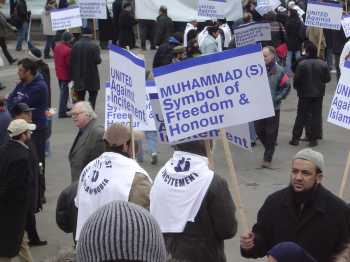
Not even in Islamic green! I would guess maybe 7,000 people showed up, perhaps 10,000 tops, at least by the time I lost interest around 3:00 and wandered off to a nearby computer faire. Many of the usual suspects were there, such as the inevitable socialist workers and CND set…
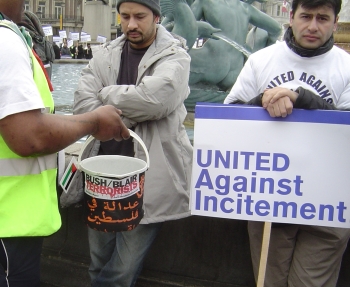
Quite what wicked old Blair and BushMcHitler have to do with protesting against cartoons of Mohammed in Denmark was not clear
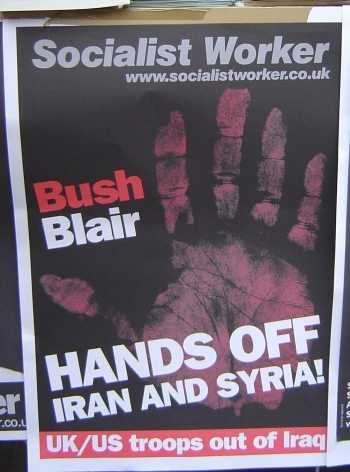
Hands off secular fascist police states and theocratic police states!
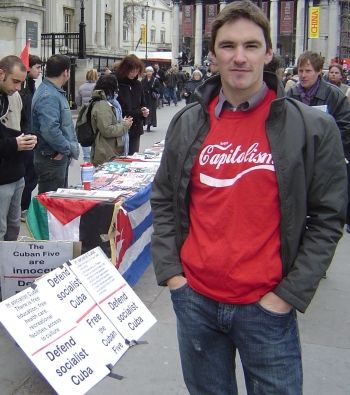
You can be sure those naughty cartoons (or that tee-shirt) would not have been allowed in Cuba! The large official signs were clearly expensive high quality creations and contained all manner of utterly irrelevant slogans designed to appeal to the ‘hard of thinking’.
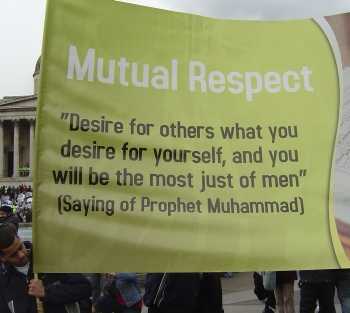
So if some Muslim desires sharia law for themselves, presumably this is what he also wishes for me… Oh I feel much better now!
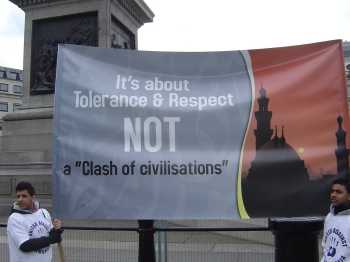
Tolerance? Sure, it is yours by right. Respect? You must be joking, that you have to earn
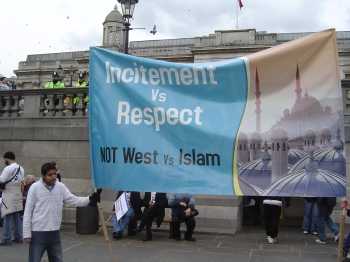
Jyllands-Posten did not ‘incite’ to violence, they just defended free expression, unlike some others we know of. Respect however has nothing to do with it
And just to remind people what this is really about…
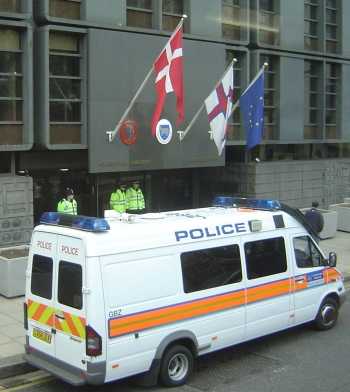
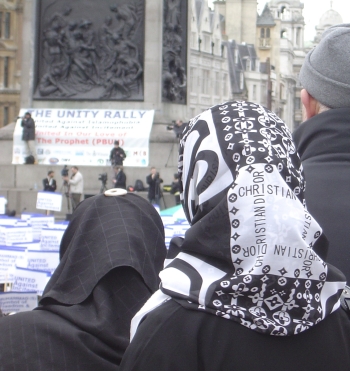
The Danish embassy in London under police guard And one final picture which tickled my sense of irony… a pleasant looking young woman watching the demonstration in her stylish Christian Dior scarf.
Governments are not know for being truthful, but it would seem sensible to tell lies that have a reasonable probability of being believed – and I do not agree that the “biggest lies are the most likely to be believed” (at least if by ‘biggest’ we mean thing that are most obviously false).
However, the British government seems to have adopted a policy of telling obvious lies. In the last few days alone we had (for example) the claim that “violent crime has fallen by 23%”. This was duly reported by the Independent newspaper (a newspaper that hates the current government, but hates truth even more – and so was glad to support the claim). This was brought out in support of the government policy of allowing “24 hour drinking”, I am not much interested in the policy (other than like so much ‘deregulation’ it has turned out to mean a lot more form filling and other such), but the claim of vast drop in violent crime was obvious nonsense.
If the government had said “contrary to people’s believe that violent crime is rising, it is actually saying much the same” that might well still have been telling lies (as violent crime is, most likely, on the up) but they would have been more likely to be believed.
But to say a “23% drop in violent crime”? They might as well have said a 123%.
Then there was the recent launch of a new navy destroyer – “The most powerful ship built since World War II”… actually it is an extremely expensive (£1 billion pound) grossly under-armed ship (part of the government’s ‘buy European’ policy – a policy exposed by Christopher Booker and Richard North). But why say “most powerful ship built since World War II” – an obvious lie even to people who nothing of Booker or North?
Lastly we had yet more claims of super educated school children “the best ever” – almost needless to say the Universities (hardly strongholds of free market people) reported today that the students they are getting are as ignorant as sin.
What is the reason for all these wild lies?
I wrote to the Department of Culture, Media & Sport (!) back on 10th January to nominate the CCTV camera as an ‘icon of England’… and they have just written back accepting the nomination.
Interesting.
Muslim Action Committee are calling for changes to the law in Britain to implement an aspect of sharia law and they want the British state to do it for them. What they want is to legally ban people from displaying pictures of Mohammed, the seventh century warlord who founded their religion, because it annoys them. Never mind that showing images of this historical figure does not threaten them with violence or prevent their exercise of religion, they want to make it illegal to annoy them.
They are planning to stage a protest march in London on 18 February, expecting to attract 20,000 to 50,000 people. I hope the number is considerably larger because I am sure as hell going to be there expressing my views as well.
If they get their way, we will undoubtedly be prosecuted as Samizdata’s response to this islamo-fascist proposal will be a “Mohammed Picture of the Day”, each day and every day until hell freezes over or we run out of server space. Intolerant Islam does not like being annoyed? Well guys, you ain’t seen nothing yet, I promise you that. Our Dutch friends at The Amazing Retecool are a fairly good place to start for interesting interpretations of Mohammed’s image.
If this ever becomes law and I personally get dragged into court over what Samizdata will most certainly do, rest assured that as we are hosted in the USA we will remain on-line and ‘expressive’ regardless, even if I have to ‘host’ myself in the USA a few years earlier that I expected. So to all your intolerant Islamic fascists out there who think it is within your power to silence all the voices you dislike, with all due respect (i.e. none), you are very much mistaken.
The Cardiff University newspaper Gair Rhydd [link down as of late 7 Feb] reprinted one of the Jyllands-Posten ‘Satanic Cartoons’ and as a result, the edition was recalled and pulped by the university authorities. Now as the paper is no doubt the property of the university, I do not contest their right to do as they please with their property. However the statements from them make no sence whatsoever
“The opinions expressed in that publication are those of the editorial team independently of the students’ union or university. The editorial team enjoy the normal freedoms and independence associated with the press in the UK, and are expected to exercise those freedoms with responsibility.”
So they recalled the edition, destroyed all the copies, suspended the editor and are ‘investigating’ three of their journalists but the editorial team enjoy the normal freedoms and independence associated with the press in the UK. As we say on the internet, WTF?
Several newspapers in Europe and elsewhere (and I do not mean student newspapers) have reprinted the cartoons, so this is hardly an act of unprofessional behaviour seeing as several editors who actually do this for a living decided it was in the interests of their readers to publish the damn things.
Had they said “it is our paper and we will pulp anything that bucks the party line”, well fine, but please, I will thank Cardiff University to not declaim as if they were on the moral high ground when all they are doing is covering their politically correct arses.
This call [original link removed] for a rally in Trafalgar Square next Saturday is interesting. Does anyone know any more details of who is behind it? I would like to know more before leaping to any conclusions.
update: question answered – not worth supporting one group of (white) fascists protesting against another group of (Islamic) fascists
Here is a photo taken of the march by Muslims protesting against Jyllands-Poster and the ‘Satanic Cartoons’ saga in London earlier today.
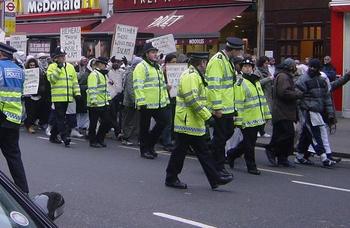
click for larger image The placards read Behead those who insult Islam & Butcher those who mock Islam & Slay those who disrespect Islam etc. etc.
Freedom of expression is quite literally intolerable to them. And we cannot and must not tolerate that. It makes no logical sense to tolerate intolerance.
With thanks to H for the picture
And for those of you who say “It’s just a protest”…
Not only is the state not your friend; it does not live in the same country you do. Failing to keep proper books and records in a business is likely to end in your going to jail, if you do not go broke first. So almost all businesses do manage it.
What would happen to the board of directors of a corporation with a turnover of £10 Billion and 61,000 employees, if it were discovered it did not even reconcile its bank statements during their tenure? Something like this, perhaps? In most corporate scandals the accusation is not defective or absent bookkeeping, but that it was too clever.
Here is the National Audit Office on 31st January 2005:
Sir John Bourn, head of the National Audit Office, reported to Parliament today that the Home Office had not maintained proper financial books and records for the financial year ending 31 March 2005. Sir John therefore concluded that, because the Home Office failed to deliver its accounts for audit by the statutory timetable and because of the fundamental nature of the problems encountered, he could not reach an opinion on the truth and fairness of the Home Office’s accounts.
[…]
Because of the difficulties in implementing the new accounting system, the Home Office was unable to reconcile its cash position during 2004-05, i.e. match its own records of cash payments and receipts with those shown on its bank statements. This is a key control for the prevention and detection of fraud. Following significant work by the Home Office to investigate a £3.035 million discrepancy, it had to make adjustments of £946 million to reconcile its cash position. However the Home Office found no evidence of fraud following this work.
The report points out that the poor quality of the financial statements and the delay to their production reflected a lack of skills within the accounts branch compounded by late recognition by management of the serious problems being encountered. Management procedures to ensure the quality of the financial information produced were also inadequate.
I particularly like, “the Home Office found no evidence of fraud”. Did nobody think to call in the Serious Fraud Office just so that they could say there’d been an independent check?
This is government, you see, and the rules for government are different. I confidently predict that there will be no consequences whatsoever for anyone but the taxpayer, who will stump up for yet another incompetent systems review. No minister will be censured, no official will lose his job, and no-one will go to gaol.
Which is just as well, considering how badly the prisons are run — by the Home Office.
The Home Office is an organisation that is currently preening itself before setting out up to become the Master Department, ruling them all through the largest and most complicated IT system ever, anywhere. It is currently asking suppliers what it should do and how much they think that should cost, while telling parliament it will not reveal any cost estimates (See: Lords Hansard 16 Jan 2006 : Column 428) in case it damages the bargain to be got from those same suppliers.
Though I have other reasons for thinking that the Home Office should not be permitted to seize from the Treasury the role of colossus over the rest of Whitehall, this NAO report at least ought to give any sane administration pause. I cannot see any whelk stalls or breweries taking the risk of offering their facilities for the necessary in-house training.
|
Who Are We? The Samizdata people are a bunch of sinister and heavily armed globalist illuminati who seek to infect the entire world with the values of personal liberty and several property. Amongst our many crimes is a sense of humour and the intermittent use of British spelling.
We are also a varied group made up of social individualists, classical liberals, whigs, libertarians, extropians, futurists, ‘Porcupines’, Karl Popper fetishists, recovering neo-conservatives, crazed Ayn Rand worshipers, over-caffeinated Virginia Postrel devotees, witty Frédéric Bastiat wannabes, cypherpunks, minarchists, kritarchists and wild-eyed anarcho-capitalists from Britain, North America, Australia and Europe.
|





Recent Comments