We are developing the social individualist meta-context for the future. From the very serious to the extremely frivolous... lets see what is on the mind of the Samizdata people.
Samizdata, derived from Samizdat /n. - a system of clandestine publication of banned literature in the USSR [Russ.,= self-publishing house]
The claim that muslim thugs have been harassing people walking through ‘muslim areas’ of Britain has received much coverage in the UK media. I am always leery of taking such stories at face value… how prevalent is this? I do not live in an area with much in the way of a muslim population but I do regularly visit parts of London that do… and I have never seen anything like what is shown in the linked article/video happening.
That is not to say I do not think this sort of thing is at all implausible… not at all and heaven knows I am never slow to think poorly of a religion that explicitly espouses a totalitarian political order in its holy writings. But I wonder just how much of a problem it is? I am not in a position to judge for myself, but that it happens at all is intolerable.
Nevertheless, I wonder if the appearance of ‘Muslim Brownshirts’ in Britain is the sort of problem that is particularly amenable to government suppression. In truth, it seems to me it would be best dealt with at a more local and social level… no, I do not mean via some officially sanctioned ‘community outreach’ but rather by people taking a more ‘civil society oriented’ approach, which is to say confronting the fuckers on the streets, getting in their faces and if needed, replying to any violence by kicking them in the bollocks repeatedly.
Ideally, this sort of thing should be done by non-lunatic members of Britain’s muslim community, but that should by no means be seen as a prerequisite for pushing back. Indeed as they seem to enjoy picking on perceived homosexuals, perhaps some members of the typically vocal gay community might like to forcibly stick their oar in the water on this… but who pushes back matters less than someone should.
I suspect a more ‘grass roots’ approach would be vastly more effective than anything our worthless political class is likely to come up with.
So it takes a bit of front for some vile toad from the government to moan about oil companies screwing the customer by not reducing prices fast enough when the global prices fall.
So how fast does the government reduce their tax burden when the economy is tanking? Oh yes, I forget, they generally increase taxes when that happens.
A lot of British people have done a “John Galt” in recent years, it seems, according to UK member of Parliament Nick de Bois:
Mr de Bois said tax does play a part in emigration, but suggested that culture is a more important factor, warning that Britain should encourage people to succeed and get rich, not criticise them. “Government must help lead a culture change in this country that competes with the new economies, one where competitiveness and success are valued and personal achievement and personal wealth are respected, not pilloried,” he said.
If you are mystified by the “Galt” reference (most Samizdata regulars will know it), it refers to the plot of Ayn Rand’s Atlas Shrugged, in which a character called John Galt leads a “strike” of the top businessmen, scientists, artists and others to abandon their work at a time when such people are increasingly hampered by the State. In the US, the expression “Going Galt” has caught on to describe the sort of thing written about here.
Of course, emigration needn’t be a bad sign for a country and indeed, in some countries, emigration can relieve domestic pressures. In the 19th Century, large numbers of Britons left for the New World, seeking a better life. Of course, many from the around the world did so for reasons of persecution and poverty. The ability to exit a country is also one of the few things that might persuade an otherwise foolish government to pursue policies that encourage wealth creation rather than hurt it. As I have noted before, the ability of the super-rich – or indeed far less wealthy people – to get their money abroad, or move overseas, can be a healthy constraint on government. That is why I think “tax competition” between jurisdictions, far from being an evil, as leftist campaigners claim, is a good force in the world. And so it is important to bear in mind that when governments impose capital controls and exit visas, be very afraid.
Here is a classic piece of nonsense to start this week in chilly Britain:
The UK tax authority said the amount of tax that big companies may have underpaid by using artificial intercompany transactions to inappropriately reduce taxable profits has risen 48 percent last year. The figure comes as public anger grows over tax avoidance by big businesses and British MPs investigate possible remedies.
I read this report carefully and nowhere does it say that the firms concerned have broken laws, engaged in fraud, or used violence or engaged in criminal acts. They are taking full advantage of the laws of the jurisdictions with which they have contact, as their shareholders would expect them to do in maximising shareholder returns. If politicians really wanted to reduce what they see as such dodgy tax avoidance, perhaps they should enact taxes that are simple, low, and flat. This is not rocket science, as the 2020 Tax Commission report issued last year showed.
The recent naming and shaming of Starbucks, for example, of simply making use of legal arrangements, was particularly odious. No wonder people are thinking that we are living in a world like something from the pages of Atlas Shrugged.
Tim Worstall writes about this sort of issue a lot, usually in the process of skewering that socialist “accountant” from Wandsworth, Richard Murphy. Tim is always entertaining and instructive at the same time.
I like photographing new London buildings, the taller the better. And I am also very fond of photographing cranes, which can be quite dramatic but will soon be gone. So, when a new tower started getting built just across the Thames from me, all the while lovingly tended by just the one very tall crane, I photoed it, quite often.
Here is how the tower and its crane looked in May of last year.
That’s a shot taken from Vauxhall Bridge.
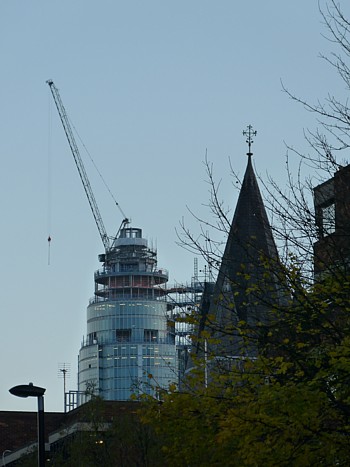
Here is a somewhat more artistic shot of the top of the tower, and its crane, taken last November, from Vauxhall Bridge Road, which is to say from rather further away:
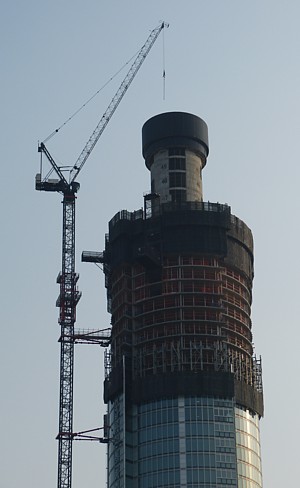
But now look at them, as photoed by me this afternoon:
The tower is okay, but the crane is in a sorry state.
During this morning’s rush hour, when it was very misty, a helicopter smashed into the crane. As you can see, the crane suffered badly, but what happened to the helicopter was far worse. It lost its blades, plummeted to the ground in flames, killing its lone occupant, the pilot, and another person on the ground. Blazing aircraft fuel was all over the place, and nearby cars were engulfed in the resulting flames and themselves also exploded. Had it happened rather later, when the road where all this happened would probably have been traffic-jammed, it might have been an order of magnitude more horrific.
This afternoon I got nowhere near where all this drama had happened, and didn’t seriously try to. But a zoom lens was all I needed to photo what happened to the crane, and this will surely get photoed a lot, for as long as it stays up there for all the world within about half a mile to see. I’m guessing that there is going to be lots of tidying up and sorting out to be done at ground level, before it will become possible to replace the crane, and finish building the tower.
Terrible. Deadly. And, given how costly it is when a major building project is at all seriously delayed, as this one surely will now be: very expensive.
LATER: A better view of the ruined crane, in the form of an expanded detail of the crane itself, minus most of the tower, here.
Today a friend from way back who is a structural engineer by profession dropped by. He is semi-retired now, but was not so long ago a pretty big cheese in the bridge designing trade. He still has quite a bit of influence on bridge designing, albeit rather less now than he used to have.
He told me of an engineering bee, concerning train safety, now buzzing about inside his head.
Trains are, on the whole, he said, very safe. But apparently level crossings are the big train exception. A trickle of deaths? A rather big trickle, he replied. “Scores every year” was the phrase I recall him using. I don’t know if that’s quite right, but level crossing deaths are certainly a big deal in Britain.
Perhaps partly because he is a bridge designer, my friend believes that where possible and where not too disruptive and expensive, level crossings should be replaced by … bridges.
Trouble is, there is an acronymic organisation (I think he was talking about this one) concerned with British train safety, which demands very large clearances, both upwards and sideways, for all new road bridges over railways. And it takes only a small increase in a demanded clearance size to require a greatly more elaborate and expensive bridge. Which means that a lot of bridges, that might be built, aren’t.
Partly this demand for big clearances is because at some future date the railway line in question might be electrified, and in the meantime, space must be left under all bridges for that.
My friend says: Fine. In the meantime build smaller but temporary bridges. If electrification ever happens, replace these small bridges with bigger bridges. (Or, I suppose, go back to having level crossings, although that possibility wasn’t mentioned.) Meanwhile, save many lives now lost at level crossings.
But partly, the reason is a safety consideration of another kind. Says the acronymic organisation: all imaginable train wobblings, including the most unlikely, must be allowed to occur under all future bridges without any train afflicted by such wobbling hitting the bridge, even though many existing bridges allow for no such wobblings, with no detectable effect on train fatalities.
Result? The rather big trickle of deaths at level crossings goes on, and on, and on. In the pursuit of even more perfect safety where perfect safety has pretty much already been achieved, a closely related and very unsafe circumstance is caused to persist.
The pursuit of safety, badly done, is resulting in the persistence of unsafety.
When people now speak, as they so often now do, of “health and safety gone mad”, this is one of the things they surely mean. It isn’t just that safety is pursued and damn everything else. Safety is also pursued in accordance with mindless rules, that have the effect of reducing safety itself.
Something tells me that this is not the only example of such perverse safety thinking.
One day it will be recognised how the Met Office’s betrayal of proper science played a key part in creating the most expensive scare story the world has ever known, the colossal bill for which we will all be paying for decades to come.
Meanwhile, it is not just here that this latest fiasco, reported in many countries, has been raising eyebrows. Our ministers love to boast that British science commands respect throughout the world, They should note that the sorry record of our Met Office is beginning to do that reputation no good at all.
I have filed this under “UK affairs” and “science and technology”. Perhaps, when it comes to the Met Office and such places, we need another topic code: “propaganda”.
Now some folk, such as libertarian Charles Steele, who is based in the US, get a bit exercised by those libertarians who, for example, pounce on the shenanigans of the CAGW alarmists. And he has a good point of course: whether the world is or is not heating up or not is not, specifically, anything to do with whether one favours free markets over state planning, collectivism or individualism, natural rights or serfdom, etc. (Science respects no ideologies). But – and it is a damn big but – it is a matter of inescapable, practical fact that the vast majority of those pushing the CAGW case are collectivists of one sort of another. Steele and others might try and reject that as they might reject that water flows downhill.
So while it is entirely possible for, say, a hardcore socialist to rejoice if the doom-mongers are proven wrong (the older type of socialist often liked to produce posters full of jolly workers in front of smoky factories), the fact is that showing the CAGW prediction to be the pack of bullshit that it is seems to be positive for a libertarian point of view. For what this will hopefully show is the dangers of when scientists become compromised by the rewards and incentives dangled in front of them by the State. I am sure some of the CAGW scientists are objective and high-minded. But if what Booker says about the Met Office’s behaviour is even half-true, a good many of them are nothing of the sort.
A large chunk of the Political Class is starting show all the signs of an entrenched deeply entitled group starting to smell the whiff of the great unwashed upwind of them.
My gawd, what might happen if people in the UK actually got a choice about the EU?
But of course anyone who thinks that Dave Cameron actually wants the UK out of the EU, in spite of mild bleeting about ‘renegotiation’, is quite frankly a wilfully blind fool. My only hope is that Dave is stupid enough to think that he can ride that particular wild horse and keep it under control and taking sugar from his hand without biting his fingers off.
Over at Neal Asher’s (more on him from me later, once I have finished his novel) blog, I see this entertaining Boris Johnson quote about fracking:
The extraction process alone would generate tens of thousands of jobs in parts of the country that desperately need them. And above all, the burning of gas to generate electricity is much, much cleaner – and produces less CO2 – than burning coal. What, as they say, is not to like?
In their mad denunciations of fracking, the Greens and the eco-warriors betray the mindset of people who cannot bear a piece of unadulterated good news. Beware this new technology, they wail. Do not tamper with the corsets of Gaia! Don’t probe her loamy undergarments with so much as a finger — or else the goddess of the earth will erupt with seismic revenge. Dig out this shale gas, they warn, and our water will be poisoned and our children will be stunted and our cattle will be victims of terrible intestinal explosions.
Which is all very good except that, as Tim Worstall is forever pointing out, jobs are a cost. I can see why Boris, a politician, would see votes in talking up the thousands of jobs, but I hope he understands this. When he chooses between scheme A and scheme B, I would hope he does not pick the most expensive, more labour intensive one.
And it is unadulterated good news. The greens’ opposition to fracking may be working now, but the political will will be there the moment the first blackouts hit. So I do not imagine things will get much worse than that, and then there is enough energy for a few more technological revolutions.
One of Obama’s apparatchiks has said that Britain’s membership of the EU was in the American interest.
Two responses spring to mind.
The first was… So what? This remark was obviously aimed the the dismal British government but furthering ‘the American interest’ should be very low on the list of priorities of any government that is not located in Washington DC. So even if it was true (and frankly nothing could be further from the truth), this should be of trivial import to anyone in the Sceptred Isles.
The second was… ok, so how much are you willing to pay for that “US interest”? If the US interest is served by continued British membership of the sclerotic EU, then perhaps the hapless US taxpayer should get shafted for, oh, lets say 50% of the cost?
First you pay income tax. Then they pay some of it back as child benefit. Then you pay some of the child benefit back as the higher income child benefit charge.
The Samizdata people are a bunch of sinister and heavily armed globalist illuminati who seek to infect the entire world with the values of personal liberty and several property. Amongst our many crimes is a sense of humour and the intermittent use of British spelling.
We are also a varied group made up of social individualists, classical liberals, whigs, libertarians, extropians, futurists, ‘Porcupines’, Karl Popper fetishists, recovering neo-conservatives, crazed Ayn Rand worshipers, over-caffeinated Virginia Postrel devotees, witty Frédéric Bastiat wannabes, cypherpunks, minarchists, kritarchists and wild-eyed anarcho-capitalists from Britain, North America, Australia and Europe.
All content on this website (including text, photographs, audio files, and any other original works), unless otherwise noted, is licensed under a Creative Commons License. Powered by WordPress & Atahualpa






Recent Comments