We are developing the social individualist meta-context for the future. From the very serious to the extremely frivolous... lets see what is on the mind of the Samizdata people.
Samizdata, derived from Samizdat /n. - a system of clandestine publication of banned literature in the USSR [Russ.,= self-publishing house]
|
If asked which groups posed the greatest threat to individual liberty in modern Britain, I would unhesitatingly cite two groups. These groups are, broadly, the medical profession and those who are generally called ‘celebrities’ – pop stars, film stars and so on.
– “Whig”, at the Adam Smith Institute blog.
Nick Cohen is that rare and admirable thing, a genuinely liberal left-winger. Here he is in full flow today in The Observer:
We are in the middle of a liberal berserker, one of those demented moments when “progressives” run riot and smash the liberties they are meant to defend. Inspired by Lord Justice Leveson, they are prepared in Parliament tomorrow to sacrifice freedom of speech, freedom of the press and fair trials. They are prepared to allow every oppressive dictatorship on the planet to say: “We’re only following the British example” when outsiders and their own wretched citizens protest.
A rant worth reading. Do.
Something that Mr Cohen doesn’t cover is that, we too, appear about to be regulated. Parliament is not just abridging the freedom of the press, but of the web too. As Guido Fawkes explains regulation looks likely to cover not just Fleet Street (if that were not bad enough), but:
“relevant publisher” means a person (other than a broadcaster) who publishes in the United Kingdom: (a) a newspaper or magazine containing news-related material, or (b) a website containing news-related material (whether or not related to a newspaper or magazine)
(My emphasis.) That means ALL the blogging commentariat there, almost all charities and campaigning organisations of every political stripe who publish news comment or press releases or highlight particular stories on their websites, and maybe your personal site, too.
Once you’ve read what Messrs Cohen and Staines have to say, you might feel like commenting on the news yourself. If you live in Britain an email to your MP, especially if he or she is a Labour or LibDem MP, might be worth the effort. You can write to them – including the ones who will only take a fax – easily from the site of the same name: writetothem.com Do so before they vote on the proposals.
The three main parties are all deciding how they will kill off the last vestiges of freedom of the press in Britain.
Ed Miliband was hoping to sit down with David Cameron and Nick Clegg later on Tuesday or Wednesday to agree a historic new deal which would see newspapers regulated like the BBC.
We will know soon enough exactly how they will do this, but do it they will. And you can be sure they will present it as protecting freedom of the press.
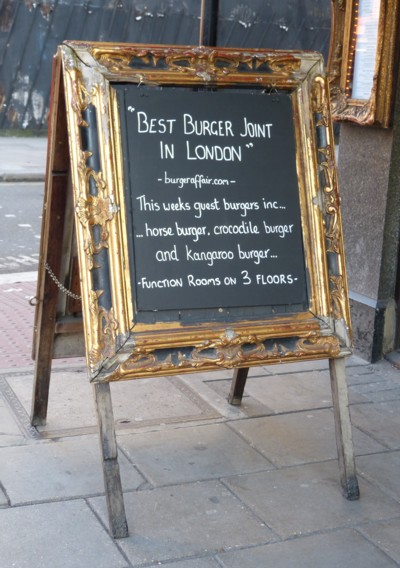
Yesterday, I took this photograph in Holborn, London, advertising the (Australian influenced?) cuisine of this pub:
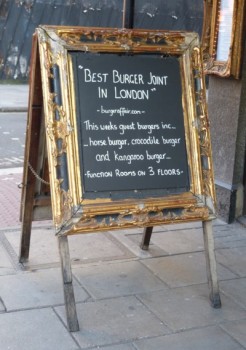
Click to enlarge, and then note the horse burger. It’s starting to look as if the main long-term effect of the Great Horse Meat Scandal upon Britain is that the British diet will be expanded. The politicians huff and puff. We get to discover how good horse can taste (that being a piece that was linked to by Instapundit yesterday).
Healthy life expectancy is shorter in the UK than abroad
People in the UK enjoy fewer years of good health before they die than the citizens of most comparable European countries as well as Australia and Canada, a major report shows.
The health secretary, Jeremy Hunt, said Britain’s performance was “shocking” compared with that of other countries, and called for action to turn it around by local health commissioners, who are about to take up their new responsibilities.
The UK ranked 12th out of 19 countries of similar affluence in 2010 in terms of healthy life expectancy at birth, according to a detailed analysis from the Global Burden of Disease data collected by the Institute for Health Metrics and Evaluation (IHME) in Seattle.
Despite big increases in funding for the NHS in recent years and many reform initiatives, the UK was in exactly the same place as in the league table for 1990, according to the IHME report, published in the Lancet medical journal.
Emphasis added. The report’s authors, and the Guardian article from which I quote, are at pains to say that
the problem is only in part to do with hospital care – much of it is about the way we live. Our diet, our drinking and continuing smoking habits all play a part
In other words, Britain’s relatively poor average life expectancy partly is to do with NHS hospital care, but they would rather not say so. As for the remainder of the problem that is not caused directly by the failings of the NHS, I wonder if the report’s authors have considered the possibility that the “despite” might be a “because”? Why do the British do worse than other nationalities of similar wealth when it comes to living an unhealthy lifestyle? It is no answer to just say “culture”; why is our culture as it is? Have we always been thus? We have a long tradition of getting drunk, I grant you, but my impression is that the British were not considered any fatter or any more drug-addled than comparable nations a few decades ago… before 1947, let us say for the purposes of discussion.
It is often said that one of the great blessings of the NHS is that it has lessened the fear of illness. The fact that they do not have additional worries about costs or insurance does come to those already worried about illness as a huge relief, and NHS-sceptics like me have to engage with that, sometimes in our own lives. So let us do so. I submit the hypothesis that a certain amount of fear of getting ill is salutary – both in the general sense of producing a beneficial effect and in the more specific, and original, sense of promoting health.
Naturally, I speak here of averages over a large population. Many illnesses cannot be avoided by human action; that is what insurance is for. When considering any one individual, I doubt that when making the many small bad decisions that have the cumulative effect of making him or her unhealthy, “hey, I don’t have to worry about paying for healthcare” often comes consciously to mind. But, like the proverbial mills of God, the mills of incentives grind slow but they grind exceeding small. In some countries those many small decisions take place under the shadow of “I might end up with a bill for this”. In Britain they do not. My hypothesis might go some way to explaining Britain’s anomalously poor average health. Something must explain it.
By the way, I shall take it as read that every human being has a perfect right to eat, drink, smoke and inject as he or she pleases. I shall also take it as read that the authors of the report and 95% of its readers wish to deny others that right. If the hypothesis above is correct, Britain has set up a system that, besides the inherent wrong of being based on coercion, removes one of the incentives for people to take care of their own health. How to solve that? More coercion, of course.
“If you want to revisit the 1970s, you no longer need a history book or a time machine. All that’s required is a collection of today’s newspapers – Right- or Left-leaning, it matters little – together with a regular infusion of BBC agitprop. With a few notable exceptions, all seem to gravitate around a tediously predictable banker-bashing, anti-profit, bonus-hating, anti-big-business agenda which spins us 40 years back in time to one of the lowest points in British history. What goes around comes around, I suppose, so with inflation perking up again, it can surely only be a matter of time before the Government brings back a fully blown Prices Commission. I exaggerate, of course, but only to make the point.”
– Jeremy Warner
He is broadly right, of course. Some of the “banker bashing”, though, has even come from the free market side of the fence, such as from the likes of Professor Kevin Dowd – who is known around these parts – making the point that banks operating with the implicit guarantee from the state and cheap money have been able to let their normally healthy instincts run amok. Alas, most of the attacks have focused on their allegedly big bonuses, which while it does not miss the mark entirely, is not really central to why we got into our current mess.
And Warner is interesting on how an energy sector, which has its problems, will not be in good shape if we keep hitting bank finance. There is another issue, meanwhile. What we might be seeing is a mixture of “junk science” (the notions that are leading us to turn our backs on cheap or at least reliable energy) and “junk money” (Quantitative Easing, etc).
It is interesting that he argues that there is a 1970s feel about the UK at the moment. He is right, although the private sector does not have the union militancy of back then, and the Cold War is over, and globalisation, for all its ups and downs, has taken more hold to the immense benefit of countries such as India and China. I see little sign of a move back to the 1970s in Asia.
The typical member of the British ruling class of yesteryear was complacent, arrogant, and a hypocrite. However his public school had at least imbued him with one particular virtue, or, failing that, had imbued him with the desire to appear to have that one virtue, which does well enough for most purposes. He wanted to be seen as a good sport. A chap who played the game. A chap who would not shoot a sitting duck or a grouse out of season, and who would never hit anyone who by reason of sex, age, or any other cause, could not hit back.
We have dispensed with all that foolishness now.
It is contempt of court for a juror ever to describe the deliberations of the jury of which he or she was a member. Thus the members of the jury held up to public scorn (“…a fundamental deficit in understanding … in 30 years of criminal trials I have never come across this at this stage, never”) by Mr Justice Sweeney for asking stupid questions cannot defend themselves.
Not playing the game, sir, not playing the game at all.
Related: Sexual and financial privacy and the bully pulpit.
If they figure at all, it is as a group to be derided, reduced to a caricature framed by Boden, Waitrose tempered by Lidl, holidays in France, and a fondness for television box sets. Their dinner-party concerns about finding a good school, a decent house or a good hospital qualify for jokes, little else. The tributes paid to Richard Briers remind us that, at best, the middle classes are an object of gentle ribbing, but seldom to be admired as the shock troops of economic recovery. Instead, politics has been reduced to an argument over how best to clobber the wealthy in order to help the poor, two small groups who attract a disproportionate amount of attention from politicians.
– Ben Brogan
Of course, it would be refreshing if we could just talk about people as individuals rather than as members of classes at all.
“More regulation” is the cry in every gagging throat, following the revelation that numerous cheap meat dishes in several supermarkets that were labelled as beef or lamb actually contained horsemeat.
Regulation caused the problem in the first place.
From today’s Times (subscriber only):
The Government knew last summer that a sudden ban on cheap British beef and lamb meant it was “inevitable” that unlawful meat would be imported from Europe.
Unintended consequences, again. It would make a horse laugh.
Jim Paice, the former Agriculture Minister, warned the committee last summer that unlawful meat would be imported from Europe as manufacturers sought cheap sources to make up for banned British supplies.
The warning came after the FSA [Food Standards Agency] suddenly told meat processors to halt the production of “desinewed” beef and lamb, which was used in tens of millions of ready meals, burgers and kebabs each year, after orders from European Commission inspectors.
The committee demanded in July last year that the Government set out its plans to prevent illegal imports, stating: “The Agriculture Minister’s evidence suggested that it was inevitable that wrongly labelled or unlawful meat products would be importing into the UK to replace UK produced desinewed meat.”
Emphasis added. Do not, however, expect this aspect to be emphasised in the Radio 4 Food Programme. I could be proved wrong; there is a podcast here which I am not in the mood to listen to, but so far the BBC’s coverage has been a relentless flow of, if you will forgive yet another revolting processed meat metaphor, pink slime.
I am not much impressed with Roger Bootle’s drearily conventional arguments for what the UK economy needs.
“I have banged on before about decisions on key projects which have large public sector involvement but which may also hold the key to major private sector spending, e.g. over London’s airport capacity.”
Preposterous Keynesian fallacy at work. It presupposes that money allocated to some project via the political process is more likely to create a ‘multiplier’ than market driven uses of that money… and it assumes that the money taken by the state by force would not have been invested in something more worthwhile in aggregate if the decisions were left to its original owners before it was confiscated by the state.
But of course as it is easier to see something like an airport rather than the myriad of other uses the money would have gone to had it not been forced into that project, so somehow the big flashy ‘infrastructure’ protect is claimed to have driven knock-on investment and is therefore an obvious Good Thing. As Bastiat put it “That which is seen versus that which is not seen”.
Ain’t necessarily so and given the record of government decision making versus the more diffused decision making of markets, usually ain’t so.
It is officially calculated that, between 2005 and 2009, up to 1,200 patients at Stafford Hospital died needlessly. Let us imagine that a comparable disaster occurred in any other institution or enterprise in this country. Suppose that hundreds of customers of the cold food counter at Sainsbury’s or Tesco died of food poisoning. Suppose that, at an army barracks, large comprehensive, steelworks, bank, hotel, university campus or holiday theme park, people died, and went on dying for years, at rates that hugely exceeded anything that could be attributed to the normal course of nature.
What would happen? In all cases – though more quickly in the private sector than in the public – the relevant management would be sacked. Indeed, the very idea of unnecessary deaths taking years to notice is almost inconceivable. Criminal charges would be brought. In many cases, the offending institution would close down.
But this is the National Health Service, and so we approach it with superstitious reverence, as if the fact that Stafford Hospital performed so many human sacrifices is so awe-inspiring that little can be done about it. For all its rhetoric of condemnation, this week’s report of the Mid Staffs inquiry by Robert Francis QC argues, in effect, that those in charge should stay in charge.
– Charles Moore
|
Who Are We? The Samizdata people are a bunch of sinister and heavily armed globalist illuminati who seek to infect the entire world with the values of personal liberty and several property. Amongst our many crimes is a sense of humour and the intermittent use of British spelling.
We are also a varied group made up of social individualists, classical liberals, whigs, libertarians, extropians, futurists, ‘Porcupines’, Karl Popper fetishists, recovering neo-conservatives, crazed Ayn Rand worshipers, over-caffeinated Virginia Postrel devotees, witty Frédéric Bastiat wannabes, cypherpunks, minarchists, kritarchists and wild-eyed anarcho-capitalists from Britain, North America, Australia and Europe.
|





Recent Comments