We are developing the social individualist meta-context for the future. From the very serious to the extremely frivolous... lets see what is on the mind of the Samizdata people.
Samizdata, derived from Samizdat /n. - a system of clandestine publication of banned literature in the USSR [Russ.,= self-publishing house]
|
It is difficult to accept the sincerity of the professed free market beliefs from the kind of Tory who rails against the permissiveness of our age; even on the purely economic side, the supposedly laissez-faire beliefs of some extreme Tory activists are barely skin-deep.
– Samuel Brittan, in 1969 reviewing ‘Freedom and Reality’ by Enoch Powell for ‘The Spectator’.* As true today as it was 40 years ago, sad to say. He goes on:
There is no evidence for putting Mr Powell in this latter category. But his economic liberalism is allied uneasily with an attachment to the nation state as the absolute political value. Most economic liberals, on the other hand, while conceding that Englishmen would naturally have a greater feeling for other Englishmen than Peruvians, regard the national interest as a function of the interests of the individuals who compose it, and are highly suspicious of supposedly superior collective entities. Indeed, once the supremacy of overriding national goals is admitted it is difficult to see what arguments there are against Mr Wilson, having been elected by a national majority, decreeing that an excessive consumption of candyfloss is against his conception of the British idea.
The latter was merely a philosophical fancy in 1969. Mr Wilson went out of his way to be photographed smoking. O tempora! O mores!
![Let us revive the permissive society! [pic: Allan Warren]](http://www.samizdata.net/wp-content/uploads/2013/01/766px-Lord_Harold_Wilson_2_Allan_Warren-350x274.jpg) Let us revive the permissive society! [pic: Allan Warren] —
* [Reprinted in his 1973 book ‘Capitalism and the Permissive Society’ whose 40th anniversary calls for a series of quotations. Let us revive the permissive society!]
Two men dressed as Oompa-Loompas – characters from Willie Wonka and the Chocolate Factory – are being sought by police in Norwich after an attack in the heart of the city.
The Daily Telegraph.
Look, I know that folk from East Anglia – where I come from – are used to being abused for being “in-bred” or having “webbed feet” and other silly nonsense, but to be accused of trying to commit crimes while dressed as Willy Wonka’s employees is a bit much. (Just in case anyone wonders, I am not making light of what might be a serious crime.)
Mind you, Norwich did used to have several chocolate factories. Oh well, it makes a change from reading about the US “fiscal cliff”. I promise to be a bit more productive on this site than I have been in recent months. 2012 was effing busy.
Steve Redgrave writes in the Telegraph (which may be inaccessible to overseas readers unless you delete the Telegraph cookie):
The 29 gold medals – not to mention the dozens of silvers and bronzes – won by Team GB not only defined the most spectacular year of sport I can remember, but completely overhauled how we are perceived as a nation.
Really? Who is this ‘we’ I wonder? I perceived Britain as a regulatory statist nation circling the drain with a smug grin on its collective and in-need-of-a-punch-in-its-Steven Fry face before the Olympics… and the preposterous and expensive spectacle has just reinforced that view.
Indeed the much trumpeted ‘success’ of the games just tries to stuff the economic damage they caused down the memory hole. But hey, in the final self congratulatory event, the establishment got to praise that ‘envy of the world’ that so few other nations seem to envy enough to emulate, the NHS, so no… the Olympics just reinforced my less than flattering view of Britain rather than ‘completely overhauling’ it.
While the default response to reading any government document is and must forever be “Bah humbug”, I must admit that, when reading the latest from the DCLG this Christmas Eve*, I am tempted to let slip a surreptitious “God bless us, every one” or similar piece of Tiny Timmery.
Via Velvet Glove, Iron Fist, I learn that the thirty-seventh of 50 ways to save: Examples of sensible savings in local government suggested by Eric Pickles’ department is
Cease funding ‘sock puppets’ and ‘fake charities’: Many pressure groups – which do not deliver services or help the vulnerable – are now funded by state bodies. In turn, these nominally ‘independent’ groups lobby and call for more state regulation and more state funding. A 2009 survey found that £37 million a year was spent on taxpayer-funded lobbying and political campaigning across the public sector. Many of these causes may be worthy, but why should they be funded by taxpayers?
Endearingly, Mr Pickles or whoever wrote this has not got the usage of the term “sock puppet” quite right. I would have called what is being described “astroturf” myself, but even so the appearance of the term “sock puppet” in a government document is a great big blog-print in itself. Specifically the print left by the currently inactive but still influential trope-namer “Fake Charities” blog started by Chris Mounsey of Devil’s Kitchen fame.
Scanning back to sensible suggestion no. 31, it too shows the influence of blogs:
Scrap trade union posts: Get rid of unnecessary non-jobs such as taxpayer-funded, full-time trade union ‘pilgrim’ posts.
“Pilgrims” was a term coined by Guido to describe a full time union organiser paid from the public purse, named after one Jane Pilgrim, who posed as, and was admiringly reported as, a nurse giving the then Health Minister a piece of her mind before the revelation that she hadn’t been near a patient in years.
*As one does. It’s that or “Merlin must find a way to overcome his greatest challenge yet, yadda yadda, the young wizard finally comes face to face with his destiny.” The latest heartstopping ep of “Examples of sensible savings in local government” is probably more exciting and less politically correct.
“England has 39 police forces, headed by 39 chief constables or commissioners. In the past 18 months, seven have been sacked for misconduct, suspended, placed under criminal or disciplinary investigation or forced to resign. That is not far off a fifth of the total. In the same period, at least eight deputy or assistant chief constables have also been placed under ongoing investigation, suspended or forced out for reasons of alleged misconduct. No fewer than 11 English police forces – just under 30 per cent – have had one or more of their top leaders under a cloud.”
– Andrew Gilligan
The Tories are re-learning the point that unionised organisations tend, over time, to pursue their self interest in ways that, unless subjected to the rule of law, will be destructive. This conduct is some way off from the ideal as set by Sir Robert Peel.
This blog has reported repeatedly on the Paul Chambers case. Quickly, Mr Chambers was convicted of a criminal offence for stating on Twitter that he would “blow (Robin Hood airport) sky high” if it did not reopen soon after bad weather, because he wished to catch a flight in order to see his girlfriend. This was an obvious joke, and was understood as such by absolutely everyone, but he was convicted anyway, lost two jobs as a consequence etc etc, before being finally cleared on appeal to the High Court.
News out today. Slightly before this incident, members of the same security staff at that same Robin Hood airport in South Yorkshire came close to actually blowing the airport sky high. They did this through utter incompetence, by insisting on opening and inspecting a shipment of anti-tank ammunition that had been flown into the airport, despite having no expertise or understanding of how to properly do so.
Guess what? The security staff in question were not convicted of anything. In fact, by law they cannot be prosecuted in such circumstances. Funny, that.
Andrew Rawnsley asks, “was Andrew Mitchell stitched up?”
The police log, the leaking of which to the media fuelled the clamour for Mitchell to quit as chief whip, claimed that his swearing shocked “several members of the public”. Yet the CCTV footage appears to show there was no crowd watching at the gates of Downing Street: there was just one passerby at the time of the incident. While we still cannot be absolutely certain what transpired that night – there is no audio – the footage does not appear to suggest a serious altercation. The supposed independent eyewitness who came forward to corroborate the log’s version of events – a fatal development for Mitchell – is said to be a serving copper who was not at the scene.
Emphasis added. Because if this turns out to be true, it is a case of false testimony by a police officer.
There was a good comment to the above article from PolishMark:
A small incident, yes, but with serious ramifications. This is starting to look like a police conspiracy to remove an elected politician from Government. You don’t have to like the Government to be concerned by this.
There was also a good visual comment from Guido Fawkes.
Iain Martin at the Telegraph has made point worth quoting at some length, particularly as readers from outside the UK may be not be able to read the entire article. He writes,
For weeks, print journalists of all kinds – from tabloids to broadsheet – have been trying to explain that the press cannot be free if the state, or parliament, wields power over it. At times it has been as though we are talking a different language from parts of the rest of the population, such has been the bafflement. What could there possibly be to worry about if politicians – even at one remove, through a quango they appoint – essentially authorise, underpin or license press regulation? It would be “independent”, wouldn’t it? Politicians and their increasingly large staffs of spinners, strategists and assorted hangers-on would not dream of using this as a chance to apply pressure, bully, cajole or generally lord it any more than they already do over journalists trying to write uncomfortable stories that involve said politicians.
Step forward Joanna Hindley, Mrs Miller’s special adviser, who has unwittingly just performed the press and her country a great act of service by the way she dealt with a Daily Telegraph reporter who was making perfectly fair enquiries about the rather eye-boggling expenses of the Culture Secretary.
As the Telegraph reports:
“When a reporter approached Mrs Miller’s office last Thursday, her special adviser, Joanna Hindley, pointed out that the Editor of The Telegraph was involved in meetings with the Prime Minister and the Culture Secretary over implementing the recommendations made by Lord Justice Leveson.
“Maria has obviously been having quite a lot of editors’ meetings around Leveson at the moment. So I am just going to kind of flag up that connection for you to think about,” said Miss Hindley.
Miss Hindley also said the reporter should discuss the issue with “people a little higher up your organisation”.
It’s the NHS first got me thinking how the power of the narrative distorts so much of how organisations & ideas are viewed. This one starts; “Staffed by dedicated doctors & caring nurses the British National Health Service is the envy of the world…”
It runs for a couple of paragraphs, was first written the day before its inception & has been repeated so many times it’s probably encoded somewhere down in our DNA by now. It’s not just that the public believe it. Almost everyone connected to the NHS do as well. Doctors, nurses, administrators, politicians. Even most of the media. It makes it impossible for any of them to view it with a clear eye.
The incidents quoted above… others much worse we’ve heard about in the last few years… they should be part of the narrative as well but it just rewrites itself over them. Edits them away so the next time comes as exactly the same shock as the one before & the one before that. No-one actually learns any lessons or does anything because the narrative reassures them it’s not necessary. They’re just aberrations. Momentary & inexplicable blips in an otherwise perfect system. Or just signs that even more money needs tipping into it. That the engine that’s coughing & banging & spewing out smoke & broken parts would be running as sweet as a sewing machine with just a little more fuel.
– Commenter ‘Bloke in Spain’
Last night I attended the Adam Smith Institute Christmas Party.
Here are ASI President Madsen Pirie and the speaker for the evening, Allister Heath, editor of City A.M., kindly taking the time to pose together for me:
So, there didn’t seem to be any problem about me taking photos. But actually, it rather seemed as if there was. Try as I might, I don’t seem to be able to get away from this theme, in my bloggage of this week.
The most famous personage present was a very recognisable Member of Parliament. And in quite a few of my crowd shots, he is to be seen glaring rather angrily, sideways, at my camera, rather than in the direction he ought to be have been looking, so to speak, as if to say: I didn’t come here to be photoed. I came here to get away from all that crap and to be among friends. Fair enough, no pictures of or naming of him.
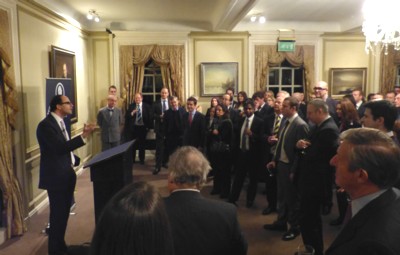
Besides which, the public point made by such gatherings, insofar as there is one, and aside from the matter of everyone having a fine old time and fine old natter, catch-up, etc., was not so much the quality of those present, qualitative though it definitely was, as the quantity of that quality. These people were not merely rather impressive. There were a lot of them:
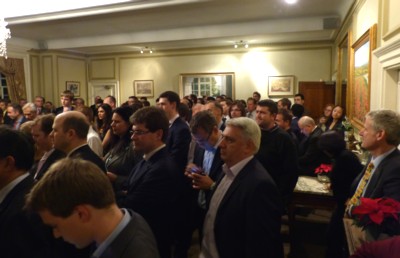
That’s Heath holding forth, and that’s the front of his audience. This is the back of his audience:
Spot the join. Unless my eyes are seriously deceiving me, you can’t. I am pretty sure there is no join to spot, and that there were further people present, to the right of those at the front, and to the left of those at the back. My camera has a gratifyingly wide angle of vision, but was not nearly wide enough in its vision for this gathering, given where I was standing.
As to the content of Heath’s remarks, well, anyone who knows their City A.M. will know that he is in a pretty gloomy state of mind about the immediate prospects of the British economy. There was a copy of City A.M. in the lobby, and I took notes (with my camera) of stories with headlines like UK is facing a lost decade for growth and More Yuletide misery for the City as well as Allister’s own editorial of that morning, entitled Politicians need to stop moralising – and reform our taxes. His editorial today is entitled A case of lies, damn lies and our rocketing national debt.
And as if to match that mood, most of us were dressed in “office attire”, meaning dark and funerial. Even I broke the habits of a decade and dressed funerially. It neither looked nor felt like a Christmas Party. The only thing Allister Heath could think of to cheer us up was to say that for all the governmental mismanagement of our country’s finances, at least technology continues to advance, although no thanks to us. He mentioned, in particular, Google’s robot cars, which is a story that I have been attending to myself for quite some time, and which I intend to blog about here Real Soon Now.
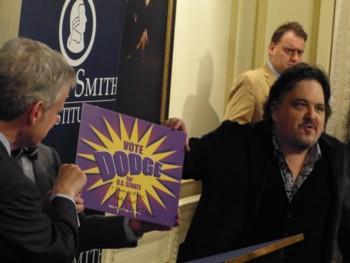
The end of Heath’s talk was hijacked by this guy:
Yes it’s Andrew Ian Dodge, presenting some Andrew Ian Dodge for Senator propaganda to Eamonn Butler, so that Eamonn Butler can exhibit it, somewhere. Now there‘s a man who has no problem about being photographed.
Councillor Harry Phibbs, top right, is not impressed by this pushy American.
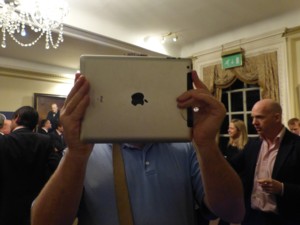
This guy, on the other hand, preferred to hide his face behind his iPad:
Well, no not really. He was taking a photo, of me.
“And may I say that the exaggerated outrage over the “phone hacking” scandal is particularly hypocritical given the culture of pervasive surveillance of citizens that the British government — ahead even of our own — has established over the past decade or two. Those criticizing the press here are in no position to complain about invasions of privacy.”
Glenn Reynolds weighs in on the the Leveson Report’s recommendation to regulate the UK media. Being a good American living in a land that has a First Amendment – not always well observed – Reynolds is distinctly unimpressed by Leveson. And we Brits should well remember how, if the UK media – or bits of it – are subjected to control, how this will lend some encouragement to authortarians the world over. (This is a fact that some members of the present government, such as William Hague, the foreign secretary, have grasped).
I am not often found defending the BBC or its offshoots, but this is just out of order.
The Welsh Government (for so the lads with the office on the fifth floor of Tŷ Hywel have styled themselves since May 2011 – there’s posh for you) demanded that the Welsh-language TV station S4C give the government a right of reply and refrain from ever repeating an episode of the soap opera Pobol y Cwm because a fictional character said the Welsh government “doesn’t have the backbone” to cull badgers.
Quite rightly, S4C repeated the programme as scheduled.
Like anyone else, the Welsh government has the right to complain if it believes that the BBC has failed in its statutory duty of impartiality as a tax-funded broadcaster, and that includes complaining about fiction. I did so to the point of exhaustion here. But what gave the Welsh Government the impression that it could try to impose impartiality right down to the level of re-writing the script for a particular actress in a soap opera?
The Leveson Report, probably.
|
Who Are We? The Samizdata people are a bunch of sinister and heavily armed globalist illuminati who seek to infect the entire world with the values of personal liberty and several property. Amongst our many crimes is a sense of humour and the intermittent use of British spelling.
We are also a varied group made up of social individualists, classical liberals, whigs, libertarians, extropians, futurists, ‘Porcupines’, Karl Popper fetishists, recovering neo-conservatives, crazed Ayn Rand worshipers, over-caffeinated Virginia Postrel devotees, witty Frédéric Bastiat wannabes, cypherpunks, minarchists, kritarchists and wild-eyed anarcho-capitalists from Britain, North America, Australia and Europe.
|






Recent Comments