We are developing the social individualist meta-context for the future. From the very serious to the extremely frivolous... lets see what is on the mind of the Samizdata people.
Samizdata, derived from Samizdat /n. - a system of clandestine publication of banned literature in the USSR [Russ.,= self-publishing house]
|
The public sector strike the other day, which Perry welcomed and I did not notice, was nominally about austerity. I have heard various conflicting claims about UK government spending, so I decided to find out myself and make my own graphs using figures from ukpublicrevenue.co.uk and ukpublicspending.co.uk.
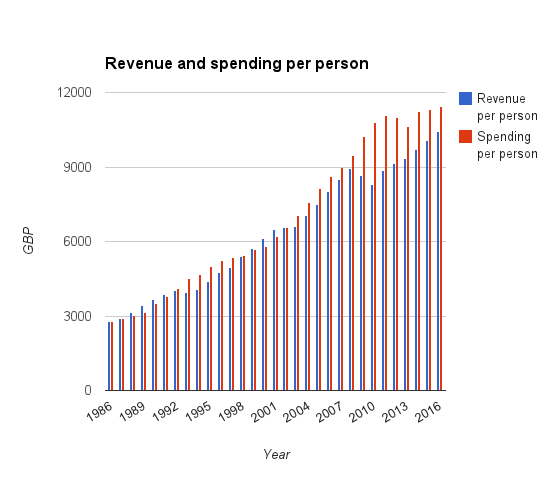
Spending did go down a bit in 2012 and 2013, so I suppose that is the austerity. But it is still higher than in 2009, and much higher than revenue, even though the latter has increased every year, contrary to the narrative that austerity is to benefit rich taxpayers.
The years 2014 to 2016 are estimates, which if to be believed indicate the plan is to resume the growth of the state.
These are absolute numbers. Other charts I have seen correct for inflation or GDP and population. I do not trust official inflation figures, and I think government spending makes the GDP statistic less useful. So I got average earnings figures from measuringworth.com and using the population figures from ukpublicrevenue.co.uk calculated spending per person as a percentage of average earnings. This makes sense to me because the fraction of my earnings that are appropriated by the state is what directly affects me.
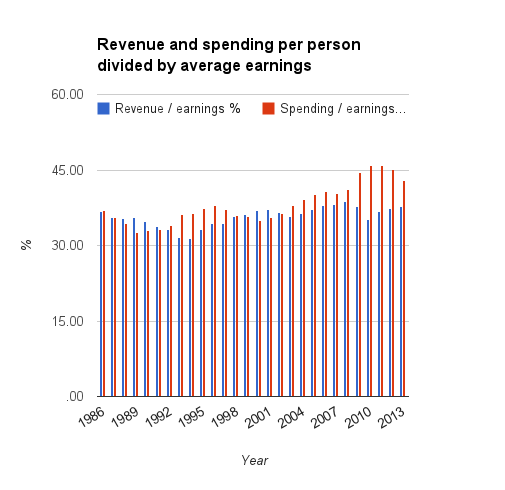
The graph ends in 2013 because I have no estimates for average earnings. There has been a slight decrease in spending by this measure in 2012 and 2013, but no return to conditions before the step change in 2008.
In short, there is a lot of talk about not a lot of action. I have a suspicion that small cuts have been made to the wages of particularly vocal and popular public servants in order to make austerity seem like a bigger deal than it is while keeping powerful public servants in the manner to which they have become accustomed.
You can see bigger graphs and my working out in my spreadsheet.
Edit: I had mis-labelled the y axis on the first graph; it shows revenue and spending per person in Pounds. I have fixed the labels now.
Suddenly we’re told there’s a brand new bill that looks like it was written by the National Security Agency that has to be passed in the same manner that a surveillance bill in the United States was passed in 2007, and it has to happen now. And we don’t have time to debate it, despite the fact that this was not a priority, this was not an issue that needed to be discussed at all, for an entire year. It defies belief.
– Edward Snowden
As the rest of the world becomes more skeptical about mass surveillance, there is one country where it is seldom ever mentioned, except to babble about the need for more of it. The country that the romantic conservative Daniel Hannan says “invented freedom“: Britain.
The latest symptom of the “polite and commercial people” of Britain’s complacent unconcern with freedom and privacy is emergency legislation to be passed through all parliamentary stages early next week, the Data Retention and Investigatory Powers Bill or Act, as we shall have to call it almost immediately. There is little doubt this will happen. All three major parties are agreed they will drive it through.
The “emergency” is a confection. It is ostensibly because of a legal challenge to regulations under an EU directive which was invalidated by the European Court of Justice – which took place in April. So obviously it has to be dealt with by hurried legislation to be passed without scrutiny and not even adumbrated in public till Wednesday. This is the order of events:
- 8th April – ECJ declares Data Retention Directive 2006/24/EC invalid – in theory telcos and ISPs no longer required to gather certain data
- …wait for it…
- 7th July – Rumours surface in the press that “something will be done”
- 9th July – The Sun in the afternoon carries a “security beat privacy” piece boosting the scheme as the only way to beat terrorists and paedophiles.
- 10th July, 8am – Emergency cabinet meeting briefs senior ministers.
- 10th July, 11.18am – Bill becomes available on gov.uk website (still not available via parliament), Home Secretary makes statement in parliament.
- 11th July (Friday), 4pm – Draft regulations to be made under the Bill as soon as it is enacted made available.
- 15th July (Tuesday) – All House of Commons Stages of the Bill (normally about 4 months).
The pretext, reinstating these regulations (which the Home Office has claimed are still subsisting in the UK anyway) is hard to accept as “vital”. Other countries manage fine without them, and they only existed at all because of some bullying by the UK of other EU states after the 7th July 2005 bombings. I covered this background in an article for City AM written on Thursday. But since then we have had a chance to read what is proposed.
Reinstating the regulations – or anchoring them against legal challenge, since they are still operating – would be simple. The new Bill need only say that parliament enacts the content of the regulations as primary Act of the UK parliament. I wouldn’t be pleased. But it would be doing what was required by the ostensible emergency. That however is not what is happening. The new Bill would broaden the regulations and the scope of the Regulation of Investigatory Powers Act under which most state snooping in Britain is conducted and give the Home Secretary powers radically to expand the data required, by further regulations. It is a move in the direction of the supercharged surveillance regime set out in the Communications Data Bill, which was dropped as too controversial ante-Snowden. The clearest detailed analysis is by David Allen Green in the FT, he says:
The removals of civil liberties, and the encroachments of the state, are rarely sudden and dramatic. It is often a subtle change of legal form here, and the deft widening of legal definitions there. And before one knows it, the overall legal regime has changed to the advantage of officials and the otherwise powerful, and all we have done is nod-along as it happens.
I fear it is worse than that. Politicians and press have been so comprehensively suckered that some who would normally stand up for civil liberties are burbling about how “it offers [the] chance to bring rise of surveillance state under democratic control”. DRIP.
The Liberal Democrat politicians who have been most reliable n this topic all appear to have been bought off with a sunset clause and the ludicrous promise of “a review”, even though they have now had several years of experience of arrant avoidance of their questions by the intelligence services. DRIP
Even this cannot persuade them that the security state (sometimes called the “deep state”, though that flatters its dysfunctional smugness) is mocking them. DRIP.
Our permanent establishment in Whitehall treats ministers with condescension, and mere parliamentarians with the same contempt it reserves for ordinary citizens. But those in public life need to believe the state is their honest servant. DRIPS!
I support the Public Sector in the UK going on strike… in fact I hope they all stay out on strike for a really, really, really long time.
It is amazing the establishment is still peddling the whole nonsensical ‘climate change’ fraud. I guess they did not get the memo that people outside the BBC/Guardian bubble have noticed that the Emperor has no clothes.
Perhaps it is a measure of my cynicism but this does not surprise me in the slightest. Indeed my only surprise is that anyone is surprised:
Anyone with any sense who was in trouble would come to the whips and tell them the truth, and say now, “I’m in a jam, can you help?” It might be debt, it might be a scandal involving small boys, or any kind of scandal which a member seemed likely to be mixed up in, they’d come and ask if we could help.
This was the Tory party, but of course it matters not one iota which political party it is, for they are all cut from the same cloth.
I, and I am sure many other readers of and writers of Samizdata, have been following the career of Steve Baker MP, ever since he was elected MP for Wycombe in 2010. However, the last posting I did here about Baker elicited understandable scepticism from commenters about whether Baker would stick to his free market principles long enough to make any difference. Yeah, sure, he is now on the Treasury Select Committee. Big deal. Baker, like all the others, said doubters, would soon go native.
Well maybe he will, but he hasn’t yet. Not if this City A.M. report by Peter Spence about Baker’s latest sayings and doings is anything to go by:
In almost every area of economics we’ve accepted that markets do it best, he says. Few could imagine a committee of nine wise men deciding how we produce food, clothes, cars, or mobile phones.
But when it comes to producing money, we’ve accepted just such an arrangement. And for Baker it’s crazy that this has led to an obsession with what men like Carney have to say. That we’re trying to decipher from after dinner comments the trajectory of monetary policy is illustrative of the mess we’re in. “The truth is this is like kremlinology, have we worked out what the politburo thinks? It’s mad.”
We see the same thing across the Atlantic, where former Federal Reserve chairmen Alan Greenspan and Ben Bernanke have both given speeches to investors shortly after leaving the office. What investors think about US monetary policy has knock-on effects around the world, evident after last summer’s “taper tantrum”, as the Fed stumbled towards scaling back QE.
“It’s amazing we tolerate this,” says Baker, as words from both men have had the power to move markets, such is the extent of the “kremlinology” investors are hooked on. “I want the people doing this kreminology, making their living doing it, to question whether this is actually a free market,” he says.
“I think we operate a kind of monetary socialism, and it’s the single biggest institutional problem with our economic system.”
That bit about wanting people to “question whether this is actually a free market” is the bit that really matters here, I think. Clearly, Baker wants all such questioners to realise that the answer is: “No”.
Much of the problem with the world’s financial system these days is the most observers of it don’t even seem to think of it as a nationalised, government dominated system in the same way that tractor production was a nationalised, government dominated system in the old USSR. It is simply inconceivable to them that “money” could, by its very nature, be anything but a nationalised industry, so much so that to think of it as a “nationalised industry” is beyond them, because even to use such a phrase is to allude at least to the possibility – the thinkability – of a non-nationalised, free market version of the same industry. This is not a debate about how the nationalised industry of money should be managed, so much as a debate about the fact that it is a nationalised industry. Or, it would be such a debate, if only people like Steve Baker MP can manage to get such a debate started.
No doubt many Soviet tractor-makers felt similarly about what they did. That too, they were sure, just had to be run by the government, or else tractor making would descend into a black hole of chaos and impossibility and absurdity. The idea of a “free market in tractors” was, for such people, literally unthinkable. And millions in the West mocked all this nonsense. So, why do the descendants of such mockers – literal and intellectual – not mock their own Central Bankers now, just as Central Tractorers were mocked back then?
People may respond to Baker’s challenge by saying: “Yes, it is a nationalised industry, and a good thing too.” But for people even to talk like that would be a huge shift in thinking, because the fact of monetary nationalisation would have been accepted, even as it is being defending.
Until the metacontext (to use a favourite word here) of this debate is changed, free market capitalism will go on getting the blame for all that is wrong about the world’s financial system. And the “solution” will continue to be to restrict free markets in financial matters ever more ferociously.
Keep it up Mr Baker. You have not gone native yet. And you have an admiring fan club out here that continues to notice and continues to applaud.
Positive Money want to end fractional reserve banking and have the state create money directly. According to them, when quantitative easing created £375 billion, only £30 billion was made available for the government to spend, at a time when construction workers were being laid off and school building plans to fix leaky buildings were cancelled (which juxtaposition made for a nice Facebook meme). The quantitative easing also caused a stock market bubble and made some rich people even richer.
Instead, the government could have simply invented some sovereign money, debt free with no bookkeeping, and paid the builders to fix the schools. No unemployment and happy children.
Detlev Schlichter points out that it is the government who encourage fractional reserve banking, and all that really needs to happen is for them to stop doing this and banks will create some money but not nearly as much. Also, having the state create money is no less a recipe for disaster than having the banks do it, and maybe more of a disaster. The same economic distortions will apply.
If I attempt to apply Detlev’s thinking, I imagine that perhaps the state invents lots of money and gives it to schools to spend on building repairs. Suddenly the demand for construction is skyrocketing. Prices go through the roof. This stimulates supply. Software developers and professional bloggers quit their jobs for better paid jobs in the construction industry. Whole new construction businesses are started. Pensioners put all their savings into construction industry shares. And then all the school buildings get repaired, and the government moves on to curing some other perceived shortage, and the construction bubble bursts and you are back to having unemployed construction workers and starving pensioners.
Now, Positive Money responded to Detlev Schlichter. It turns out they more or less agree with him — apart from the bit about how we do not need anyone at all to create money, which they never got around to addressing directly but I gather from their criticism of Bitcoin is because they think without inflation people will speculate and not spend. But, importantly, they do not trust politicians to control the money supply either. It turns out they think some sort of “public and transparent body” can do it.
The whole thing strikes me as wishful thinking. It sounds so good it might even get somewhere. You get to bash bankers and have free money and keep politics out of it. All you need is for the public and transparent body to stay truly transparent and public and be able to manipulate the economy with precision from a central point of control. What could possibly go wrong?
It is graffiti for goodness sake, and here we have assorted people arguing about whose graffiti it is. Oh what a strange world we live in.
It is an amusing work I grant you, and if someone can find a mug who wants to lift it off and buy it for real money, I can see why the lawyers get called in… but please spare me the “Banksy is a National Treasure” crap. He is a talented criminal who does not think ‘crimes against property’ are really crimes (and the reason they are is because the crimes are actually not against ‘property’, they are against the owner of the property).
I wonder if he expects anyone to respect anything he owns, such as his legs for example? Fortunately for him not everyone thinks the way he seem to.
That said, where he to find himself in a prison cell for said ‘crimes against property’, he should probably be given a brush and some paint to pass the time.
I suppose some people who loathe rock festivals and want to pretend how much they enjoy playing the “working class hero” line might sympathise with Bruce Dickinson, who is the front-man for group Iron Maiden, in refusing to play at Glastonbury for it being “middle class”. (He was privately educated, which is ironic.) I normally really like Dickinson (if not his music, at all) due to his being a qualified pilot and having fairly pro-free market, no bullshit, views. And he cannot stand Coldplay and all that dreary stuff, so he must be a good egg overall. But something about all this makes me think, “Fcrissakes, can we just take class out of it and enjoy the music on its merits? Does it always have to have some frickin’ socio-economic agenda?”
Here is the item:
Bruce Dickinson, who attended the private Sharrow Vale boarding school in Sheffield, said the band had no interest in playing there. He said: “In the days when Glasto was an alternative festival it was quite interesting. “Now it’s the most bourgeois thing on the planet. Anywhere Gwyneth Paltrow [the actress] goes and you can live in an air-conditioned yurt is not for me.”
Dickinson, who is also a qualified commercial pilot, said he was glad he was instead playing at hard rock festival, Sonisphere, at Knebworth Park in Hertfordshire in July. “We’ll leave the middle classes to do Glastonbury and the rest of the great unwashed will decamp to Knebworth and drink lot of beer and have fun,” he said in an interview. Fellow heavy metal band Metallica are headliner’s at this year’s Glastonbury Festival, which starts next week and is attended by more 100,000 people. Tickets for the event, which sells out in minutes, are £210.
I can see his point about having a raving good time with cheap beer etc. Heck, I went to Le Mans last weekend to watch the 24-hour endurance motor race, which is the petrol-head equivalent of a rock festival with very, very fast cars blasting around a track in central France. There are lots of overweight middle-aged, lower-middle class guys (few women) who attend it, as well as the odd toff, group of rowdy youngsters and so on. I suspect even a few leftie-liberals go, in a guilty-pleasure sort of way. Think of Essex man and his European/North American versions all having a great time away from the other half and the kids. My wife stays at home with her friends and would not go there for love or money. And of course it is gloriously loud, vulgar, a hymn to non-PCness. But I don’t worry about the class backgrounds of those who go and would be a pretty sad individual if that sort of issue coloured my enjoyment. This weekend, I am in the Royal Enclosure at Ascot to watch the horses, and it doesn’t get more “upper class” in a cliched way than that.
Can we please, just for once, take the class obsession out of every such event? Please. Pass the champagne.
|
Who Are We? The Samizdata people are a bunch of sinister and heavily armed globalist illuminati who seek to infect the entire world with the values of personal liberty and several property. Amongst our many crimes is a sense of humour and the intermittent use of British spelling.
We are also a varied group made up of social individualists, classical liberals, whigs, libertarians, extropians, futurists, ‘Porcupines’, Karl Popper fetishists, recovering neo-conservatives, crazed Ayn Rand worshipers, over-caffeinated Virginia Postrel devotees, witty Frédéric Bastiat wannabes, cypherpunks, minarchists, kritarchists and wild-eyed anarcho-capitalists from Britain, North America, Australia and Europe.
|





Recent Comments