We are developing the social individualist meta-context for the future. From the very serious to the extremely frivolous... lets see what is on the mind of the Samizdata people.
Samizdata, derived from Samizdat /n. - a system of clandestine publication of banned literature in the USSR [Russ.,= self-publishing house]
|
The purpose of the NHS is political, not medical. In the UK, in our Coronation of the State as our Bountiful Lord, it is the Crown, the dole is the Orb and State Education is the sceptic sceptre.
Those who question the State threaten to leave you without medical treatment, leading to a horrible death, or starve or be illiterate. Yet a Slaughterhouse like the Mid-Staffs can kill on a scale that an early 1940s German bureaucrat might admire, and nothing happens until hospital the pile of corpses becomes too obvious for excuses not to be shuffled out.
– Samizdata commenter Mr. Ed
The only serious black mark against the NHS was its poor record on keeping people alive
– Denis Campbell and Nicholas Watt.
This was written in all seriousness in a Guardian article praising the NHS. Seriously. Not joking. You could not make this up.
Is it too much to hope that one day these uneducated and bigoted Yorkshire folk will understand that claiming benefits, fly-tipping, littering the streets, threatening people and playing loud music all night – these were the things of which they complained – are simply expressions of cultural diversity, to be warmly embraced? Why don’t they understand that we all have to get along?
– Rod Liddle
When it comes to “climate science”, I have for quite a few years now, as my sneer quotes make clear, been inhabiting the land of confirmation bias. So, I will not say that this proves me right. It merely confirms me in my state of ever more glacially advancing contempt for the “science” here described:
Several months afterwards, the society’s ‘newsletter’ was published. It contained a special section on the conference at which I had spoken, with a brief description of each talk, the work behind it, and with thanks offered to each speaker. I searched for my name – nothing. My presentation was ignored in its entirety.
“Disheartening” isn’t the term I would use, and I seriously considered giving up on the entire idea of academia, and getting a nice little 9-5 job. But, I am still here, still working on the problem, still uncovering, lets call them ‘anomalies’, in many areas, which the scientists involved have no clue how to explain, but about which they will hear no view other than their own.
Biases being confirmed all round, it would seem.
Food banks provide invaluable support for families on the breadline but the fact they are needed in 21st Century Scotland, as across the UK, is a stain on our national conscience.
So says Jamie Livingstone, head of Oxfam Scotland, in a report on the increase in the use of food banks. Quite right too. That the nation has allowed its state to impede economic growth to such an extent is indeed a stain on its conscience. The nation should probably do something about that. Food should cost almost nothing by now.
The report said changes to the welfare systems, low and stagnant wages and increases in food prices were all contributing to the increase in numbers.
Indeed: welfare makes the nation dependent on an ever expanding state, inhibiting the growth that would make food prices fall in relation to human labour prices.
Of course I am quoting out of context. What Oxfam and the Trussell Trust, who co-authored the report, are really saying is that more state welfare is needed.
Government ‘names and shames’ minimum wage underpayers!
Says our tax funded news bringers at the BBC.
So can we also now get a list of companies who did not create certain jobs for people at all because the minimum wage made it uneconomical to do so?
The minimum wage: a cunning government programme for making bourgeois statists feel good about themselves whilst simultaneously motivating companies to automate and reorganise their businesses to employ as few low income people as possible.
I am curious… have the odious statists at the Daily Mail been getting ‘sponsorship’ money from Britain’s Bin Bag manufacturers?
‘We are not trying to tax people. We are trying to change people’s behaviour, encourage much more environmentally-friendly behaviour’
Ed Davey, Energy and Climate Change Secretary, upon having just imposed a tax on people…. without trying apparently.
Has this sublime tradition, the tradition of Edward Coke and John Hampden, of James Harrington and Algernon Sidney, of John Milton and John Locke, of Pitt the Elder and Edmund Burke, of Earl Grey and Viscount Palmerston, of Richard Cobden and John Bright – and, yes, of Benjamin Franklin and Thomas Jefferson truly found its quietus in the person of Nick Clegg? The thought is almost unbearable.
– Dan Hannan
It’s one thing to read a Guardian piece complaining about Uber. That certainly makes Uber seem like a fine thing, but you can’t trust everything you read, can you? Maybe Uber is not actually as great as the Guardian is making it appear. Last Friday evening, a week ago, by a lucky chance, I went one better. I had an actual trip in an Uber-taxi. It was a good experience.
Rooted as I am in the twentieth century, I was not the one who set this journey in motion. The man who did was my twenty first century friend Rob, who is as computer-savvy as I am computer challenged. I and Rob were guests at a dinner party, and I heard that he and another guest had some kind of lift home fixed, going back towards central London, and I asked if I could join in. Yes, fine. I then rather delayed things by taking what turned out to be rather too long to do my thankyous and farewells, because, basically, I am not used to taxis being this fast in answering the call. But, eventually I was aboard, and off we went.
It was only when I was in it that I learned that this was one of these new-fangled Uber taxis, this being why it had arrived so quickly to pick us up and why I should have been quicker off the mark when leaving the party.
What Rob had done, as soon as he and the other guest decided they needed to be off home, was crank up the Uber app on his smartphone and summon – and here’s the point of this system – the nearest Uber taxi, by looking for blobs on his smartphone Uber-map.
On our journey, we and the driver chatted about how the new system worked. New technology often has this effect, I find. It gets people talking. It reminded me a bit of the early days of blogging, which got all sorts of people in touch with each other who would never normally have been communicating.
Our driver preferred his new Uber-life partly because he now gets no grief from a demanding taxi-cab office with its rigid time and place demands and general stress and hassle. He now eludes that middle man and, via his new and improved middle man (Uber), instead relates directly to his passengers. There is an elaborate regime to register both complaints from drivers about passengers, and from passengers about drivers, but for a driver who wants to do an honest job, that’s all good, just as it is for passengers who are willing and indeed eager to behave themselves.
We passengers also like the service that the driver and his comrades provide, because it is cheaper than old-school taxis, and quicker, and easier to track. But given that Uber is so cheap for us passengers, and given that the driver pays twenty percent of the reduced fare that we pay him to Uber, how come the driver is nevertheless such a contented guy?
A big plus for the driver is that he now works exactly when he likes, that being what a lot of the grief between him and his former taxi office had been about. He can start and stop when he pleases, with no warning concerning either, provided only that he finishes all paid-for journeys he embarks on.
But just as impressive as the increased flexibility the driver enjoys is that the flip side of us having hailed the nearest Uber taxi to us when we wanted to start our journey is that our driver is immediately available to start his next useful journey just as soon as he has completed his previous one. Our driver had been taking someone to that particular part of suburban London, and within moments there we were, wanting him to take us back to the middle of London from that same out-of-the-way spot. He doesn’t have to drive back, empty, to some damn taxicab office. He resumes work at once. This is why Uber-taxis are cheaper. This is not done by lowering the standard of living of the drivers or the quality of the product. It is done by seriously improving the efficiency of the drivers and their vehicles.
You can tell that Uber is a massive efficiency gain by the fact that the regular black cab drivers are in a state of fury about it, and have been threatening to screw up London’s traffic, with some kind of demo/disruption or suchlike. Their excuse is that there is apparently some law or other which, in the opinion of the cabbies and their lawyers, these new Uber-taxis are breaking, concerning computer tracking or something. But such complaining seems likely only to publicise that if the law is getting in the way of Uber, then it should stop.
If you want some more jeering at those angry black cabbies, see what City A.M.’s Guy Bentley has to say about them.
That the black cabbies are demonstrating against Uber in particular, rather than against “Kabbee, Hailo, Addison Lee, GetTaxi, Uber and Green Tomato” merely serves to establish Uber in the public mind as the market leader. I daresay there are also “network” reasons why one big brand leader is advantageous to most customers. So, big win for Uber, I’d say.
I am sure that there are many, many tweaks to Uber that I am not even remotely aware of, the kind where not only do I not know the answer but where I had never even thought of the question. But presumably Uber-savvy commenters can fill in many more details.
In particular: what could go wrong? Our driver didn’t seem to have any worries. But, was he perhaps being a tad optimistic? Will his income maybe decline if lots more want in on the driving side of things? What about if robot cars join in, and snatch away his job? Great for us passengers, because if it’s not it won’t catch on. But not so great for our driver.
Once you start talking about systems like Uber and robot cars in the same sentences, is the longer term implication of things like Uber going to be: fewer privately owned cars? Will Uber 3.0 be the first robot car killer app?
But oh yes, back in the here and now, one further detail I do now remember the driver talking about. If you are an Uber customer based in Los Angeles (as a recent passenger of his was), you can use the exact same account to whistle up our London driver as you have already been using in LA. The exact same account. Think about that. In any Uber-enabled city, and there are now a lot of such cities around the world, you can use taxis with the kind of confidence you already have about Uber-taxis in your own back yard.
My guess would be that a characteristic Uber first time user is someone who is about to venture to a foreign city where Uber is in action, and he signs up for Uber beforehand, so that he knows his taxis in the strange foreign landed will then be sorted at non-punitive expense and without grievous risk. Where he lives, he has a car and trusts the local taxis. But in foreigner-land, Uber taxis will be a massive plus. Then, once he has sampled the service in a strange city, the obvious next thing will be to use it back home more regularly. If that’s all approximately right, you can see why the black cabbies are spitting blood.
But alas for the black cabbies, their complaints are only advertising Uber to a global audience of city-hopping tourists and businesspersons. London’s black cabs are famous the world over. So if they are now moaning about Uber, that’s a global story. With enemies like this, Uber hardly needs an advertising agency.
But that’s enough guessing from me about Uber. Over to our commenters and their amazing ability to share a collective conversation with us and with each other, thanks to the work of an earlier generation of computer-magicians.
I don’t know if (politicians) are enemies or more prey but I certainly didn’t go into Westminster to make friends and in that I’ve certainly succeeded.
– the ever splendid Paul Staines (aka Guido Fawkes)
If I emerge from the front door of my block of flats, but then realise that I have forgotten to bring my camera with me, then, unless I am in an extreme hurry, I turn around, go back up the five flights of stairs to my home, and get my camera. I cannot bear to be out and about in London without it, being a ever-more voracious photographer of whatever I see on my perambulations that interests me, and that’s more and more, the more I think of different interesting things to keep track of.
Plus, I just know that if I am not careful in this way, then the one day when I do not have my camera with me will be the exact day that an Airbus 380 on its way into Heathrow gets into trouble so serious that it is visible even to me, and plummets down into central London.
One of the things I like to photograph is the front pages of newspapers, because of their often amusing or arresting headlines. I mostly do this in the shop where I often buy my monthly copies of the Gramophone and the BBC Music Magazine (by “music” this magazine means classical music) and my weekly copies of the Radio Times, so the proprietor doesn’t mind me photographing other things. He knows that I am not going to buy any of these newspapers, but that I might be about to buy something else, and that I regularly do, even if maybe not on that particular day.
And, I take a lot of other photographs, of such things as cranes, bridges, Big Things, roof clutter, signs and notices, and other digital photographers, especially when they are engaged in photographing such things themselves, or in photographing themselves.
All of which is my explanation of why I took the photo below (on March 14th 2014) but then forgot about it, until I went trawling through my photo-archives seeking something else entirely:
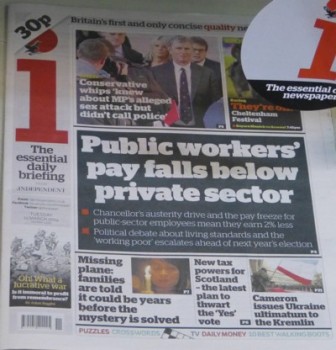
I couldn’t find that exact story on the www, but here is the Evening Standard version of the same thing.
For me, this is always an interesting moment in the see-saw that is now British politics, between regimes which contrive as much government as the voters feel they can afford and regimes which unleash more government than the voters feel they can afford. (The option of having less government than the voters feel they can afford, is not, alas, considered worth offering.)
I cannot remember to the nearest year when the Blair/Brown regime was reported as having pushed public sector pay above this same mark, contriving a country in which public sector workers were, on average, reported to be getting more than private sector workers, but I do remember noticing that moment, and thinking it of some significance.
And this latest little tilt in the balance between production and predation strikes me as significant also, and worth noting here even if the announcement happened a couple of months ago. Just for now, for the time being (or so it says in the newspapers): production gets you better wages than predation. Good.
I know, I know. As good news comes, this is pretty small stuff. After all, even this feeble milestone took them four years to get past. As “austerity” goes, it is very mild indeed. But it is good news, I think. And I particularly enjoy being told it by a newspaper which so obviously disapproves of the story that it is telling.
In London today, the BBC has revealed a remarkable revelation:
Windows work in both directions! Not only can a person in a hotel room see out of a window, it is possible for people to also see in from the outside!
Truly we live in an age of marvels! Ah that such a cognitive breakthrough could have happened here, it make me proud to be English! Article like this are why I often send the BBC twice the licence fee they actually demand from me (under threat of jail if I do not pay up) because how can anyone doubt they provide such inestimable value. No, seriously, for the life of me, I cannot estimate how much value they provide. I truly cannot.
|
Who Are We? The Samizdata people are a bunch of sinister and heavily armed globalist illuminati who seek to infect the entire world with the values of personal liberty and several property. Amongst our many crimes is a sense of humour and the intermittent use of British spelling.
We are also a varied group made up of social individualists, classical liberals, whigs, libertarians, extropians, futurists, ‘Porcupines’, Karl Popper fetishists, recovering neo-conservatives, crazed Ayn Rand worshipers, over-caffeinated Virginia Postrel devotees, witty Frédéric Bastiat wannabes, cypherpunks, minarchists, kritarchists and wild-eyed anarcho-capitalists from Britain, North America, Australia and Europe.
|





Recent Comments