We are developing the social individualist meta-context for the future. From the very serious to the extremely frivolous... lets see what is on the mind of the Samizdata people.
Samizdata, derived from Samizdat /n. - a system of clandestine publication of banned literature in the USSR [Russ.,= self-publishing house]
|
It’s final. Instapundit reports DeCSS (a DVD encryption unscrambler) is legal… if you live in the free world.
We send our heartfelt congratulations to the author of DeCSS, Jon Lech Johansen, on his acquittal and total victory over the forces of evil.
Computer games are evolving at an astonishing rate, acting as the primary driver of desktop computer development (after all, how many people actually need a 2.5 GHz CPU, a 128 Mb graphics card and 512 Mb of RAM to do word processing and spreadsheet work?)
Back in the Paleolithic age of computers (the 1980’s), computer games looked like this…

Wolfenstein: Shoot! Mild fun… but not for long
Mildly amusing but crude in the extreme. By the early 1990’s however, came the advent of the ‘FPS’: the First Person Shooter!

Wolfenstein 3D: Shoot! Great fun… but not for long
They seemed astonishing at the time, actually putting you inside the gun wielding hero. The graphics were rather basic, to put it mildly and after a while the lack of multifaceted interaction tended to make the games rather tedious after the initial ‘gee whiz’ factor wore off… other than opening doors, the only way to interact with things was to shoot at them.
My goodness how things have changed!
Wolfenstein 3D begat Doom, which begat Quake, Hexen, Marathon, Unreal, Duke Nukem, Tomb Raider etc, etc… all worthy ‘shooters’ of steadily increasing graphic quality.
Sudden surges came with games like Half Life, released at the end of the computer games neolithic era (1998) and yet still playable now…and featuring not just excellent graphics but Artificial Intelligence which actually shows a bit of intelligence, rather than just a desire to commit virtual suicide… Half Life & the spin-offs Blue Shift and Opposing Forces brought also the ability to ‘talk’ with the computer generated denizens of the game as opposed to just shoot at them.

Half Life: Don’t shoot, he is on your side.
Great fun… for hours on end!
Then games like No One Lives Forever (NOLF), a spy thriller set in the 1960’s with frequent plot specific cut scenes came along, and suddenly the story line of the computer game actually started to matter.
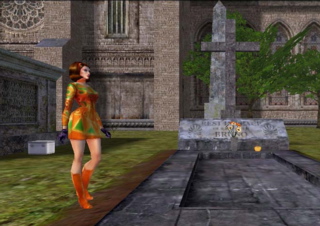
NOLF: Cate Archer, at the grave of her ‘dead’ mentor
The next generation of releases saw the success of story intensive NOLF and soon games of almost cinema grade plot and characterization started appearing, such as the conspiracy ladened Deus Ex and then the gritty darker than dark Max Payne.
And so yesterday the new Gamespy PC Game of the Year was announced, and it is the excellent No One Lives Forever 2.
As well as being superb graphically (caveat: you do need a high spec computer to get the best out of this game), it is just down right funny! Set in the 1960’s, this ‘spy shooter’ owes more to the wonderfully camp ‘Man from U.N.C.L.E.’ than James Bond or Smiley’s People. Although slightly more ‘serious’ than Austin Powers (but only slightly), it provides endless entertainment by allowing you to eavesdrop on the all-too-believable conversations of other people.
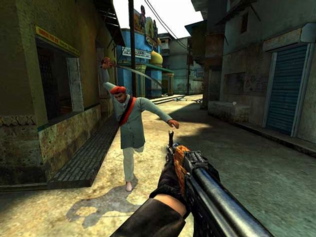
NOLF2: This Indian H.A.R.M. agent has a sword…
but Cate has a Kalashnikov
I look forward to continuous progress in computer games… pure distilled essence of capitalism married to explosive creativity. Within a few years, interactively with the virtual environment will be almost total, opening up steadily more ambitious story telling possibilities whilst at the same time the holy grail of photorealism comes closer to realization. The future is so bright, we are going to need shades to see it. I can hardly wait!
Youthful policeman are a standard yardstick of personal maturity and you really know that middle age is looming when politicians begin to look ‘fresh-faced’. However, there is nothing quite like the passing of your teenage rock ‘n’ roll idols to have you looking in the mirror and counting those grey hairs.
“Joe Strummer, lead singer of seventies punk band The Clash, has died at the age of 50.”
‘The Clash’ provided the background music for my student years. I loved them. R.I.P Joe and thankyou.
Michael Blowhard hits a very important nail on the head with this:
In fact, art and science have little in common. However much science is influenced by such factors as personality and culture, it’s empirically based; it’s testable. The powder goes ka-boom when a match is touched to it or it doesn’t. Actual progress is made; disputes between rival views are finally adjudicated. If you understand the science of today, you basically understand all of science. (And let’s set aside for the moment the kind of babble about “uncertainty” and “chaos” that art intellectuals love to indulge in. As far as I can tell, they’ve got no better a grasp on the scientific meaning of those terms than I do.)
In art, none of this is the case. Testable? Well, the success of “Star Wars” certainly demonstrated something about what movie audiences were ready for in the mid-’70s, but “McCabe & Mrs. Miller” has probably meant more to actual filmmakers. A lost weirdo painter (Henry Darger) is discovered and causes a sensation; a previously unknown art tradition (Tuva singing, for instance) gains notice. A prominent artist – Longfellow, for instance – is forgotten.
In the field of art, all this is normal. In science, it wouldn’t be. A great discovery remains a great discovery; and no one’s reviving the theory of phlogiston.
There were various comments afterwards trying to say that science is more like art than people think. But people (and Michael) are right and these commenters are wrong. Science is all about communal progress. Art is all about individual responses. Scientific theories compete according to which of them, in the collective opinion of the scientific community, constitutes the most progress. That science progresses, in the words of one of these commenters, “one funeral at a time” just means that scientists can be stubborn idiots, not that science is a matter of subjective individual whim. Truth, in the end, is a communal matter. The truth is what you and I and everybody else who is paying attention have, in the end, to agree about. Artistic excellence on the other hand …
One commenter even suggested that Michael Blowhard ought to read more Feyerabend. This comment is my nomination for the silliest and most potentially disastrous blog comment of the year 2002. Michael Blowhard’s brain is an important blogosphere resource, but although I’ve never met him I sense that he’s the sort of person who would read Feyerabend, just because some twat anti-philosopher of anti-science had suggested this on Blowhards. Michael might emerge from the experience mentally unscathed, but the downside risk doesn’t bear thinking about.
The importance of all this, as Michael himself explains very well, is that if you do accept that art “progresses”, then you immediately install a “taste mafia” in power who are there to tell you where art is just now, and where it’s been, and where it’s going. After all, if art is like science, that means we all must all defer to the art scientists, doesn’t it? And a vertical third finger to that. Or maybe the second finger also, Agincourt longbowman style.
Tomorrow I hope to be meeting with my Little Man who will be installing my Cullture Blog for me. So far the operation has resembled the sad time about ten years ago or so when I tried to install a shower. While this worked, it had the two standard British shower settings: Far Too Hot and Far Too Cold. Then it stopped altogether. I do hope that my Culture Blog grief is all happening now, and that soon it will start and then just get better and better the way a British shower never would.
The Blowhards have both inspired me and relaxed me about this project. They have inspired me by their very existence, and they have relaxed me by doing a proper culture blog so properly that I don’t have to worry about doing that myself and can just have some fun with my one, as and when I feel inclined.
In among blogging up as much of a storm as I could manage during the last few months, I’ve also been ploughing my way through a book, which I’ve had cause to mention here several times before, but do not apologise at all for mentioning yet again: Peter Hall’s magnificently blockbusting Cities in Civilization.
It is full of delights beyond numbering. Recently I enjoyed a thrill of patriotic pleasure when I got to the end of the chapter dealing with the birth of Rock and Roll (“The Soul of the Delta”).
The Story So Far: Rock and Roll has arisen, in Memphis, as a creative collision, fertilised by the newly active music radio, between Delta Blues and Country and Western. But the New York Los Angeles Axis of Evil (bland pop with no mention of Black People) is fighting back and threatens to submerge R+R in a tsunami of upbeat but basically middle-class woolly cardigans and Christmas albums. But, riding to the rescue, yes, it’s the British Cavalry:
Understood or not, these British groups left no doubt about their debt. Indeed, they went out of their way to record it. When the Beatles first came to America they told everyone they wanted to see Muddy Waters and Bo Diddley; one reporter asked: ‘Muddy Waters … Where’s that?’ Paul McCartney laughed and said, ‘Don’t you know who your own famous people are here?’ Eric Clapton quoted Little Walter, Chuck Berry, Bib Bill Broonzy, Robert Johnson, and Blind Boy Fuller, but above all B. B. King; Muddy Waters was discovered by white America only after the Rolling Stones took their name from one of his tunes. John Lee Hooker understood when he said: ‘It may seem corny to you, but this is true: the groups from England really started the blues rolling and getting bigger among the kids – the White kids. At one time, fifteen years back, the blues was just among the blacks – the old Black people. And this uprise started in England by the Beatles, Animals, Rolling Stones, it started everybody to digging the blues’.
I guess most Americans who care about such things knew this story already, but I didn’t realise this until now. I just thought, you know, the Brits went to America and sold a lot of tickets and a lot of records and got drunk and drugged and had a good time, playing essentially the same kind of stuff as their US rivals. That they played such an important part in the nurturing (if not the birth) of Rock and Roll, I did not know.
It’s a frightening thought that, world impactwise, this is probably about the last truly interesting thing that Britain has done. Are there any other more recent Big Things that have originated in or even been partly done in (like Rock and Roll) this little land of ours? I’d love to be told, but fear that the comments won’t add up to much. (And before Rock and Roll, you have to go back to Bomber Command.)
Our current popsters – and I know I sound like an old fart here but there you are, I am an old fart – are an embarrassment, not just musically to my Rolling Stones trained ear, but also commercially. I’m told that Britpop is doing no business at all in America. Right?
I thought Robbie Williams made a promising start, and I loved his performance of “I Hope I’m Old Before I Die” on Top of the Pops about a decade ago, but his latest single is, I think, as exciting as cold washing up water. I further understand that some Idiot Old Record Company has just paid him 4 billion quid for his next fifty albums. I believe that They Will Regret This.
On the other hand, I bought a DVD of the Rolling Stones recent “Zimmer Frame Tour” (no, the “Bridges to Babylon Tour 97-98”, which is but a blink of an eye ago in Rolling Stones time) and there was a new track on it which I hadn’t heard before, in among the old classics, called “Flip The Switch”, which I thought was great.
Have a nice weekend.
Michael Jennings tackles, albeit only in passing, one of the late twentieth century’s most enduring and to many most mysterious of questions: why did Molly Ringwald, given the excellence of her performances in such fine movies as Sixteen Candles and Pretty In Pink, never make it as big in the movies as she should have? Why, from the late eighties onwards, was the Ringwald career ride mostly down hill?
I think I can throw some light on this problem.

Molly then
Ms. Ringwald was a totally convincing and attractive teenager, certainly from where I was sitting. However, she did have one drawback. She was one of those females who, through no fault of her own, gives the impression of being just one misfortune away from bursting into tears. In a teenager this quality is tolerable, even endearing. Why can’t those bigger boys see what a fine and sweet girl Molly is? Why are those rich bitches from the posh side of the tracks being so nasty to Molly? Poor Molly. Somebody do something. You, handsome rich boy, dump your shallow girlfriend and give Molly a ride in your red Porsche. And as for you Andrew McCarthy, for once in your life show a bit of backbone!
Unfortunately for Molly, however, as teens turned into twenties, and then thirties, and then whatever the lady is now, she still gives off the same victimhood vibe, and whereas this used to tug at the heartstrings; now, on those rare occasions when we still witness it, it merely gets on the nerves. What had formerly seemed innocently melancholy – an artless appeal for aid and comfort – now seems frozen into a manipulative routine that ought to have been caste aside. Girl-girls are fine, one of nature’s greatest bounties. But girl-women? Let’s just say that this is the kind of thing that has to be done right. So when Molly the Woman hove into view, still with the exact same lacrimosity threat problem, the reaction was: Grow up woman. Stop your whining. This is not the stuff of which lady film stars are made.

Molly now
Please understand, Ms Ringwald (after all we’re talking about a woman who may now have time on her hands and could well be reading this – especially if she thinks she might learn from this posting how she could become a movie star), please understand that I am not offering a personal criticism of your personal qualities, which are probably not at all as I have described them. I am talking about your screen persona, the way you come across in the cinema, in front of the cameras. You come across, on screen, as one of life’s victims, and what is worse as a victim not so much of circumstances as of an inadequately developed character. Sorry, but there it is.
(It occurs to me that another bratpacker of that vintage and another would-be movie star, Rob Lowe, now to be seen in the political TV drama “The West Wing”, has suffered in recent years from a rather similar problem. Coming of age, beautiful. Come of age, not convincing. Not the finished article.)
But please understand also, Ms. Ringwald, just how fabulous you were in your all-too-brief years of glory. Sixteen Candles and Pretty In Pink are two of my all time favourite movies.
Remember the days when I was going on here about Brian’s Education Blog, but when there was no actual Brian’s Education Blog to go and look at. Well, now there’s another Brian Blog opening up Real Soon Now: Brian’s Culture Blog. I had been saving this posting or something like it for that. But when Michael opened up the Ringwald issue over at his place I decided that my analysis of this should be made public, now, and of necessity here. I hope that was the right thing to do. As for what’s holding up BCBlog, I won’t mention any real names but will say that the Atlas who carried the load so manfully when BEdBlog was getting started seems, temporarily, to be shrugging.
The Wild West wasn’t just wild, it was a scream:
“Marvel Comics plans to break new ground in the comic book industry by introducing the first openly gay title character in a comic book.
The character will appear in a revival of the 1950s title, “The Rawhide Kid.” Marvel expects a February debut.”
Here’s one gunslinger that will definitely be shooting up the bad guys.
I recommend a longish piece that Michael Jennings has just put up about the truly extraordinary Hollywood machinations which resulted in the three Lord of the Rings movies getting made, by an “insane bearded New Zealander”. I haven’t seen any of these movies, but I enthusiastically concur with this concluding observation:
… At least one insane bearded New Zealander is now insanely rich. And I think a world in which insane bearded New Zealanders can become insanely rich by making ludicrously over-ambitious movies is better than one where this is not the case. …
Quite so. The insane New Zealander is obviously quite a character, but even more extraordinary is the person who produced these movies, someone called Bob Shaye. It’s a real feet-in-the-gutter but eyes-on-the-stars story.
I took the liberty of looking at the Jennings site meter, to see if saying this here could be expected to make any difference to anything. Apparently, it might. I think Jennings deserves a lot more readers than he’s now getting.
Not me, that is for sure. Even harder to figure out is the film going public… and after a chat with Hollywood film producer and blogger Brian Linse the other day, I get the impression from him that even Hollywood cannot figure out the film going public.
Take two movies, both based on computer games. Firstly, Tomb Raider, staring Angelina Jolie as Lara Croft.
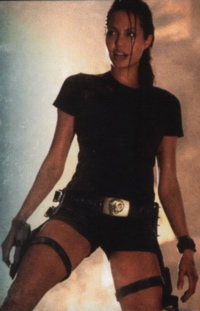
Angelina Jolie as Lara Croft: striking a Lara-ish stance
The Tomb Raider series of computer games were massive and more or less redefined the genre. I thought they were all quite gripping and am very eager to get my paws on the latest episode of Lara Croft’s adventures, Tomb Raider: Angel of Darkness.

Angel of Darkness: Lara Croft in all her pixellated glory!
As you might expect, I was rather keen to see Tomb Raider: The Movie, directed by Simon West. It had everything going for it: Angelina Jolie is an interesting looking woman and without doubt a technically skilled actress. Although she is not quite ready to challenge Gwyneth Paltrow for her crown as ‘Best-Yank-Actress-who-can-do-a-perfect-British-accent’, she is pretty damn good nonetheless.
The film clearly had a truly humongous budget, was adequately acted and tolerably directed in parts (with a couple startlingly bad scenes: it takes a certain perverse skill for a director to make a gratuitous shower scene with Angelina Jolie laughable for all the wrong reasons). Unfortunately the story line was weak, convoluted and confusing. Worst of all, the production was dire: it was almost as if it was three separate movies, casually spliced together, differently paced as if styled by three sets of completely unconnected film makers, then finally so badly edited as to make some parts of the story incomprehensible. Although Tomb Raider: The Movie was not utterly without merits, the overall effect was shockingly disappointing. 
And yet, due to the Tomb Raider/Lara Croft brand name and massive marketing, this clunker rode out the appropriately scathing reviews and was by no means a commercial failure in spite of costing a great deal to make. A sequel is in the pipeline.
And then let us look as the second movie, Resident Evil staring Milla Jovovich as Alice.
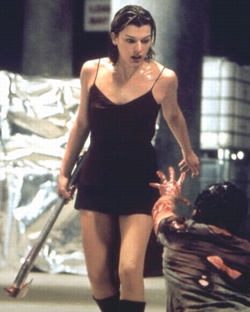
Milla Jovovich as Alice: about to demonstrate how unhappy she is with her ex-boyfriend
The game that the movie is based on, similarly called Resident Evil is a big name in the Playstation console world, but it does not have anything like the brand recognition of ‘Tomb Raider’ and ‘Lara Croft’ with the general public.

Killer pixels: Veronica from the Resident Evil – Code V game
The Resident Evil movie, directed by Paul Anderson, clearly has a far smaller budget, it was marketed poorly to put it mildly and with the exception of Milla Jovovich (Fifth Element, Zoolander, Blue Lagoon, Two Moon Junction etc.) had a cast of more or less unknowns. Resident Evil had a simple but nearly flawlessly executed story, was artfully directed, skillfully produced and very atmospheric. It was well cast and Milla was excellent as the killer amnesiac conspirator known simply as ‘Alice’… and unlike the jarring T&A scene in Tomb Raider, the opening shower sequence with dazed Milla worked perfectly, setting the deliciously ill-at-ease tone for the whole movie.
In short, this movie rocks… vastly superior to ‘Tomb Raider: The Movie’ on every level. It has no pretensions to be high art or intellectually challenging, but it does exactly what it sets out to do with considerable flair. 
And yet unlike the dismal Tomb Raider, Resident Evil almost immediately vanished off the screens and onto video/DVD. Fortunately, because it cost so little to make, the picture seems to have still made a profit and thus in this case too, a sequel is in the pipeline called Resident Evil: Nemesis (which will no doubt cause confusion with the impending Star Trek movie called ‘Nemesis’). Movie making is a very strange business.
Go out and buy or rent Resident Evil: The Movie on DVD or Video, it is destined to be a cult classic. Avoid Tomb Raider: The Movie like it was smallpox.
Update: The Resident Evil follow-up movie has been retitled Resident Evil: Apocalypse, presumably to avoid confusion with the recent Start Trek movie flop called ‘Nemesis’
Well, this Samizdatista finally donned his false beard and shades to spy on the latest James Bond epic, Die Another Day at the weekend. After stumbling out of the cinema, my ears still ringing after nearly two hours of loud bangs and eye-scortching special effects, here are my random thoughts about it.
My first thought about the film is that the franchise has become so entrenched as a formula that they resemble cartoons more than films with real people. I like Pierce Brosnan, who plays Bond with a certain wry wit and swagger (though he ain’t a patch on Sean Connery), but overall the film just doesn’t have that certain X-factor, that sense of style and sophistication, which made the early films so much fun. I miss the John Barry scores, which created a haunting background tone of their own. There is virtually no connection any more between the Bond of the cinema and the complex character that Ian Fleming created all those years ago in the Cold War.
I quite liked the opening sequence, even the bit where our Jim gets roughed up in the North Korean prison (glad to see one of the Axis of Evil nations getting ragged in the movies. George W. Bush will love it). You don’t get much of this in most Bond films, where the hero seems to pass through all manner of combats with nary a hair out of place. For once 007 gets a hard time. I sensed some members of the audience got a bit uncomfortable about that. But I thought it gave the film a bit of an edge we haven’t seen before, and the film-makers deserve some credit for that.
But the basic plot idea, of an errant North Korean bad boy plotting world domination via a scheme to harness diamond tech. to vaporise the West, was, well, so damn implausible that it lost me. In fact, quite a lot of the film was pretty much like outright science fiction. Now don’t get me wrong – I like science fiction. But the key to the best Bond films was ability to keep just this side of plausibility. The trouble with this one is that it falls right off the edge. Admittedly the makers may believe they have to create a diabolical villain while skating over the hottest current world controversies so as not to offend unduly. I cannot quite imagine 007 being pitched against Al Qaeda just yet. We tend to forget Bond started out going after the Russkies, but right from the start the film-makers have downplayed any ideological issues. Sometimes this means they come up with some very contrived villains. In this film none of the baddies really make a lot of sense.
The special effects and action scenes are great, but many of them are done at such high speed that you almost have no time to appreciate them. The film is not well paced. Arguably the best Bond film ever, Goldfinger, was able to mix up the rough-house stuff with slow-moving scenes such as the famous golf game with Goldfinger.
James Bond movies will probably roll on for a while yet. They make fantastic amounts of money and the makers know that barring disaster, they won’t lose their drawing power yet. But wouldn’t it be nice if just for once, we could tone down the gadgetry and try to make something that resembles the vision of its literary creator? I am not holding my breath.
 
Two good reasons to go see the new Bond movie
Alice Bachini takes on the post-war modern(ist) architecture and a BBC Open University educational programme in one sweeping and scathing masterblog:
“But alas, somehow, the Great Vision of Modernism went wrong. Mr Doodah is now the only person living in the enormous freezing-cold ‘penthouses’ perched atop the huge ‘mega-centre’ designed for shops and offices that inexplicably refused to co-operate with his vision and move to DumDoodle in the darkest Hebridean Countryside. “It was designed as a Centre For Living,” he explained, “a complete, all-in-one place which you would never have to leave again! And look,” he says. “What do we have now instead of my miraculous ideas? Shopping malls. Who wants shopping malls, might I ask you? Honestly!” and he shook his head in disbelief and delusion.”
[…]
“And there we have it: modernism. Yet another tragic victim of the international capitalist conspiracy.
The End. A BBC Educational Production for the Open University.”
Yesterday Perry and I went to see the Aztecs exhibition at the Royal Academy of Arts in London. The event has been widely advertised, commented upon and heralded as “once in a lifetime opportunity to experience the grandeur and sophistication of this once great civilisation”.
It was certainly unique – most of the Aztec artefacts were for the first time shown outside Mexico and the exhibition presented a powerful image of the extinguished culture. It also felt rather alien, without any reference point to a known cultural context. Greek and Roman art is familiar, and we have grown accustomed to aesthetic norms of other cultures – Indian, Far Eastern, Arabic, Egyptian, Assyrian etc. We have come to terms with the diversity and varied beliefs across history and view them with a tourist’s curiosity and fascination.
We have also restrained ourselves from pronouncing any judgement on other cultures and their ways, satisfied with our understanding of why they did things the way they did. We only heap judgement and condemnation on the European ancestors and their evil, corrupt and dark ways – slavery, imperialism, feudalism, colonialism, fascism, unrestrained capitalism, the list of -ism is long, conspicuously lacking Marxism, Leninism, Stalinism, Maoism… But I digress.
And so I encountered an uncomfortable paradox. The Aztec culture was bloodthirsty, obsessed with death and killing in a way that surpassed any other civilisation known to us in its cruelty and disregard for human life. At the exhibition you can see the stone across which they bent the humans about to be sacrificed, sliced their breastbone open and tore the beating heart out to offer it to one of their insatiable blood-craving gods. There is also a funny looking vessel, with a carpet of little blobs on its surface, complete with a lid to keep the stench of human skins of the flayed victims of Aztec religious rituals. The surface is meant to look like human skin turned inside out. How artistic and in the best possible taste!

Kneeling Cihuateotl. (one monkey) Stone. The British Museum, London. Photo © The British Museum, London
Yes, there are also many splendid works of art. A rattle snake carved out of stone, a stunning jade mask that was a valuable Olmec antique to Aztecs themselves, numerous statues of people, gods and animals, breath-taking in their beauty and strangeness. The Aztecs’ artistic skill, however, did not make them a civilisation worthy of respect and propagation.

Mosaic mask of Tezcatlipoca, Aztec. Human skull, mosaic of turquoise and jet, eyes of shell and pyrite. The British Museum, London. Photo © The British Museum, London
Their society was rigidly ordered and controlled. It was totalitarian and authoritarian in the most sublime matters and in the most trivial. It required human and blood sacrifice and its warriors were used almost exclusively for capturing humans for sacrifice. It also prescribed to a minute detail what people were allowed to wear depending on which class they belonged to. OK, the last one may sound just like a typical feature of a feudal society with its rigid medieval hierarchy but believe me there is a difference. For the Aztecs, the only good death was a violent death and they believed that dying as a human sacrifice was one of the most ‘valuable’ deaths. Dying in childbirth was another one. Go figure. They also believed that sacrificing humans was essential to all existence. Their gods required blood and without it the sun, moon, earth and other bits would cease to exist. By the time of the Spanish Conquistadors this cosmology ‘required’ them to sacrifice 10,000 people a year in their main temple.

Sacrificial knife, Mixtec Aztec. Flint with turquoise mosaic handle. The British Museum, London. Photo © The British Museum, London
Now, if someone tells me that it was alright for Aztecs to kill 10,000 people, ‘cos the poor dears believed that the sky will fall on their heads if they don’t, I would tell them that they have lost their marbles. To me it is a manifestation of a primitive and barbaric civilisation that was doomed. And if it wasn’t, I am glad it was exterminated. I do not agree with the Spanish Conquistadors and their methods any more than I’d agree with raiding for sacrificial victims but Aztec culture was demonic. I am glad I can see what the Aztec artists created and marvel at their talent and skill but I rejoice that they are in a museum.
I want to be able to condemn what I see as evil in their civilisation just as we criticise societies in our past and present. So in the West we have animal rights activists who would not allow us to wear fur coats but will admire a civilisation whose priests wore skins of their human victims until it rotted off their bodies (their heads too, yuck). Of course, to them it’s not the same, for we want to fiendishly protect our bodies from cold, or God forbid, adorn ourselves (how beastly!), whilst the Aztecs symbolise renewal and the preference for human skin was merely part of their spring festival (how quaint!).
Just like the masterpieces of da Vinci and Michelangelo do not suggest that the contemporary societies and their rulers were just and equally inspired in their expression, let’s not confuse the strange appeal of Aztec art with the inhuman nature of their society. I may be inspired by the Aztec art, but there my inspiration ends and so does my admiration for their culture and civilisation.
|
Who Are We? The Samizdata people are a bunch of sinister and heavily armed globalist illuminati who seek to infect the entire world with the values of personal liberty and several property. Amongst our many crimes is a sense of humour and the intermittent use of British spelling.
We are also a varied group made up of social individualists, classical liberals, whigs, libertarians, extropians, futurists, ‘Porcupines’, Karl Popper fetishists, recovering neo-conservatives, crazed Ayn Rand worshipers, over-caffeinated Virginia Postrel devotees, witty Frédéric Bastiat wannabes, cypherpunks, minarchists, kritarchists and wild-eyed anarcho-capitalists from Britain, North America, Australia and Europe.
|





Recent Comments