We are developing the social individualist meta-context for the future. From the very serious to the extremely frivolous... lets see what is on the mind of the Samizdata people.
Samizdata, derived from Samizdat /n. - a system of clandestine publication of banned literature in the USSR [Russ.,= self-publishing house]
|
In yet another travesty of British justice, Barry-Lee Hastings has been convicted of manslaughter for defending not just his property but his family from a career serial burglar.
Naturally the state sees things differently.
Det Chief Insp Matthew Horne said the case sent a clear message that people in such circumstances should call the police “and let us do our job. If you take the law into your own hands there is always a danger”
Yet in the last year we have had story after story of the Police responding to pleas for assistance by turning up hours if not days later. The fact is, the job which Detective Chief Inspector Matthew Horne is speaking about is not your protection but rather the protection of the State’s monopoly on the means of violence.
Institutionally speaking, the safety of you, your family and your property is purely incidental: if it were otherwise, a person could legally own a weapon for their personal defence in Britain… yet regardless of the fact you may manifestly be at risk from violence in a high crime area or live in a home which has been robbed again and again and again, you may not even use a kitchen knife, let alone a gun, to protect yourself. Ask Barry-Lee Hastings.
The state is not your friend.

Here is a completely gratuitous picture of Elizabeth Hurley, who we very much wish would write for our splendid blog
Pubs, ladies fashion stores, restaurants, banks, cafes, mobile phone stores, boutiques, gift shops…
If you are looking for the real England, you will not find it in the pages of the Guardian, but rather on the high streets and in the shop windows.
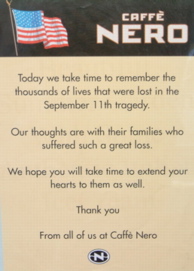
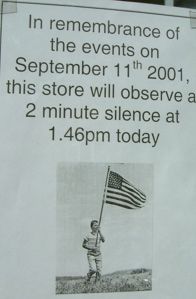
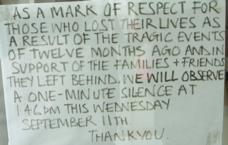
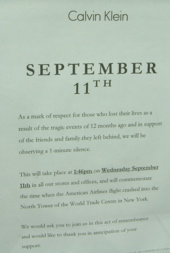
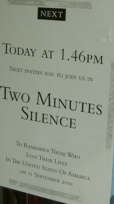
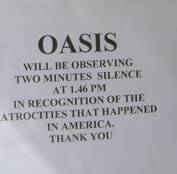
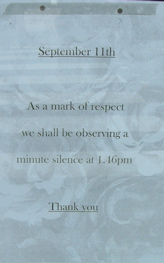
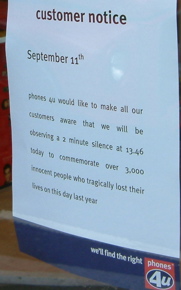
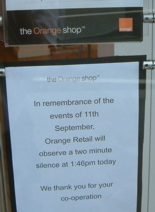
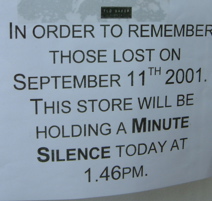
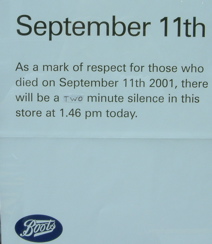
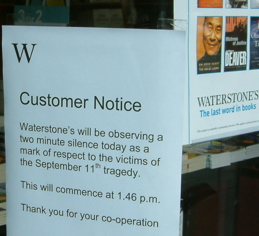
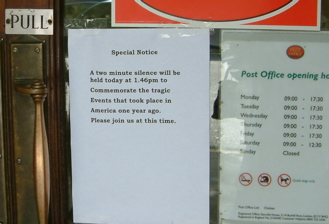
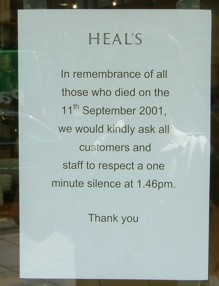
I have just got back from lunch and what I saw on the King’s Road in Chelsea, here in London, amazed me. There is no law requiring it, no government departments ‘encouraging’ it loudly, yet shop after shop are displaying signs saying words to the effects of “At 1:46 pm to day, we will be observing two minutes silence in remembrance of the atrocities on September 11th of last year in the United States.” Others are expressing memorial sentiments, still others just displaying small American flags. No doubt these signs will all be gone by this evening, but they are there now.
Some signs are hand written by shop managers, others were clearly printed by a head office… but the signs are there and they come not from above, passed down from the salons of the chattering classes, but from below, from the true heart of England.
There is indeed an Anglosphere and it is very, very real.
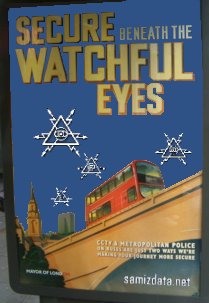
Rage against the Panopticon State!
We had 25 people show up to the Second British Blogger Bash and the party has been hailed as a great success.
Below can be seen (L to R) Ben Sheriff of Layman’s Logic, Mike Solent (back turned), Steve Chapman of Stephen Chapman (formerly ‘Daddy Warblogs), Tom Burroughes of Samizdata.net (back turned), Andrew Dodge of Dodgeblog, Brian Micklethwait of Samizdata.net, Alex Singleton (barely visible) of St. Andrews Liberty Log, Peter Briffa of Public Interest UK and Natalie Solent of Natalie Solent.
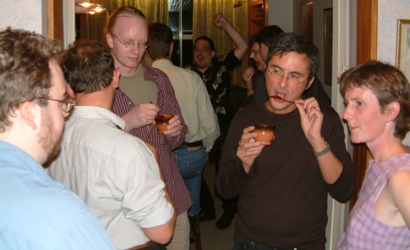
Steve Chapman and Peter Briffa were disappointed when
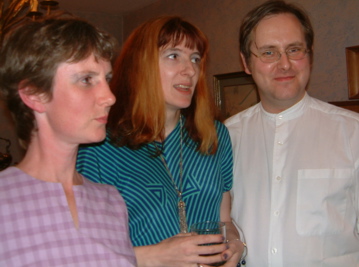
they discovered what ‘having a little pot for desert’ actually meant Below are Nikki Brandt, Luisa Gutierrez and Adriana Cronin of Samizdata.net.

The ladies discuss the aerodynamics of a
Frisbie with and without salad dressing Below are Perry de Havilland of Samizdata.net and Patrick Crozier of CrozierVision and UK Transport.
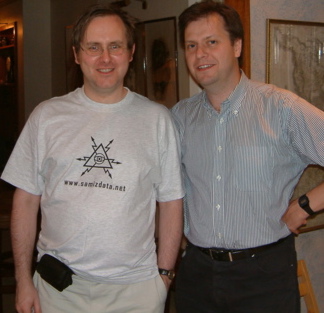
Perry shamelessly advertises Samizdata.net tee-shirts Below are David Carr of Samizdata.net and Adriana Cronin of Samizdata.net.
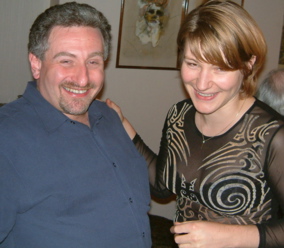
David and Adriana make jokes about why they had
to drink Brendan O’Neill’s share of the booze Below are Patrick Crozier of UK Transport and Dale Amon of Samizdata.net, uncharacteristically shown wielding a beer.
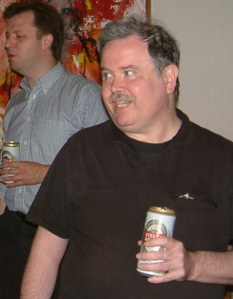
Dale demonstrates the correct stance for
accurately hurling a beer can at a passing politico Below are Natalie Solent, Alice Bachini of A Libertarian Parent in the Countryside and Perry de Havilland.
Alice, having eaten the collar of Perry’s shirt (with some
fava beans), washes it down with some nice Chianti Brendan O’Neill was unable to attend due to prior obligations… you missed a good one, O’Neill.
04:30am The Second British Blogger Bash has finally run out of steam as its participants have started dropping like flies…
…I suspect there may be somewhat less blogging on Sunday from the London Samizdata HQ.
02:15 am The Second British Blogger Bash continues and the tone of discourse has become more ‘interactive’ with the arrival of Andrew Dodge…
10:45 pm: The Second British Blogger Bash in London is in full swing and as the picture below indicates, things are sober and sedate.

Claire Berlinski and Alex Singleton
Well it just so happens to be Hedy Lamarr Day! I know this to be the case because Shannon Okey told me and we all know that Shannon, the veritable Lucretia Borgia of the Blogosphere, would not say such a thing if it were not so.
And just incidentally, if you are going to go and peruse the Bitter Girl site, make sure you do not miss one of the funniest blog articles in quite a while:
Tune in a decade or two from now for the year 2018 version of this post, when I take on Britney Spears’ cellulite, visible C-section scars and obvious track marks as she performs “Oops, I Did It Again!” at the MTV VMAs with Michael Jackson, who, by then, will be made entirely of plastic and have a robot monkey to guide him on and off stage.
Prescient.
Several blogs have also picked up on Janet Daly’s article that Brian Micklethwait mentioned at length earlier on Samizdata.net. However the section of Daly’s piece which attracted my attention was not the section that Brian quoted:
Collectivism involves giving up your autonomy and your moral responsibility to the group. In practice, in modern political economy, that means giving them up to the state. There is nothing inherently good or ethical about this. But that is a wildly unfashionable thing to say – just like saying “No” to the euro used to be.
The way I see it, writing “there is nothing inherently good or ethical about this”, whilst most certainly true, really misses the point as it looks at the question from the wrong direction. There is something inherently bad and unethical about giving up your autonomy and your moral responsibility to the group. In fact it is completely impossible to transfer moral responsibility: that is why a soldier can be tried for any war crime that they carry out regardless of the fact they were only ‘following orders’ from their duly constituted superiors. The entire concept of ‘group morality’ is an absurdity. Individual morality is the only morality.
It does not matter what anyone else does or what ‘permissions’ you are given by family, religion or state, you are morally responsible for your actions. For it to be otherwise you must be quite literally insane.
Occasional Samizdata.net guest writer Alice Bachini has been bitten by the blogging bug and has her own splendid blog called A Libertarian Parent In The Countryside.
It may well have the longest blog address I have seen (libertarian_parent_in_the_countryside.blogspot.com)!
Check it out. 
People across Europe are digging bomb shelters in their back gardens and staring skyward fearfully for the first signs of the mighty Namibian airforce.
No, not really… Afro-socialist bigot President Sam Nujoma of Namibia has added all the nations imposing the flimsy and ineffective sanctions against his good buddy Robert Mugabe of Zimbabwe to the list of his usual targets for incoherent invective (i.e. homosexuals, capitalists, white people).
“I just want to make it categorically clear that if the EU does not lift the sanctions against Zimbabwe, the whole African Union will also impose economic sanctions against Europe. Either there is peace or war and we don’t want a war. Change your attitudes. If you don’t change, we are going to get you.”
I am quaking in my boots. 
|
Who Are We? The Samizdata people are a bunch of sinister and heavily armed globalist illuminati who seek to infect the entire world with the values of personal liberty and several property. Amongst our many crimes is a sense of humour and the intermittent use of British spelling.
We are also a varied group made up of social individualists, classical liberals, whigs, libertarians, extropians, futurists, ‘Porcupines’, Karl Popper fetishists, recovering neo-conservatives, crazed Ayn Rand worshipers, over-caffeinated Virginia Postrel devotees, witty Frédéric Bastiat wannabes, cypherpunks, minarchists, kritarchists and wild-eyed anarcho-capitalists from Britain, North America, Australia and Europe.
|






Recent Comments