Samizdata.net’s many spies have told us that these are being stockpiled in Iran for use during the coming ‘transitional times’.
|
|||||
|
My chum Julian, who is a prince amongst men, contrived to acquire me a copy of Lara Croft’s latest outing for the PC… Tomb Raider: Angel of Darkness. I have been very keen to see what could be done with this franchise now that all aspects of games technology have advanced so far. Alas, although I am only about a third of the way through it so far, I am mightily unimpressed. The graphics are downright primitive: there is simply no excuse for representing tree branches and foliage with 2-D sprites these days. Character models are boringly drawn, lack detail and either do not lip-synch at all or do so very badly. Two female character in the part I have just finished use exactly the same face model, hands look like baseball gloves … if graphically speaking U2003 powered ‘Splinter Cell’ is the current state of the art, then Tomb Raider: Angel of Darkness is at least two years behind the curve. It is little more than a re-hash of the last Tomb Raider, which was looking tired even back then. The some of the graphics purporting to show the game on the Internet are misleading to put it mildly. If there is a way to get it to look that way I have yet to discover it. And yes, I am using a fairly high-end PC with a good graphics card and half a gig of RAM. Additionally, the voice acting is flat, the controls are a f**king nightmare when attempting precise manoeuvres, camera control is dreadful and sometimes simply does not work at all, the story line is just a re-hash of all that went before it… in short, the whole bloody thing is un-engaging and frustrating. To make matters worse, the program is buggy as hell, with entire documented features apparently unimplemented (I have yet to get ‘sprint’ to work no matter what key I map it to and unarmed combat does not seem to do much either). One character (a bartender) chats to Lara whilst appearing to be turned inside-out and all manner of graphic anomalies are scattered throughout the game, strongly suggesting extremely sloppy beta testing by the makers. I honestly cannot think of a single positive thing to say about this game. I will probably complete the game regardless but if they had managed as much humour and snappy dialogue as someone did with the promotional stuff for the game, I might not be playing with gritted teeth. Given that the ‘Lara Croft’ franchise is such a valuable property, if I was a shareholder with money invested in this I would be looking for boardroom-heads-on-spikes about now. I am very glad I got this game as a present but I would not recommend it to anyone. Save your pounds/bucks/euros etc. and wait for Half Life 2 and Deus Ex: Invisible War. July 7th, 2003 | 7 comments - (Comments are closed)
 As usual, it starts with a scrum of bloggers descending on the beer and chili… 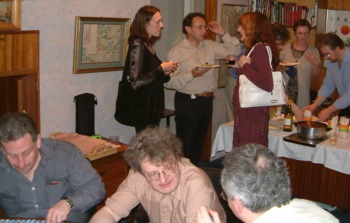
Glug, glug, munch, munch Shockingly, many of the bloggers discussed… BLOGGING! 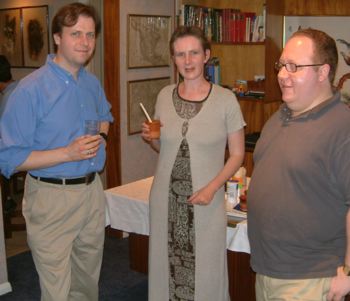
Patrick Crozier, Natalie Solent, Stephen Pollard Eventually numbers and the need to smoke causes the proceedings to explode out into the garden. Many curses were uttered at the people responsible for the absence of Andrew Dodge and Sasha… 
My… what big eyes you have! Much beer was consumed… 
I was only resting! It is now 02:30 in the morning and strangely, people are starting to demand more chili! 
Why aren’t you people tired yet? Will it never end??? Update: Over a dozen of the hard core are still here… 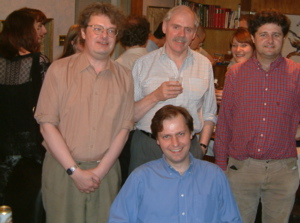
The Transportblog Team: would you buy a train ticket from this lot? Nearly 04:00 in the morning and at least one intrepid blogger has passed out in The Comfie Chair… 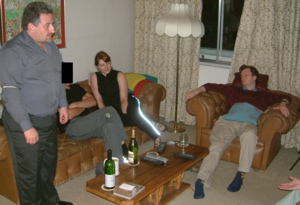
Don’t you people have blogs to write for? Final update: The grizzled hardcore diehards finally staggered off into London’s cold morning air at the first warning glow of daylight, a few minutes past 05:00 this morning… 
Another highly successful British Blogger Bash! July 6th, 2003 | 29 comments - (Comments are closed)
verb. To use one’s blog to beg for assistance (usually for information, occasionally for money). One who does so is a ‘blegger’. Usually intended as humorous. July 5th, 2003 | Comments are closed
Tonight the cream of the British and European blogerati is descending on Chelsea once more for one of our famous Blogger Bashes… and thus there may be rather less output than usual on this blog (and quite a few others) tonight.
but hopefully not too much… July 5th, 2003 | One comment - (Comments are closed)
noun. RDF is a web content syndication format. Acronym which stands for Resource Description Framework July 3rd, 2003 | Comments are closed
Used as noun or verb. The willful omission of one or more words so the meaning of the statement is no longer understood but that the statement suits the needs of the writer in launching an ad hominem attack whether or not the construction is truthful or grammatically complete. Named after Maureen Dowd, based on her manufacture of a quote attributed to President Bush in her May 14, 2003 column (as first reported by Robert Cox on TheNationalDebate.com). The term and the practice are often found in the Blogosphere. (Coined by James Taranto) July 3rd, 2003 | Comments are closed
When Hong Kong was handed over to Communist China by the British state, to much joy and acclamation by credulous Chinese and Gweilos alike, the totalitarian gerontocracy in Peking pronounced soothingly that Hong Hong would retain its relatively liberal order under a doctrine ‘One nation, two systems’. Tens of thousands of people have marched in protest at a planned anti-subversion law aimed at an EU style ‘harmonizing’ of Hong Kong law with that of the rest of Communist China. One nation, one system it would seem.
Well it comes as no surprise to me that these patent lies only took six years to be revealed. I look forward to hearing the people who rejoiced at the surrender of Hong Kong’s people to China recanting their folly. I am not holding my breath however. 
The Chinese way of dealing with effective protests (WSJ link via Combustable Boy) July 1st, 2003 | Comments are closed
When Hong Kong was handed over to Communist China by the British state, to much joy and acclamation by credulous Chinese and Gweilos alike, the totalitarian gerontocracy in Peking pronounced soothingly that Hong Hong would retain its relatively liberal order under a doctrine ‘One nation, two systems’. Tens of thousands of people have marched in protest at a planned anti-subversion law aimed at an EU style ‘harmonizing’ of Hong Kong law with that of the rest of Communist China. One nation, one system it would seem.
Well it comes as no surprise to me that these patent lies only took six years to be revealed. I look forward to hearing the people who rejoiced at the surrender of Hong Kong’s people to China recanting their folly. I am not holding my breath however.
The Chinese way of dealing with effective protests (WSJ link via Combustable Boy) July 1st, 2003 | 6 comments - (Comments are closed)
We got a mention in The Times (link may not work if you are outside the UK) today in an article about blogging by Michael Gove. Excellent. And they go our URL completely wrong. Bugger. I called up The Times this morning and asked them to at least correct the URL for the on-line edition. And did they? Nope. It seems the wheels grind extremely slowly at The Times. Oh, and Michael… I ready don’t think our antipathy to statist solutions to most things makes us ‘right wing’ as social conservatives we ain’t. June 30th, 2003 | 12 comments - (Comments are closed)
Like some undead zombie in B-grade horror movie, we have pumped the hideous thing full of lead from our rifles and shotguns… it falls riddled with logical holes and yet somehow the creature staggers to its feet again with bits falling off, lurching forward once more. Gauche is clinging remorselessly to the term ‘Libertarian Socialism’
Well on one point I am in complete agreement with Gauche… his view is utopian. In fact, the notion that a state which redistributes wealth by force and provides ‘education’ to its citizens can be a minimal state is more than just utopian, it is fantastical. Wage control? Nationalised healthcare? Nationalised education? Nationalised housing? And how, exactly, would this be different to the non-libertarian modern socialist (i.e. social democratic) states found all over the western world? The answer is it is exactly the same thing. The only liberty in Gauche’s libertarianism is the liberty to take the money of others by force without prior consent and to run the economy on political, rather than social, interaction. Sure, there is a long history of people calling themselves libertarians. But so what? Liberty means not having one’s life under the force backed direction of others… socialism means using force backed politics to direct people’s life in accordance with socialist political ends. The two are antithetical. 
Arrrggg… I’m a…libertarian…too! June 28th, 2003 | 11 comments - (Comments are closed)
As Gabriel Syme wrote earlier today, the objective on this blog is to argue for a ‘broad front’ push to regain some ground lost to successive governments in the struggle for individual civil liberties. But as a hard core free market individualist who opposes collectivism in all its left and right flavours, it would fair to say that when I write for Samizdata.net, I tend not to make many friends amongst socialists, social democrats or statist conservatives. And yet… on White Rose I try to leave some of my narrow political views at the door as the aim here is about forming a much broader front in the resistance to the diminution of individual liberty. Gabriel was right to point out the excellent article by Stephen Robinson in the Telegraph in praising left winger John Wadham for his stewardship of the human rights group Liberty. I have recently been taken to task by libertarians and conservatives for praising George Orwell, because he was a socialist. Yet it would be hard to overestimate the importance of 1984 and Animal Farm in estabishing a popularised meta-context in which the true nature of tyranny could be understood by millions of people across the world. It is my desire that people reach the conclusion that the state is over-mighty and that its actions pose a clear and present danger to individual liberty… I am far less concerned how they reach that conclusion. If Orwell felt his socialist collectivism could be squared with an abhorance for tyranny, well fine. I may not see it that way but Orwell made many of the right arguments nevertheless. We must take our friends where we find them. The need to resist the tide of the regulatory state’s smothering of individual rights has appeal far beyond the narrow confines of libertarianism or any particular -ism, and if we are to ever roll back the trend towards a panoptic micro-regulated ‘society’, to quote Benjamin Franklin, we must hang together, or surely we will hang separately. June 27th, 2003 | One comment - (Comments are closed)
|
   |
||||

All content on this website (including text, photographs, audio files, and any other original works), unless otherwise noted, is licensed under a Creative Commons License. |
|||||


Recent Comments