We are developing the social individualist meta-context for the future. From the very serious to the extremely frivolous... lets see what is on the mind of the Samizdata people.
Samizdata, derived from Samizdat /n. - a system of clandestine publication of banned literature in the USSR [Russ.,= self-publishing house]
|
To be honest I have never understood what the fascination people have with so-call ‘reality TV’ programmes like Big Brother. I have forced myself to watch a couple times and ended up despairing for the future of western civilization. Suddenly my taste for explosion filled action movies and lycra clad starlets with guns does not seem so low-brow after all.

Oooo! Very exciting!
No doubt some of our faithful commenters will put me right on this area of complete disconnection between me and an entire baffling area of popular culture.
But maybe this Disneyfication of the entirely unfunny term ‘Big Brother’ that George Orwell coined will soon be coming to an end.
Then maybe we can start getting more people frowning with concern rather than smiling vacuously at the sound of the words ‘Big Brother’. Why bother watching the TV to see a bunch of self-absorbed cretins in a room back-stabbing each other when you can be in your very own rolling endless episode of ‘Big Brother’ by just walking down almost any CCTV filled high street in Britain?
Here is some real reality TV, staring… you.
 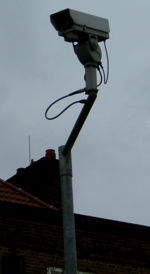


A new speed camera installed at the urging of Robert Marshall, a Conservative on South Staffordshire district council has caught its first few victims, one of whom was… Robert Marshall.
The Tory speed demon was nailed doing a whopping 43mph in a 30mph limit.
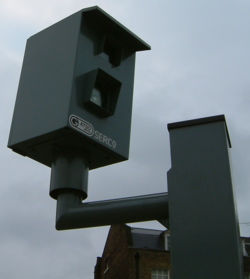
Gotcha, you Tory bastard!!!
Social individualists of the world unite!
You have nothing to lose but your chains
and a whole world to win!
Although intended as a humorous meme-hack, the statement is also quite clearly true. The irony is that for individuals to preserve their individuality, they must unite with others to fight the collectivist political pressures that would deny that we are moral free agents and make us so much less than we are: to fight involuntary collectivism we must voluntarily act collectively.
And so that is why I set up Samizdata.net and lured others to dive into the blogosphere with me head first.
It was my attempt to give a platform to shout out to the world for like-minded individuals who rejected the intrusive force backed collectivist view of the world. We are not really trying to ‘convert’ people, though that would be nice, rather we are trying to change people’s meta-context and let the ideology take care of itself. That is our ‘mission statement’ if you like.
A meta-context is a person’s frames of reference through which they interpret the world around them. It is not an ideology or a political ‘ism’ or even a philosophy… it is ‘just’ a series of axioms and ‘givens’ that colour and flavour how you think about things and come to understand them via a set of critical or emotional preferences and underlying assumptions. We all have a personal meta-context.
For example, it is one of the reasons that although I have written many articles on Samizdata.net about the issue of private ownership of firearms in the USA, I very rarely discuss the Second Amendment. Why? Because an individualist meta-context does not have rights as something which are dependent on The State.
The Second Amendment of the US Bill of Rights is a legal artifice, but it is not the source or reason that people should be able to own weapons as a matter not of privilege but by right. In fact, no state and its laws is the source of any right whatsoever: rights are objectively yours to begin with and are not given to you by anyone. Thus I will never argue an American has the right to own a gun because ‘it says so in the Second Amendment’ because they would have a right to do so even if it said nothing of the sort.
Yet that is not to say I think the Second Amendment is a bad idea, just that it is nothing more than a useful profane tool to secure an objective right, not a source of rights. To me as an individualist, I see do not see the state as central to my life or quite frankly to civil society… as I am not a fully convinced anarchist I do see some role for limited government in securing the rights of individuals, but just as an adjunct to far more important the networks that are primarily social rather than political.
And so if we are trying to change people’s meta-context to include more individualist and less collectivist frames of reference, then it behoves us to use phrases which assist in this process rather than those which are loaded with ‘trigger words’ that may well get our views unhelpfully pigeonholed in places that does not really reflect where we are coming from. Now I certainly regard myself as a libertarian of the minarchist flavour… what is sometimes called a ‘Classical Liberal’. However the term ‘libertarian’ is increasingly loaded with meanings that generate more heat than light, and thus I have started using the term ‘social individualist’ rather than ‘libertarian in Samizdata.net’s introduction in the sidebar. We have not changed… certainly I have not… and I intend to continue arguing that the term ‘libertarian’ can only be used correctly to describe people who promote the individual liberty to chose how you interact with the world via social interaction rather than force backed political interaction. Just as Living Marxism changed its name to Spiked in order to shed the ‘baggage’ of the term ‘Marxism’ without actually changing a thing ideologically, we started life as ‘Libertarian Samizdata’ back in our early days on-line and then just became Samizdata.net in order to better reach beyond the worthy true believers. We are no longer Libertarian Samizdata but our thinking is really no different to when we started.
Yet if the term ‘libertarian’ gets in the way of what we are trying to do, it is time to start de-emphasising it. I am still a member of the executive committee of the London based Libertarian Alliance and I still regard myself as a pukka libertarian. But a more accurate description of my views than just the broad church of ‘libertarianism’ would be that I reject collectivist views of the world as utterly falsified, but at the same time I do not regard individuals as atomised objects existing in splendid isolation. Unless you live alone in a log cabin in the middle of Canada subsisting on nuts and moose meat, you are an individual within a social environment: a civil society. And it is the extent to which you can freely act within civil society as an individual pursuing self-defined ends by right, without political coercion or permission, that is the measure of whether you are free or not.
Additionally, I have long regarded socialism as the most ironic use of language in the history of mankind, given that it means to replace social interaction with entirely political interaction. It is time to reclaim the word social and reject the newspeak inversion of it into meaninglessness.
And it is addressing those issues that make this a social individualist weblog.
Anticipation is growing… Angel of Darkness, the latest instalment of Tomb Raider is about to hit the streets, Deus Ex: Invisible War is coming soon, Doom III is snarling its way towards us and the most anticipated of them all, Half Life 2 will soon be on the shelves.
After the disappointment of the by-the-numbers Unreal 2, the bug-fest of the otherwise promising Devastation, the even buggier CFS 3 and that mixture of complete genius and forehead-to-keyboard annoyance that is Splinter Cell, I think on balance it will end up a fulfilling year for hardcore gamers.
One of the things the (relative) failure of Unreal 2 suggests to me is that for single player games, great graphics and effects are just not enough anymore… those are more or less expected now. For a game to really rock a gamer’s world these days, there needs to be betters quality plots and an engaging story (which is what made Half Life and Deus Ex such durable successes and in so doing, raised the bar).

Last night Samizdata.net’s illustrious blog suddenly went tits-up for a while. For some reason half of the main index template just… disappeared.
The blog had been exhibiting some odd behaviour (and I am not referring to the writing style of Gabriel Syme) and so I started poking around inside to see what was amiss.
So when the site went splat a few minutes after I started looking around, I thought I had accidentally screwed the pooch in some fit of mouse-wielding madness as I noticed a huge chunk of the main index was just…gone 
But I soon realised that the part of the template which vanished into hyperspace was nowhere near where I was messing around (and in any case, all I did was remove a spurious line break). Has anyone out there even had this sort of thing happen to them in Moveable Type?
We may have lost a few sidebar links, so if you notice your blog has been de-linked, please let us know and we will reinstate it. And yes, I will be backing up far more often in future!!!
Oh, and by the way… let me extol the greatness of the Queen of the Goddamned Internet, Stacy Tabb who de-lobotomised our belovéd blog in record time 
The sharp eyed and attentive amongst you may have spotted the funky monkey that has appeared in the ‘free market’ section of our sidebar… we have acquired a sponsor!
But not just any sponsor.
The Gold Casino is an off-shore internet casino (obviously) in the most literal sense of the term. It is located on a server in the Principality of Sealand, a fully independent micro-state off the shore of Great Britain. Don’t like the state? Go set up your own.
No I am not joking!
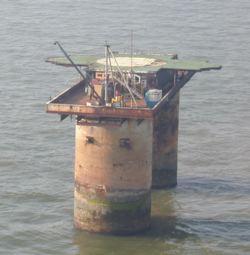
Well I did say micro-state, didn’t I?
So take a peak at what our sponsor is offering by poking the funky monkey and check out their message via the link underneath the sidebar graphic. I assure you it is far more interesting that the usual marketing blather one is usually confronted with… you will see why we find them so ideologically agreeable!
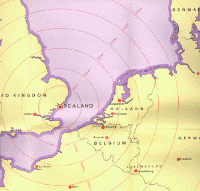
It adds a whole new nuance to the term ‘off-shore business’
The proposed EU regulation of blogs and other forms of Internet speech being suggested by the Council of Europe (a quasi-governmental think-tank whose views have inordinate sway with the EU’s policy making elite) is very revealing about what lies at the heart of The Great European Project.
Steven Den Beste has written a rather good article on why the press is treated differently than broadcast media which use the finite resource of the electromagnetic spectrum. One can argue that as the EM spectrum is finite, it is reasonable to share out its use and as clearly not everyone can set up a radio or TV station, some rules to prevent the use of the media from becoming over mighty are justified. This is not quite how I see that issue myself but the contention is far from absurd.
One can even make the far less supportable assertion that because in reality setting up a newspaper is far beyond the means of most people simply because it is so expensive, the state should regulate the press, at least to some extent. Not surprisingly I flatly reject this notion and think the only defence individuals need against the established press are laws against libel. However the thinking behind this sort of regulation is at least easy to understand and can, if you accept the state as an essentially benevolent neutral institution (which I certainly do not), be seen as a way to prevent abuses of power by an over-mighty media corporation given the vast asymmetry of access to public opinion between a newspaper and an individual.
But when the Council of Europe start urging the EU to regulate blogs like this one, it should be clear that none of the arguments which can be applied to broadcast media and or the press apply here. As I mentioned in my previous article on this issue, if you have a cheap computer and a crummy modem, it still only takes about five minutes and no money whatsoever beyond your dial-up or broadband connection charges to set up a blog. There is no asymmetry of access to the public involved here. Granted, setting up an effective blog is another issue entirely, but simply getting viewable grievances in front of blogosphere eyeballs is simplicity itself.
So if anyone can set up a blog, and there is no finite resource in need of being allocated ‘fairly’ and there are no de facto capital related barriers to ‘market’ entry, what are we to make of this Council of Europe proposal to regulate us? → Continue reading: What is really going on in Europe?
People in the US, who take notions of Freedom of Expression and Private Property for granted, will be astonished by the latest steaming pile of wisdom to emerge from the clenched cheeks of our European would-be masters. Declan McCullagh reports:
The all-but-final proposal draft says that Internet news organizations, individual Web sites, moderated mailing lists and even Web logs (or “blogs”), must offer a “right of reply” to those who have been criticized by a person or organization.
With clinical precision, the council’s bureaucracy had decided exactly what would be required. Some excerpts from its proposal:
- “The reply should be made publicly available in a prominent place for a period of time (that) is at least equal to the period of time during which the contested information was publicly available, but, in any case, no less than for 24 hours.”
- Hyperlinking to a reply is acceptable. “It may be considered sufficient to publish (the reply) or make available a link to it” from the spot of the original mention.
- “So long as the contested information is available online, the reply should be attached to it, for example through a clearly visible link.”
- Long replies are fine. “There should be flexibility regarding the length of the reply, since there are (fewer) capacity limits for content than (there are) in off-line media.”
It’s pretty zany to imagine that just about every form of online publishing, from full-time news organizations to occasional bloggers to moderated chat rooms, would be covered. But it’s no accident. A January 2003 draft envisioned regulating only “professional on-line media.” Two months later, a March 2003 draft dropped the word “professional” and intentionally covered all “online media” of any type.
Read the whole article.
So what is the message to the EU I mentioned in the title? Simple:
We will not comply
We have a comments section on samizdata.net in which people can and do comment about what we write, but access to that comment section is at our capricious discretion. If we decide we want to IP ban someone or want to delete their remarks from our comments section because we think they are offensive, or even if they are not offensive but we just bloody well feel like doing it because we have a headache, then we bloody well will. This is our private property.
We are already hosted on a server in the USA and I am quite confident our hosters would tell the EU where they can stick any demands to yank us off the net because we decline to submit to political moderation of the form our free speech takes on our private property (i.e. the server space we rent from them). If we have to go entirely pseudonymous and log onto Samizdata.net in order to post via ‘dead drop’ servers rather than submit to EU regulation of how we manage the information on our blog, then that is exactly what those of us who post from within the rapidly emerging EU tyranny will do. We utterly reject political moderation of free speech in civil society. This is not about giving people a voice but rather about replacing social interaction (which is what true free speech is), with political interaction mediated and mandated by the state.
If these regulations become the law of the EU (as seems likely), we will not obey, we will not cooperate, we will not accept that anyone has a ‘right’ to reply on our blog. Do you think we have said nasty things about you and want to reply regardless of our unwillingness to let you use our comment section? Fine…go to blogger.com, sign up (for free), click on ‘create a new blog’ and voila… you have your own blog on which you can scream about how those mean old Samizdatistas ‘done you wrong’ to your heart’s content.
And if the EU says we have to let you comment… tough shit, it ain’t gonna happen. The people who write for Samizdata.net all now live next door to Samizdata Illuminatus, in Arkham, Massachusetts.

 
And of course I am sure he does not particularly care what I think either. In an article titled Europe and Liberalism, he notes that Ramesh Ponnuru has praised him for changing his mind about the European Union.
Sullivan now thinks the European Union is not such a good thing as he once thought and both he and Ponnuru have finally noticed that having the EU completely swallow Britain is also not in the national interests of the USA. In fact that Americentric utilitarian observation seems to be the entire basis for their opposition to The Great European Project. Massive regulatory statism? Dramatic erosion of due process? Ever higher taxes? ‘Fortress Europe’ trade barriers with the rest of the world? Spectacular corruption? Higher unemployment? No… the reason to finally start glaring at the EU across the Atlantic is to preserve the UK’s ability to support the US in foreign policy matters and to work for US interests from within the bastions of Fortress Europe.
This narrow utilitarian argument seems to be what has brought Sullivan to stop being a cheerleader for the EU without much of a nod to the idea that maybe the EU is bad for Britain. So whilst I am happy to see a fairly influential commentator like Sullivan stop arguing Britain should embrace the EU even more deeply, he has nothing whatsoever to contribute to the British domestic debate on the subject. In fact, the stated views of Sullivan play to anti-American sentiments within Britain so harmoniously that I really wish he would just shut the f**k up.
To argue that the reason Britain should not allow its national sovereignty and identity to be submerged by Europe is because it does not suit the United States, is to put many of the people who dislike the EU in Britain in rather a quandary. Many such folks dislike the EU because British interests matter far more to them that those of the EU… and for exactly the same reason they are also highly suspicious of the USA, seeing it as subordinating ‘our’ interests to ‘their’ interests. For an example of anti-EU sentiments allied to deep and festering suspicion of the USA, you need look no further than Air Strip One. I see little value in Sullivan actively kicking the none-too-tight lid off latent anti-Americanism with statements like:
Keeping Britain both in the [United States of Europe] and outside of it militarily, diplomatically, and monetarily should become a prime U.S. objective in foreign policy. Without it, the United States could lose its most valuable military and diplomatic ally.
But the fact is almost no one who actually (in theory) gets a vote on the subject, not even Atlanticist enthusiasts like myself, think US interests are more than passingly germane when trying to argue against Britain sleepwalking to the gaping maw of that half-dead and half-mad leviathan called the European Union.
It seems Sullivan is no fan of the social/cultural Anglosphere meme. What with him being a party political right-statist (a Republican) and only a passing commentator on things like objective rights and moral philosophy, I suppose it is not all that surprising to read him taking a highly collectivist ‘American national interests’ view of pretty much everything, but then this is precisely why his views are of little value in any positive way to people outside his American national collective.
I would argue that the Anglosphere does exist as a cultural vibe, but it is something that can be made a great deal weaker precisely by attitudes like Sullivan’s. The underlying cultural basis for UK political support for US actions in Iraq sprang from these very real Anglosphere notions. Yet if I thought the United States government was working to keep Britain inside a United States of Europe (just not too far inside) for its own interests and at our expense, which is to say working against people like me who are calling for the UK’s complete withdrawal from the EU, then I would be bulk purchasing US flags to burn in demonstrations in central London… and if a relentlessly Atlanticist Anglosphere person such as me thinks that, one can only speculate what less pro-American segments of popular opinion might think.
If the US government wants Britain as an ally, fine. But if it wants to sacrifice individual British people as political cannon fodder to mitigate the effects of EU power? Want to know where you can stick that? I will continue to regard US civil society as having many admirable qualities and still feel an Atlanticist affinity to it regardless… but at that point the US government loses its ‘lesser evil’ status for me and becomes just another enemy on every level as the last basis for having incidental common goals vanishes.
We started off on Samizdata.net with a sitemeter.com tracker… alas the java version which tracks referrals refused to work when we upgraded our site to Movable Type, so we added a Extreme tracker. That too is doing strange things now since our latest Movable Type upgrade (all referrals are being recorded as coming from our MT installation rather than the actual referral page) and as I have never, not once, got a reply from their tech support people no matter how often I send them messages (and I have their premium paid-for version), I am looking for recommendations regarding:
- What might be causing our problem with the Extreme’s tracker?
- And is the java version of sitemeter’s premium counter likely to work with MT 2.6x?
- Are there any better premium trackers out there as I hate to keep paying for crap service from Extreme?
Any suggestions?
An update regarding tonight’s ‘Undercurrents debate’ on BBC Radio 3 Night Waves, 9:30 pm UK time (also via Internet).
The topic is:
Is Democracy Dead – superceded by the power of the markets and the media?
Participating will be George Monbiot, John Lloyd, John Kay and me.

I was just watching a report on early morning TV which was in itself a rather mundane piece about how the authorities in Britain are clamping (immobilising) cars which are stopped on the road and found to have unpaid vehicle tax. Yeah yeah, whatever.
But then came a remark which astonished me…
“Unpaid annual Vehicle Excise Duty costs the British economy millions of pounds per year”
Now without getting into the rights and wrongs of vehicle ownership taxes (as opposed to road use taxes), the implication is clear: money not paid to the state for the privilege of owning your own several property does not create wealth… only when that money is safely in the hands of the state does the British economy benefit. Note, the words use are not “costs the British state millions…” but rather “costs the British economy millions…”
And with that tax money taken out of private hands, the state creates a net gain in wealth how exactly? Hiring more wealth destroying bureaucrats? And of course that money you selfish tax dodgers have not paid to the state is going to be flushed down the toilet rather than being used for some alternative economic activity, right? Likewise immobilising people’s transport because they have not paid an annual ownership tax, and thereby preventing those people making deliveries or getting to work, that does not British economy a penny, right?
Arrogance and ignorance in equal measure. The state is not your friend.
|
Who Are We? The Samizdata people are a bunch of sinister and heavily armed globalist illuminati who seek to infect the entire world with the values of personal liberty and several property. Amongst our many crimes is a sense of humour and the intermittent use of British spelling.
We are also a varied group made up of social individualists, classical liberals, whigs, libertarians, extropians, futurists, ‘Porcupines’, Karl Popper fetishists, recovering neo-conservatives, crazed Ayn Rand worshipers, over-caffeinated Virginia Postrel devotees, witty Frédéric Bastiat wannabes, cypherpunks, minarchists, kritarchists and wild-eyed anarcho-capitalists from Britain, North America, Australia and Europe.
|




