We are developing the social individualist meta-context for the future. From the very serious to the extremely frivolous... lets see what is on the mind of the Samizdata people.
Samizdata, derived from Samizdat /n. - a system of clandestine publication of banned literature in the USSR [Russ.,= self-publishing house]
|
1. noun. A blog (depreciated).
2. noun. A hybrid blog/website, featuring website features such as a conventional on-line company brochure (for example) but also incorporating a blog in a sidebar as a supporting feature on the same page.
(coined in this context (usage 2) by Adriana Cronin)
It is hard to know what to make of this:
Gordon Brown celebrated his return to politics yesterday by firing a shot across the bows both of Brussels and Tony Blair. Perhaps the Chancellor has found the time while on paternity leave to read the 250 pages of the draft European constitution. Mr Brown evidently does not agree with his neighbour in Number 10 that the constitution is a mere “tidying-up exercise”. On the contrary, he is obviously alarmed by the text agreed by the constitutional convention, which extends EU competence into areas of economic policy hitherto jealously guarded by the Treasury.
The only thing I am sure of is that it does not mean exactly what it says. My tentative take on it is not that Brown dislikes a regulated economy/society per se, but rather than he insists on being the one doing the regulating. The guy is hardly a free market capitalist after all and neither is he much of a nationalist. Maybe he feels that as Kinnock already has his snout highly placed in the EU’s trough, there will not be room enough for another ‘big beast’ such as himself and thus he is stuck with maintaining his looting rights via obsolescent old Westminster.
Alternatively, could it is just a ploy to demonstrate that there is a ‘vibrant Euro-sceptic wing in the Labour Party’ and thus forestall natural Labour supporters from feeling they have to vote a revitalised (ha!) Tory Party under Count Drac… Michael Howard, given that Brown is making it clear that “Labour is not entirely in the pocket of Brussels”. Are Labour’s strategists really that clever though? Not sure.
Cynical? Moi?
I must be the last person in the blogosphere to have spotted this. Some guy seems to have been fired by Microsoft for posting a photo of a bunch of Macintosh G5 computers being delivered to some nameless warehouse in Microsoft’s Redmond headquarters.
It seems a tad capricious… unless of course there is more to this than meets the eye. Much as I dislike Microsoft, we have only one side of the story here so I feel no great need to follow the herd in leaping to this bloke’s defence.
For me the interesting thing is the way a personal problem of less than earth shaking import can flash around the world and get the blogosphere clucking… I guess it was a slow week for interesting world events to write about and anyway, who can resist the chance to bash the Evil Micro$oft?

I have mentioned before that I am a great fan of the movie Resident Evil… well the sequel of which I spoke is going to hit the cinemas soon and a tantalising teaser can be found here!

The server upon which we are hosted was a bit dyspetic for about an hour today… but it is feeling much better now after it was burped (rebooted) by our excellent chums at Hosting Matters, who really are the worlds best hosting company!
Although I still maintain that I do not take iCan all too seriously, I have bunged a new ‘campaign journal’ up and also written the same piece up as an iCan ‘article’ called Neither chaos nor regulatory dystopia. iCan is wildly convoluted and a real nightmare to navigate and I could not figure out how to ‘attach’ the article to Anti-Activist Activism.
I did however find out how to attach the article to iCan ‘issues’, such as ‘direct democracy’, where I am sure it will be about as welcome as a turd on a billiard table 
…can also be our enemy too. Just because a person dislikes the regulatory state, that does not mean they see several liberty as first of all virtues.
Here on Samizdata.net, we have written many articles abominating the coercive law enforced process of moral relativism called ‘Political Correctness’. As a result, it is a measure of how bizarre some commenters can become when they starts accusing us of being PC because we do not have a problem with women joining the military, regardless of the fact none of us ever suggested a significant number of women have the physical strength to be front line infantry. It is apparent that the reason we are called ‘PC’ is that we do not think the only reasonable role for a woman in society is that of bearing and raising children.
Now I for one am all in favour of people who wish to have and raise children doing exactly that. Yet when it is suggested that a woman who might like to, say, spend her time flying a combat jet or wandering around lawless Basra as a military policewoman, we start seeing quack-science trotted out about ‘evolutionary biology’ and psychology and words to the effect that ‘real women are just unsuited to such things’ regardless of the mountain of evidence to the contrary… whilst somehow missing the rather obvious fact that actual biological evolution seems to have equipped woman, as well as men, with vastly powerful brains imbued with a capacity for reason and informed choices beyond crude instinctual motivations. Women have absurdly overpowered heads if the totality of their lives is driven by evolved psychological imperatives to immerse themselves in simple tasks such as having sex and keeping the house clean. → Continue reading: The enemy of our enemy…
The European Conference of the Libertarian Alliance and Libertarian International will be in London from Saturday 22nd to Sunday 23rd November 2003.
The speakers include fellow Samizdatista David Carr and serial Samizdata commenter Paul Coulam.
Future Conservative UK? It might stand for something else too and no, I did not have ‘French Connection’ in mind. You choose.
Over on the Adam Smith Institute blog, there is much speculation going on about the shape of the future Tory front bench.
I am only passingly curious as to who will be presiding over the continuing erosion of our civil liberties in the next government, regardless of which statist party wins, but I realise other people live for this stuff, hence the link to the worthy ASI blog… I will be pleasantly surprised if it makes a whole lot of difference. Presumably the tax burden will be (slightly) less under a Tory government.
However if you like what David ‘Big’ Blunkett has done to civil liberties in the UK, might I remind you that all he did was successfully implement most of the measure than Michael Howard was pushing for (largely) unsuccessfully as Home Secretary in the previous Tory government. Now imagine such a man not as Home Secretary but as Prime Minister. Lovely, eh?
And I don’t suppose I need remind anyone here who it was that introduced the complete ban and confiscation of handguns in Britain, except those used by the state of course… any takers on that question? And would anyone like to remind us by how much gun crime has fallen now that they are completely illegal in the UK? Any one?
…from an Internet café in Japan to be exact. Michael Jennings is en route to Australia and stopped off at Narita International Airport long enough to blog about some very odd demands made of him before he was allowed to use the Internet.
Check out the article on White Rose.
In an hour from now, we will know if Iain Duncan Smith has survived as leader of the Tory Party…
…or more accuratly, some of you will know, because I have just noticed that there is going to be a fascinating wildlife documentary about the mating habits of the Northumbrian Lesser Spotted Leaping Tree Vole on one of the documentary cable channels.

Update: 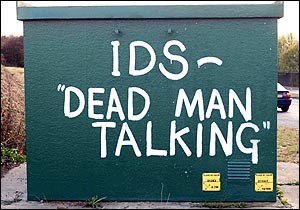
I could not resist a bit of mischief making… The BBC has set up something called iCan, which Wired magazine described thusly:
A couple of years ago the British Broadcasting Corporation was blindsided by a grassroots campaign against rising taxes on gas. Although discontent had been growing for some time, the BBC didn’t report the story until the British army was called out to protect gas stations from protesters.
Hoping to avoid this kind of blindness to ordinary Britons’ political concerns, the broadcasting behemoth is launching a radical online experiment to reconnect itself with grassroots sentiment.
[…]
On the other hand, the effort is intended to counteract what officials at the broadcasting network feel is widespread political apathy in the United Kingdom, marked by low voter turnout at elections and declining audiences for its political programming. As a state-financed institution operating under a royal charter to inform, educate and entertain, the BBC feels it is within its purview to help disenfranchised citizens engage in public life.
And therefore I have taken it upon myself to set up an iCan campaign aimed at… encouraging people to not vote (i.e. active voter apathy, yeah I know it is an oxymoron) and to regard politics as just proxy violence. I have called this Anti-Activist Activism. Come join me as I take some herbicide to the BBC’s grassroots.
It is just too damn tempting 
Update: I have made the first journal update at Anti-Activist Activism called Turning iCan into iShouldn’t.
|
Who Are We? The Samizdata people are a bunch of sinister and heavily armed globalist illuminati who seek to infect the entire world with the values of personal liberty and several property. Amongst our many crimes is a sense of humour and the intermittent use of British spelling.
We are also a varied group made up of social individualists, classical liberals, whigs, libertarians, extropians, futurists, ‘Porcupines’, Karl Popper fetishists, recovering neo-conservatives, crazed Ayn Rand worshipers, over-caffeinated Virginia Postrel devotees, witty Frédéric Bastiat wannabes, cypherpunks, minarchists, kritarchists and wild-eyed anarcho-capitalists from Britain, North America, Australia and Europe.
|




