We are developing the social individualist meta-context for the future. From the very serious to the extremely frivolous... lets see what is on the mind of the Samizdata people.
Samizdata, derived from Samizdat /n. - a system of clandestine publication of banned literature in the USSR [Russ.,= self-publishing house]
|
I for one was delighted when I heard Salman Rushdie was going to be knighted… which might sound odd given that I regard the puffed up popinjay as a caricature of the very worst traits of the ‘meejah’ class, truly an example of how the empty vessel makes the most noise (though I cannot fault his taste in crumpet).
But the fact UKGov did something that was so obviously going to put one in the eye of the Islamists is a good think in and of itself regardless. Like the Mohammed cartoons incident and its aftermath, the reaction across the Muslim world to this serves as a very useful reminder that the ‘moderate Islam’ is a myth (for a superb account of this ‘from the inside’, I recommend Infidel by Ayaan Hirsi Ali, and that not only helps in the battle against intolerant Islam directly, it helps in the culture war closer to home against Islam’s host of useful idiots in the western world.
The Libertarian Alliance has published a new pamphlet by Samizdatista Paul Marks called A Critique of a Critique: An Examination of Kevin Carson’s Contract Feudalism.
He is in splendid and splenic form, I am pleased to say.
…Abolish it. That is what the latest Libertarian Alliance press release demands and I find it hard not to agree.
In this era of channel fragmentation, cable, satellite and the rise of the internet as a method of distribution, what on earth is the point of the BBC? If I want to see what the other side is thinking I can watch Al Jezeera or read the Independent.
One of the downsides of being stuck in a hotel is having ones breakfast browsing depend overly on the dismal International Herald Tribune, the incestuous off-spring of the Washington Post and the New York Times.
There was an article in the IHT about the Italian state cracking down on tax evasion which cause the customary eye rolling when a free marketeer reads statements of of unquestioned absurdity such as:
If tax evasion is Italy’s national sport, as many people say, then the government of Prime Minister Romano Prodi has been working to change the rules of the game since taking office last year. Prodi says he believes that cracking down on tax cheaters is essential for an upswing in Italy’s lackluster economy. This month, he warned that his government could not lower taxes until “the indecent level of tax evasion” was reduced.
So taking more money away from people, essentially destroying some of their wealth, will make the economy better? And the government will not reduce the amount of personal wealth it destroys until people start cooperating more with having their wealth destroyed?
Yes, that all makes perfect sense.
There is an interesting article on New West by Christian Probasco, called California Looms.
California is a trendsetter state. Much like the weather, every Californian fad eventually makes its way over the Sierras and diffuses into the intermountain West. That’s wonderful, and it’s frightening, because there are some pretty disturbing things going on in the Golden State right now. O.K., I’ll admit: disturbing to people who take their civil liberties seriously. But I’m one of them.
His description of California reminded me of… Blair’s ever more authoritarian Britain. Another example of creeping democratic totalitarianism?
Seen on a street in Addis Ababa, near the interesting Entoto market
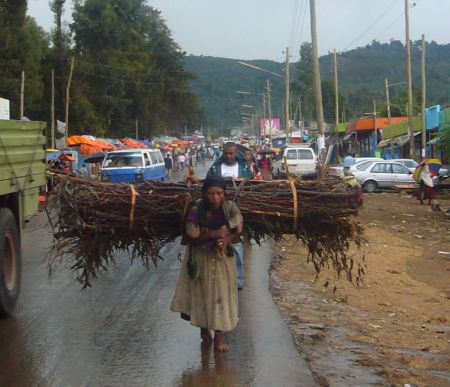
So you reckon your job sucks, eh?
Getting on-line in Ethiopia is a nightmare and so it has taken me a while to comment on a strange article in the Financial Times that had me choking on my breakfast of injera and zil zil tibs.
Peter Hambro, executive chairman of Peter Hambro Mining, an Aim-listed company that is one of Russia’s biggest gold miners, said the claim from Tony Blair that western companies could shun Russia unless it shared democratic values “ran the risk of being damaging” for British businesses in Russia. […] Hans Jörg Rudloff, chairman of Barclays Capital, said the government was mistaken when it publicly expressed concern about the growing risks of investing in Russia, ahead of last week’s G8 talks. “Their approach looks unbalanced,” Mr Rudloff said. “Russia’s transition to a market economy has been successful and cannot be undone.”
And later in the article, readers are reminded that Royal Dutch Shell was forced last November to sell control of its $20bn Sakhalin-2 oil and gas venture to state-controlled Gazprom and BP’s flagship Russia venture TNK-BP is now being threatened with the loss of its licence to develop the east Siberian Kovykta field. So how exactly are these de facto nationalisation (in reality seizing assets for the benefit of members of Putin’s clique) a sign that “Russia’s transition to a market economy has been successful and cannot be undone”? Seems to me that Putin is doing an excellent job of undoing it.
Alice Thomson has writen an interesting article called Be a ‘bad’ parent and let your children out in which she decries the enervating risk-averse trends in which parents, with the encouragement of our political masters, try to supervise and regulate every aspect of their children’s lives.
The comments are also quite interesting. One of them , calling herself ‘Mum’, bristles at the suggestion Thomson makes:
People who don’t have children are always telling those of us who do what we are doing wrong. I also had a free and easy childhood, but got flashed at, followed home twice and had numerous near misses at being run over. I don’t let my child play out, although she has the run of the garden where she can make camps, climb trees and do all the usual outside things, and usually has a number of friends out there with her.
Well ‘Mum’, I do not have any children either but I am very happy you were not my ‘Mum. Moreover I, like everyone else, am fully qualified to have on opinion on how children should be raised because believe it or not, I and everyone else was once a child.
I agree totally with Alice Thomson and think it is time people stopped indulging their neurotic need to control everything and just let children grow up without panoptic supervision.
It is not often I read the Independent but even that haven of fluorescent idiocy seems to be on the right side of the need to face down Vladimir Putin’s increasingly sinister regime. There is a very interesting open letter by journalist Yelena Tregubova on the importance of not pretending that everything in Russia is just fine and dandy.
Of course over the last few days Putin has made the task of those shouting warning about the dangers posed by Russia a great deal easier, what with him threatening to target nuclear weapons at Europe again and pretty much announcing that he is about to appropriate BP’s investments in Russia.
Clearly Putin needs to be taken down a peg or two because if there are no consequences for his theft of foreign investments in Russia and the murders of opponents to his regime both at home and overseas, all we can look forward to is ever more destabilising antics coming out of the Kremlin.
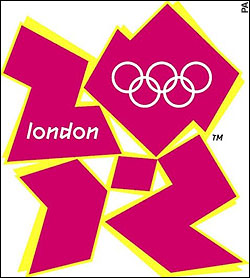
The new logo for the 2012 London Olympics has been unveiled and it has produced howls of outrage. Yet I beg to differ. I think it is perfect.
What does it look like to you? To me it is obvious: a collapsing structure of some sort, perhaps a building at the moment of demolition. The sense of downwards motion towards the bottom of the page is palpable.
Breathtaking. I mean what truly magnificent symbolism. The entire Olympic endeavour has been a massive looting spree with already grotesque cost over-runs (and it is only 2007), so surely something that conjures up images of collapse and disaster is really on the money… and speaking of money, at £400,000 (just under $800,000 USD) for the logo, it perfectly sums up the whole ‘Olympic Experience’ for London taxpayers.
No, if ever there was ‘truth in advertising’, this is it. Well done Lord Coe, I salute you.
to·tal·i·tar·i·an
–adjective
1. of or pertaining to a centralized government that does not tolerate parties of differing opinion and that exercises dictatorial control over many aspects of life.
2. exercising control over the freedom, will, or thought of others; authoritarian; autocratic.
–noun.
3. an adherent of totalitarianism.
Random House Unabridged Dictionary
But are those really the best definitions of totalitarian?
When someone uses the term ‘totalitarian’, we think of Stalin’s Soviet Union or Hitler’s Germany or Pol Pot’s Cambodia or Mao’s China. Those were indisputably totalitarian states. We think of gulags and killing fields. We think of secret police and surveillance.
Yet I would argue that all those things can just as satisfactorily described as ‘tyranny’ of whatever political completion. The thing that makes a place ‘totalitarian’ is not the nastiness of it or even the repressiveness of it, but the totality of state control. The real defining characteristic of totalitarian seems obvious from the word itself.
And what is a total state? It is a state in which there is no civil society, just politically derived rules by which people may interact. And I would argue the key to that is removing the right to free association, usually on grounds of ‘fairness’ or ‘diversity’ and by declaring private property to be ‘public’.
Britain has no gulags, no killing fields, it has a relatively free press (though less so than it was), it has no internal passports (though they are working on that with ID cards and panoptic surveillance)… but every year we take more and more steps towards the destruction of a voluntary civil society of free interaction and its replacement with a state in which no aspect of life is not politically regulated. This is often described as making things ‘more democratic’… and in that the supporters of the total state are not being disingenuous, for democracy is just a type of politics after all.
We are headed for a different kind of totalitarianism than that of Stalin or Hitler or Mao, but a total state really is what a great many people have in mind for us all. They seek a sort of ‘smiley face fascism’ in which all interactions are regulated in the name of preventing sexism, promoting health, and defending the environment. The excuses will not invoke the Glory of the Nation or the Proletariat or the Volk or the King or the Flag or any of those old fashioned tools for tyrants, but rather it will be “for our own good”, “for the Planet”, “for the whales”, “for the children”, “for the disabled” or “for equality”.
But if they get their way it will be quite, quite totalitarian.
There is an excellent article in the Telegraph by Charles Moore called What if Israelis had abducted BBC man?, addressing the morally demented attitude amongst the tranzi media and government set.
But just suppose that some fanatical Jews had grabbed Mr Johnston and forced him to spout their message, abusing his own country as he did so. What would the world have said?
There would have been none of the caution which has characterised the response of the BBC and of the Government since Mr Johnston was abducted on March 12. The Israeli government would immediately have been condemned for its readiness to harbour terrorists or its failure to track them down. Loud would have been the denunciations of the extremist doctrines of Zionism which had given rise to this vile act. The world isolation of Israel, if it failed to get Mr Johnston freed, would have been complete.
If Mr Johnston had been forced to broadcast saying, for example, that Israel was entitled to all the territories held since the Six-Day War, and calling on the release of all Israeli soldiers held by Arab powers in return for his own release, his words would have been scorned. The cause of Israel in the world would have been irreparably damaged by thus torturing him on television. No one would have been shy of saying so.
But of course in real life it is Arabs holding Mr Johnston, and so everyone treads on tip-toe. Bridget Kendall of the BBC opined that Mr Johnston had been “asked” to say what he said in his video. Asked! If it were merely an “ask”, why did he not say no?
Whatever one thinks of Israel’s policies on various issues, the nauseating double standards so consistently in play by so many ‘news’ organisations are something that need to be pointed out often and unapologetically. Charles Moore is to be commended for his article. Read the whole thing.
|
Who Are We? The Samizdata people are a bunch of sinister and heavily armed globalist illuminati who seek to infect the entire world with the values of personal liberty and several property. Amongst our many crimes is a sense of humour and the intermittent use of British spelling.
We are also a varied group made up of social individualists, classical liberals, whigs, libertarians, extropians, futurists, ‘Porcupines’, Karl Popper fetishists, recovering neo-conservatives, crazed Ayn Rand worshipers, over-caffeinated Virginia Postrel devotees, witty Frédéric Bastiat wannabes, cypherpunks, minarchists, kritarchists and wild-eyed anarcho-capitalists from Britain, North America, Australia and Europe.
|





Recent Comments