We are developing the social individualist meta-context for the future. From the very serious to the extremely frivolous... lets see what is on the mind of the Samizdata people.
Samizdata, derived from Samizdat /n. - a system of clandestine publication of banned literature in the USSR [Russ.,= self-publishing house]
|
I was somewhat surprised to learn about the possibility of taking complete control of a Jeep Cherokee using a laptop and a mobile phone. It seems as if the car makers have added software features to their cars without properly understanding how to make them secure. I work with embedded software that merely has to prevent movies from being copied. If the hacking methods described by Wired are accurate, there are some quite obvious precautions we take that the makers of Jeeps appear not to. I am glad not to be working on life or death software; I expect more from people who do.
Nonetheless, this should all be fixed soon.
Carmakers who failed to heed polite warnings in 2011 now face the possibility of a public dump of their vehicles’ security flaws. The result could be product recalls or even civil suits, says UCSD computer science professor Stefan Savage, who worked on the 2011 study. Earlier this month, in fact, Range Rover issued a recall to fix a software security flaw that could be used to unlock vehicles’ doors. “Imagine going up against a class-action lawyer after Anonymous decides it would be fun to brick all the Jeep Cherokees in California,” Savage says.
Free speech and free markets seem to be working, then. Which makes this seem unnecessary:
It’s the latest in a series of revelations from the two hackers that have spooked the automotive industry and even helped to inspire legislation; WIRED has learned that senators Ed Markey and Richard Blumenthal plan to introduce an automotive security bill today to set new digital security standards for cars and trucks, first sparked when Markey took note of Miller and Valasek’s work in 2013.
As an auto-hacking antidote, the bill couldn’t be timelier.
Meh. It sounds to me more like the government has come along after the problem is already being solved to take the credit. I suspect such a bill will end up protecting car makers from civil suits if they merely have to show they have complied with inevitably flawed regulations.
US Presidential Election 2016: Donald Trump is the leading Republican candidate in the polls
So a guy who has in the past contributed funds to Barack Obama, Ted Kennedy and John Kerry is leading the… Republican… pack? 😀

Singapore is the only place I know where you can meet someone who has an economics degree from Stanford, and have her tell you that she has a liberal arts background.
– Marginal Revolution
I have been to Singapore several times, and love the place.
Paul Johnson, writing in the Times about the minimum wage (“Why it’s a gamble to follow Ikea on higher pay”) talks some sense but puts the cart before the horse:
It is a bet that forcing companies to increase wages will force them to increase productivity. If you have to pay £9 an hour then you’ll be forced to invest in the training and the machinery to ensure you get your money’s worth. Indeed this could be one of the reasons why productivity in France is so much higher than in the UK. With high minimum wages and extensive labour market regulation French companies can only survive by being highly productive. On the other hand that same regulation probably partly explains higher French unemployment.
Of course French workers are productive. The people who would have been the least productive French workers aren’t workers at all. Thanks to the minimum wage they’re unemployed, except for a little light rioting.
However Mr Johnson’s penultimate sentence cannot be faulted:
The minimum wage as it stands is widely seen to have been a success.
Everyone loves a feelgood story, and to increase the minimum wage feels so good. How vividly one imagines the joy of the hardworking night cleaner as he counts the extra in his meagre pay packet! In contrast, how dim and watery is the mental picture of the, um, potentially-but-not-actually hardworking unemployed person who might theoretically have benefited from a job at the till at a supermarket but now there’s an automated checkout machine instead. She’ll never know. The supermarket chain are not such fools as to announce that the reason for them scaling back their hiring plans is that they would rather not pay their employees any more. They will present automation purely as a benefit to the customer. The customers will continue to curse at the words “unexpected item in the bagging area” and moan about what a pity it is that they don’t have real human beings at the till like they used to, especially since that nice Mr Osborne put up their wages.
An afterthought: Oh, and about that hardworking night cleaner… six months after he was interviewed by the BBC saying what a wonderful difference the extra pay would make to his life, he was let go. Nothing personal, but what with the rising wage bill, the only way for his employers to keep within budget was to cut the frequency of cleaning. The BBC were long gone. Warmhearted people continued to feel good about how companies were finally being made to pay a “decent living wage”.
I recently had a clean-out of my home, and one of the things I chucked out was a small stack of recent and not-so-recent newspapers.
Before binning them I took photos of their front pages, because front page photos, I find, can often make very evocative souvenirs. Plus, unlike the actual newspapers, they don’t clutter up my home. (Just my hard disc.) I also often take photos of front pages when I am out and about in London. Maybe (although I promise nothing) I’ll do one of those “a year in newspaper headlines” postings, come the end of the year.
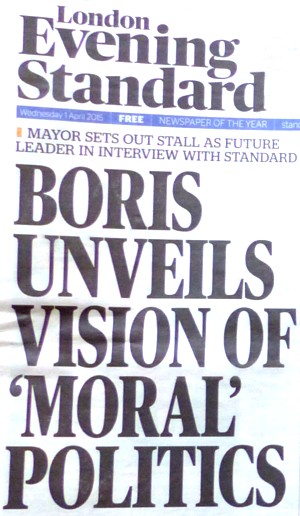
I haven’t gone through this latest clutch of front page photos properly yet. My camera always sees more than I do, until I really look at what I’ve got. But, I have already been smiling at this front page headline:
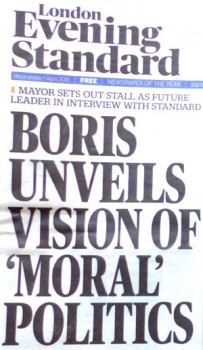
Someone’s having a laugh, right? I don’t think it’s just me.
And the date above the newspaper headline …:

… tells me that one of the someones having a laugh is the Evening Standard. Nice one, gentlemen.
Here, for those who care, is the story.
If the project itself would add value then it should be built, recession or no. And if it doesn’t add value then it shouldn’t be built, recession or no. There is no room left for the argument that it should be built because recession.
– Tim Worstall, on the ASI blog writing “Keynesian infrastructure spending might not be the answer you know“
Obama collecting personal data for a secret race database, reports the New York Post.
A key part of President Obama’s legacy will be the fed’s unprecedented collection of sensitive data on Americans by race. The government is prying into our most personal information at the most local levels, all for the purpose of “racial and economic justice.”
Unbeknown to most Americans, Obama’s racial bean counters are furiously mining data on their health, home loans, credit cards, places of work, neighborhoods, even how their kids are disciplined in school — all to document “inequalities” between minorities and whites.
This Orwellian-style stockpile of statistics includes a vast and permanent network of discrimination databases, which Obama already is using to make “disparate impact” cases against: banks that don’t make enough prime loans to minorities; schools that suspend too many blacks; cities that don’t offer enough Section 8 and other low-income housing for minorities; and employers who turn down African-Americans for jobs due to criminal backgrounds.
So they want to push banks into making more loans to minorities who tend to lack good credit histories. What could possibly go wrong? When companies like Wonga encourage poor people to take out loans they cannot afford, it’s called loan sharking.
As with my previous post, I first learned of this story via the Drudge Report, which seems particularly good at sniffing out and really making public stories of this type in which momentous developments were previously “made public” in a purely technical sense by bland official reports. “You will be assimilated” was the catchphrase of the Borg, a “collection of species that have been turned into cybernetic organisms functioning as drones in a hive mind called the Collective”, formerly thought to be fictional.
Le Journal du Dimanche printed a loyal address made by President Hollande to Jacques Delors on the occasion of the old emperor’s nintieth birthday.
Here are some extracts, translated by me and Messieurs Google et Bing:
“Because Europe can only advance if it carries the idea of transcendence. No nation can contemplate giving up part of its sovereignty if it is not satisfied that it will emerge stronger from this process. He [Delors] intuited that out of the crisis, Europe needs to define a new horizon that can give rise to a new hope, because he knows that the European idea runs out of steam when it is no longer put into action.”
“What threatens us is not too much Europe but too little.”
“The eurozone has managed this week to reaffirm its cohesion with Greece.
The quality of the Franco-German relationship had a great deal to do with it. The European spirit prevailed. But we cannot stop there. I have offered to take forward Jacques Delors’s idea for a Government of the euro area with the addition of a specific budget and thus also a Parliament to ensure democratic control.”
Found via Bloomberg and the Drudge Report. The French original can be seen at the first link. Is he really saying what I think he’s saying? A unified Eurozone government?
But the church has no particular expertise in science… the church has got no mandate from the Lord to pronounce on scientific matters. We believe in the autonomy of science
– Cardinal George Pell
I have been reading Derek Wilson’s book about The Plantagenets, which is a succinct, blow-by-blow history of England’s monarchs from the beginning of the reign of Henry II in 1154 to the death of Richard III at Bosworth in 1485 at the hands of Henry Tudor. It’s good. All the various blows are briskly and engagingly described. If that’s the sort of book you are looking for, look no further.
In 1471, it seemed at the time as if the fighting had ended. The chapter covering 1471-1485 begins thus (on page 259 of my paperback edition):
After half a century of governmental breakdown, baronial strife and dynastic uncertainty the country needed internal and external peace and a firm hand on the tiller, and Edward IV certainly settled things down for a dozen years. …
But as anyone familiar with Medieval English history knows, and as Wilson then of course immediately relates, the fighting wasn’t quite done. This same paragraph then continues:
… However, following his death at the age of 41 his family managed to tear itself apart, provoke fresh conflicts and pave the way for a challenge from a minor branch of the Lancastrian dynasty, something which had up to that moment seemed inconceivable.
But then, Wilson switches in his immediately following paragraph to a different story:
Beyond central politics profound changes were taking place in these years. Commerce – especially the trade in woollen cloth – flourished, and a wealthy capitalist, mercantile class emerged. Renaissance influences from the continent began to affect cultural life and provoke new patterns of thought. But most revolutionary of all was the appearance of cheap books from the new print shops, which brought the world of ideas within the reach of many more people.
Now I want to make it clear that I have no major complaint to make about Derek Wilson, or his book. His aim with it was to tell the story of the Plantagenet kings, and he succeeds very satisfactorily. What I am here regretting is the absence of a point which he might have made here, maybe in a mere couple of phrases. I am not accusing Wilson of failing to understand the point I am about to make. I am merely noting that, for whatever reason, this is a point that he does not, at this highly relevant moment in his story, make himself.
Wilson could have connected the two paragraphs above, with half a sentence which added something along the lines of: “Perhaps partly because the aristocracy were consuming their energies fighting each other rather by meddling with commerce …”, and then noted that commerce at this time flourished.
For my point is that this royal “hand on the tiller” that Wilson says the country so much needed can sometimes be rather too firm.
→ Continue reading: An infirm hand on the tiller has its advantages
The following content was posted by Radley Balko to Facebook — I claim no credit for it. I would normally have just linked to it, but links to Facebook content are often a bit fragile, and this is perhaps one of the most spectacular things I’ve seen for a while and deserves wider viewing.
Now improved! Edited to add headlines from March through July!
Portrait of an obsession: Every Alternet and/or Salon headline about libertarians from the last two years.
As Gene Healy put it, “Never before have so many been so intimidated by so few with so little political power.”
[New articles up to July 2015]
Libertarianism is for white men
What Rand Paul’s libertarian hypocrisy reveals about the GOP’s giant race problem
America’s libertarian freakshow: Inside the free-market fetish of Rand Paul & Ted Cruz
Rise of the techno-Libertarians: The 5 most socially destructive aspects of Silicon Valley
Big Data’s big libertarian lie: Facebook, Google and the Silicon Valley ethical overhaul we need
Elon Musk will not save us: Why libertarians waiting for a superman are wasting everyone’s time
Beware the Silicon Valley elite: Ayn Rand, Google libertarianism and Indiana’s “religious freedom”
I was a troll on the white dude-bro Internet: The dark side of gaming, libertarianism, and guns
Rand Paul’s civil rights fiasco: How Jon Stewart just unmasked him — and exposed libertarians’ perverted view of freedom
Rand Paul’s dystopian America: 6 things to know about the war-mongering, faux libertarian
5 Worst Things About the Techno-Libertarians Solidifying Their Grasp on Our Economy and Culture
Liberland: Hundreds of Thousands Apply to Live in the World’s Newest—Very Tiny—Libertarian ‘Country’
Rand Paul, Doofus: The Libertarian’s Embarrassing “Racial Outreach”
Will War Between the Religious Right and Libertarians Tear the Tea Party Apart?
My Personal Libertarian Hell: How I Enraged the Movement and Paid the Price
How Big Business Invented the Theology of ‘Christian Libertarianism’ and the Gospel of Free Markets
Welcome to ‘Libertarian Island’: Inside the Frightening Economic Dreams of Silicon Valley’s Super Rich
It’s Bizarre: Libertarians Are Clueless About the ‘Free Market’ That They Worship
The True History of Libertarianism in America: A Phony Ideology to Promote a Corporate Agenda
[New articles up to March 2015]
Libertarianism is for petulant children: Ayn Rand, Rand Paul and the movement’s sad “rebellion”
The atheist libertarian lie: Ayn Rand, income inequality and the fantasy of the “free market”
Nightmare libertarian project turns country into the murder capital of the world
21 Rand Paul quotes that expose libertarianism for the con job it is
Ann Coulter: Libertarian voters are “idiots” who deserve to “drown”
My unusual libertarian journey: How a former outlaw broke the political mold
Libertarian Sham: Using the L Word to Hide Even Worse Politics
Ayn Rand’s capitalist paradise lost: The inside story of a libertarian scam
The sharing economy is a lie: Uber, Ayn Rand and the truth about tech and libertarians
→ Continue reading: Portrait of an obsession: Every Alternet and/or Salon headline about libertarians from the last two years.
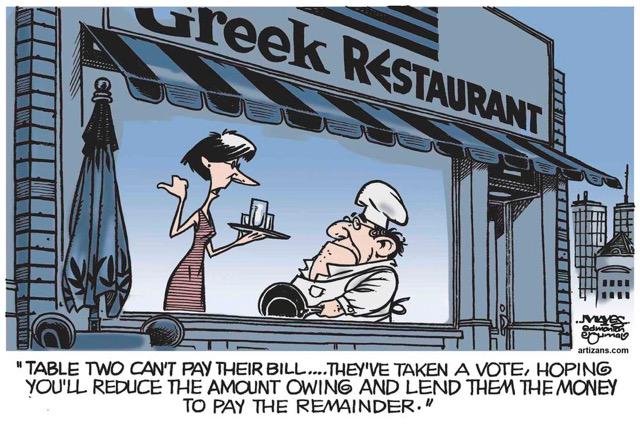
People in Greece are rioting against ‘austerity’ (which is the term used to describe the state spending less of other people’s money).
Troika. IMF. Democracy. blah blah blah…
Yet what is all really boils down to is this…
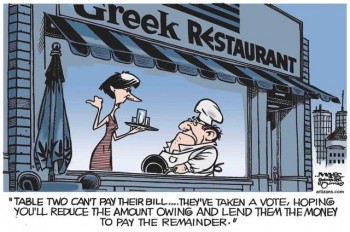
Hardly surprising so many Latvians, Lithuanians and Slovaks are utterly unmoved by the ‘plight’ of Greece.
|
Who Are We? The Samizdata people are a bunch of sinister and heavily armed globalist illuminati who seek to infect the entire world with the values of personal liberty and several property. Amongst our many crimes is a sense of humour and the intermittent use of British spelling.
We are also a varied group made up of social individualists, classical liberals, whigs, libertarians, extropians, futurists, ‘Porcupines’, Karl Popper fetishists, recovering neo-conservatives, crazed Ayn Rand worshipers, over-caffeinated Virginia Postrel devotees, witty Frédéric Bastiat wannabes, cypherpunks, minarchists, kritarchists and wild-eyed anarcho-capitalists from Britain, North America, Australia and Europe.
|