We are developing the social individualist meta-context for the future. From the very serious to the extremely frivolous... lets see what is on the mind of the Samizdata people.
Samizdata, derived from Samizdat /n. - a system of clandestine publication of banned literature in the USSR [Russ.,= self-publishing house]
|
George Orwell wrote of government power, “If you want a vision of the future, imagine a boot stamping on a human face—forever.” He may still be right, but there’s now a decent chance someone will be there with a cell-phone camera to post it on YouTube. And exposing abuse of power is half the battle.
– The magnificent Radley Balko, who does more for exposing abuse of power than just about anyone.
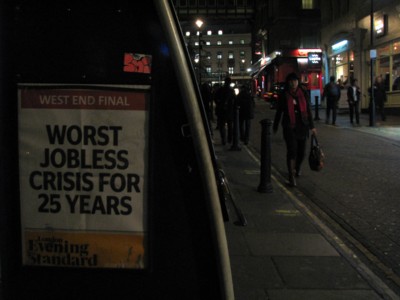
This evening I dined with a friend, and on my way there took this snap of an Evening Standard headline. A couple of years ago I thought that the Evening Standard itself – never mind these billboards – would soon be extinct. But although diminished in number, these headlines are still a familiar part of the London scene, now as then usually telling of catastrophe of one kind or another, public or personal. This evening’s offering was no exception:
Here‘s the story. Depending on your preferred explanation for this sad circumstance, you’ll pick out a different bit of the story. I pick this:
The shocking new total was published today as Bank of England governor Sir Mervyn King warned Britain is in danger of sliding back into recession.
He downgraded his growth forecasts again, saying the economy will expand by one per cent this year and next, a fraction of the hoped-for rate.
As Instpundit would say: Unexpectedly! It would appear that quantitative easing is proving less than completely stimulating. We here are not shocked by this bad unemployment news.
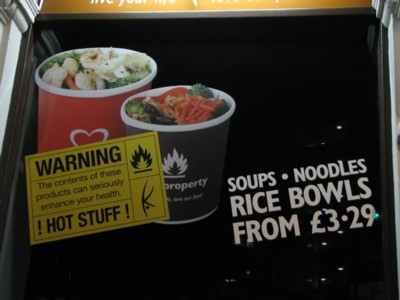
For a little light relief, here’s a snap I took later, on my way home:
The advertising trade was bound to take advantage sooner or later of the wave of health and safety signage that is such a feature of British life just now. This is the first time I’ve noticed it, but I’m sure others have seen such things many times already.
The National Space Society and the International Academy of Astronautics held a press conference at the National Press Club yesterday to announce stunning advances in the systems design of Space Based Solar Power satellites.
John Mankins has been working on a modular solar power station architecture for a number of years. Instead of a big, all up construction project, there are mass produced small modules that begin paying for themselves almost immediately.
His concept could be flying in 10 years. Rather than assume a system has to look like the concept drawings from the 1970’s, he completely rethought it using modern technology. The result is a module that can launch on an existing rocket and immediately make itself useful by delivering power to anywhere on earth it is needed. On its own one module is not going to power a city, but it might power a small remote facility or supply emergency power to a team at a disaster area. As cash-flow or investment capital allows, more identical units can be launched. They may be used separately… or they might be joined up like robotic Lego blocks to form larger and larger structures, generating larger and larger amounts of energy for Earth-Based usage.
Take a look at the IAA report.
The video is now available.
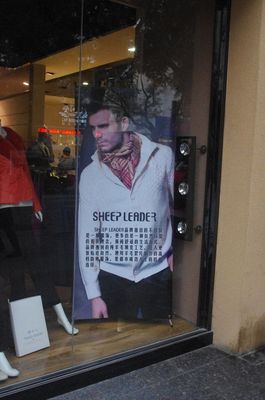
Beijing, China. November 2011
Part three in an ongoing series
I have long thought, first, that the United Kingdom has for some time been heading towards being the Non-United Kingdom, and second, that this would probably be a very good thing.
If such a separation is indeed happening, then what is causing it is the end of the British Empire. That and what followed around half a century later (i.e. around now), probably as an inevitable next step, namely the abandonment of the English-stroke-British attempt to remain a top ranking Great Power.
The British Empire meant that lots of Scots wanted to be attached to England, to get in on all the deals involved. Then Britain, empireless but still trying to remain a Great Power, needed Scotland to remain in. Scotland provided and still provides military manpower, and projected and still projects British power in northerly and westerly and easterly directions, in a way that England without Scotland will never be able to match. Could England without Scotland (to say nothing of Northern Ireland) have won the Battle of Atlantic? Hardly. Could England then have even threatened to win the re-run of that battle that from the end of WW2 until the collapse of the Soviet Union, dominated British naval thinking, and Britain’s strategic thinking generally? Again, hardly. For as long as the Cold War lasted, the English plus whichever local allies went along with them, were determined to square up to the Russians and thus keep their seat at that Top Table that politicians are all so very keen to be seen sitting at. A dis-United Kingdom was a non-starter, for contriving all that.
But now? Russia remains a looming monster, or a huge wreck if you prefer the Perry de Havilland take on Russia, which I think I probably do. But even if you think that Russia remains very strong, it no longer fancies itself as a global ideological magnet, bankrolling and talking up every nutter in the civilised world with a mad plan to derange civilisation. It no longer even goes through the motions of attempting to conquer everywhere else. Russia is now just another Problem, along with government debt and bank turmoil, the Euro, the Dollar, the Pound, China, energy shortages or “climate change” (again according to taste), crime, schools’n’hospitals, etc. etc. etc., rather than The Problem.
The global ideological derangement torch has now been seized by Mad Mullahs, and they won’t be re-fighting the Battle of the Atlantic any time soon. Nor do they have nearly so many nuclear bombs, or nearly such potent means of chucking them about in the world. They require very different strategies. Given the weaknesses and difficulties faced by the Mad Mullahs, and given the weaknesses and difficulties faced by us, their enemies, I wouldn’t now want to call them anything more than just another Problem, among all the others.
Other career paths for English politicians to that Top Table have since been identified, based less on British power and more on personal skills and individual contributions to the new global elite. To put it bluntly, you don’t need to be part of one of the old empires in order to participate in running the New World Order.
England’s Great Power-ish inclined warriors and foreigner-scarers, of greatly varying social grandeur from Air Marshals to ex-army pub landlords to army-fan dog-owning T-shirted denizens of south of England housing estates, are being presented with a fait accompli. This warrior tendency has traditionally been very pro the Union with Scotland, but is now being being starved of resources and humiliated by its consequent failures to make very effective uses even of those resources that it does still receive. Its last serious throw of the dice was the Falklands War. Since then, Britain been militarily “powerful” by supporting America, which is not nearly so satisfying, or so impressive to spectators. Britain’s more recent military escapades, against those Mad Mullahs, seem to have accomplished, and to be accomplishing, less and less with each passing year. Chasing terrorists in foreign parts is all well and good, but it seems foolish to be trying to impose democracy upon such places as Afghanistan, given the problems we now have domestically. And even if you don’t agree about that, you can hardly deny that most English people surely now do think thus. The Will to Great Power, to adapt Nietzsche, seems more and more to be lacking in Britain. Too costly. Not worth it. Time to consign all that to the history books.
And with it, the overriding imperative for England and Scotland to remain politically attached to one another.
Meanwhile, that strand of English opinion which favours trade, free markets, and so on, is, in the absence of any continuing great power logic to justify union with Scotland, likely to become ever more irked but it. This tradesman tendency, so to speak, of free market inclined businessmen, City of Londoners, shopkeepers, and bookish students who like reading Hayek and Friedman and, these days, clicking onto mises.org, has lately suffered a severe dose of Scottish moralistic … I don’t think anti-Englishness is too strong a phrase for it, at the hated hands of Gordon Brown. More and more they (and count me in too) now think: well Jock, if you want out, then you just go ahead and get out. We might then get the sort of government we want, instead of having our choice vetoed by you all the time.
The above thoughts were triggered again in my head just last week, by a recent report (thank you Bishop Hill), which said that if Scotland does go independent, it will as a direct consequence have to stop being nearly as crackpottedly ridiculous as it is now about “renewable” energy, i.e. the sort of energy of which there is not now and for the foreseeable future never will be enough. Suddenly, I found myself becoming a passionate Scottish Nationalist, if only to put the wind up the idiotic wind-farmer tendency. Although, Bishop Hill jokes that such greenery in Scotland is actually a plan to keep the Union with Scotland going, by making Scottish independence impossible.
For wind-farming in particular, read Scottish economic thought and policy generally. Libertarians like me have another reason to want to see Scotland separate itself from England, which is that once the indignity of being told by annoying English people like me to favour more rational economic theories and economic policies has been removed, the Scots, once independent, will then almost certainly become far more ready to tell each other to think and to behave in an economically more sane manner.
If Scotland goes independent, then Scotland will, for reasons of sheer economic self-preservation, have to stop being a huge drag on the global pro-free-market tendency in general and the libertarian movement in particular, and might even become a net contributor to such tendencies. Again.
Final thought. Where will all this leave UKIP? Changing its name for a start. But then, as the EIP, much more likely to get what it wants. And that’s another reason for England to eject Scotland from its union with England. It would then be a lot easier for England to eject itself from the EU.
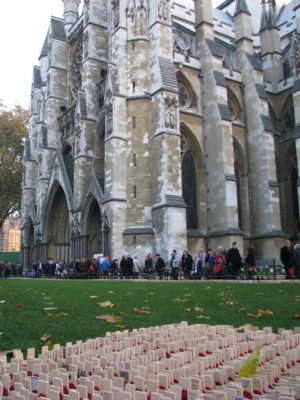
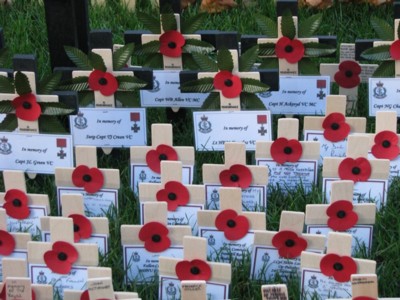
Earlier today, Remembrance Sunday and a rare sunny day after many grey ones, I walked to Westminster Abbey, to take photos of the commemorations outside the Abbey of our war dead:
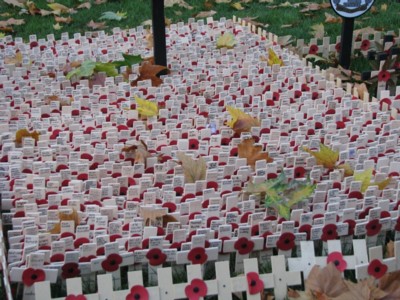
As every year around this time, Britain remembers its war dead with smal wooden crosses, almost all with a poppy attached, and a small written message, of a name or a note of remembrance.
Not surprisingly, given how many died, there are a lot of crosses:
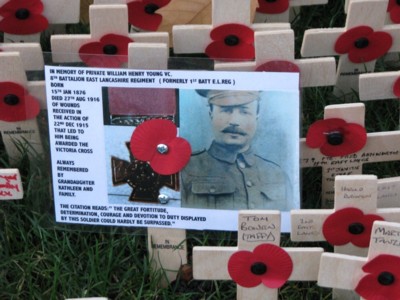
Some of the messages said that every one of the dead was a “hero”. Maybe. But there can be no doubting that these men, with “VC” after their names, definitely were, whatever you may think of the wars they were fighting:
As was this man:
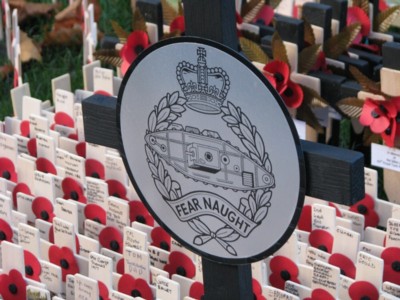
There are not many individual commemorations of this sort, with a personal photo. More common were clutches of crosses, with the bigger lettering used only for the names of the regiments of the men commemorated.
I liked this regimental sign, embodying what tanks looked like on the very first occasions when they took to the battlefield:
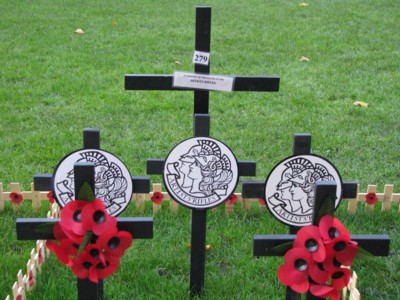
And once I started noticing in particular these regimental signs, I particularly noticed this one:
Artists’ Rifles? Artists?
Yes, apparently these men were, to begin with anyway, painters who chose to swap their paintbrushes for rifles and their tubes of paint for bullets:
The first ‘Captain’ of the Regiment to be elected was Lord Bury (later the Earl of Albemarle) but he did not remain in office for very long. The first Commanding Officer in 1860 was Henry Wyndham Phillips, the painter and amongst the early distinguished ‘Artists’ were John Everett Millais, G F Watts, Val Prinsep, Frederick Leighton (later Lord Leighton, CO after Henry Wyndham Phillips and a future President of the Royal Academy), R W Edis (a future CO), Holman Hunt and William Morris.
However, the artistic influence somewhat declined:
The influence of the Pre-Raphaelite group, however, appears to have been more social than military! As years went by the composition of the Regiment was broadened to include many other professions. By 1893, for example, painters and sculptors represented less than 5 per cent. of the membership with architects 12 per cent., lawyers 12 per cent., doctors 10 per cent. and civil engineers 6 per cent.
Blog and learn.
Imagine that happening now.
Of all the enemies to public liberty war is, perhaps, the most to be dreaded, because it comprises and develops the germ of every other.
War is the parent of armies; from these proceed debts and taxes; and armies, and debts, and taxes are the known instruments for bringing the many under the domination of the few. In war, too, the discretionary power of the Executive is extended; its influence in dealing out offices, honours, and emoluments is multiplied; and all the means of seducing the minds, are added to those of subduing the force, of the people.
– James Madison [Thanks to Sara Scarlett for reminding me]
When young beautiful and really smart girls are on your side, you know you are winning. Check out Token Libertarian Girl’s Youtube channel
You will not regret it.
I know I sometimes rather overdo the cricket here, but this, from one of the Cricinfo blogs, really is quite amusing:
Now that the man’s gone, the name may soon follow. The Punjab Olympic Association has asked the provincial chief minister to rename the Gaddafi Stadium in Lahore, in keeping with increasing public opinion against associating the historic venue with the former Libyan dictator. The ground was originally called Lahore Stadium but was renamed following Gaddafi’s visit to Pakistan in 1974. Now it’s time to change things back, says association secretary Idrees Haider Khawaja. “I don’t think his profile is inspirational enough to link with our cricket stadium’s identity,” Khawaja told ESPNcricinfo.
No, I guess it’s not, any more. I further guess that they called it the Gaddafi Stadium because they were inspired by a flow of money from Gaddafi, to such persons as those who took it in turns to be Punjab’s provincial chief minister, and that this source of inspiration has now dried up, what with Gaddafi being killed and all.
In other words, the reason he Gaddafi Stadium won’t be the Gaddafi Stadium any more is the same reason that the Oval, just across the Thames from where I live in London, was called the Brit Oval, but is now not. In the case of the Oval, it was all out in the open. In Lahore, the arrangement was, I surmise, somewhat more hidden. Which puts news like this, about bent Pakistani cricketers being jailed, into its national context. (I wrote about that here (good comments on that one also) when that story first emerged.)
It will be interesting to see what they decide to call the Gaddafi Stadium next.
Not a lot of news coming out but I found this news on the Polywell Fusion reactor testing.
500 shots so far. A long way to go, but Dr. Bussard’s concepts have now survived quite a lot of testing. There is probably a lot more interesting information behind the scenes, but the US Navy Office of Naval Research prefers they not talk a lot.
I wish them success because it changes everything for all of us if they do succeed on the final hurdle of creating a working fusion generator.
God’s light, these villains will make the word as odious as the word ‘occupy;’ which was an excellent good word before it was ill sorted
– Henry IV Part II, Act III Scene 4. (In past centuries “occupy”, used as a transitive verb, had an additional meaning.)
I came across this note in one of the notes I get from banks and law firms. I am not sure of the source, but it was allegedly said by the mother of Karl Marx:
“I wish Karl would accumulate some capital, instead of just writing about it.”
Of course, Marx spent a lot of his life living off the capital as generated by other people. A familiar pattern.
|
Who Are We? The Samizdata people are a bunch of sinister and heavily armed globalist illuminati who seek to infect the entire world with the values of personal liberty and several property. Amongst our many crimes is a sense of humour and the intermittent use of British spelling.
We are also a varied group made up of social individualists, classical liberals, whigs, libertarians, extropians, futurists, ‘Porcupines’, Karl Popper fetishists, recovering neo-conservatives, crazed Ayn Rand worshipers, over-caffeinated Virginia Postrel devotees, witty Frédéric Bastiat wannabes, cypherpunks, minarchists, kritarchists and wild-eyed anarcho-capitalists from Britain, North America, Australia and Europe.
|