We are developing the social individualist meta-context for the future. From the very serious to the extremely frivolous... lets see what is on the mind of the Samizdata people.
Samizdata, derived from Samizdat /n. - a system of clandestine publication of banned literature in the USSR [Russ.,= self-publishing house]
|
Found on the 8-12 shelf, Space Case by Stuart Gibbs is a science fiction adventure story set on a realistic moon base in which its twelve-year-old protagonist helps to solve a murder mystery. Its sequel, Spaced Out, is about a missing person mystery. A relatable protagonist, some science fiction with proper science, a location with opportunity for adventure and an engaging mystery: these ought to be great ingredients for a book my son could enjoy.
The first problem, however, is that the protagonist is very negative about living on the moon. It would be possible to complain a bit about the poor food and the lack of space while also being excited and in awe of the achievement of living on the moon. But no, there is no upside. Even the boredom is only relieved by terrible events, leading the protagonist to yearn for boredom once more. And he’s not an inspiring chap who faces his challenges head on, with aplomb. He mostly moans about things or is scared. Instead of being relieved to get out of the micrometeorite storm alive, after the discovery of a hole in the top layers of his suit, the author dwells on his fear and dislike of returning outside even when the threat of incoming meteorites disappears.
Minor spoiler in the next paragraph…
→ Continue reading: Spaced Out review
I recently read the book Dangerous Hero: Corbyn’s Ruthless Plot For Power, by renowned investigative journalist Tom Bower. Bower has also written books on various people such as Richard Branson, Rupert Murdoch, Robert Maxwell and Tony Blair, with varying degrees of deserved brutality. He now has turned his attention on the leader of Her Majesty’s opposition.
Much of the book is not quite the trove of astonishing revelations that it might have appeared to be, if only because I had realised quite some time ago what Corbyn is and stands for, and read about his involvement in, and support for, hard-Left causes for quite some time. I knew about his support for Hamas, his attendance at a funeral of a killer of Israeli athletes (he initially lied about it), his outreach to Sinn Fein IRA within days of the Brighton bombing of 1984 (I was a student living in Brighton at the time, and it was when the name “Corbyn” first entered my consciousness), his holiday-making in the Soviet satellite states and so on. I knew much of this, and assume that most political junkies who follow UK affairs had a reasonably solid grasp of all this gruesome detail.
What is nonetheless striking about this book is the way it shows that Corbyn’s Marxism was quite possibly formed in a period when – never fully explained in his own accounts – he left Jamaica (in the late 60s) and had, so Bower speculates, gone to Cuba. Corbyn’s hatred of the UK, and the empire it created, is very much at the core of his political credo. Corbyn is incurious in some ways about enterprise – other than loathing it, and has tended to leave the details of how a socialist state will direct our lives to colleagues such as John McDonnell. What really floats Corbyn’s boat is his adversialism towards the UK and West as a whole. Any power and person whom he thinks has the ability to hurt the UK and the West as a whole gets his support, no matter how murderous or malevolent.
This anti-British, anti-Western stance is a coherent strand throughout. It explains Corbyn’s cozying up to Iran (and willingness to appear on Iranian TV and get paid for this) – because he hates Israel (a pro-Western, broadly free nation); it explains, even his anti-semitism (Bower is very clear about this; no sophistry about how Corbyn is anti-Zionist but not anti-semitic); it is the key to his hatred of the US and the UK. It shows why he has been a champion of the cause of a united Ireland, preferring to support the IRA, and attend the funerals of IRA operatives, rather than focus on the messier routes of democratic politics in Northern Ireland. And it also shows why he has more recently praised Venezuela, at least until its recent disasters, because that country was seen as being a pain in the bum for the US. To take another Latin American case, Corbyn was happy, it seems, for the Argentinian junta to invade the Falklands Islands, a UK territory, and never mind the democratic wishes of the island’s locals.
One of the most useful parts of the book was its account, told with moments of unintended humour, of Corbyn’s time as a Labour Party councillor in North London, and of how he worked to remove real/alleged enemies and take control. Bower also shows that while Corbyn obviously craved the approval and circle of senior hard-Left figures such as Tony Benn, he was no real intellectual himself and did not contribute original ideas. What Corbyn was very effective at – and Bower ruefully admits this – was being an organiser of protest. He also had a sort of rubber-ball quality – he seemed able to take all kinds of abuse and setbacks and kept ploughing on. He was and is also fairly immune to straightforward venality and corruption, one of his few positive traits. (That does not mean his views are less unpleasant, but as far as one can tell Corbyn was not motivated by money in the way that Tony Blair seems to have been.) It also seems that he is quite a red-blooded sort of bloke, but also not very easy to get on with for the long haul: three marriages as of the time of writing. Another nugget: One of his former wives said that she never saw him read a book during the time they were together.
It is sobering to think that Corbyn has learned nothing from the past half a century in any way that would affect his thinking away from socialism. The many disasters of socialist states have had no impact on his thinking. The end of the Berlin Wall is, one suspects, a grave sadness to him, and people around him, such as media advisor and unashamed Stalinist, Seamus Milne. This fixity of ideological purpose makes me think that socialism really is, for some, a secular religion. The Bower book contains the nugget that John McDonnell, now shadow Chancellor, once thought of going into the priesthood.
Now, a socialist might scoff and say that libertarians can become a bit dogmatic too (that is correct), but there’s a big difference: a market-based economy has, through the processes of bankruptcy and profit, a feedback system in which bad, mistaken ideas fail, and good ones succeed. With socialism, by contrast, failure (such as the misallocation of resources in Soviet Russia) is taken to mean that the State must do even more socialism, that “beatings will continue until morale improves”, so to speak. The free market is like a sort of constant Karl Popper-style testing of hypotheses (business ideas). Socialism does not have any sort of equivalent process.
What to explain how far Corbyn has come despite all this? Bower gives some idea about this. Corbyn is sly and enjoys letting others do the dirty work of knifing colleagues and betraying real/alleged enemies, and likes to appear above it all (he is not unique in this, of course), and play the part of the scruffy, dotty-but-endearing Leftie with his vegetable patch and penchant for photographing street furniture. It is striking how even the joke tag “Magic Marxist Grandpa” is almost an affectionate term, until you realise what Marxism will do. Corbyn shows you can get away with appalling, mistaken views if you speak softly, are bit of a “character” and have good manners (although he can lose his temper when confronted in some cases). And finally, there is Corbyn’s quality of patience. He’s been working away, waiting for his chance. In 2015, when the former Labour leader Ed Milliband stood down, the party’s leadership/voting rules allowed a person such as Corbyn to stand. People voted to let his name go on the ballot. It is proof that random events can really make a difference. (Ironically, it rather undermines the Marxist idea that we are propelled deterministically by economic forces and relations of production. Specific human acts can make a big difference.)
The book, however, for all its pace and verve, is unlikely to convert a lot of people away from Corbyn and what he stands for, although I suppose one or two people might be swayed. I do think that the anti-semitism must have rattled a few even more devoted fans, and his dithering over the EU issue is a delight to watch because Brexit is an issue that doesn’t fall into any obvious map that Corbyn has in his head.
An issue with this book is that Bower has no references or footnotes, a fact that Bower justifies by saying that so much of what he was told was off the record, and that he took legal advice to that effect. The problem with no references is that it is easy therefore for some people to attack the veracity of some of his details. Peter Oborne, who like some right-wingers has a sort of madly odd affection for Corbyn, on the grounds that he is “authenic” (I fail to see what is great about being an authentic nasty piece of work), has attacked the book’s accuracy. Bower hasn’t responded. I remember many years ago, when I wrote pamphlets for libertarian causes, that Brian Micklethwait and other old friends such as the late Chris Tame drummed into me the importance of references and sources, with lots of specific details, in the interests of good scholarship. If a book is going to drive a stake into the heart of Corbyn, I think it would have been more effective had it contained some explicit sources.
Dangerous Hero is a gripping read – I went through it very fast – and it is gruesome, even chilling, reading. It is a well-paced, angrily written account of the life of a man who, let’s not forget, is still a potential prime minister of this country. As his IRA chums used to say, defenders of freedom have to be eternally vigilant, because for the likes of Corbyn, they need to be lucky just once.
About two hundred and forty years ago, the human species began to experience a wealth explosion. Poor people, who had been living and dying on the edge of starvation for millennia, began to get less poor, and slightly richer people started to become even richer, and much more numerous. Every graph measuring human comfort, wealth, progress, length of life, and so on, switched – historically, in the blink of an eye – from being a nearly horizontal line to being a nearly vertical line. This wealth explosion began in North West Europe, and quickly spread to other parts of Europe and to the USA. Now, poor people everywhere are getting less poor in unprecedentedly vast numbers. It’s a different world, and for just about everyone, a hugely better one.
What caused this wealth explosion? And why did it first erupt where it did, in Europe?
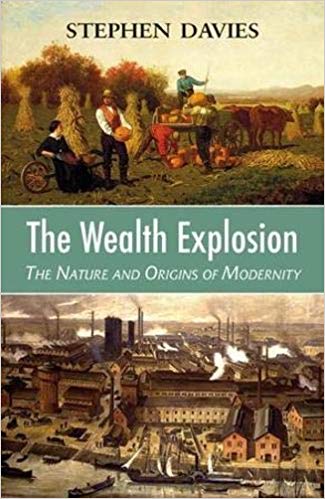
For some time now I have been getting to grips with a new book by Stephen Davies entitled The Wealth Explosion: The Nature and Origins of Modernity.
The central and most striking arguments in this book concern how Europe was – and just as significantly, was not – exceptional, as a potential detonator of this wealth explosion.
Clearly there was something exceptional about Europe, or the wealth explosion that we all now enjoy would not have started here. And equally clearly, all the positive ingredients needed for the explosion had to be present here for it to start happening. But the mere presence of all these positive ingredients, says Davies, is not what made Europe exceptional. Until Europe started exploding economically at the end of the eighteenth century, it had been, globally speaking, an economic and cultural backwater. All of these ingredients – demographic, economic, social, institutional, intellectual, spiritual – had been present, in greater strength and for far longer, in other parts of the world, most notably in China. The economic and cultural centre of the world, at least until the late eighteenth century, was not Europe but rather the lands around the Indian Ocean. So, why did the wealth explosion not happen there?
The answer that Davies supplies in The Wealth Explosion is that Europe was exceptional in being the only one of the world’s great civilisations that was not, at the historical moment when it mattered, politically unified. No European “hegemon” emerged in the centuries just before the wealth explosion got started, in the way that single imperial regimes had emerged to dominate Russia, the Middle East and India, and as had long been in successive imperial command in China.
This was the decisive negative ingredient that Europe possessed but which was lacking elsewhere, and this was what made the difference. The wealth explosion got seriously explosive in Europe because, when it started and from then on, nobody in Europe was powerful enough or motivated enough to stop it. On the contrary, the rulers of Europe never stopped competing with one another, and were therefore strongly incentivised to keep their wealth explosion going, despite all the upheaval that it caused. Economic stasis, and cultural stagnation of the sort that would have stopped the wealth explosion, was not, for the various contending rulers of Europe, an option. They needed guns, guns which had to keep on getting better. They needed money, to pay for the guns, and for the ever increasing numbers of people needed to develop, fire and later to carry the guns into battle. They needed the wealth explosion, no matter how much it was empowering new classes of citizen producers and citizen warriors. So, they let it happen. They even encouraged it. At which point the only way not to be beaten by the wealth explosion was to join it. And there we have it: the modern world.
The above is my best shot at summarising what I think is the most important line of argument in The Wealth Explosion. I had intended to write a single, quite long, mostly glowing review of this book. And I tried, I really tried. But the task defeated me (especially the “quite” long bit). Despite its small size for such a subject (only 248 pages) The Wealth Explosion contains so many interesting ideas besides those summarised above, so much pertinent historical detail, and so many judgements based on the voluminous writings and discoveries of other historians, that I found it impossible to say everything that I wanted to say about it in one blog posting, while remaining confident that anyone at all would want to wade through all that I had written. So, I abandoned the attempt to say everything, and instead decided to make a start by merely saying something. I now intend that there will be several more postings here about The Wealth Explosion (in the manner of these recent postings here by Patrick Crozier about Ulster).
That’s the plan anyway. I’ll end this first posting about The Wealth Explosion by saying that, although I don’t now want to elaborate on why I find the central argument of this book, as outlined above, to be so persuasive, I do find it to be very persuasive, and the book in general to be fascinating. And since the historical event in question is arguably the biggest single fact that there is about the world that we now live in, that makes this a very good book indeed. How do you write an excellent work of grand historical theory? You ask important questions and you supply convincing answers. You support these answers with many other interesting and closely related truths, and with reports of relevant debates among and with your fellow historians. This is what I think Stephen Davies has done.
Meanwhile, to learn more about The Wealth Explosion, read the review of it that Ananya Chowdhury did manage to write, for the Adam Smith Institute blog. Or, read what Stephen Davies himself wrote about his book and its conclusions, for CapX. Or, if you like it when people are good at talking to camera as well as good at writing (Stephen Davies is very good at both), listen to what Davies said to the Cato Institute about his book, as recorded in this video.
The 50th anniversary of the Apollo 11 space flight to and from the Moon has been covered extensively in a raft of books, television programmes and films. A few weeks ago I watched the Apollo 11 film of that name. This is a documentary that features, so the film-makers say, previously unseen footage, and it certainly is a remarkable film. One of the good things about it is that it does not involve any narration: the film and the action do the “talking”. I watched it on a large IMAX screen at London’s Science Museum. I heartily recommend it. I actually found it rather moving. That sequence of when Armstrong takes control of the Lunar Module and flies to the surface, with Aldrin counting out the altitude, knowing they have precious little fuel to spare, is one I can watch over and over. (Armstrong is one of my all-time heroes. The very fact that he conducted himself in such a modest way since the mission ended only reinforces that.)
The space missions of the 1960s were, of course, part of a much bigger set of actions involving the US, former Soviet Union and other select powers. Let there be no doubt: the Moon missions were a big “front” in the Cold War. We libertarians will debate whether all the spending on such a programme was justified (I will come back to this point in a bit) but it strikes me that the success of the Apollo missions were surely a valuable morale booster for the West and for America. It showed that for all the Soviets’ early successes in beating the US in some aspects of space flight, that by the mid to late 60s that edge had gone.
Putting the likes of Armstrong, Aldrin et al up there was a way for the US to poke Moscow in the eye. But it was about much more than that. It appears to me (born in May 1966) the product of a time when governments still had tremendous confidence in technology, as did much of wider society. And yet as we know, the end of the Moon programme coincided with events such as various environmentalist campaigns calling attention to the real/alleged damage Man was doing to the environment; it also overlapped with the Vietnam War, the oil price shock and the challenge to established Western assumptions about energy. And there was the rise of radical feminism and the Civil Rights campaign.
A lot of people have noted how the space programme contrasted with all the tumult and messiness of wider American/Western society at the time. At more or less the time that Armstrong was taking his “giant leap” for Mankind, Jimi Hendrix was playing his version of the Star Spangled Banner at muddy Woodstock (he’d probably be condemned by today’s left for being a reactionary conservative for playing it at all); Charles Manson and his fellow monsters were causing havoc. Several major public figures, such as Martin Luther King and Bobby Kennedy, were murdered. The space programme was, on the other hand, all clean, with white rockets and gleaming craft; it had a focus on scientific precision and a celebration of human efficacy. It was about what Man can do and achieve, given rational focus on a goal. It was also a very technocratic thing, and an example – which is often trotted out by politicians who like big vanity projects – of a big government effort actually working pretty well. (From the moment that JFK gave his speech about the Moon in 1962 it took just eight years to pull that feat off. It takes people longer to make James Bond films these days.) The men (and some women) at NASA looked different from the rock musicians and protesters of the time: whenever I see photos and old films of the chaps at Mission Control, for example, they all have air force-style buzzcuts, narrow dark ties and have names like Dave, Deke and Al. They drive Corvettes , live in small neat homes with pools (this impresses a Brit) and talk with clipped Midwestern or occasionally more gravelly Texan accents. They play golf. Al Shepard even took a golf club up to the Moon. How middle class is that?) They don’t look like Janis Joplin fans and probably could not give a damn about recycling of single-use plastics.
→ Continue reading: Book Review: Apollo In The Age Of Aquarius
Capitalism in America: A History. By Alan Greenspan and Adrian Wooldridge.
I recently read this book, published a few months ago, and it is written by a senior journalist who is political editor of the Economist, and former Federal Reserve Chairman Alan Greenspan. Given their respective occupations, I had a rough idea of their broad ideology (a general predisposition towards free markets, private property and limited government) and on the whole I enjoyed reading this book a great deal.
Their core thesis is that America has been as successful as it has been because it allows a great deal of “creative destruction” – new technologies and business models disrupt and replace older ones, causing pain for specific groups but big benefits for the wider population over time. America is so big, and people have traditionally been so willing to move around to find work, that the “creative” side wins over the “destructive”. They observe the back-and-forth process of how there have been periods of intense growth and upward progress, such as the post-Civil War boom, the rise of the great business tycoons such as the Rockefellers, and then the push-back of anti-trust and the Progressive Era, William Jennings Bryan and his “cross of gold” hysteria. We get the Roaring 20s, and ooops! the Great Depression, followed by WW2 and the post-war boom; the troubles of the late 60s, then 70s; the Reagan era, supply side tax cuts and the dotcom boom. For a while, people are diagnosed with something called “affluenza”. And finally, the 2008 crash happens and there’s all the angst over declining productivity and worries about skyrocketing debt.
The most impressive thing about this book in my view is the way an enormous amount of information, some of it arcane, is conveyed into a fast-paced narrative. This book is written very well and packed with anecdotes and even a bit of sly humour. There are some standouts: the book gives a marvelous account of the agricultural technologies and innovations that turned the Great Plains into the breadbasket of the world; its understanding of business models and mass production techniques is first class. It largely absolves the likes of Rockefeller, Carnegie and the rest of the “robber baron” tag and suggests that much anti-trust doctrine is bunk. Later, in discussing the present controversies over Facebook and other “Big Techs”, it is similarly sceptical about whether state bust-ups of such entities is a good idea.
The book points out how, by the late 19th Century, the US government was so small relative to today’s that the largest department of the Federal government was the Post Office. It generally praises the idea of the Gold Standard – Wooldridge and Greenspan are pretty rough on Bryan and others who think that printing money is a solution to economic problems. They are also pretty harsh on F D Roosevelt, pointing out that during the 1930s, unemployment averaged in the double-digit percentages, and that much of the New Deal was, on its stated terms, a failure. They give Roosevelt stick for his vindictive acts and foolish interventionism – they realise that his genius, if we can use that word, was inventing a myth about himself and in telling people that he was going to make sure everything was OK.
Needless to say, the narrative gets more awkward when it covers the period when Greenspan, a man who in his youth was an acolyte of Ayn Rand and an advocate of gold-backed money, became Fed chairman. The book argues (page 385) that critics cannot prove that the 2008 financial crisis can be blamed on loose monetary policy. Well, how jolly convenient! They say that the Fed’s ability to set interest rates, and influence borrowing costs for those with mortgages, etc, was largely restricted by the global “savings glut”. (I will come to this a bit later.) To a great extent, they blame the 2008 disaster on government-subsidised/supported sub-prime mortgages, excess confidence by bankers in risk models and the sheer complexity of financial products, such as in the derivatives markets. All these criticisms of the financial system prior to the collapse of Lehman Bros. in September 2008 look valid but there is also a problem.
A problem to overcome, the authors say, is how rising entitlement spending (Social Security, Medicare, Medicaid) has “crowded out” private savings and that, over a period of time, savings as a share of total GDP has declined. Coupled with this, and with rising regulation (which they rightly attack) has been less overall capital investment, leading to lower productivity growth. When people talk about “stagnant” wages, it is sub-par productivity that is largely to blame.
Okay, so low savings are a problem. If it is true that insufficient private sector savings is a problem to be fixed, how come the “glut” of savings in the years leading up to 2008 was a problem? If Chinese/other savers were pouring genuine savings (not central bank confetti) into the West, and investing in real capital, then why would this be an issue (other than a dislike of the origins of the savings)? When do we know that there is a “glut” of savings if, in other parts of the narrative, Greenspan/Wooldridge say there are insufficient savings because of a state “crowding out” effect? Of course, had Fed interest rates been higher than they were, yield-hungry Chinese savers might have put even money into the US, but then again it might have chilled the housing market enough to halt some of the damage.
Such points aside, Capitalism In America is a good study of some of the big shifts in the US economy since the Republic was born.
Whatever your views on free market principles, it is clearly dishonest to imply that those who support tax cuts, lower government spending and greater economic freedom do so in the belief that some wealth will belatedly “trickle down” to the poorest in society or because they view entrenching wealth amongst the privileged as an end in itself. Free marketeers would instead argue that allowing people to pursue all the opportunities they can through free exchange, with the minimal amount of government interference, will lead to generalised wealth creation. The virtue of cutting taxes is not that it benefits the rich, but that it benefits everyone.
– Madeline Grant
The author is commenting on what appears to be a shoddy misrepresentation of the ideas of persons such as the late FA Hayek. Interestingly, one of the writers of the book in question, Angela Eagle, had attempted to run against current hard left Labour leader Jeremy Corbyn. But it appears Eagle’s understanding of the classical position is terrible and her opposition to such freedoms as we enjoy seems clear. So the question I ask is that if Eagle and her allies are the “moderates”, then in what ways can they possibly be any better than Corbyn, apart from perhaps being less indulgent to anti-semites and certain other thugs?
I get the question, in another form, from teachers, who suggest I should write about ‘real’ things like racism and unemployment. Sometimes the teachers claim that fantasy is too difficult, or ‘beyond the average child’, but a lot of them complain that it doesn’t give them opportunities enough for class discussions of important modern issues. (‘Why don’t you write real books?’, Diana Wynne Jones)
In Orwell’s 1984, one of the many acts of the IngSoc (English Socialist) party is to write garbled versions (called ‘Definitive Texts’) of books whose message undermines the totalitarian ethos but whose titles are too well known just to repress. A review (h/t instapundit) shows that the recent film version of Madeleine L’Engle’s ‘A Wrinkle in Time’ has given it this treatment. Meg and her mother are now black, and the child actor chosen to play Charles Wallace adds so considerably to the rainbow effect that the film makes him adopted, lest even the most woke viewer notice the impossibility of his being the offspring of Meg’s mixed-race parents. The twins are missing entirely
which may be a blessing, considering that political correctness probably would have dictated they be played by a Native American dwarf and a disabled transsexual
etc. And all this merely serves as a distraction from the ruthless gutting of the Christian resonances that are as much a part of L’Engle’s books as of the Narnia stories. (The numerous other incoherent plot changes may reflect the scriptwriter’s wokeness or their poor memory or both.)
The review presents all this well enough. I’m not writing here to repeat it, but to reflect on how it hurts the PC themselves, not just us. To explain, I have to provide a worked example (so this post is longer than mine usually are).
Sadly, I missed the chance Natalie once had to meet the late Diana Wynne Jones, so I never asked her the questions I had. One of the more trivial was about her third reason why her early books all had male leading characters. (Her first reason is by far the more worth discussing – but that is another story.) Her third reason was she wanted to write a book that her children (all boys) would read and “in those days, boys would not read books with a girl as lead character.”
Obviously, Diana knew that was not literally true. Swallows and Amazons (written long before “those days”) stars twice as many girls as boys, and a later book in the series has thrice as many girls as boys. However she could have replied that none of those girls ever think a thought that would bring a blush to the cheeks of a young boy. When Nancy and Peggy are obliged by their great-aunt to dress in party frocks rather than the sailing gear they prefer, their reaction is almost as horrified as a boy’s might be. Susan’s femininity is strictly practical – boys know that when children camp or sail, someone has to manage the cooking. Perhaps Dorothea, with her dreams of Dutchmen bringing her tulips across the north sea and her yearning to be a writer, gets closest to thinking girlish thoughts: one can just about imagine her writing “The Tale of the Twin Princesses” if there were the slightest chance any of her friends would read it – but since she knows they wouldn’t, she writes “The Outlaw of the Broads”, which is clearly a swashbuckler.
So what I would have asked Diana was, “Did you ever try ‘A Wrinkle in Time’ on your sons?” (It was published in 1963 – their ages suit). I read it at age seven or eight and could not put it down, so I think she could have got her sons to read it – despite the fact that Meg, for all her mathematical genius, is not at all like the Amazon girls. Page one of ‘A Wrinkle in Time’ finds Meg angsting away in her bedroom. The next day she meets a boy and, after a shamefully brief period of caution, goes gooey over him. She’s embarrassed when her mother accidentally reveals she still plays with dolls – but that’s nothing to what a small boy identifying with her would feel.
Now part of why that boy keeps reading is because if small boy reader gets as far as page 2, he may think for a bit that the book will be about Charles Wallace. Adoring elder sister Meg knows Charles is a genius, despite the neighbours thinking he’s an idiot. Every small boy relates to this. Every small boy knows he’s a genius but, for some strange reason, the people around him treat him as if he were an idiot. Maybe this book is really about the amazing deeds of superboy Charles Wallace, as chronicled by Lois-Lane-like sister Meg?
If this brief mistake were in any way contrived, it would be a huge turn-off to re-reading. “The Turbulent Term of Tyke Tyler” was praised by all the usual suspects. Aided by deceptive cover art, its writer works hard to persuade you that first-person-narrator Tyke is a boy. Then she reveals Tyke is a girl. It’s as easy as ringing a doorbell and running off. “Yes comrade, this proves you too still suffer unconscious gender micro-stereotyping. Report to your assigned gender deconstruction re-educator immediately.” I assume some boys with feminist mothers read it once. I’d guess fewer read it twice. (Of course, these days, the making of those fixed binary assumptions about Tyke’s she-it-he gender identity would be the verboten thing. It is so hard for the woke to stay ‘relevant’.)
In a ‘A Wrinkle in Time’ however, this initial impression is wholly natural and innocent. It is close to how Madeleine L’Engle really does see Meg’s and Charles’ later relationship. (In the later books of the series, more-grown-up Charles is usually pointman, with Meg in a supportive role.) In the first third of ‘A Wrinkle in Time’, Charles takes the initiative in trying to rescue their lost father. Meg is the observer of the action but also the weakest: the slowest to recover from multi-dimensional travel, the slowest to learn the lessons their guides teach, the least patient (though the value of this is slightly more ambiguous). In a character-displaying scene the children confront the wall that sucks in the forms which define everyone on the totalitarian planet of Camazotz. The two boys each reach out a hand to touch it – “Ugh!” says Charles, “It’s like ice”, says Calvin – while Meg, between them, is intensely conscious she has no desire whatever to let go of their other hands to touch this vile wall herself. The boys can explore the wall; her job is to give (and receive) moral support. Already however, we’ve had hints that Charles is too young, too confident, more at risk than he realises. When he first attempts a dangerously overconfident move, Meg, terrified, temporarily saves him by almost knocking him out but when he recovers the two resume their relation of Charles taking the lead. Assuring her he can handle it, he advances open-eyed to his doom. The first third of the book ends with Meg, her rescued father and her boyfriend fleeing in the nick of time from Camazotz, where Charles is now far more enslaved than his father was.
In the middle part of the book, Meg is desperate to rescue her beloved baby brother – and her plan for doing so is that her father and boyfriend should come up with a plan for doing so and carry it out. Her job is to motivate them, so she gets angrier and angrier as, despite their best efforts, they make little progress at the impossible task before them. Finally, they manage to contact the guardians who have guided them, only to be told that both father’s plan and boyfriend’s plan are pure suicide. In the awful silence that follows, the unbelieveable idea occurs to Meg (for the first time) that she is expected to do something. Her immediate reaction is to shout, “I can’t go”, and when the cuttingly dismissive response shows her that in fact that is the idea, she has a tantrum. Only after that can she face the facts. It is Charles mind that is enslaved. Her boyfriend has known him for less than a day. Her father has been a prisoner since before Charles could speak. Only Meg knows him well enough to have any chance of freeing him. An impossible task for them, it is only almost impossible for her. Father and boyfriend protest vigorously against sending her – and it is clear both Meg and Madeleine L’Engle would be immensely unimpressed with them if they didn’t – but there is no escaping the logic to which the plot has naturally led her (and the small boy reader). If anything defines Meg, it is that she loves her brother, and to this, everything else she thinks about herself must give way.
Thus we reach the final part of the book, and it is Meg who must “do the hero bit”, as Dianna Wynne Jones puts it. She is the one who must walk, alone and terrified, towards the dark tower (which in this book is a low building pulsing with an insane light), armed only with the usual cryptic clue – that only a single weapon can save her “but you must find it for yourself”. I won’t spoil it for you by telling whether she wins through or not – but I suspect you can guess.
So (for those who have managed to endure reading this far) not only could ‘A Wrinkle in Time’ be made the subject of “classroom discussions” but I have (I hope) demonstrated that a lefty teacher with at least two brain cells to rub together – and, much more important, the ability to set their inner PC censor temporarily to a low enough setting while reading it that they can think about it – could make remarks about roles and expectations and all that stuff they like to go on about. But “you can’t say that” silences their ability to think more than our ability to speak. Gross crude effects – make Meg black, replace the Christian themes – plastered onto the tale like Pollock-style paint blobbed onto a Rembrandt, provide the ‘definitive text’ for a socially-aware classroom discussion, a woke review, an idiocy of political correctness – but nothing that relates the actual work to their actual (supposedly) concerns.
Simon Gibbs has a review of Clive Fox’s cute quick techno-thriller ‘First Hook‘, which has launched today.
The series is modelled on shows like the A-team, but produced natively for consumption in written form as a serial short story. Much as Bleak House was originally published by Charles Dickens as a regular newspaper feature this punchy little story will be added to over time in the way that a TV show is added to with a new episode broadcast each week, except that future episodes are not yet all written. As such it borrows something of the currency of a soap opera, able to evolve and adapt constantly, but is firmly in the sci-fi category. This is an interesting and novel form of written fiction.
Anyone questioning why a lightweight techno thriller should be reviewed on Samizdata would do well to read Brian Micklethwait’s summary of The Power of Fiction, a talk given by former City AM managing editor Marc Sidwell. Anyone wondering what on Earth they might do about it, finding themselves unable to write fiction of their own should read the thoughts of Richard Gleaves, author of Ride Headless and Ride (itself reviewed on Libertarian Home).
So anyway, here is the Amazon review. You can buy it, read it and write your own review on Amazon:
Clive Fox is making an important contribution at a critical time.
When business paper The Financial Times offers advice to tech CEOs it is to warn them of their waning popularity and their “responsibilities”. Tech giants in California bring fantastic wealth to the area, and amazing technology to mankind, only to be slammed for the crime of gentrifying impoverished San Francisco – their staff hounded on company minibuses. Those companies branch out to the UK bringing us world changing products and brilliant new services, only to be pumped for more cash. Modern society fails to appreciate the source of it’s modernity.
Aftermath clearly know all about the problems of modern – and future – technology. Yet they have the balls to value it, master it, become one with it, and when necessary to beat it. The resulting tensions and dramas are evident in this first outing. I am thirsty for the next instalment.
– Simon Gibbs
Sam Dumitriu of the Adam Smith Institute has written a piece called “Fake news in the Guardian“.
Oh dear, how embarrassing. The Guardian’s George Monbiot appears to have fallen hook, line and sinker for Nancy Maclean’s poorly (dishonestly?) researched book Democracy in Chains.
Democracy in Chains smears Nobel Laureate James Buchanan (amongst others) with deliberate misquotes and pernicious accusations of racism. It asserts that Buchanan sat at the centre of an elaborate academic conspiracy to undermine democracy and replace it with ‘a totalitarian capitalism’.
Yeah, I know, the presence of fake news in the Guardian is not news. It’s a “Dog bites man” story if ever there was one. But Mr Dumitriu’s article is still well worth a read. With terrier-like tenacity (I had to justify the “dog” bit of my title somehow) he worries away at the arguments made in George Monbiot’s article and by extension at the arguments in Nancy MacLean’s book. Dumitriu backs up his claim that MacLean misrepresents Buchanan with copious supporting links to Buchanan’s actual words, demonstrating that he has actually read the books concerned. Monbiot usually prides himself on providing references to enable the reader to check his sources but appears to have taken MacLean on trust.
This paragraph shows how little she deserves that trust:
This wasn’t Maclean’s only ‘mistake’. David Henderson at EconLib highlighted a particularly egregious misquote.
Maclean writes
‘People who failed to foresee and save money for their future needs’, Buchanan wrote in 2005, ‘are to be treated as subordinate members of the species, akin to . . . animals who are dependent.’
Contrast that with what Buchanan actually wrote
The classical liberal is necessarily vulnerable to the charge that he lacks compassion in behavior toward fellow human beings – a quality that may describe the conservative position, along with others that involve paternalism on any grounds. George W. Bush’s “compassionate conservatism” can be articulated and defended as a meaningful normative stance. The comparable term “compassionate classical liberalism” would approach oxymoronic classification. There is no halfway house here; other persons are to be treated as natural equals, deserving of equal respect and individually responsible for their actions, or they are to be treated as subordinate members of the species, akin to that accorded animals who are dependent.
Maclean doesn’t just get this quotation wrong—she edits it so that it says exactly the opposite of what Buchanan actually wrote.
This isn’t an aberration. It’s not a sloppy mistake in an otherwise well-researched book. This is Maclean’s modus operandi.
Added later: Gene in the comments has pointed out this detailed and damning analysis of MacLean’s book by Professor Michael C. Munger. It begins,
This essay is a response to the recent book, Democracy in Chains: The Deep History of the Radical Right’s Stealth Plan for America, by my Duke University colleague, Nancy MacLean, a professor in our distinguished Department of History.
It is, let me say at the outset, a remarkable book.
He makes very clear that he does not mean “remarkable” in a good way. It is indeed remarkable that the Professor of Political Science, Economics and Public Policy at Duke University is willing to say the following about a colleague he might meet on campus:
The misuse of the cut-and-paste feature of MacLean’s word processor is not accidental, and it is not intended ironically. MacLean knew perfectly well that the main points of Public Choice are that checks and balances are actually crucial, and that “social consensus in favor of the Constitution” is good, not bad, for Public Choice scholars. Thus, it is not “fair to say” that Cowen was writing a handbook for fifth-column subversion. But the truth is rather boring, and that just wasn’t the story she wanted to tell here. As you read the book, you may notice that when something like “fair to say” is used for a paraphrase, that paraphrase is destructive of the meaning the person being quoted actually intended.
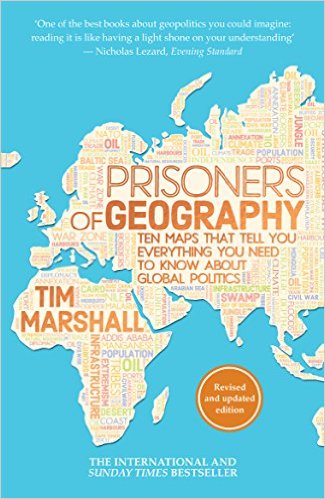
History, goes the old rhyme, is about chaps, while geography is about maps. Tim Marshall’s book, Prisoners of Geography, is all about how these two matters are actually very hard to separate. What the chaps think and do, says Marshall, is profoundly influenced and often downright determined by the circumstances described in the maps.
When I bought this book, in a remainder shop, I did not know who else was reading it. I am fascinated by the impact of geography upon history, but is anyone else? Since buying the book I have learned that it is now a best-seller. This pleases me, because it is a very good book, and in particular a very unsentimental book.
Britain and Western Europe, and then the other parts of the world where English is the dominant language, have mostly been blessed with a degree of geographically conferred freedom of manoeuvre that is denied to the inhabitants of pretty much all other nations. That is why these places got rich first. And it also now means that we Euros and Anglos are able to believe, as a matter of practical political policy rather than merely as privately pious aspiration, in a wide range of idealistic things of very variable value – things like freedom, democracy, equality, human rights, freedom for women, “social justice”. and so on and so forth – things that geographically more constrained people can only, as yet, dream of, and which they often regard as more as a threat to their own ways of doing things than as any kind of promise.
Another book that Marshall refers to quite frequently in this book is Jared Diamond’s Guns, Germs and Steel, which also offers a fundamentally geographical explanation for these facts. I share Marshall’s admiration for this book , and it heads the bibliographical list at the end of Prisoners of Geography, but this is an accident of spelling. I was also intrigued to see in that same list two works by Halford Mackinder, in particular Mackinder’s Democratic Ideals and Reality, a title which Marshall might have picked for his own book had it not already been taken.
Why, for starters, did the modern industrial era that helped to create all that freedom of political manoeuvre for the world’s luckier people, having kicked off in Britain, then, after an imitative surge in Western Europe, then see its centre of gravity shift to the USA? Well, there are many reasons.
→ Continue reading: Tim Marshall on chaps and maps
Marc Sidwell’s book How To Win Like Trump: Nine Simple Rules for Victory Against the Odds explains how Donald Trump won the US presidential election. It is written in the style of a self-help book and in simple Trump-like language. This makes it a fast and easy read: it does not take itself too seriously. And it avoids “Consequences of Erudite Vernacular Utilized Irrespective of Necessity”. But it is packed with insight.
For example, politicians and the press are between them largely acting out a fiction which has similarities to the kayfabe of professional wrestling.
Trump had two insights, thanks to his grasp of kayfabe. First, Trump recognised the widespread fakery of modern politics. That let him see past the curtain of narrative, revealing the limited insight of political experts and the vulnerability of “inevitable” candidates whether Clinton, Rubio, Bush or Cruz. Second, Trump realised that by injecting the kind of entertainment and character common in wrestling narratives into the meek, grey world of political illusion, he could slam everyone else to the mat.
[…]
It’s underappreciated how much of the mainstream media’s tremendous influence lies in its power to frame big events. Hundreds of thousands of New York Times readers and millions of public radio listeners get taught the same framing story, and learn the socially acceptable limits for discussing whatever just happened.
As such, media organisations and a one-man master framer like Trump were always going to tread on each other’s toes. But Trump had an efficient, reframing response. All attacks on Trump through the media got reframed as evidence of a biased media persecuting a man it hated. This sidelined questions about the merit of any accusation. It established a catchall frame presenting Trump in a flattering light. And when negative stories did run, they only reinforced Trump’s favoured frame. That’s how to frame your way to victory.
It explains that Trump’s tweeting is partly about direct contact with people, and partly about quickly testing the product with real users.
Trump’s constant movement is also an endless process of improvement. It’s always looking for what works better. It is an evolving strategy, one that never gets to the end of the line. And that made his presidential bid more like a startup than a campaign. The Lean Startup movement believes in constantly evolving towards a product that fits the market through a cycle of building, measuring and learning. Rather than sweating to get something perfect, Lean Startups aim for the minimum viable product. Then they test it on an audience. Get it in front of a customer. See what they make of it. Improve it. Rinse and repeat.
This explains his constant changes of mind and hiring and firing, something that his opponents have claimed as a weakness. Another supposed weakness is his apparently defensive and petulant fighting back at anyone who criticises him, as he did with Megyn Kelly.
There is one very, very big way — and it’s so big, gigantic really, massive — that Trump’s haters and losers fail to get him. They think his temperament is unpredictable. Yuuge mistake. Believe me.
Marc argues that Trump’s consistent strategy is to maintain peace until he is attacked, and then consistently fire back, and that this is good game theory.
Trump’s essentially peaceful strategy relies on consistency and clarity to work. Every time he does what he always does, he reminds people of the consequences. The more disproportionate his reactions, the more Trump signals he is willing to bear any cost to get someone back.
This makes him not such a bad person to be holding the nuclear button:
What Trump understands by instinct, and demonstrates consistently in action, are the principles of nuclear deterrence. No first use. Credible threat of massive retaliation. That policy has kept the world safe from nuclear holocaust. Its creator Thomas Schelling worked it out using game theory, winning the Nobel for economics in 2005 in recognition of his breakthrough. Schelling even worked out that it helps if your enemies also think you are a little bit crazy and capable of attacking them at very high cost to yourself. It’s called the Madman Theory. President Nixon used it.
I am left wondering just how much of Trump’s strategies are luck rather than judgement, and it remains to be seen how long they will continue to work. But I do have more understanding of how the things he does that work, work. It is nice to see it all enumerated and made obvious.
Highlights I have not mentioned so far include the description of the way Trump picked off his opponents one by one in the primaries, how he used Clinton’s 3AM phone call commercial against her, and how he makes himself relatable to ordinary Americans. And there is a good bit about how Trump gets inside his opponents’ OODA loops (a concept I heard about years ago from one of my favourite sources of inspiration, Eric Raymond).
In the book Medina in Birmingham, Najaf in Brent: Inside British Islam, the author – a BBC radio producer (boo, hiss) – attempts to provide an overview of the various strands of Islam in the UK. Her aim is not to tell us what to think but simply to provide the facts – what are they called? how many of them are there? where so they come from? what do they believe? etc. It is up to us, the readers, to draw conclusions.
Along the way there are a number of surprises. One of them is how different Islam is from Christianity. You would expect them to be rather similar given that they are both book-based, mono-theistic religions that revere both Abraham and Christ. Not a bit of it.
For example, in Christianity there is usually a close relationship between denomination and building. In Islam (at least in the UK) it is far more vague. A sect might be said to be “in control” of a mosque, the implication being that that control is temporary and could be lost. Many influential Muslim organisations such as Tablighi Jamaat and Jamaat-e-Islami have no mosques at all or very few.
Another is that the largest two sects in the UK are the Deobandis and Barelwis. No, I’d never heard of them either. For the record they are both Sunni (one definitely Sufi the other arguably so) and both originated in British India. It is worth pointing out that for the most part Bowen focuses on Sunni Islam but that is hardly surprising given that Sunnis vastly outnumber Shi’ites both globally and in the UK.
Another is that interest in Islam seems to be a second-generation thing. The first generation brought their Islam with them but seem to have regarded it as something they did rather than thought about. The second generation are much more inclined to read the Koran, take it seriously and ask questions. Even so, the most influential Islamic thinkers still tend to be based abroad.
I said earlier that it is left up to the reader to draw his own conclusions. So what does this reader conclude? Well, my biggest takeaway was that despite there being many strands of Islam and many weird and wonderful doctrinal disputes within Islam, there is no “good” Islam. The best you get is “less awful” Islam.
We are all well aware of the religion’s major dos and don’ts: praying, fasting (which includes liquids in case you didn’t already know), pork, alcohol, Halal etc. But there are others. The Deobandis, for instance, deprecate watching TV and listening to music. Almost all sects oppose celebrating the birthday of Muhammed which I assume gets extended to birthdays in general. There isn’t even the avenue of creativity in the service of the religion. Christianity has inspired great art, great songs and great buildings. But Islam has nothing to show for itself – at least not recently. The fact is that to be Muslim is to be miserable.
Of course, people are free to be miserable in private. What we really want to know about is whether they are going to blow us up or not. The news is not good. Islamic thought – of whatever strand – has little time for infidels and their institutions. Almost all sects are inward looking and wish to isolate themselves from the surrounding society. In this, they are helped by the welfare state and an ideology of political correctness. There seems to be no inquiry as to why it is that the followers of the one true God have ended up so poor while the non-believers and wrong believers are so rich. At best infidels are to be tolerated. At worst, to be eliminated. As such, Islamic terrorism is a bit like a genetic disease. Millions of Muslims by their faith can carry the disease without ever showing the symptoms but every so often it becomes virulent and people die. Islam and violence are inseparable.
This even has an impact on language. In the West words like “scholar” and “pious” tend to have positive connotations. But when they are applied to Islam – as Bowen does from time to time – they imply something altogether more sinister.
The only real challenge to Islam and violence comes from Ismaili doctrine which allows women to go around unveiled and for alcohol to be drunk in moderation and whose adherents do not appear to have got mixed up in terrorism. Ismailis have never had political power (at least not recently) and have a long tradition of trading. It is a general rule that the more trading that goes on in an Islamic community the less likely it is to produce terrorists. Even so the very small amount of tolerance that the (Nazari) Ismailis permit is largely – if not entirely – due to the influence of the Aga Khan. A different Aga Khan could easily change things.
|
Who Are We? The Samizdata people are a bunch of sinister and heavily armed globalist illuminati who seek to infect the entire world with the values of personal liberty and several property. Amongst our many crimes is a sense of humour and the intermittent use of British spelling.
We are also a varied group made up of social individualists, classical liberals, whigs, libertarians, extropians, futurists, ‘Porcupines’, Karl Popper fetishists, recovering neo-conservatives, crazed Ayn Rand worshipers, over-caffeinated Virginia Postrel devotees, witty Frédéric Bastiat wannabes, cypherpunks, minarchists, kritarchists and wild-eyed anarcho-capitalists from Britain, North America, Australia and Europe.
|