We are developing the social individualist meta-context for the future. From the very serious to the extremely frivolous... lets see what is on the mind of the Samizdata people.
Samizdata, derived from Samizdat /n. - a system of clandestine publication of banned literature in the USSR [Russ.,= self-publishing house]
|
“If you want to be a conservative in an England broken by revolution, you need to look beyond a rearguard defence of forms from which all substance was long since drained.. The conservative tradition may have been dominated since the 1970s by Edmund Burke. But it does also contain the radicals of the seventeenth century. And – yes – it also has a place even for Tom Paine. If you want to preserve this nation, you must be prepared for a radical jettisoning of what is no longer merely old, but also dead. The conservative challenge is to look beneath the plumage and save the dying bird.”
– Sean Gabb. He pulls no punches in condemning what he sees as the poor conduct of the British monarchy in signing off on a host of liberty-destroying legislation, including its apparent silence over the Lisbon Treaty. Strong stuff, and I urge folk to read the whole piece.
Windows 7, the new version of Microsoft Windows and the successor to Windows Vista, is officially released in two days time. On his blog, my good friend Patrick Crozier has asked a possibly not very important question, specifically
I’ve heard of Windows 3.1. I am about to a lot about Windows 7. But I’ve never heard a peep about Windows 4, 5 or 6. Were they, by any chance, really good versions of Windows that we never got to hear about because the praise for them was drowned out by complaints about 95, 98, 2000, Millenium and Vista?
I think we should be told.
The simple answer is of course that 95, 98, 2000, Millenium and Vista were Windows 4, 5 and 6, although not necessarily in that order. Microsoft decided in 1995 to abandon product numbers on many of its products, and replace them with names consisting of the years in which the product was released. Since then, they have released products with names consisting of product numbers, years, two letter codes that might or might not means something, and words that might or might not have anything to do with what the product is supposed to do, with versions of the same product seemingly seldom ever using the same convention twice.
If you ask Microsoft’s PR department, they will tell you that Windows 95/98/ME were Windows 4, Windows 2000 was Windows 5.0, Windows XP was Windows 5.1, and Windows Vista was Windows 6.0, which it appears to make a certain amount of sense to follow with Windows 7.
However, it is of course more complex than that, and I am going to attempt to explain it. Reading the rest of this post is unlikely to improve your life in any way, although it will teach you something about the mindset of Microsoft and/or that of nerds in general. Madness may lie at the end of it. However, here we go anyway.
→ Continue reading: The story on the Windows version numbers
Yet again, Dave Cameron shows that far from representing an ‘alternative’ to Labour, he is as one in his underpinning world view. A vote for Cameron is a vote for “more of the same”.
So if you think that the sort of identity politics we have seen for years now is a splendid thing, then a vote for Dave makes perfect sense: you will get a younger energetic leader able to apply the ways of ever expanding regulatory statism more effectively… i.e. an end to the neurotic, sclerotic and thankfully ineffective Brown and a return to the much more effectively imposed Blairite Britain… Tory Blair.
No doubt under Cameron we will see more contracting out of government “services”, which Tories will hold up as evidence of their “free market” credentials and Labour will howl about Tory vandalism of th public sector… as if making a government “service” more efficient by changing the organisation details of who gets paid to do it in any way reduces the toxic society destroying purview of the state.
Then again, if you actually want to vote for a conservative, you can always vote UKIP.
Via Iain Dale’s blog, I came across this nifty piece of Conservative Party electioneering poster art. As Mr Dale says, this is incredibly prescient. Of course, the glee of Mr Dale in finding this is somewhat undermined by the fact that the Conservatives have not, to put it mildly, covered themselves with glory on this issue down the years, even though, to be fair, that it was Churchill’s Conservatives who axed ID cards and the final bits of rationing in the early 1950s. But whatever quibbles one might have, there is little doubt that today, Labour MPs will struggle ever to be taken seriously on the civil liberties issue. That is for certain.
Last night I listened to a great talk by Henry Porter, the journalist and book author, and the spy fiction novelist Charles Cumming. For Porter, civil liberties issues form a part of his latest book. Recommended.
There is swear-blogging, and then there is this:
Emily Thornberry MP: a very stupid and thoroughly unpleasant person who should be severely punched in the cunt, and then thrown into the sea.
That’s way too far over the top of the top for me. Maybe I’m getting old. It’s in a posting in response to a posting here by Johnathan Pearce on Saturday, about how giving women rights at work will make them more expensive to employ and consequently cause women to be employed less.
I’m genuinely in two minds about this swear-blogging thing. (See also this blog.) On the one hand, as with the passage quoted above, I think it can be horribly offensive by almost any standard and liable to make a lot of people think badly of something I value, namely the libertarian movement. (If you look under affiliations, you see that DK is affiliated to the Libertarian Party.) I can foresee a time when such passages as the above will be quoted in evidence against us all. If anyone points out that “they” (i.e. us libbos) were writing things like that, and none of “them” complained, well, I did. And if this posting alerts enemies of the libertarian movement otherwise unalerted and it all blows up in our faces, then the sooner the better, I say. Get the argument about swear-blogging over with.
On the other hand, this kind of language does at least communicate just how angry people get about the plundering and bossiness of politicians. If you are similarly angry, read on, Devil’s Kitchen is for you. You are not alone. It libertarianism was only written calmly and dispassionately, something important would be lost.
One thing I do know is that if Devil’s Kitchen was nothing but the above offensiveness, I wouldn’t give a … flip … about him. It is because he writes good stuff about important topics, in among the effing and blinding and sometimes worse, that I now ruminate upon the wisdom or lack of it of how he writes. Whatever I end up thinking about this, I am not now recommending and never will recommend that what I might consider to be excessively sweary swear-blogging should be illegal, to read or to write.
I followed a link I spotted for ‘great science hoaxes‘… and imagine my surprise when it turned out to not be about Anthropogenic Global Warming!
“Fox News often operates almost as either the research arm or the communications arm of the Republican Party.”
– Anita Dunn, White House communications director and fan of the greatest mass murderer in history.
So one network for the Republicans and three for the Democrats then.
This essay, written by the philosopher Edward Feser in 2005, contains much food for thought. I like these couple of paragraphs:
“The claim that we all own everything is more in need of justification than the claim that no one initially owns anything. Surely such a claim is not merely unjustified, but counterintuitive, even mysterious. Consider the following: a pebble resting uneasily on the surface of the asteroid Eros as it orbits the sun, a cubic foot of molten lava
churning a mile below the surface of the earth, one of the polar icecaps on Mars, an ant floating on a leaf somewhere in the mid-Pacific, or the Andromeda galaxy. It would seem odd in the extreme to claim that any
particular individual owns any of these things: In what sense could Smith, for example, who like most of the rest of us has never left the surface of the earth or even sent a robotic spacecraft to Eros, be said to own the
pebble resting on its surface? But is it any less odd to claim we all own the pebble or these other things? Yet the entire universe of external resources is like these things, or at least (in the case of resources that are now
owned) started out like them—started out, that is to say, as just a bunch of stuff that no human being had ever had any impact on. So what transforms it into stuff we all commonly own? Our mere existence? How so?”
“Are we to suppose that it was all initially unowned, but only until a group of Homo sapiens finally evolved on our planet, at which point the entire universe suddenly became our collective property? (How exactly did that process work?) Or was it just the earth that became our collective property? Why only that? Does something become collective property only when we are capable of directly affecting it? But why does everyone share in ownership in that case—why not only those specific individuals who are capable of affecting it: for example, explorers, astronauts, or entrepreneurs? It is, after all, never literally “we” collectively who discover Antarctica, strike oil, or go to the moon, but only particular individuals, together perhaps with technical assistance and financial backing provided by other particular individuals. Smith’s being the first to reach some distant island and build a hut on it at least makes it comprehensible how he might claim—plausibly or implausibly—to own it. This fact about Smith gives some meaning to the claim that he has come to own it. But it is not at all clear how this fact would give meaning to the claim that Jones, whom Smith has never met or even heard of, who has had no involvement in or influence on Smith’s journey and homesteading, and who lives thousands of miles away (or even years in the future), has also now come to own it.”
He also beautifully undermines the claim, sometimes made even by pro-market people, that no-one has been able to prove that property rights can ever arise justly ex-nihilo, that they are all, in the end, derived from a sort of act of initial theft. He takes that point apart.
A number of Members of Parliament are up in arms about the clearly arbitrary rulings by Sir Thomas Legg regarding the repayment of money claimed as expenses by various MPs. It seems obvious to me that the ‘rules’ being applied by Legg are criteria he has more or less plucked out of the air for deciding what constitutes a ‘reasonable’ expense for an MP to claim.
And I must say I find this an edifying show. That the apex predators of the looter class are being given a taste of what it is like to be at the mercy of a capricious ruling by some state functionary fills me with delight. Moreover the public perception of MPs wriggling on the hook are unlikely to be one of legalistic understanding but rather a deepening of the perception of a socially remote class squealing over their looting privileges being squeezed.
The notion of taking one for the team obviously does not appeal to a number of the Honourable Members and frankly from my perspective, ideally the MPs will prevail and end up not paying back the money they took in order to yield the maximum effect I would like to see.
But whoever wins the argument in the end, there is simply no downside from my point of view at the spectacle of a cross party selection of bloated hippos noisily snorting and harrumphing and rolling around in the steaming mud piles of public relations effluent slathered across the floor of the House of Commons… oh… fulsome apologies to the world’s hippos for that unkind analogy.
I hope this process drags on and on as the already palpable cynicism with which the political establishment class are viewed by most people gradually slides into loathing. From such seeds do interesting fruits grow.
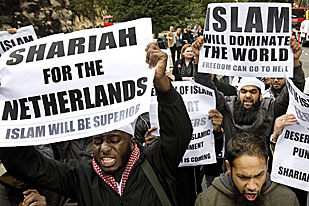
These guys crack me up. Geert Wilders finally makes it to Britain after a court overturned the disgraceful ban, and he delivers his anti-Islam message in Westminster… and how do his enemies show that Wilders is wrong to characterise them as a threat to western civilisation?
In one TV interview I saw, one of the Muslim protesters said “he should just come out and talk to us and get our point of view”… very reasonable… whereupon a second bearded paragon of the Religion of Peace interjected words to the effect “If he did not have all those police around him, we’d show him what we do to enemies of Islam” (if anyone spots an on-line video of this exchange, please post it in the comments).
I just cannot avoid smiling at these guys who are always so keen to give a televised performance of “Crazed Muslim Lunatics” straight out of Central Casting any time someone sticks a microphone in their face.
Although I disagree with Wilders’ ideas regarding banning the Koran, is it not remarkable how when he says profoundly reasonable things, defending the rights of Jews and Gays no less to be free from the threats promised by a great many Islamic commentators, somehow almost all the mainstream media tag him as “far right”.
The story, which I learned about today, here, has already done the rounds. After all, it happened a whole two days ago. Still, all those interested in new media, and all who fret about where news will come from if newspapers collapse, will find (will have found) the story interesting. It’s the sort of thing they presumably now study in media studies courses. If not, they should. Not that you need to be doing a media studies course to be studying the media (and the rest of us certainly shouldn’t have to pay for you to do this), but you get my drift.
Basically, a London Underground staff member called Ian swore at an unswervingly polite old man who had got his arm stuck in a train door and was trying to explain that fact to Ian. Ian said (shouted more like) that the old man would have to explain himself to the police. At that point a nearby blogger who just happened to be there, Jonathan MacDonald, started up his video camera, and soon afterwards did a blog posting, complete with video footage, about what he had witnessed. In due course the mainstream media tuned in, and went ballistic.
If you do feel inclined to follow this up, I suggest reading the original blog posting, and then some thoughts, also by Jonathan MacDonald, concerning what it all means. He supplies copious further links.
Nichola Pease, a top City executive, caused a stir last week when she said that state-enforced maternity leave “rights” for women – and for that matter, paternity leave – was a cost that had a bad consequence. If you tell a company that it must pay a woman her full salary for a year while she is not working and raising her child, say, then, other things being equal, fewer women will be employed in the first place, however hard one tries to enforce so-called equal opportunity hiring practices.
This is a simple fact. If you raise the cost to a company of employing a person or increase the risk that employing a woman will be more expensive than employing a man, say, then fewer women will be employed. It is a fact as undeniable as a the laws of gravity. Unfortunately, one of the driving characteristics of many politicians down the ages is a petulant hatred of such facts, and a desire that 2+2 could equal five rather than four. Consider this reaction to Ms Pease’s comments by a Labour MP. It is not so much an argument as a tantrum:
“I am absolutely horrified to hear such an old-fashioned view expressed by someone who should know better.”
In other words, a City executive has said something that this MP considers to be unsayable. There is no argument given, no attempt to explain how driving up costs will not have an adverse result. End of discussion.
What needs to be pointed out is that every time the government creates some new “right” to such things, such as paid long holidays, long periods of paid leave for child-rearing, or whatever, there is a cost of some kind, that is borne by someone, often those more vulnerable than the group intended for the original benefit. The honest answer is for such MPs to openly admit as much rather than to pretend otherwise. For example, it would be refreshing if defenders of minimum wage laws could state that they prefer a bit more unemployment to the sight of people working on very low wages. Of course the argument is still bad and involves coercively arranging affairs to benefit some groups at the expense of others, but it would at least be preferable to what we usually get.
|
Who Are We? The Samizdata people are a bunch of sinister and heavily armed globalist illuminati who seek to infect the entire world with the values of personal liberty and several property. Amongst our many crimes is a sense of humour and the intermittent use of British spelling.
We are also a varied group made up of social individualists, classical liberals, whigs, libertarians, extropians, futurists, ‘Porcupines’, Karl Popper fetishists, recovering neo-conservatives, crazed Ayn Rand worshipers, over-caffeinated Virginia Postrel devotees, witty Frédéric Bastiat wannabes, cypherpunks, minarchists, kritarchists and wild-eyed anarcho-capitalists from Britain, North America, Australia and Europe.
|






Recent Comments