Whenever is found what is called a paternal government, there is found state education. It has been discovered that the best way to insure implicit obedience is to commence tyranny in the nursery.
– Benjamin Disraeli
|
|||||
|
Whenever is found what is called a paternal government, there is found state education. It has been discovered that the best way to insure implicit obedience is to commence tyranny in the nursery. – Benjamin Disraeli October 25th, 2009 | 10 comments - (Comments are closed)
 So if you purchase a Baby Einstein for your child and he/she does not in fact attain legendary levels of accomplishment in the subjects of physics and mathematics (and become laughably inept at economics), i.e. become just like Albert Einstein… apparently you can get your money refunded. I assume any parents who dangled a ‘Baby Mozart’ over Hank and Britney’s cribs and were rewarded with nothing but derivative Anton Salieri pastiches from their children, they too can demand Disney put them into funds to compensate them for their bitter disappointment at the mediocrity of their offspring. A good friend of mine who purchased a ‘Baby Guderian’ for his child several years ago is now expressing some alarm that young Rupert may not in fact turn out to be the military genius that Britain is sure to need in future years when we inevitably take our final leave from the EU, not to mention liberating Aquitaine from the intolerable yoke of the French state. Is there no end to corporate misrepresentation and malfeasance? October 25th, 2009 | 14 comments - (Comments are closed)
I have little interest in streamlining government or in making it more efficient, for I mean to reduce its size. I do not undertake to promote welfare, for I propose to extend freedom. My aim is not to pass laws, but to repeal them. It is not to inaugurate new programs, but to cancel old ones that do violence to the Constitution or that have failed their purpose, or that impose on the people an unwarranted financial burden. I will not attempt to discover whether legislation is “needed” before I have first determined whether it is constitutionally permissible. And if I should later be attacked for neglecting my constituents “interests,” I shall reply that I was informed that their main interest is liberty and that in that cause I am doing the very best I can – Barry Goldwater October 24th, 2009 | 25 comments - (Comments are closed)
… and another for ‘outsiders‘. When the LibDems take money that is questionable, it is done in ‘good faith’ and that is the end of the matter… when UKIP does it, they are bankrupted by the Electoral Commission. Curious, no? October 24th, 2009 | 3 comments - (Comments are closed)
Microsoft has no taste. Who in the name of Allah thought this was a good idea?  Update: Here is some proof that this is real. Some people may find this video disturbing. October 23rd, 2009 | 37 comments - (Comments are closed)
Patrick Crozier recently did a podcast interview with our own Michael Jennings, on the subject of businesses that are now failing, which I heartily recommend. Michael zeroed in, in particular, on bookshops, spectacles, newspapers and – very topically for today (although the conversation itself took place a short while ago) – postal services. A particular point which Michael emphasised was how the same technology can start out by helping a particular business, but then turn round and smack it in the vital organs. The dead tree press, for instance, thanks to the lead given by men like Rupert Murdoch, at first thrived on computer technology. Now look at it. Computer technology also started out by making postal communication a better deal rather than a worse one. Junk mail, without the e- at the front, was, after all, an early bastard child of computers. And postal services the world over, like most businesses, have enthusiastically applied computer technology to their various activities, making old-school physical communication that much quicker and cheaper and thus more attractive to users than it would otherwise have been. But again, now look at the predicament of post offices, and in particular, today of all days, our own Royal Mail. Note how easily the Royal Mail itself is managing to communicate with us all, despite not being able to send out any letters. I found particularly interesting what Michael said about the book-selling trade. Once again, the same pattern repeats itself. Early computer technology helps the old-school businesses, in this case the big book-selling chain stores like Borders, by making them more organised. But the big Borders expansion has now gone into reverse, with, for instance, the Oxford Street, London, manifestation of it having just now closed. Book selling works well on the internet because books are a standard product that you don’t necessarily need to smell, fondle, weigh in your hand, and so on, like you might want to do with something like a camera or a laptop computer. But a product doesn’t have to be generic and standardised to work well as an internet purchase. It just has to be easy to describe with complete accuracy. Most pairs of spectacles are a bespoke product. You just have to know exactly what you want. But this is doable. So high street opticians are a good candidate for execution any year now. I am sure that the Samizdata commentariat will be able to suggest more candidates for imminent death. Patrick and Michael ended their conversation by agreeing that they didn’t think that the bad economic conditions we’ve been having lately are going to go away any time soon, which means, as Michael pointed out, that people are not going to stop being highly price-conscious, which is one of the big drivers of computerisation and internet-isation, and failure for all the businesses that can’t adapt to these processes. I’ll end this by recycling an interesting comment that Michael has just added to Patrick’s posting:
Like I say, recommended. October 23rd, 2009 | 16 comments - (Comments are closed)
Sarah Palin has joined several other quite prominent Republicans and demonstrated that she ‘gets it’ by endorsing a third party Conservative over a Republican RINO running for the House in New York … whereas Newt Gingrich has demonstrated the exact opposite. Gingrich stated of his backing the official Republican nomination Assemblywoman Dede Scozzafava:
Which means he thinks the way to revitalise the Republican Party is to nominate Republicans who are functionally interchangeable with Democrats on a great many issues. Contrast with Palin’s view, who clearly drew the correct lessons from her experience running as McCain’s veep, has picked the Conservative Party of New York candidate over the official Republican one, as did Dick Armey and Fred Thompson:
As I have been arguing for quite some time now, this is exactly the sort of notion that needs to work its way into the Republican Party. No wonder the media hate her. October 23rd, 2009 | 34 comments - (Comments are closed)
There is an excellent article in the Times (of London) today about the bitter fruits of relativism, of the pernicious idea, so beloved by our faux sophisticates, that there is no such thing as objective truth. That notion has done enormous damage; far from shielding us from the effects of bigotry and violence, the idea that there are no rights or wrongs has arguably achieved the opposite. Give up reason and respect for evidence, and monsters fill up the resultant gaps. Just look at the wasteland of much of our education system today, for example. I am reminded of an outburst from a gentleman at a recent talk I attended by the University of Texas philosopher and Objectivist, Tara Smith (a very smart and nice lady, by the way). I blogged about it here. The person concerned – I do not know his name – became incredibly angry that she had dared present any argument that says that there is an external reality outside of ourselves, that existence exists whether we like it or not, that there are laws and principles one can discover, etc. What he did not realise was that his own certainty about his own opinion undermined the notion that one cannot be certain of anything. In the act of attacking certainty, he in fact validated it. October 23rd, 2009 | 51 comments - (Comments are closed)
“There is no real evidence that any fewer UK banks would have gone bust had this separation been in place. It was not proprietary trading that brought down HBOS, it was bad lending to commercial property. Northern Rock, Bradford and Bingley and the Dunfermline did not own investment banks. RBS was brought to its knees as a result of a multitude of bad lending decisions, the over-priced takeover of ABN Amro and vast holdings of dodgy “assets”; its collapse was not caused by a giant investment banking bet gone wrong. In the US, it is likely that Citigroup would have required a bailout even had it not owned an investment bank. Generally, the same is true of all of virtually all the recipients of Tarp funds.” – Allister Heath, arguing against the idea, floated the other day by the Bank of England governor, that governments should force banks to split off their supposedly high-risk investment banking arms. Of course, with the “too big to fail” doctrine now more or less entrenched, the danger is that politicians will feel – with some justification, arguably – that they do not want taxpayers to be held to ransom by the threat of having to bail out huge firms, so the “solution” is to prevent banks being so big in the first place. My own preference is that all state-backed deposit protection should be abolished, so that any bank operating on a fractional reserve basis would have to take its chances in a free market, with the only deposit protection coming from private insurance. But in the current policymaking environment, that does not appear very likely or politically palatable. But sooner or later, the idea of taxpayers’ underwriting the losses of FRB banks has to be confronted. October 22nd, 2009 | 16 comments - (Comments are closed)
There is obviously plenty of controversy – seen across the internet and the MSM – about the decision by the BBC, the UK state broadcaster, to let the British National Party leader Nick Griffin appear on the BBC’s Question Time current affairs show. For non-Brits, I should explain that QT is a show where a panel of politicians, pundits and the occasional “personality” take questions from an audience. The audience is selected, according to the BBC, from a supposed balanced cross-section of the public. What in fact this means is that such folk are often drawn from a series of pressure groups and the like. The journalist Paul Johnson once said, many years ago, that if the QT audience were representative of the UK population as a whole, he would think of blowing his brains out. I agree. If I ever chance upon the programme, I feel murderous not towards the panelists, but towards a large part of the audience. It fills me with despair. Even so, the decision of the QT producers to let this man on the show has thrown up some bizarre arguments. This morning, the Labour MP and pundit, Diane Abbott, told the BBC Breakfast TV show that Griffin should not appear. At the core of her argument, if one can dignify it with such a word, was the idea that only “mainstream” parties should be allowed to be panelists. The interviewer did not immediately hit back with the question as to what Ms Abbott defines as “mainstream”. After all, one could object to a Labour, or indeed Conservative politician, appearing on the show on the grounds that both parties support the idea of seizing a large portion of our wealth on pain of imprisonment; support wars against countries that, whatever the justification, involve the deaths of innocent civilians; support the UK’s membership of an oppressive and undemocratic European federal state, have taken away the right of self-defence for householders; have supported, and continue to support, an intrusive, meddling and yet also incompetent state apparatus. On those grounds alone, one could argue that such politicians should not only be banned from Question Time or any other forum, but hanged from a lampost. Given that the BNP – a party with a hard-left, socialist economic agenda, by the way – has been elected to several seats in the EU Parliament, it would be odd not to allow the leader of a party that has won a million votes not to be held to account in the run-up to a general election next year. Of course, if we had a genuine free market in broadcasting, the editorial judgement of the BBC, which is funded by a tax, would be irrelevant. But given we have a state-financed broadcaster, that broadcaster, under its charter of incorporation, should enable elected political parties to be put to the public test. The BNP is an odious party for a libertarian, and Mr Griffin is, as his background suggests, a nasty piece of work. What have other parties to be afraid of in putting this lot under the media microscope? October 22nd, 2009 | 36 comments - (Comments are closed)
Some thoughts on Anglo-American history contrasted with Bavarian history – with possible political and/or cultural consequences. The main expanders of the state in 19th century Britain are remembered (at least by most of the minority of people who remember them at all) as good people. Edwin Chadwick was a good man who urged for state police forces to be made compulsory in every town (done in 1835 as part of Municipal Corporation Act, the Act that swept away, apart from in the City of London, the nasty Tory closed corporations and created the new councils that would mean more economical local government – of course we are still waiting for those lower local taxes). And in the rural areas , achieved by the Act of 1856 (which also provided central government funding and controls) – before this time the people of the villages of England and Wales were savages who hunted each other for food. Chadwick was also the nice man who saved us all from being killed by filth (government being the only thing that can provide water or remove waste you see) or falling over in the dark (government being the only thing that can provide street lighting) and so on on and so on. A noble reformer in the tradition of his mentor Jeremy Bentham (although Bentham’s dream of 13 departments of state controlling every aspect of human life, had to wait till the 20th century to come to pass – even the national Public Health Board was repealed in 1858 in the time of the wicked Palmerston). All of Chadwick’s doctrines are described as things that “everyone agrees with” in J.S. Mill’s “Political Economy” of 1848, of course there were large numbers of things that looked human that did not agree, but J.S. Mill did not count them as people (a full person being someone whose mind is fully developed – and whether someone had a fully developed mind could be determined by whether or not they agreed with J.S. Mill, this is also true of the Labour Theory of Value which was “settled” with everyone in agreement the people who did not agree, such as Richard Whately and Samuel Bailey, being nonpersons). Academics and media people carry on with J.S. Mill’s tactic to this day, and like him, they talk endlessly of “freedom” and “liberty” as they do so. → Continue reading: Anglo-American history contrasted with Bavarian history October 22nd, 2009 | 20 comments - (Comments are closed)
It is not everyday you find an email in your email box telling you someone you know is a real, honest to goodness spy, but that is what happened to me this morning. According to The Huffington Post:
Personally I find it difficult to become exercised over someone passing information to an ally who may well use that information to do horrible things to people who really, really deserve it. It would be rather different had he sold information to China, North Korea, Iran or one of the other current or potential future enemies. Oh, and the personal connection? I have crossed paths with Stu off and on over the last thirty years as he was once active with the L5 Society and was a leading figure in the Clementine lunar mapping project for which we (the National Space Society) awarded him one of our highest honours. 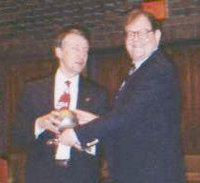 Stewartt Nozette receives the National Space Society’s Space Pioneer Award at the 1994 International Space Development Conference (ISDC) in Toronto for his work on Clementine. Photo: copyright Dale Amon, All Rights Reserved I still hold Stewart in the highest esteem and if I have anything to do with it, we will still reserve that space for his name on the Luna City wall of “Heroes of the Frontier” . October 21st, 2009 | 42 comments - (Comments are closed)
|
   |
||||

All content on this website (including text, photographs, audio files, and any other original works), unless otherwise noted, is licensed under a Creative Commons License. |
|||||
Recent Comments