We are developing the social individualist meta-context for the future. From the very serious to the extremely frivolous... lets see what is on the mind of the Samizdata people.
Samizdata, derived from Samizdat /n. - a system of clandestine publication of banned literature in the USSR [Russ.,= self-publishing house]
|
And so Dave Cameron stands up and says “Only conservatives offer real change” and the media report this more or less at face value.
We have a vast regulatory welfare state under Labour. We will still have a vast regulatory welfare state under Cameron… no? Well how many million state employees will Cameron fire in his first term in office? What number did he put on it? Anyone? Has he said he will have a massacre of the QUANGOs? He has loudly promised more green regulation and sticking it to the financial sector but where exactly will he de-regulate? Yet the media just repeats Cameron’s claim to represent anything other than more of the same as if it is a self evident truth. Yet “Big Society” looks a lot awful like the same old “Big State” we have right now.
Are you unable to resist the urge to vote? Well someone is actually calling for two million less state employees over five years. Dave “I represent change” Cameron? Don’t make me laugh.
As the crisis goes on, things are getting pretty grim
So is the closure of Europe and Britain’s airspace really needed to ensure safety?
‘We simply checked every single aircraft very carefully after the landing in Frankfurt to see whether there was any damage that could have been caused by volcanic ash,” Weber said. ”Not the slightest scratch was found on any of the 10 planes.”
German air traffic control said Air Berlin and Condor had carried out similar flights.
[…]
Air Berlin Chief Executive Joachim Hunold declared himself ”amazed” that the results of the German airlines’ flights ”did not have any influence whatsoever on the decisions taken by the aviation safety authorities.”
Quelle surprise!
Via Instapundit, is an academic paper on the issue of how merchant vessels can protect themselves from pirates. This will not break new ground for Samizdata regulars, of course, but I recommend it.
Talking of merchant shipping, if this volcanic ash problem continues to mess up air travel, then merchant shipping is likely to get a boost in the short run. Bring brack the transAtlantic ocean liners, maybe. Here’s a website where you can even buy such monsters of the sea. Bit out of my price range, alas.
The United Kingdom Transhumanist Association has organised a small shindig at Conway Hall, the Mecca for freethinkers, to present and discuss issues that become less radical every year. This takes place next Saturday, April 24th.
The UK chapter of Humanity+, an organisation dedicated to promoting understanding, interest and participation in fields of emerging innovation that can radically benefit the human condition, announced today that registrations are on track for record attendance at the Humanity+ UK2010 conference taking place in Conway Hall, Holborn, London, on April 24th.
Always worth making the case that emerging innovation requires the precondition of liberty.
I note that there may be some absences if Iceland continues its revenge.
I thought that this quote, by a commenter called “Berlinerkerl” in response to a Guardian article that really was called “Arm our children with media studies”, was too good to be left languishing in the “more than 50 comments” bilge tanks of a Comment Is Free article.
In his detailed study of Bill and Ben the Flowerpot Men, Jones (2001) draws our attention to the mass of early post-modernist contradictions running throughout the series. Whilst Bill and Ben live in an idealised, hedonistic, not to say nihilistic world, they only come out to play when the Man Who Works in the Garden, the authority figure par excellence, goes to have his dinner. Whilst the Class Oppressor is therefore an absent figure, he nevertheless should not be ignored. Class Oppression is, indeed, a recurring theme, as every time Slowcoach the Tortoise appears, the Flowerpot Men dance on his back, as Marxist critics such as Stalin (1995, p786) have pointed out.
That the Flowerpot Men are invariably awoken by the Little Weed is a clear pointer to a drug-addicted subculture. The language used by the Flowerpot Men harks back to the Theatre of the Absurd – Smith (1997, pp 129-150) draws parallels with Ubu Roi.
Bee-bop-flobbalob 🙂
Another commenter called Pressman56 suggested instead that instead of arming our children with media studies we arm them with Kalashnikovs.
I recall a time when President Clinton was really quite unpopular, or so it appeared from where I was sat, then as now, in London. It was during his first term. In particular, I recall a libertarian friend who had recently been in America (although he may not himself have been American – not sure about that), sitting on my sofa in my living room, at one of my last Friday of the month libertarian talk evenings, telling me that President Clinton was absolutely not going to be re-elected. Too many people just did not like him. I pressed for details. Are you sure it’s not just that you don’t want Clinton to be re-elected? No, he isn’t going to be re-elected. And the point is, my libertarian friend was sort of right. Clinton wasn’t going to be re-elected. At the very least he didn’t then look like being re-elected. But then, Timothy McVeigh blew up that big office block in Oklahoma and from then on, Clinton never looked back.
Politics is all about story telling. It is about, as we like to say here, the meta-context. And what this explosion accomplished for Clinton was that it completely changed the story being told at that time about what the state was and is. It turned the state from an economic and regulatory threat to the people, into the leading protector of the people. And it turned right wing grumblers about all those damned taxes and regulations into enemies of the state, and hence enemies of the people. Clinton no longer had to struggle to tell the story that he had been trying all along to tell, of the state as the necessary partner of the people, and of the people who were suspicious of the state as people who, at best, simply did not get this. Timothy McVeigh did that for him. And I remember how my heart sank when I heard about the Oklahoma bombing, and who had done it, and why, because I feared exactly the story switch that then happened.
Now the grumblers against taxes and regulations are back being the people. And the Democrats might yet find themselves losing their epic battle, the one which was supposed, in the words of Kyle-Anne Shiver, to have …
… delivered the plum of America to the international socialist collective, or at least pushed us past the point of no return.
Even if regular people forget what turned this kind of story around for Democrats last time around, Democrats surely do remember. And just in case anyone has forgotten what a difference Timothy McVeigh made to the story told by President Clinton in particular and the story of America in general, Clinton is himself now reminding everyone.
But Bill Clinton, not for the first time in his life, is taking a chance. The danger for the Democrats is that they risk looking like they want another Timothy McVeigh. As quite a few of them surely do.
However, if the Democrats do get lucky and another McVeigh really does materialise, there is a big difference between now and the time when the original McVeigh did his thing. Then, there was no internet. The story was whatever the then mainstream media decided it was. But that rule no longer applies.
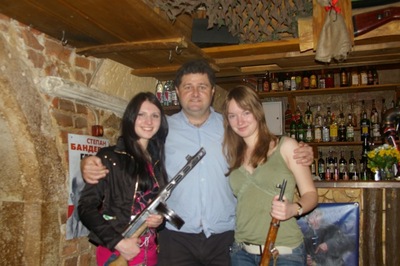
 Rzeszow, Poland, April 2010 Yes, I understand that this is actually a straightforward translation of a common word into Polish, but if I ever open a bar, “Alkohole” will be a great name for it.
As it is, I am now in the Ukraine, a little to the east of Rzeszow. Given the closure of most European airspace, I have no idea whatsoever how or when I am going to return to the UK. One option would be swearing.
 This is also presumably a straightforward translation into Polish? Another option, and the one I will be taking up, would be to just potter around for a bit. I am in no pressing hurry to return to London, and pottering around in this part of the world is not expensive. I could try and return by surface transport, but crowds and crushes and expenses and sold out trains and ferries do not sound like much fun. I may even head east for a bit. Odessa and Crimea sound interesting.
It has been said elsewhere that the Leader demanded ‘cash’ from the Icelandic types, and they thought he said ‘ash’.
– Commenter ‘Chuckles‘
 Lviv, Ukraine. April 2010 I was given a fairly serious “These foreigners are crazy” look when I started photographing the salt and pepper shakers in the restaurant. Such are the joys of being a photographer. On the other hand…
 Lviv, Ukraine. April 2010
Alas one of our redoubtable Samzdatistas is marooned at Newark Airport as all flights into the UK have been delayed due to the volcano eruption in Iceland.
I am still pondering some way to blame David Cameron for this…
According to the Telegraph…
The Conservative leader presented a bold vision of Britain in which communities – rather than government – worked together to solve shared problems. In calling for the role of the state to be scaled back, Mr Cameron sought to establish a philosophical divide with the Government after 13 years of public sector expansion under Labour.
According to Samizdata…
The Conservative leader presented a bold vision of Britain in which when communities work together, which happens in something we call ‘markets’, nice caring Dave will regulate them and give us MORE state, which the media will call LESS state… and magically it will cost less money… somehow… and yes any claims he is going to scale back the state in any meaningful way is pure and utter bollocks, but it suits the needs of both main parties to pretend otherwise because in fact there is no philosophical divide. Confused? Just shut up and vote and then go back to your reality TV.
Nothing to see here, move along, move along.
|
Who Are We? The Samizdata people are a bunch of sinister and heavily armed globalist illuminati who seek to infect the entire world with the values of personal liberty and several property. Amongst our many crimes is a sense of humour and the intermittent use of British spelling.
We are also a varied group made up of social individualists, classical liberals, whigs, libertarians, extropians, futurists, ‘Porcupines’, Karl Popper fetishists, recovering neo-conservatives, crazed Ayn Rand worshipers, over-caffeinated Virginia Postrel devotees, witty Frédéric Bastiat wannabes, cypherpunks, minarchists, kritarchists and wild-eyed anarcho-capitalists from Britain, North America, Australia and Europe.
|





Recent Comments