We are developing the social individualist meta-context for the future. From the very serious to the extremely frivolous... lets see what is on the mind of the Samizdata people.
Samizdata, derived from Samizdat /n. - a system of clandestine publication of banned literature in the USSR [Russ.,= self-publishing house]
|
“After trying to watch the first debate Maggie said, ‘they irritate me’. She is particularly angered by the way all three do their utmost not to answer questions.”
– Margaret Thatcher’s apparent view of the recent election debate. Attributed to her by Katie Hind
Regular Times columist Matthew Parris writes eloquently, if with somewhat sweeping generalisation, about how “we” do not want to hear the truth. “We” do not want change. “We” want things to carry on as they are. “We” want to stay as well off as “we” are, and will snarl and rage at any politician who dares to even hint otherwise. He has a point. Whichever combination of politicians turn out to have lumbered themselves with the grim task of running the next British government will have to cut, cut and cut. So, what should they cut?
Let me prove that Matthew Parris’s generalisations don’t entirely apply to me by suggesting a reduction in some at least of the fluid that I personally now suck from the governmental tit. How about abolishing these?
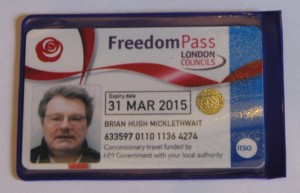
That thing gives me, at no charge whatever, the run of the entire London Underground network, plus all buses in the same approximate area, plus, if I understand things correctly, free travel on local buses throughout the UK.
I wouldn’t like losing all that, not one bit. But I acknowledge that cuts like this will have to happen, if only to soften the blows a little for others who are being told that they must suffer far worse. Like losing their entire jobs for instance.
Can you, esteemed commenter, suggest other cuts, that you personally would be quite badly hurt by, but which you nevertheless think would be a good thing to do? Or, at least, a cut or cuts that would wound you personally, maybe far worse that losing my “Freedom Pass” would wound me, but which you would find it very hard to argue against? Maybe you have an entire job that you can’t defend and are now ready to admit that you wouldn’t have in a better governed country.
I wonder how Matthew Parris would answer this question.
Or Guy Herbert, whose posting immediately below I had not read when I posted this.
Assiduous readers will have noted from my (sparse, of late) posts that I do not agree with some other Samizdatistas about UK elections. I do not think political disaster will save us or that small government might arise from the wreck of huge government. Mine is a mitigation strategy.
Just as we have to eat, even when the choices are unappetising, we have no choice but to be governed. Therefore I vote, and am active within the existing political system, in order to to try get the least worst result I can.
Sometimes the least worst is not very good. Politicans in a democracy have an amazing ability to back themselves into impossible corners, even when they don’t have to.
The Conservative party’s promises to “protect” the budgets for the National Health Service and overseas aid may be mad as government, but they do have an electoral logic. They are explicable as strategic decisions to change the image of the party, and appear to have worked as such. Overseas aid is largely symbolic, peanuts compared with the welfare bills. (And few will really care if that promise ends up broken.) Whereas keeping up spending plans on a bloated NHS which absorbs approaching a fifth of the budget and a tenth of the nation’s wealth, supports huge lobby groups and unions, and has been force-fed taxpayers’ money like a Strasbourg goose by the incumbent regime, is a serious commitment it will be hard to row back from. Still, maybe they had to do this to themselves, as the price of power: middle Britain worships the NHS; it is more important than IHS, more established than the Church of England. The Tories were not trusted to keep that faith, and had as a result no more chance of governing than a secular party in Iran. Now they are accepted as orthodox.
But why would you make a promise no-one expects, but that similarly constrains your scope for radical action? No party has promised not to raise VAT rates, despite pressure. No party has directly promised not to make cuts to state wagerolls. And Cameron did just promise a pay cut in the public sector. Sounds good? Oh dear, no. He did so in a way that disastrously locks him in and creates a political bar to the cuts that are really needed.
A 5% cut in ministerial pay, and freezing it for the life of a parliament, is easy populism. “Slashing” the BBC calls it. However, in practice it is trivial; and, much worse, it puts a ceiling on what can be done to tackle the deficit. Ireland has already cut all public sector salaries—by an average of 13.5%. Had he said ministers will be paid a third less, and hinted at serious cuts in other public sector salaries over £60,000 (representing impossible wealth to most voters), then he could have been populist with room for manoeuvre. But now Cameron will be very hard put to do as much as freeze the wage bills of the bureaucracy. Even though ministers are arguably underpaid, getting much less in real terms than their Victorian forebears, it will be impossible now to cut the salary of any signficant public sector interest group by more than 5%. Protecting the NHS forces greater cuts from every other department just to stand still.
A promise to cut just made cutting nearly impossible. That is a terrible mistake.
Instapundit compares President Obama to Apple, saying, in connection with recent rather belligerent rhetoric from Obama, and similarly belligerent conduct by Apple regarding the alleged stealing of their latest iPhone before they had themselves unveiled it, this:
Like Apple, Obama’s strength is mostly in the image department …
That may be right on the money about Obama. Don’t know for sure. Don’t live there. But I definitely think it’s wrong about Apple. For me, Apple’s stellar “image” is based on an underlying reality of product quality, not on how nicely Apple supposedly behaves, or did behave until this recent atrocity.
A lady friend of mine has the earlier version of the iPhone, which she adores. Talks about it like it’s her perfect boyfriend, and looks at it like its a new and really good baby she just had. When she first got it, she could hardly stop gazing at it, and kept not listening to anything I was saying, instead wanting to demonstrate how fabulously it worked and how great it was for tracking emails and recognising pop songs and taking snaps and the rest of it, like she was a fat old geek with no life. Shame about the battery life, she says. But of course they are fixing that in the new version.
And then there’s my beautiful Apple keyboard, which a few months ago I purchased and attached to my clunky old PC because every PC keyboard I have ever owned or seen or heard of is total shite, either about a mile across with a completely useless accountancy section adding even more mileage to its width or, if a sane size, doomed to instant disintegration and requiring baby fingers to use even half accurately and so flimsy that if you type like an adult with your adult fingers it slides across your desk like a big insect. Also, on all the PC keyboards I have ever owned a few of the damn letters soon became invisible, and I had to buy new stick-on letters from Rymans. Contemptible.
My new Apple keyboard is the total opposite of all such shiteness. It is the keyboard I am happily typing on right this minute, and it is well on the way to convincing me that my next entire computer should be Apple as well.
Quality like this is not “image”, of the sort based on merely incidental nice behaviour. I suppose you could argue that what happens on the front of an iPhone is “image”, in the sense of legible lettering, clever pointiness and so forth. But that’s image of the kind that is central to the quality of the product. And my keyboard is solid, beautiful reality, at its most solid and most beautiful. (Make of that what you will.) → Continue reading: Apple’s strength is that it now makes great products – not that it behaves nicely
The economy in Britain and much of the world is in dire straits and it would not be an exaggeration to say we have entered a period of history that far from being a ‘crisis of capitalism’, historians looking back may well call it the ‘crisis of regulatory statism’.
And that is what makes the current UK elections… and indeed the recent US election… so utterly uninteresting.
Political parties on both sides of the imaginary left/right divide are in near total agreement that question at hand is not “how do we change the state of affairs that got us into our current predicament” but rather “how do we manage this crisis best in order to preserve the status quo”. The one thing that everyone in politics agrees on is Britain’s vast regulatory welfare state is an immovable given. This is literally beyond debate and exists at the meta-contextual level …all that is actually up for discussion is how best to preserve it.
Commentary in the mainstream media accepts as axiomatic that the parties represent the struggle between laissez faire and regulation, between capital and labour, between right (whatever that means) and left (whatever that means).
Indeed the parties themselves employ the same rhetorical markers to differentiate their products as they have always done: the so-called ‘conservatives’ speak of “prudence” and “responsibility” and “living within our means”… Labour and the LibDems speak in terms of “fairness” and “equality”… and these terms are simply accepted at face value and repeated by most of the media as if the choices on offer were between chalk and cheese, and as all the parties benefit from this differentiation, this linguistic legerdemain is unchallenged and uncontroversial.
Yet the choices on offer are in truth more akin to that between Coke or Pepsi… the ‘sacred rite of democratic empowerment’ actually comes down to being given the option of selecting rapist A, B or C and then being told not to complain when you get raped because, after all, you got to vote.
And so we see the media portraying David Cameron as Thatcher the Milk Snatcher reborn… a dangerous welfare wrecker when he states that he intends to, and I quote from a Daily Telegraph article last year:
Mr Cameron said he would increase government spending from £620bn this year to £645bn next year – rather than the £650bn proposed by ministers. He warned voters not to expect an incoming Tory administration to slash public spending and cut taxes, saying: “That’s not what they should be thinking. They should be thinking this would be a responsible government that would make government live within its means, that would relieve some of the debt burden being piled up on our children.”
So the Tory party, those slash-and-burn laissez faire wildmen, wanted to take £25 billion more out of the productive economy in taxes so that the state can spend it… at a time when the economy is actually contracting… and somehow that will relieve rather than increase the burden on “our children”. Yup, clearly an ardent capitalist is our Old Dave… it must be so because the media reports him saying he is all for markets largely without comment.
But the core truth here is that if by some dark miracle Brown’s Labour wins, we will have a vast regulatory welfare state. If the even more spendthrift LibDems win, we will have a vast regulatory welfare state. However if Cameron’s Tories win, we will have… a vast regulatory welfare state… oh, and fox hunting will be permitted again.
And yet the idea that there are meaningful differences between any of these gits is a given even though all they are really discussing is how their different approaches to rearranging the same elements can preserve the very state that got us where we are now. Rearranging the deck chairs on the Titanic comes to mind.
Nigel Farage of UKIP at least talks of sacking two million public sector workers and having a bonfire of the QUANGOs… making him the only half way visible politician making any truly radical statements at all. Sadly Farage also seems to think “quantitative easing”… i.e. just running the printing presses in order to re-inflate the very credit bubble that has been the trigger for much of the current woes, is just fine and dandy, so I do question his grasp of economics, not to mention causality… but by the standards of current discourse he is Ludwig Von Mises reborn and perhaps in time Pearson can smack some sense into him on that score.
But UKIP will not be running the next parliament and so it does not matter which of the three plonkers you vote for because in effect the same person will still be in 10 Downing Street: and that would be the ring-wraith-like presence of Tony Blair of course… or Tory Blair if you like… the name and party hardly matters because that grin remains like some demonic Cheshire Cat in the sky over Westminster.

What did you say your name was again?
It is impressive just how much I would like to see this lot annihilated and humiliated in the election, all considered.
“Amazing isn’t it? Not that Labour slimed an ordinary member of the public who disagreed with them. They’ve been doing that since before they were elected in 1997. The lucky ones only found their reputations traduced in the press. The not so lucky ones found themselves dead in a field. No, what’s amazing is that is was caught live and bang to rights.”
– Blognor Regis
If I were this Mrs Duffy person who was slimed by Brown, I’d be thinking of watching my back for a few months. One thing we have learned over the past 13 years is that NewLabour are vindictive bastards.
Update: Janet Daley draws a certain parallel – as well as noting a key difference – in another famous example of a leftist politician blurting out certain comments during an encounter with an ordinary member of the public, the famous Obama/Joe The Plumber exchange.
As this Joe character found, Obama’s attack dogs tried to make life hard for him and as I said above, it may already be happening to the lady who was slagged off by Mr Brown.
Gordon is cyanide on the doorstep.
– Rachel Sylvester gets lucky quoting a Labour candidate in what used to be a safe Labour seat, just before Gordon Brown calls a core Labour voter a bigot. I reckon he’s cyanide everywhere.
Hardly a day seems to go by nowadays without somebody with approximately the same kind of political attitude as me scratching his head, publicly, in writing, about President Obama’s bafflingly sensible space policy, which sticks out like a healthy thumb in an otherwise horribly mutilated hand of policies.
Critics are disturbed by the large and unprecedented role Mr. Obama sees for the private sector in space exploration. For a president who is often accused of being a socialist, he has more faith in the ingenuity of the private sector than his detractors do.
Maybe so. But how could someone so opposed to free market notions here on earth be so keen on them in space? I would like to offer a version of President Obama which maybe makes sense of this puzzle. What follows is sort of a joke. I certainly hope that readers of it will be entertained. But I also think it might be true. → Continue reading: On the unintended consequences of President Obama
Ian Dale writes that the internet and all that is having very little effect on this general election. I’m sure we can all see what he means. The politicians strut about emitting their parallel universe proclamations, while the rest of us stolidly refuse to be impressed as we sit about wondering just which big party and big party leader we loathe and despise the least, so that we can humiliate most of them, instead of what we would really like to do.
But in another sense, a negative sense, I think that the internet is already having a very profound effect on this campaign. Put it like this. The good thing about blogs and facebook and twitter and all that is that we can speak our minds. We tell it not necessarily like it is exactly, but how we truly reckon it is at the time or writing. The big cheese politicians? Like I say: parallel universe of staged dishonesty.
Trying to combine doing regular politics with joining in the New Media hubbub means either being ignored as a useless bore, or getting into trouble, for saying something honest and eloquent but verboten. The two just don’t mix. Remember that scene in that great regular politics movie The Candidate, starring Robert Redford, where the Redford character tries telling the truth (as he happens to see it) at a campaign event. His handler just tells him to do up his trouser buttons, grow up, and campaign properly, i.e. go back to emitting the correct barrages of staged dishonesty. As far as the old pro regular politician is concerned, telling it like it is, like you are blogging or twittering or something, is just waving your willy about like a stupid little kid. Honesty didn’t work then for regular politicians, and it doesn’t work now.
But the difference is that the rest of us can now do honesty, and consume honesty. We now have honesty. For several years now we’ve been waving our willies about and having a ball. It’s just that the regular politicians can’t join in without making asses of themselves.
So, one: rise of the New Media. And, two: a general election in which almost nobody looks like they’re going to be happy. None of the politicians, with the possible exception of The Clegg, and none of the voters. Nobody is going to “seal the deal”. It used to be that someone did. Now, we seem to hate them all.
No effect? I think not. I know exactly what Iain Dale means. The New Media aren’t contributing anything positive to regular politics. The New Media aren’t helping regular politicians to canvass, get out the vote, assemble people to mass meetings and get them all excited about their preferred version of regular politics. The New Media aren’t helping to spread barrages of lies, and then cheering like lunatics. They (we) are merely standing at the back muttering to each other that it’s all lies. But just because the New Media are doing nothing positive for regular politics doesn’t mean they’re having no effect on regular politics.
Iain Dale is nearly there when he describes the internet this time around as “the dog that didn’t bark”. But the fact that the dog isn’t barking is highly significant, as Sherlock Holmes himself pointed out in the original story. The New Media dog, from where Iain Dale stands, is doing nothing, and that is what is so interesting.
Via Arnold Kling at the EconLog blog, is his plan to fix the US financial system. It applies with equal force to the UK, I think, apart from one or two specifics. It is not the sort of more radical measure that the likes of Kevin Dowd has favoured, but it is pretty good and it actually is something I could envisage being attempted. I even think it might be possible to contemplate a partial breakup of the banking system to avoid a “too big to fail” issue although I would caution that bigness, per se, is not the problem. What is the problem is the fractional banking system as it now operates under the moral hazard regime of a central bank, legal tender laws, and the rest.
Excerpt:
“The overarching principle I have is that we should try to make the financial system easy to fix. The more you try to make it harder to break, the more recklessly people will behave. By reducing the incentives for debt finance and for exotic finance, you help promote a financial system that breaks the way the Dotcom bubble broke, with much lesser secondary consequences.”
Anyway, something for the politicians to ponder.
Here is a related post of mine a few weeks ago about the need to push the case for free market banking even though the details can be sometimes overtaken by events.
Until the first annual Let’s Draw Mohammad Day!!!
Can you outdo the humor of Danish cartoonists? Be sure to try your hand at this global effort to raise a scream of maddened agony from people with minds too small to comprehend anything outside of their circularly reasoned unreality.
Be the first on your block to drive a Jihadi so berserk his head spins around and pops like a champagne cork!
|
Who Are We? The Samizdata people are a bunch of sinister and heavily armed globalist illuminati who seek to infect the entire world with the values of personal liberty and several property. Amongst our many crimes is a sense of humour and the intermittent use of British spelling.
We are also a varied group made up of social individualists, classical liberals, whigs, libertarians, extropians, futurists, ‘Porcupines’, Karl Popper fetishists, recovering neo-conservatives, crazed Ayn Rand worshipers, over-caffeinated Virginia Postrel devotees, witty Frédéric Bastiat wannabes, cypherpunks, minarchists, kritarchists and wild-eyed anarcho-capitalists from Britain, North America, Australia and Europe.
|





Recent Comments