We are developing the social individualist meta-context for the future. From the very serious to the extremely frivolous... lets see what is on the mind of the Samizdata people.
Samizdata, derived from Samizdat /n. - a system of clandestine publication of banned literature in the USSR [Russ.,= self-publishing house]
|
When a person spends time at high altitude, that person’s body reacts to the lesser amount of oxygen in the air by increasing the number of red blood cells. These carry oxygen round the body, and if there are more of them, the body can process similar amounts of oxygen even though there is less of it available. If a person descends after spending days or weeks at high altitude, the higher number of red blood cells persists for a few days. In that period, the body is able to process much larger amounts of oxygen than is normal. This results in tremendous feelings of euphoria, and greater than normal athletic stamina. From personal experience, I can assure you that this feels wonderful. On one occasion, after descending several thousand metres in the Himalayas in several days, I felt like Superman. It was great. It was like being on the right drugs without actually being on drugs.
This effect can of course be duplicated at sea level. One way is to train in enclosed facilities with artificially lowered air pressure. Another, though, is medical. One can have one’s own blood removed from your body, the red blood cells filtered out, and these can be transfused back into your body in time for the athletic event. This is “blood doping”, and is much used in endurance sports, particularly cycling. It is generally considered to be cheating, but it is a very difficult form of cheating to detect. The fact that it is like being on drugs without the use of actual drugs perhaps gets to the core of the problem. Detecting the presence of drugs is relatively simple. Detecting the presence of the athlete’s own blood is simple too, but this doesn’t prove anything. As a consequence, athletes in affected sports are subjected to searches of their homes during the competition season in which inspectors look for medical equipment used in the necessary transfusions. (They also look for pharmaceutical supplies of the hormone erythropoietin, which stimulates production of red blood cells in the bone marrow).
Other tests for blood doping involve blood analysis, and involve such things as comparing the number of young red blood cells in a sample with the number of old blood cells, simply registering blood with an excessively high number of such cells as evidence of cheating. Plus they look for that hormone erythropoietin, for which it is apparently possible to tell the difference between the cloned and artificially produced version and the natural version produced in the athlete’s kidneys, although this distinction is sometimes controversial.
The trouble with tests of this kind is that they have difficulty distinguishing between people who are cheating (according to the rules) and people who simply have extreme and unusual physiology. To some extent, high level sport is all about identifying people with extreme and unusual physiology. The right kind of extreme and unusual physiology is known as “talent”. The aim of much performance enhancing technology is all about mimicking the extreme and unusual physiology that the finest athletes have naturally. Distinguishing between the naturally weird and the artificially weird by testing for weirdness is problematic.
And in the case of blood doping, we have a further problem. Blood can be doped naturally, simply by training at altitude. You cannot simply ban all athletes who live or train at altitude: that would be ‘discriminatory’. However, it leads to a situation where an athlete with a high red blood cell count due to altitude is a fine, well trained athlete and a role model for our children. One with a high red blood cell count due to a transfusion at sea level is a cheat and someone to be despised, even though the end result of both techniques are the same. (This makes me think of “organic” food, somehow. Food grown with nitrogen from natural fertilisers is good. Food grown with identical nitrogen from artificial fertilisers is bad).
Governments find it highly prestigious when national athletes win Olympic gold medals, and are often willing to spend money on elite athlete training programs. Two kinds of governments seem to do this. There are totalitarian regimes who wish to demonstrate that their system is superior by producing superior athletes. Classically, we are talking East Germany, the USSR, and more recently China. Such governments seem perfectly willing to break the rules if they think they can get away with it. More recently, though, we have freer, more democratic rich countries doing the same thing. As the state expands, development of the national Olympic team becomes part of its remit. Outright cheating has certainly occurred in such training programs too, but in a democracy it becomes a major scandal if you are caught. Therefore, government funded programs in democracies tend to prefer to remain within the (always very arbitrary) rules, but they will go as close to them as they can without actually breaking them.
If you are going to find a place to train at altitude, for fairly obvious reasons you want a place that is high but not too cold, so you are going to want it to be on a mountain not too close to the poles. You ideally want it to be on an isolated mountain rather than high up a mountain range, so athletes can regularly practice going from high altitude to low and vice versa. You are going to want it to be in an area where the other facilities of an advanced, high technology country are readily available – good hospitals and access to all kinds of medical professions, nice hotels, housing, and restaurants for associated officials, staff, and hangers on, etc etc etc. Basically, you want a high mountain in the desert in a rich country near a significant town.
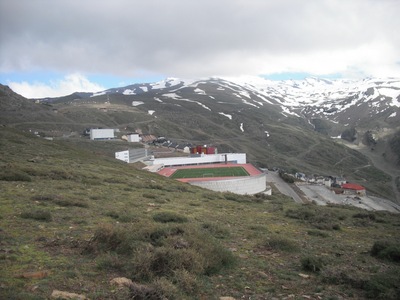
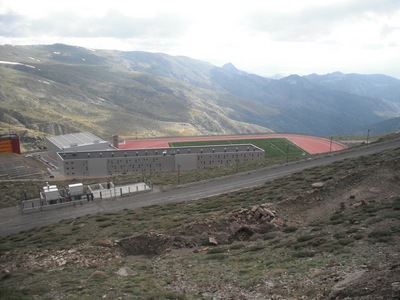
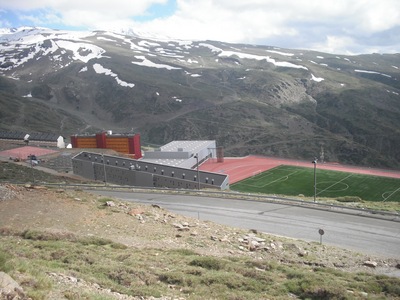
Once you understand all this, what one finds clinging to the side of a mountain when one approaches the top of the Sierra Nevada in Andalucia in southern Spain (the southernmost high mountain in Europe) becomes perfectly logical: an athletic track and vaguely Orwellian looking training and accommodation centre for athletes.
A little googling indicates that it belongs to the vaguely Orwellian sounding Senior Sports Council of the Ministry of Education and Science of Spain. Amongst the benefits of training there, I find the euphemistically described erythropoietic stimulus, which is entirely different from blood doping. Obviously.
As I said, all perfectly logical. Perfectly.
Oh, who am I kidding? This is the oddest facility I have encountered since the time I went to Hitler’s holiday camp.
Hitler would have loved this, too.
Boeing has no intentions of being left behind in the commercial race for space. I have been hearing for some time about their CST100 capsule. They are doing this on their own dime. I always knew the Boeing guys would eventually get on the commercial bandwagon and the contract to launch and support the Bigelow Aerospace space station seems a key turning point.
Once Elon Musk gets his divorce all worked out so that ownership is clear, I am pretty sure we will be hearing about an IPO at SpaceX.
Take the success of SpaceX, Boeing entering the commercial manned space market and the pending IPO and the expectation I have of a flood of investment money following a big run up in the value of the placement and you have the recipe for a commercial explosion into LEO.
First LEO, then the Moon, Mars… and beyond. Privately.
The sort of dependence that results from exchange, i.e., from commercial transactions, is a reciprocal dependence. We cannot be dependent upon a foreigner without his being dependent on us. Now, this is what constitutes the very essence of society. To sever natural interrelations is not to make oneself independent, but to isolate oneself completely.
– Frederic Bastiat
Read Squander Two on Bloody Sunday.
… of course hiding amongst non-combatants gives you a huge advantage. Such tactics would give anyone — the British, the Israelis, the Americans — the same advantages, yet they don’t use them. There’s a reason why civilised people disallow such behaviour, and that is that every single time you step into battle disguised as just another member of the public, you make Bloody Sunday more likely.
I would add that one defining characteristic of a terrorist organisation is that it wants to make Bloody Sunday more likely.
“No one died in any of these imperial takeovers of British soccer teams, no wildlife killed, no beaches littered with tarballs. But perhaps the outraged columnists in the UK should inform their football-obsessed readers that, like BP, most everything is globalized these days—from the strikers on their favorite club, to the companies headquartered in London. BP is a multinational corporation with American subsidiaries and workers, Swiss well operators, and a gaffe-prone Swedish chairman. And McDonald’s—that often-invoked symbol of American cultural hegemony—is no longer run out of Ray Kroc’s garage. The dreaded hamburger giant uses local products, employs regional officers and franchisees, is staffed by high school students from Flanders and Dortmund, and is eaten by almost everyone on Earth. Sarah Palin’s lame attempt at vilifying “foreign” BP, or Barack Obama’s subtle attempt to underscore the company’s non-American roots, is little different than former BBC reporter Andre Gilligan complaining that London is “owned by Americans,” with its streets “lined with New York Bagel shops, Manhattan Coffee Company outlets.” The stakes are different, of course, but the sentiment is much the same; if the city goes to pot, if the oil well explodes, it ain’t our fault. Obama is a blame-passing protectionist. Palin is an attention-seeking populist. And the poor British columnists are giving me reflux, that fashionable and incredibly painful American disease.”
– Michael C. Moynihan
His right, of course. Given the amount of anti-American BS that regularly comes out of the UK intelligentsia (or what passes for it), a certain amount of “take some of that, Limeys!” is understandable. Another point that adds to the angst here, of course, is that so many British people imagined, naively, that that post-racial, leftie POTUS would not lower himself to the sort of nationalist rhetoric allegedly indulged by his Texan predecessor. But then we should remember that even a supposed “progressive” such as Gordon Brown was able to come out with lines such as “British jobs for British workers”, a remark that must have surely raised a sour expression among the many US expats who work in the City over here.
One of the issues that comes up with a space that no-one owns, as in private property, is the so-called “tragedy of the commons”. As no-one has to bear the long-run costs of pollution or reaps the rewards of rising property values, so there is an incentive for people to over-farm, or over-fish, or pollute and generally muck things up. This occured to me when I read this article about the amount of junk that there now is in orbit around the Earth. The article, at Wired, also contains some rather cunning ways to deal with the problem. We cannot assume, for instance, that all this stuff eventually falls down and burns up during re-entry (although a lot does). There have been some potentially catastrophic near-misses in space.
So if any of you are star-gazers and think you have spotted a new planet, it might instead be an old satellite that is now out of commission.
The ultimate quack remedy
– Simon Singh on the Today Programme a few minutes ago, describing how France’s biggest-selling homoeopathic flu remedy, earning zillions of dollars, is made from the heart of a single Muscovy duck per year.
It’s becoming an interesting evening of sport on the television, and on the www. A teenager scored a century for Surrey (my team) in their T20 game. (I follow T20 cricket on cricinfo.com.) And Matt Prior scored a century in less than fifteen overs for Sussex, in their game. The USA, who seem to me to have a very good team, topped their group in the soccer World Cup, by beating Algeria with a very late goal, shading England from the top spot and elminating Slovenia, whom England beat, also 1-0. And the USA did this while having what looked like two perfectly good goals disallowed, one in today’s game, and one in their game against Slovenia, which might have won that for them. Now Germany are playing Ghana, and if they don’t score, they’ll be out. Hold that. Germany have just scored. If it stays like that, Germany will, I think, play England in the next round. Yesterday, France were eliminated, when they lost to South Africa. And I’ve just heard that Australia have beaten Serbia, which means that Ghana also go through.
But I heard nothing else remotely as strange as this:
“If you’ve just joined us, do not adjust your set. It is indeed fifty five all in the final set.”
I had just joined them. It’s someone called Isner versus someone called Mahut, at Wimbledon. Goodness knows how it will end. Or when it will end. Or if it will end. It is now fifty six all.
Make that fifty seven all. Now it’s fifty eight fifty seven to Isner. Still no breaks of serve in the final set. Apparently someone called Ron Mackintosh is commentating for the BBC. And this is his very first match. Follow this mate. Follow this. Mahut has now served fifty times to stay in the match. I think he is French, by the way, and Isner is American. John McEnroe just said he feels sorry for the umpire.
Fifty eight all. They are taking a break.
LATER: It’s fifty nine all, and there’s been an appeal against the light. Play is suspended.
The longest tennis match ever played, anywhere in the world. And tomorrow it will go into its third day.
“It is typical of the spin era that the first serious “crisis” in relations between General McChrystal and President Obama occurs over a few disobliging words the General and his team spoke about the President and his team. The endless rounds of deaths and dangerous patrols, the delays in finding political settlements on the ground and the ubiquitous ability of the “insurgents” to reappear are not apparently worthy reasons to recall the General for talks, but a magazine article is.”
– John Redwood, MP and blogger.
“There’s a very attractive girl in the second row. Dark and dusky … We’ll maybe put a wee word out for her. She’s very attractive, very nice, very slim. The heat’s getting to me. She’s got that Filipino look – the kind you’d see in a Gauguin painting. There’s a wee bit of culture.”
Thus spake Frank McAveety, Labour member of the Scottish Parliament … unaware the microphone was on. Mr McAveety thus ended his tenure as chairman of the petitions committee and the Labour spokesman for sport at Holyrood, and began his career as YouTube star.
Silly old fool. I bet his wife had words when he got home. He must be wondering whether the voters of Shettleston will punish him come the next election. That, and the YouTube, should be punishment enough. He should not have had to resign. Yes, the girl was fifteen (not seventeen as in earlier reports) – but he did not know that. He did not refer to her in explicit sexual terms. He just said she was attractive. I do not believe for a moment that his “put a wee word out for her” was a plan to arrange an assignation. The poor old boy just wanted to give her a tour of Holyrood and bask for a few moments in her proximity, as tubby middle aged men have tried to bask in the proximity of slim young women since the stone age. This is Benny Hill, for goodness sake, not Lavrenti Beria picking out rape victims from the lines of female gymnasts who performed before the politburo.
Yet according to the Guardian a Scottish National Party MSP, Sandra White, described the comments as “sexist, sleazy and racist” (er, why racist?) and said Scottish Labour leader Iain Gray’s failure to act as soon as the incident came to light showed an “appalling lack of judgment”. Oh, and we have spokesmen from Disclosure Scotland (er, why? Just why?) and the Scottish Parliament burbling on about the “The Protection of Children (Scotland) Act 2003″ as if the mere mention of that was not damn close to libel.
How did we get here? You know the world has got weird when you find yourself defending a Labour politician. You know the world has got weirder when his being Labour is not enough to protect him from the press. How on earth did we arrive at a place where someone as old-fashioned as me thinks this all has got a little bit crazy? I used to be fond of observing that puritanism had moved out of the bedroom and into the recycling bin, but now it’s back everywhere. It’s in the air we breathe, so that every wistful little fantasy, every bumptious little burst of bravado, is potential career disaster – at least for males. Females who do this sort of thing are demonstrating the rich, raunchy sexuality of the mature woman. Just so’s you know, boys.
Added later: A comment from CountingCats sparked a further thought: how come Frank McAveety’s mere words were enough to make him resign from a chairmanship but Chris Huhne’s actual adultery has not made him resign from anything? I speculate that sex comes under the old progressive rules whereas speech comes under the new progressive rules, which are much stricter. Also, he said “dusky.”
I am addicted to the Jack Reacher novels of Lee Child (I have read practically all of them). On Child’s website is a nifty collection of the cover art for his novels, taken from all around the world. Cover art is a much under-rated aspect of design, in my opinion.
A few weeks ago, I got my hands on an old Ian Fleming hardback – You Only Live Twice. It is a US first edition that I bought for £25, which I reckon is a serious result. It was printed in the early 60s, and its cover is deceptively simple. (Here is a collection of all the hardback covers of that novel.) The first edition Bond novels that were released first in the UK often go for a bloody fortune. The first edition of Casino Royale will cost tens of thousands. The cover art on those novels is great.
And SF cover art is often excellent. Here are some ones I like on this link.
Well, here is a good way to start the week.
The photo reminded me of a joke I heard somewhere. Back in the 1950s, the-then President, Eisenhower, was famed for enjoying his golf. There was apparently a bumper sticker around at the time that said something along the lines of, “If We Wanted A Golfer President, Vote Ben Hogan”. That’s quite funny, but at least Ike, given his pretty weighty military record and – in my view – pretty decent performance in the Oval Office – was a better president than the current occupant. (H/T: Instapundit)
|
Who Are We? The Samizdata people are a bunch of sinister and heavily armed globalist illuminati who seek to infect the entire world with the values of personal liberty and several property. Amongst our many crimes is a sense of humour and the intermittent use of British spelling.
We are also a varied group made up of social individualists, classical liberals, whigs, libertarians, extropians, futurists, ‘Porcupines’, Karl Popper fetishists, recovering neo-conservatives, crazed Ayn Rand worshipers, over-caffeinated Virginia Postrel devotees, witty Frédéric Bastiat wannabes, cypherpunks, minarchists, kritarchists and wild-eyed anarcho-capitalists from Britain, North America, Australia and Europe.
|





Recent Comments