We are developing the social individualist meta-context for the future. From the very serious to the extremely frivolous... lets see what is on the mind of the Samizdata people.
Samizdata, derived from Samizdat /n. - a system of clandestine publication of banned literature in the USSR [Russ.,= self-publishing house]
|
The arrest of Dominique Strauss-Kahn, the head of the IMF and a member of the Socialist Party in France, on sexual assault charges in the USA has triggered a stream of bizarre collectivist wailing.
“Arrest Throws France Into Disarray and Disbelief” says the New York Times…
But why ‘disbelief’? Now I have no idea as to the merits of this particular case and thus no position on this statist bastard’s guilt in this matter, but socialists are people with a profound sense of entitlement to what other people have but are not freely willing to give up without threats of violence.
So is it hard to believe that someone whose entire world view is based on using force to take what is private without prior consent might have used force to take what they wanted from a woman? It is not really so different.
Owing to my habit of listening to the BBC radio news at 9 a.m. on Saturday morning, on account of me liking to record CD Review, I just heard about this:
The heads of 15 green campaign groups have written to the prime minister warning the government is in danger of losing its way on environmental policy.
I do hope so.
The letter says the coalition should promote a green economy with “urgency and resolve” if it is to follow its vow to be the “greenest government ever”.
The groups include Greenpeace, Friends of the Earth and the RSPB.
Downing Street says it stands by its record of protecting the environment and delivering a low carbon economy.
A year ago, David Cameron said the environment would be a top priority.
I love the phrase “a top priority”, in particular the “a”. And when a government says that it “stands by its record”, that often means that it realises that it’s a stupid record and is about to attempt a somewhat different record. It will never apologise for past errors, but is now wanting to make different errors, now that the political wind has altered somewhat. It was trying to get elected. Now, it is trying to at least to appear to balance the books that the election has placed in front of it.
David Cameron is the sort of politician who cannot be relied upon even to break a “vow”, but this news sounds, if not good, then at least like an improvement. There has been quite a little furry of news lately to the effect that his government is starting to have doubts about its electoral promise to wreck the British economy in the name of junk science, by making modern life illegal. Given that the British economy is already being wrecked in the service of junk money, I guess they are starting to reckon that one self-administered catastrophe is probably as much as the country can take just now.
Presumably similar calculations are going on in all other countries. Again, I hope so.
The Daily Telegraph – which in my view continues to go downhill as a newspaper – has this decidedly mixed quality article by Jim White about the alleged evils of a large sporting institution being owned not by its “local community” but, horror of horrors, by a US family living in the sleazy state of Florida, no less. Words such as “leeches” are used. We are talking about the Glazer family, owner of Manchester United. Perhaps someone at that newspaper might gently remind Mr White that the Glazers are of Jewish origin, and that it is not terribly clever to use words such as “leeches”, given the historical demonisation of Jewish speculators as “bloodsuckers”. To be fair to White, I am sure nothing untoward was involved and he got carried away. Even so, this paragraph should have set off some editorial alarm bells:
“I believe United’s success has arrived in spite of the Glazers, not thanks to them. Rather than astute custodians, they are merely monumental leeches, blessed, in their endless requirement for blood, to be attached to such a healthy host body.”
Mr White struggles to lay out how awful it is that the club, purchased earlier in the ‘Noughties in a leveraged buyout, is now a privately held firm with a large debt interest bill. Indeed, it does seem eye-watering that since the day of purchase, interest charges of around £300 million have been paid on the debt, financed through things like rising ticket prices and the like. And yes, the days when factory workers could watch the likes of Duncan Edwards or George Best in the 50s and 60s for a relative puny sum have gone. There are even software engineers and financiers watching football these days (how vulgar!). But surely, the Glazers bought the club in a free market – no gun was held to anyone’s head when that transaction was made.
Mr White does not, as he could have done, argue that the tax rules could be changed so that equity financing is put on a level playing field (excuse the pun) with debt; arguably, some of the more foolish-looking leveraged buyouts that arose just before the credit market debacle of 2008 were encouraged by favourable tax treatment of debt. But he should realise that had ManU remainded a listed business, then the shareholders would want to see return on equity and for those returns to increase. They also want a dividend occasionally. This growth has to come from somewhere. With many sporting institutions, that growth requires things like rising ticket revenues, sponsorship, and the like. I personally think that outside of a few very big sporting institutions, such capital growth is questionable and that sport is subject to all manner of vagaries that make it an unappealing investment, in my view.
Now, if Mr White wants to make the case that the state should somehow decide and regulate the ownership of sporting institutions, then he should have the courage of his convictions and argue for sport to be run on socialist principles. Let’s see how far he can go with that.
I don’t like much of the modern professional footballing world, and yes, the lure of big money has made some players behave with particular foolishness in recent years. But Mr White should remember that if people really detest the vulgarity of modern sport as much as he claims they do, there is a simple solution. Don’t go to matches and do something more edifying instead. Or even play some football with your kids in the back yard.
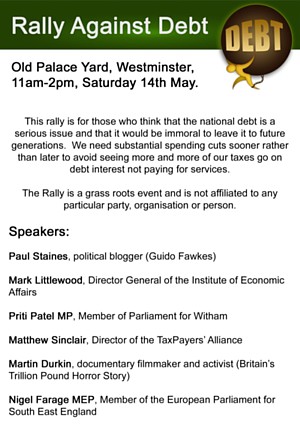
I had already pencilled in the Rally Against Debt as something I would try to be at, if only because it will be taking place a mere walk away from where I live. An incoming email forwarded to me via the Cobden Centre has made this more likely. The email had this attached:
For me, those speakers are an appealing combination of the known, the known of, and the unknown.
How many others will show up, I have absolutely no idea. But, if I can do my tiny little bit to make the turnout that tiny little bit less insignificant, I think that I should. I still promise nothing, but I really will do my best to be there, and then to report back here, hopefully with some photos.
The Daily Mash satire site has this beauty of an item on Rowan Williams, the Archbishop of Canterbury.
He is the gift that keeps on giving, as Perry de Havilland of this parish noticed a while ago.
I ran across this interesting tit-bit today:
US probably used classified helo in Bin Laden operation
The US military may have operated a hitherto undisclosed classified helicopter type in its recent raid on Osama bin Laden’s compound in Pakistan. Images of the wreckage of a helicopter that reportedly crashed during the operation, apparently due to an undisclosed technical malfunction, do not conform to any types that are known to be in service with the US military or in development
This was in a Jane’s newsletter teaser so this is the total information I have available at this moment. Has anyone else heard any interesting rumors?
I eagerly await Amnesty’s Human Rights Action Centre being turned over to the BNP for a debate on how changing demographics in England are depleting national pride
– Michael Weiss
Superb.
We are already pretty well aware of the case of people such as George Soros – the man credited with helping remove the UK from the European exchange rate mechanism in 1992 – who make a killing from financial markets, while attacking liberal capitalism. Another example is Warren Buffett, the so-called “Sage of Omaha” who, now in his 80s, is one of the world’s wealthiest men with an enviable track record for making money over the long term by what is said to be a ruthless, yet almost heartbreakingly simple commitment to “value investing”.
Over at the Cobden Centre, one of its writers, Detlev Schlichter has an excellent, and measured piece about the Buffett phenomenon. He respects Buffett’s track record (who wouldn’t?), but has this to say:
“So, should we feel sorry for Buffett for being dragged out of his comfort zone of the equity market and being quizzed on everything else? Hell, no. Buffett is a global celebrity and he obviously loves it. These big media events that celebrate him are carefully orchestrated. The tiresome shtick of the loveable everyman from the American heartland who just happens to be a billionaire is a carefully fabricated public image that Buffett uses skillfully to his own advantage – not only to sell shares in his company but – apparently – also to be on good terms with political power. It appears that, while honing his public image of the traditional investor committed to time-tested investment principles, he simultaneously has a big lobbying effort going on Capital Hill, asking for exemptions from collateral requirements for some massive derivative trades his company has made. Maybe it’s time to write another gushing letter to ‘Uncle Sam’?”
“Seriously, I have nothing against the man. I think he deserves admiration for his investment success and he may well be a nice guy. But everything else is show – and probably a cynical show at that. As Porter Stansberry has one of his characters say in this fictional but very illuminating dialogue, Buffett is a member of the establishment and now has a vested interest in the status quo, in government support of the paper money system. But remember that when paradigms shift, fortunes change. When it comes to assessing the future of our monetary system the billionaire and legendary investor may well be wrong. If so, he has the means to survive it but what about the middle-class minions who adore him and follow him blindly and who – I think- he has been lulling into some false sense of systemic stability.”
Here is something by me recently about the Koch brothers, who certainly do support capitalism. And this recently top US banker is probably one of the most hard-core defenders of laissez faire around. A refreshing break from the norm.
“Anybody visiting the Middle East in the last decade has had the experience: meeting the hoarse and aggressive person who first denies that Osama Bin Laden was responsible for the destruction of the World Trade Center and then proceeds to describe the attack as a justified vengeance for decades of American imperialism.”
– Christopher Hitchens on Noam Chomsky.
The film Alexander is playing on my TV at the moment – the Oliver Stone version – and despite some of the sillier aspects, the battle scenes are pretty good. Question: why do so many Hollywood films seem to insist that many of the actors talk with a sort of suppressed Irish accent? We have Alexander talking like Dave Allen. WTF? And of course recently there was Russell Crowe talking in the same manner in the Robin Hood film.
I am not complaining too hard, though. For as has been noted, Russell Crowe had to deliver a speech that was pure “Tea Party”.
This has nothing really much to do with some sort of grand political idea or anything, but sport is part of life – however much that upsets anti-sports folk or the plain uninterested – and this man, more than most, enhanced the life of anyone who follows the maddening and beguiling game of golf.
Seve Ballesteros, RIP.
Democracy is the theory that the common people know what they want, and deserve to get it good and hard
– H. L. Mencken
I read this article by Matthew d’Ancona and had to laugh out loud.
David Cameron would be wrong to jettison his co-pilot. Nick Clegg’s only chance of recovery is to ignore the turbulence and carry on regardless […] Instead, Clegg has led his party in another direction: into office with an ideological rival, and the cockpit of compromise, U-turns, and grinding policy formation. To say it has not been easy is a laughable understatement, and the price – so far – has been immense. But it was the right call.
Hahahaha… political rivals, sure… but ‘ideological’ rivals? Oh give me a break. Tories, LibDems, Labour, oh and SNP… ie. all of Britain’s main parties are utterly committed to the regulatory welfare state and their ‘idealogical rivalry’ amounts to arguing over the length of their minister’s ties. The ‘co-pilot’ is staring straight ahead as the aircraft in on ‘finals’ for a CFIT.
I particularly loved this…
“The best help we can give the Lib Dems is not a shopping list of policies,” says one senior Cameroon, “but to help them through their adolescence as a party of government – to help them navigate this crisis.”
It is not that the LibDems are ‘adolescent’ but rather that the entire political establishment appear to be intellectually ‘senile’ as the disconnect between objective reality and acceptable political reality grows apace (and largely unremarked by that essential priesthood of media truthsayers).
It hardly matters which of these lumps are in office. All the policies being bandied about are akin to rearranging the deck chairs on the Titanic and not only does *no* major political party have the will to implement a radical reduction in state expenditure and a massive reduction in the red tape that limit the scope for new market entrants in industry after industry, they all lack the will to even seriously discuss such notions.
When someone suggests a budget that has the state appropriating 20% less of the national wealth overall next financial year and the same the year after that, and allowing banks to simply go bust if they screw the pooch on an epic scale, well then and only then are they are getting serious… but until that happens, let the various party loyalists blather on about Dave and Nick as if it actually matters.
The Ponzi scheme has reached the ‘end game’ phase and the antics of the clowns in Westminster and their supporters are as important as a tinker’s damn. Britain and much of the western world have got the leaders they voted for and the ones they deserve. Drink wine, watch films, play games, meet friends, but only pay attention to politics for the entertainment value. It is not like politics is actually going to have much impact on where the economy is heading.
|
Who Are We? The Samizdata people are a bunch of sinister and heavily armed globalist illuminati who seek to infect the entire world with the values of personal liberty and several property. Amongst our many crimes is a sense of humour and the intermittent use of British spelling.
We are also a varied group made up of social individualists, classical liberals, whigs, libertarians, extropians, futurists, ‘Porcupines’, Karl Popper fetishists, recovering neo-conservatives, crazed Ayn Rand worshipers, over-caffeinated Virginia Postrel devotees, witty Frédéric Bastiat wannabes, cypherpunks, minarchists, kritarchists and wild-eyed anarcho-capitalists from Britain, North America, Australia and Europe.
|





Recent Comments