We are developing the social individualist meta-context for the future. From the very serious to the extremely frivolous... lets see what is on the mind of the Samizdata people.
Samizdata, derived from Samizdat /n. - a system of clandestine publication of banned literature in the USSR [Russ.,= self-publishing house]
|
Indeed:
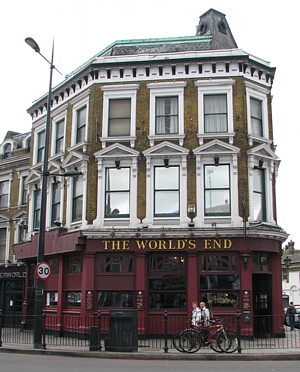
It’s a pub, across the road from Camden Town tube station. But, unlike the people Perry had a chuckle about yesterday, their End is, I presume, a place rather than a time. End as in: here your journey stops, rather than now everything stops.
Looking the other way from the tube exit, I wondered if these guys were trying to tell us all something similar, about the likelihood that the world will not be ending any time soon:
I was in Camden to meet a Goddaughter, and the two of us then walked west along the Regents Canal. Recently, I watched a TV show about the revival of Britain’s canals as desirable places to have fun on and to live next to, following their eclipse as the dominant mode of transport by the railways and their descent to wet slum status and dereliction. We saw plenty of evidence of this revival. In particular, we saw many, many canal boats, most at rest, many in motion.
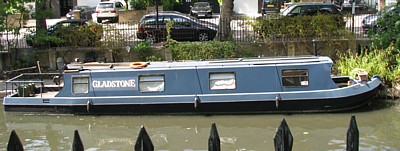
The river boat we saw that the readers of this blog will probably approve of most strongly was the one called this:
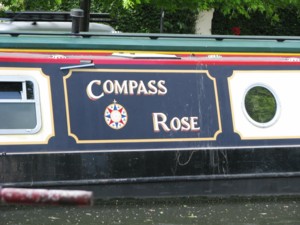
Although, the boat name that I found the most intriguing was this:
Compass Rose was the ship that got sunk in Nicholas Monsarrat’s novel about the war in the Atlantic, The Cruel Sea, which was then made into a very popular movie of the same name, starring Jack Hawkins. I don’t believe that to be a coincidence.
We saw many other sights. I liked the floating restaurant, that was doing brisk business. I was intrigued that for long stretches of the canal, roads and railways near to it are at a significantly lower level, often spectacularly so (as at the point where the canal is crossed by two big elevated roads, one on top of the other, in the Paddington area) and quite a few houses and business buildings next to the canal had basements below canal level.
Later in the afternoon, I liked how a curve in the elevated M40 juts out over a curve the opposite way in the canal, but without them crossing, like this:
And we both enjoyed photo-ing the birds in the big bird cage designed by Princess Margaret’s ex, which is right next to the canal. I did not know this.
By the time the sun was setting, we had reached Willesden, where I had further fun photoing the sunset through incomprehensible railway clutter. Click on the picture below if you’d like to see it bigger:
At which point we were both pretty tired, so we sat down in a Chinese and ate, and then went home. And I’m pretty tired now, so I will leave it at that.
Our own Dale Amon has just been named Space Activist of the Year by the National Space Society. Well done Dale.
There have been three Chinooks with US markings circling overhead above my house in London for quite some time now, and for a moment I thought that maybe the rapture was at hand and they were here to air lift me off to heaven… or wherever else it is that rotorheads go when they kick off for the last time.
Actually a place with large helicopters perpetually circling overhead fits my preconception of ‘heaven’ rather well, so maybe the world *did* end as I was certainly watching them in complete rapture.
Result!
Hello? Is there anyone else out there?
The main problem with having discussions about economics and financial markets is this: People look at these complex phenomena through entirely different prisms; they use vastly dissimilar – even contrasting – narratives as to what has happened, what is going on now, and what is therefore likely to happen in the future. Citing any so-called “facts” – statistical data, or the actions and statements of policymakers – in support of a specific interpretation and forecast is often a futile exercise: The same data point will be interpreted very differently if some other intellectual framework is being applied to it.
– The opening paragraph of Detlev Schlichter’s latest commentary on the state of the world, entitled Beyond Repair – This will not have a happy ending.
So, Ken Clarke hamfistedly but correctly says there are degrees of seriousness in rape and the law reflects this – and causes great outrage. Not just from the avowedly feminist Guardian either. The Sun says he’s a danger to women, no less.
Interestingly, both the the Guardian’s and the Sun’s commenters seem to take a more nuanced view than their respective papers. As they should. Clarke was attempting to make a valid distinction. Sure, he messed it up, particularly when he appeared to confuse date rape and statutory rape, but of course there are degrees of seriousness in rape as in any other crime. To say that is not to say that any form of rape is trivial. Whoopi Goldberg’s much derided comment that Roman Polanksi was not guilty of “rape rape” was not outrageous because she attempted to distinguish between statutory and actual rape, but because Polanski had committed rape rape.
It distresses me that so many of those who seek to help to rape victims seem to act all the time as if they were a politician on the radio. By this I mean that they have always ready in their heads one idea, one sound bite, that they must express. Nothing must detract from that message; no ifs, no buts, no side issues. I agree entirely with the One Idea in this case: all rape is serious. But when one sees what trouble a real politician on the radio got into for merely touching upon the reasons for a sliding scale of sentences one also sees why most politicians try so hard to stick with the pre-prepared One Idea. Meanwhile Lara Williams in the Guardian (linked to above), a woman whose real-life experience of helping rape victims would lead one to hope that her views were rooted in observation, comes out with the sort of mindlessly simplified slogans that have given politicians a bad name:
Through distinguishing “serious” and “less serious” rape, Clarke assumed a perverse gradient of suffering, a warped taxonomy of perceived victimisation.
No one actually believes that. If called upon in court to state what impact a particular rape had had on a particular victim, I have no doubt that this writer would recoil in horror from saying, “Oh, the usual. All rapes have the same impact. All rapes are equally bad.” Yet that is the logical implication of what she has written. She is not the only such commenter. It is sad to see obviously intelligent and compassionate people with so little faith in the public that they make themselves believe that the only way to put forward a true idea – all rape is bad – is to coarsen it into falsehood.
“A cleaner (janitor) at a London gallery cleared away an installation by artist Damien Hirst having mistaken it for rubbish. Emanual Asare came across a pile of beer bottles, coffee cups and overflowing ashtrays and cleared them away at the Eyestorm gallery on Wednesday morning.”
I still treasure that story, which appeared in this item about the art world (thanks to Tim Sandefur for the pointer. He is on a bit of a roll at the moment).
In thinking of art and tracing out the trends, good and possibly not so good, you can do a lot worse than read this book by Ernst Gombrich.
We seem to be having quite a lot of referendums at the moment in the UK and Europe. As we might note with a sort of grim amusement, the largest recent ones – on the EU Constitution – were airily ignored with customary insouciance by the EU political elites, and therefore fill many people will understandable cynicism. Over at the EU Referendum blog there is a long item about protest movements, violence, referendums and political change. I may have more to say when I have the time to study it. It looks a good piece, and I recommend it.
Talking of protests, here is a nice collection of photos of recent “rally against debt” held in central London a few days ago, as taken by our own Brian Micklethwait.
“The more corrupt the state, the more numerous the laws.”
– Tacitus
“The man must be presumed innocent until proven guilty, and in any event, there is still some chance that the whole sordid affair turns out to have been a political set-up, in which case he might even emerge from this bizarre scandal with credit and sympathy. Yet it is about time Europe’s ownership of the International Monetary Fund, and particularly France’s apparently divine right to the top job, was brought to a close. If Mr Strauss-Kahn’s nemesis in a New York hotel room loosens Europe’s grip, then that may be no bad thing. Whatever the truth of otherwise of the allegations, Mr Strauss-Kahn’s spectacular fall from grace is widely seen as a near catastrophe both for the IMF and the delicate negotiations around further rescue packages for the stricken eurozone periphery. This it is definitively not. To the contrary, it might even bring about a rethink of the currently doomed strategy of throwing good money after bad.”
– Jeremy Warner
The historian and libertarian writer, Robert Higgs. is most upset that some Americans had celebrated when Osama bin Laden was killed by US special forces a few days ago:
“The caretakers who comfort the sick and dying are often great. The priests and friends who revive the will to live in those who have lost hope are great. The entrepreneurs who establish successful businesses that better satisfy consumer demands for faster communication, safer travel, fresher food, and countless other goods and services are great. The scientists and inventors who peer deeper into the nature of the universe and devise technologies to accomplish humane, heretofore impossible feats are great. The artists who elevate the souls of those who hear their music and view their paintings are great.”
“But mere killing is never great, and those who carry out the killings are not great, either. No matter how much one may believe that people must sometimes commit homicide in defense of themselves and the defenseless, the killing itself is always to be deeply regretted. To take delight in killings, as so many Americans seem to have done in the past day or so, marks a person as a savage at heart. Human beings have the capacity to be better than savages. Oh that more of them would employ that capacity.”
I agree utterly with the first paragraph. We should celebrate goodness more than we do. Absolutely right. But come on. I really have had it with the moral posturing of people who wax indignant about their countrymen feeling pleased because an evil man has been killed. When an evil person, in a confrontation such as occurred a few days ago, is killed, then why should not the admittedly rough justice of what happened be marked by a certain degree of grim satisfaction? I don’t imagine for a moment that anyone who voiced satisfaction at OBL’s death is under the illusion that this can possibly put right the evil that was done on 9/11. There are times, however, when grim satisfaction at what happened to OBL is not only the understandable reaction, but the just one.
It interests me how some on the almost pacifist wing of the libertarian movement – if I can call it that these days – have reacted to the demise of this man. After all, such folk often complained that “neoconservatives” who supported the overthrow of Saddam or the Taliban, say, were going beyond just retribution in response to the 9/11 attacks. So what I would ask of Higgs, and for that matter, would-be POTUS Ron Paul, is what exactly do they suggest should have happened in the case of OBL, had by any chance a pristine, moral libertarian regime have managed to find him and track him down? File a lawsuit? Suggest he surrenders to the nearest police station where he can be read his Miranda rights? That was not going to happen: the most probable outcome for a person such as this would be a messy arrest, and the charade of a trial and lifetime jail term/execution, or a firefight. Welcome to reality.
Higgs finishes with this:
“Glory to the USA, glory to its hired killers, glory above all to its heroic Great Leader. The whole spectacle is profoundly disgusting. Yet we can see that many Americans have enthusiastically fallen for this trick, dancing in the streets in celebration of a man’s death in faraway Pakistan. Such unseemly behavior is not the stuff of which true greatness is made.”
“Unseemly”. Oh get over yourselves.
Here are some more thoughts over at Pajamas TV. I particularly enjoyed Bill Whittle’s comments. I share his take.
When a man is tired of ITV4 he is tired of life.
– Patrick Crozier.
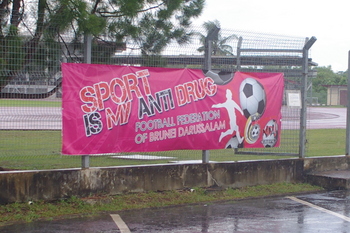 If sport were a drug, there would be no option but to institute a mandatory death penalty for people partaking in it, and nobody would want that If sport were a drug, there would be no option but to institute a mandatory death penalty for people partaking in it, and nobody would want thatMy apologies for the blurriness of the first picture. I find that people in uniforms in secure areas of airports can lack a sense of humor when I start taking photographs, so I try to do it surreptitiously. This can sometimes detract from the quality of the photographs.
|
Who Are We? The Samizdata people are a bunch of sinister and heavily armed globalist illuminati who seek to infect the entire world with the values of personal liberty and several property. Amongst our many crimes is a sense of humour and the intermittent use of British spelling.
We are also a varied group made up of social individualists, classical liberals, whigs, libertarians, extropians, futurists, ‘Porcupines’, Karl Popper fetishists, recovering neo-conservatives, crazed Ayn Rand worshipers, over-caffeinated Virginia Postrel devotees, witty Frédéric Bastiat wannabes, cypherpunks, minarchists, kritarchists and wild-eyed anarcho-capitalists from Britain, North America, Australia and Europe.
|










Recent Comments