We are developing the social individualist meta-context for the future. From the very serious to the extremely frivolous... lets see what is on the mind of the Samizdata people.
Samizdata, derived from Samizdat /n. - a system of clandestine publication of banned literature in the USSR [Russ.,= self-publishing house]
|
“As the Church of England keeps telling us how much it shares the aims of the St Paul’s protestors, I notice an advertisement in the Financial Times. The Church Commissioners need a chief operating officer. He will be paid a `six figure salary’, says the advertisement, to manage their `£5 billion multi-asset portfolio’. There is no mention of anything Christian, or even anything ethical. The language is all management-speak. The ideal candidate will have a `proven track record of driving continuous and consistent operational performance’. The job’s responsibilities include `to build and maintain internal controls and process and to lead a no-surprises culture’. Although it is pretty hard to reconcile a `no-surprises culture’ with the mystery of the Incarnation, one must admit that it might have come in useful in dealing these various `occupations’. As well as St Paul’s, there is no one else outside Bristol, Exeter and Sheffield Cathedrals. You have only to study the websites of the various Occupy groups across the country to see that they, too, stick to a no-surprises culture. Events include Palestine Solidarity Campaign rallies, performances by Billy Bragg, strikers’ benefit gigs, meetings of the Anti-Cuts Alliance. They are not forerunners of a Second Coming: they are the usual suspects. There is nothing unchristian about rounding them up (caringly, of course).”
Charles Moore, page 11 of Spectator, 19 November. (This is behind the magazine’s pay-wall. Be grateful to your humble Samizdata scribe for re-typing these words from the dead-tree version).
I like the point about Billy Bragg. He’s in danger of becoming a “national treasure”.
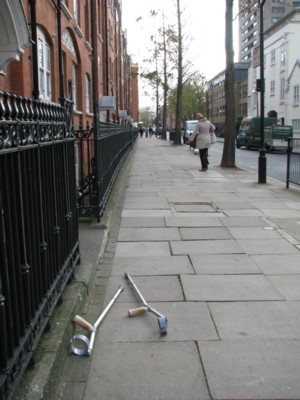
I took this photo yesterday afternoon, not far from my home in London:
Maybe I am being very dim, but what happened here? Did the former user of these crutches have some kind of accident and get whisked off in an ambulance? Did he (or she) encounter a faith healer, and thanks to him (or her), make a miraculous recovery and thus no longer need the crutches? Did the crutches fall off a lorry, and then get put helpfully on the pavement, to stop them getting run over? I strongly suspect that there is an uncontroversially obvious explanation for this circumstance, and that when a commenter provides it I will look very silly, but I can’t now think what it could be.
In its varying degrees, the political, legislative and social applications of environmental science studies in this 21st century should be carefully compared to that of Eugenics in the late 19th and through the mid- 20th centuries.
– Redoubtable serial commenter ‘RRS’
I remember, about a quarter of a century ago, speculating that the way things were heading, in Britain, all “drugs” would eventually be legal, except tobacco. We seem …
All smoking in cars should be banned across the UK to protect people from second-hand smoke, doctors say.
The British Medical Association called for the extension of the current ban on smoking in public places after reviewing evidence of the dangers.
… to be on course for exactly this arrangement:
Ex-MI5 chief Baroness Manningham-Buller is set to call for cannabis to be decriminalised in a speech.
The crossbench peer believes that only by regulating the sale of cannabis can its psychotic effects be controlled.
She is also expected to say the “war on drugs” has been “fruitless”.
I am reluctant to urge consistency in these matters. That might mean them banning the lot, which actually seems a rather more likely outcome. And note that the Baroness favours legalisation because illegal drugs are the sort over which They have less control. So both proclamations are consistent with one another, in wanting Them to have more control.
Yes, I know that there might be some room for doubt here, but an example I came across in the news pages of CityAM today clearly highlights how so-called environmental taxes are hurting the economy and costing jobs, often in areas already in dire straits:
RIO TINTO yesterday said new environmental taxes and red tape were partly to blame for the closure of its Lynemouth aluminium smelter in Northumberland, risking 600 jobs.
The mining giant said the smelter “is no longer a sustainable business because its energy costs are increasing significantly, due largely to emerging legislation.
It is thought that the coalition’s controversial plans for a carbon price floor, announced in the 2011 Budget, are being blamed alongside EU emissions trading and large combustible plant rules.
Earlier this month, the lobby group Energy Intensive Users Group said Rio Tinto was among dozens of firms asking the government for some relief from the carbon price rules.
An agreement has not been made in time for Lynemouth to remain open, though a government “support package” is due before the end of the year.
The government recognises the need to support energy-intensive industry,” said a Treasury spokesperson yesterday.
Personally, I think risking 600 jobs is pathetic. If the AGW alarmists are really that good, they should be looking to risk millions. They need to raise their game.
Sorry for the sarcasm, but you can see why this blog, along with others, gets angry about the lying and bad faith of those “scientists” who exaggerate their doomongering, and the politicians who embrace their ideas. It has consequences for actual lives.
The names on the list of his ministers – most of which were unknown to members of the Italian general public – showed that Monti had failed in his attempt to involve party representatives. His cabinet was made up exclusively of non-aligned specialists.
“The absence of political personalities in the government will help rather than hinder a solid base of support for the government in parliament and in the political parties because it will remove one ground for disagreement,” he said.
The Guardian speaks of the absence of “party representatives” in Italy’s government. The Times (behind a paywall) is more frank: Italy ditches democracy as row blazes over how to save the euro.
A new row blew up between France and Germany yesterday over how to save the euro as Mario Monti, Italy’s new Prime Minister, appointed an all technocrat Cabinet that does not include a single elected politician.
“A paramedic was also told to remove his harness and halt an attempt to reach Mrs Hume because he was not familiar with fire service equipment”
That is from a report in the Herald on the Fatal Accident Enquiry carried out by Sheriff Desmond Leslie on the slow death of Alison Hume while the Strathclyde Fire and Rescue Service read up about “the parameters of their engagement” and concluded that these did not include her rescue. She was eventually pulled out by a police mountain rescue team, but by that time hypothermia had taken hold. She died of a heart attack in hospital.
Sheriff Leslie said that some degree of “imagination, flexibility and adaptability were necessary” in conducting a rescue of this kind. He described “a preoccupation with adherence to Strathclyde Fire and Rescue Service policy which was entirely detached from the event with which Strathclyde Fire and Rescue Service was confronted.”
He said: “There was clearly a balance to be struck between the interests and safety of the rescuers, and those of the casualty they were there to rescue.”
Sheriff Leslie directly criticised two senior officers, group commanders Paul Stewart and William Thomson, for their attitudes at the inquiry. He said they were “focused on self-justification for the action or non-action taken by them”.
The sheriff said: “I found their evidence to be bullish, if not arrogant, in their determination to justify the subservience of the need to carry out a rescue to the letter of Strathclyde Fire and Rescue Service Brigade policy.”
It is good that the sheriff has named names. There is precious little penalty other than public shame that will touch a public sector employee who has adhered to procedure. Although the report says that criminal charges “may be brought”, I have a presentiment that the route between the Procurator Fiscal’s office and the criminal courts will turn out to be full of deep holes that an embarrassing report can fall down.
The Fire Brigades Union also made a contribution:
John Duffy, of the Fire Brigades Union Scotland, said: “If we are going to do these specialist rescues you need specialist teams who know what they are doing and know how to use the equipment. We have three statutory functions – to fight fires, prevent fires and deal with road accidents. The problem is we are being asked to do a whole range of duties with no more funding.”
As a commenter to the Herald story suggests, specialist equipment sat there unused and highly trained men sat there debating while Alison Hume slowly died beneath their feet.
Some past Samizdata posts that are also relevant: Alameda County Cowards, We have to wait for the fire brigade because of health and safety, and my first Loss of nerve post.
George Orwell wrote of government power, “If you want a vision of the future, imagine a boot stamping on a human face—forever.” He may still be right, but there’s now a decent chance someone will be there with a cell-phone camera to post it on YouTube. And exposing abuse of power is half the battle.
– The magnificent Radley Balko, who does more for exposing abuse of power than just about anyone.
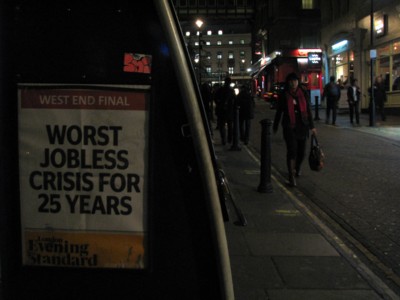
This evening I dined with a friend, and on my way there took this snap of an Evening Standard headline. A couple of years ago I thought that the Evening Standard itself – never mind these billboards – would soon be extinct. But although diminished in number, these headlines are still a familiar part of the London scene, now as then usually telling of catastrophe of one kind or another, public or personal. This evening’s offering was no exception:
Here‘s the story. Depending on your preferred explanation for this sad circumstance, you’ll pick out a different bit of the story. I pick this:
The shocking new total was published today as Bank of England governor Sir Mervyn King warned Britain is in danger of sliding back into recession.
He downgraded his growth forecasts again, saying the economy will expand by one per cent this year and next, a fraction of the hoped-for rate.
As Instpundit would say: Unexpectedly! It would appear that quantitative easing is proving less than completely stimulating. We here are not shocked by this bad unemployment news.
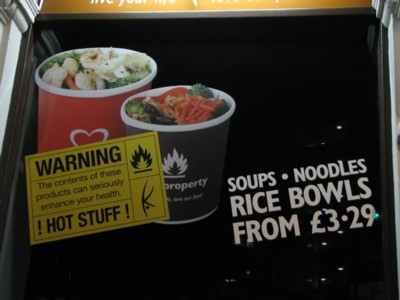
For a little light relief, here’s a snap I took later, on my way home:
The advertising trade was bound to take advantage sooner or later of the wave of health and safety signage that is such a feature of British life just now. This is the first time I’ve noticed it, but I’m sure others have seen such things many times already.
The National Space Society and the International Academy of Astronautics held a press conference at the National Press Club yesterday to announce stunning advances in the systems design of Space Based Solar Power satellites.
John Mankins has been working on a modular solar power station architecture for a number of years. Instead of a big, all up construction project, there are mass produced small modules that begin paying for themselves almost immediately.
His concept could be flying in 10 years. Rather than assume a system has to look like the concept drawings from the 1970’s, he completely rethought it using modern technology. The result is a module that can launch on an existing rocket and immediately make itself useful by delivering power to anywhere on earth it is needed. On its own one module is not going to power a city, but it might power a small remote facility or supply emergency power to a team at a disaster area. As cash-flow or investment capital allows, more identical units can be launched. They may be used separately… or they might be joined up like robotic Lego blocks to form larger and larger structures, generating larger and larger amounts of energy for Earth-Based usage.
Take a look at the IAA report.
The video is now available.
Beijing, China. November 2011
Part three in an ongoing series
I have long thought, first, that the United Kingdom has for some time been heading towards being the Non-United Kingdom, and second, that this would probably be a very good thing.
If such a separation is indeed happening, then what is causing it is the end of the British Empire. That and what followed around half a century later (i.e. around now), probably as an inevitable next step, namely the abandonment of the English-stroke-British attempt to remain a top ranking Great Power.
The British Empire meant that lots of Scots wanted to be attached to England, to get in on all the deals involved. Then Britain, empireless but still trying to remain a Great Power, needed Scotland to remain in. Scotland provided and still provides military manpower, and projected and still projects British power in northerly and westerly and easterly directions, in a way that England without Scotland will never be able to match. Could England without Scotland (to say nothing of Northern Ireland) have won the Battle of Atlantic? Hardly. Could England then have even threatened to win the re-run of that battle that from the end of WW2 until the collapse of the Soviet Union, dominated British naval thinking, and Britain’s strategic thinking generally? Again, hardly. For as long as the Cold War lasted, the English plus whichever local allies went along with them, were determined to square up to the Russians and thus keep their seat at that Top Table that politicians are all so very keen to be seen sitting at. A dis-United Kingdom was a non-starter, for contriving all that.
But now? Russia remains a looming monster, or a huge wreck if you prefer the Perry de Havilland take on Russia, which I think I probably do. But even if you think that Russia remains very strong, it no longer fancies itself as a global ideological magnet, bankrolling and talking up every nutter in the civilised world with a mad plan to derange civilisation. It no longer even goes through the motions of attempting to conquer everywhere else. Russia is now just another Problem, along with government debt and bank turmoil, the Euro, the Dollar, the Pound, China, energy shortages or “climate change” (again according to taste), crime, schools’n’hospitals, etc. etc. etc., rather than The Problem.
The global ideological derangement torch has now been seized by Mad Mullahs, and they won’t be re-fighting the Battle of the Atlantic any time soon. Nor do they have nearly so many nuclear bombs, or nearly such potent means of chucking them about in the world. They require very different strategies. Given the weaknesses and difficulties faced by the Mad Mullahs, and given the weaknesses and difficulties faced by us, their enemies, I wouldn’t now want to call them anything more than just another Problem, among all the others.
Other career paths for English politicians to that Top Table have since been identified, based less on British power and more on personal skills and individual contributions to the new global elite. To put it bluntly, you don’t need to be part of one of the old empires in order to participate in running the New World Order.
England’s Great Power-ish inclined warriors and foreigner-scarers, of greatly varying social grandeur from Air Marshals to ex-army pub landlords to army-fan dog-owning T-shirted denizens of south of England housing estates, are being presented with a fait accompli. This warrior tendency has traditionally been very pro the Union with Scotland, but is now being being starved of resources and humiliated by its consequent failures to make very effective uses even of those resources that it does still receive. Its last serious throw of the dice was the Falklands War. Since then, Britain been militarily “powerful” by supporting America, which is not nearly so satisfying, or so impressive to spectators. Britain’s more recent military escapades, against those Mad Mullahs, seem to have accomplished, and to be accomplishing, less and less with each passing year. Chasing terrorists in foreign parts is all well and good, but it seems foolish to be trying to impose democracy upon such places as Afghanistan, given the problems we now have domestically. And even if you don’t agree about that, you can hardly deny that most English people surely now do think thus. The Will to Great Power, to adapt Nietzsche, seems more and more to be lacking in Britain. Too costly. Not worth it. Time to consign all that to the history books.
And with it, the overriding imperative for England and Scotland to remain politically attached to one another.
Meanwhile, that strand of English opinion which favours trade, free markets, and so on, is, in the absence of any continuing great power logic to justify union with Scotland, likely to become ever more irked but it. This tradesman tendency, so to speak, of free market inclined businessmen, City of Londoners, shopkeepers, and bookish students who like reading Hayek and Friedman and, these days, clicking onto mises.org, has lately suffered a severe dose of Scottish moralistic … I don’t think anti-Englishness is too strong a phrase for it, at the hated hands of Gordon Brown. More and more they (and count me in too) now think: well Jock, if you want out, then you just go ahead and get out. We might then get the sort of government we want, instead of having our choice vetoed by you all the time.
The above thoughts were triggered again in my head just last week, by a recent report (thank you Bishop Hill), which said that if Scotland does go independent, it will as a direct consequence have to stop being nearly as crackpottedly ridiculous as it is now about “renewable” energy, i.e. the sort of energy of which there is not now and for the foreseeable future never will be enough. Suddenly, I found myself becoming a passionate Scottish Nationalist, if only to put the wind up the idiotic wind-farmer tendency. Although, Bishop Hill jokes that such greenery in Scotland is actually a plan to keep the Union with Scotland going, by making Scottish independence impossible.
For wind-farming in particular, read Scottish economic thought and policy generally. Libertarians like me have another reason to want to see Scotland separate itself from England, which is that once the indignity of being told by annoying English people like me to favour more rational economic theories and economic policies has been removed, the Scots, once independent, will then almost certainly become far more ready to tell each other to think and to behave in an economically more sane manner.
If Scotland goes independent, then Scotland will, for reasons of sheer economic self-preservation, have to stop being a huge drag on the global pro-free-market tendency in general and the libertarian movement in particular, and might even become a net contributor to such tendencies. Again.
Final thought. Where will all this leave UKIP? Changing its name for a start. But then, as the EIP, much more likely to get what it wants. And that’s another reason for England to eject Scotland from its union with England. It would then be a lot easier for England to eject itself from the EU.
|
Who Are We? The Samizdata people are a bunch of sinister and heavily armed globalist illuminati who seek to infect the entire world with the values of personal liberty and several property. Amongst our many crimes is a sense of humour and the intermittent use of British spelling.
We are also a varied group made up of social individualists, classical liberals, whigs, libertarians, extropians, futurists, ‘Porcupines’, Karl Popper fetishists, recovering neo-conservatives, crazed Ayn Rand worshipers, over-caffeinated Virginia Postrel devotees, witty Frédéric Bastiat wannabes, cypherpunks, minarchists, kritarchists and wild-eyed anarcho-capitalists from Britain, North America, Australia and Europe.
|





Recent Comments