We are developing the social individualist meta-context for the future. From the very serious to the extremely frivolous... lets see what is on the mind of the Samizdata people.
Samizdata, derived from Samizdat /n. - a system of clandestine publication of banned literature in the USSR [Russ.,= self-publishing house]
|
I am sitting in a motel room near the Mojave Spaceport where I am working at present and will be watching the SpaceX launch HERE and probably *not* trying to type what you can already see there. If you have questions about what is going on, fire off a comment and I will try to explain as best I can. Keep in mind though that I will have a cut off different than most of you since I am in Pacific Daylight Time, -3 hours from EDT and -8 from BDT.
For those who have not been following it, this is the first commercial cargo test flight to the International Space Station. The Dragon capsule will deliver food, water, clothing and other miscellaneous not-critical supplies; it will return to Earth carrying a lot of special purpose gear from experiments that have been completed.
The flight is a combination of two test flights which were originally planned to be separate. COTS 2 is the demonstration that the Dragon can do all of the sorts of maneuvering required for space station ‘Prox Ops’; the COTS 3 portion is an actual docking and deliver of cargo to the station and back to Earth.
This is a very big deal to those of us in the commercial space world. NASA is an initial customer but not the only one. SpaceX has signed a contract with Bigelow Aerospace to handle resupply for the Bigelow space stations that will be going up starting in the middle of this decade.
01:17 PDT: Video feed is live
01:44 PDT: This is going to be a tough one. The launch window is seconds wide… any hold and they will have to wait until Tuesday to try again.
01:56 PDT: Oh, well. Not tonight. Vehicle had a terminal abort. SpaceX has very conservative limits and go criteria. If this wasn’t a one window per day due to the tight parameters for an ISS rendezvous, they will not be able to recycle and try again as they have in the past. It will be a Tuesday window. I will be in DC for the runup to the ISDC by then.
02:00 PDT: They had a chamber pressure high on one of the engines. Well, they have several days to work it out. For now they are safing the vehicle.
It seems that Alain de Botton, who I might add is a weapons grade plonker of the first order, has finally come up with a good idea.
As his next project, the philosopher and founder of The School of Life is aiming to revolutionise pornography. Driven by the way society has been saturated by explicit images and videos, de Botton is asking ‘what next for porn?’. The writer intends to meet with leaders in porn and the arts in order to bring about a better kind of pornography.
Well I am all for anything that leads to better products. And perhaps he will use this opportunity to point out to these “leaders in porn” that boob implants are to porn what McDonald’s is to fine dining.
What does anyone know about the outfit calling itself FairSearch?
Based on growing evidence that Google is abusing its search monopoly to thwart competition, we believe policymakers must act now to protect competition, transparency and innovation in online search.
Policymakers? That is a bit like asking a collective of rapists to protect chastity, virginity and privacy. In my experience nine times out of ten when I hear people calling for a market leader to be kicked by ‘policy makers’, it is because they find it cheaper to pay lobbyists to do in the competition’s legs than actually compete with them.
Anyone have the low down on these guys?
This article on Greeks seeking refuge from their woes by emigrating to Australia is a bit old now, although I would be very surprised if the desire to go has changed at all. Greeks are now, by one measure I saw, the seventh largest ethnic grouping Down Under.
Of course, countries such as Australia and Canada, for that matter, might not be as easy to emigrate to as in the past if the would-be emigrant does not have the sort of skills that are likely to appeal to any granters of visas. And without wishing to sound sour about it, I could argue that the sort of enterprising Greeks who would have been welcomed with open arms by such countries have left their ancestral homes long ago. Another problem is that the very people who are trying to get the hell out of Greece are likely to be the sort most likely to drive their country back towards some semblance of prosperity.
Update: EU officials are starting to admit they are planning for a Greek exit. The end of Greece’s eurozone membership is very close now, I think.
A Dead Statesman
I could not dig; I dared not rob:
Therefore I lied to please the mob.
Now all my lies are proved untrue
And I must face the men I slew.
What tale shall serve me here among
Mine angry and defrauded young?
Rudyard Kipling
Ponder…
Today I had an idea for a website that might be worth monetising. Nothing I could give up my day job for, but something that might bring in a few tens of pounds pocket money from Google Adsense. It would be fun; it might help fund my gadget habit. But:
Despite what you may have read somewhere on the Internet, any income earned from Google Adsense is taxable income. It makes no difference whether you earn £5 or £10,000 – this money must be declared to the Inland Revenue as income derived from self employment. Moreover, you must declare yourself as self employed as soon as you start work (this could be when you begin that new website or insert Google Adsense into a personal blog).
Says Her Majesty’s Revenue and Customs:
If you’re self-employed on a temporary or part-time basis you must register for business taxes with HM Revenue & Customs (HMRC) as soon as you start work. You’ll have to complete a Self Assessment tax return and are responsible for paying your own tax and National Insurance contributions on the income you earn.
Even if you don’t think you’ll earn enough to need to pay tax, you still need to complete a tax return.
Right now I pay my tax on Pay As You Earn, meaning my employer employs a department of people to do all the form filling. I like it that way. I have a very strong aversion to filling in official forms. When forced to do so my heart rate increases, I start to sweat, I hyperventilate, my writing hand cramps up, I have a stong urge to shout and throw things and people around me get nervous. This is partly indignation at being made to do something I do not want to do, partly the unease of spending time doing something that is not pleasant and not what I am skilled at (if I was good at organising paperwork and form filling I would have made different career choices), and partly irrational. And I can never find the damned supporting documents no matter how organised I have tried to be. I could elaborate yet further but thinking about it now is starting to induce symptoms so I must end this paragraph soon. The point is: the rewards would have to be very high to overcome this aversion, or I would have to make enough to pay someone else to do it for me.
A quick google suggests I am not the only one. Even for normal people, the cost, time and effort to fill in a tax return must be high enough to rule out all but the most serious of business ventures.
What is the cost to society of all the little side projects, hobbies and micro-businesses that do not get started because it is not worth the bureaucratic hassle?
Update: I found some tax examples graciously provided by HRMC. I particularly enjoyed the phrase “air of commerciality”. No grey areas here, then.
Samizdata’s favourite Member of Parliament, Steve Baker, has been elected an Executive Member of the 1922 Committee. What this shows is that he is the kind of Member of Parliament whom other Members of Parliament rate highly, and pay respectful attention to. It means that Baker has a Parliamentary following. He is not a loan (!!!) lone voice in the wilderness. Good.
In other words, ideas like this (written by Baker in response to some recent remarks by William Hague to the effect that we should all work harder) are now getting around:
Senior politicians must realise that hard work cannot produce prosperity without the right institutions. In addition to Adam Smith’s “peace, easy taxes and a tolerable administration of justice”, hard work must be rewarded with honest money which holds its value, not money which the commercial banks and the Bank of England can produce at the touch of a button.
Money loaned into existence in ever greater quantities caused the present crisis. It has given us a society based on crushing burdens of work in exchange for rewards which quickly disintegrate. That is the problem which must be solved if hard work is to have proper meaning and if we are to have a moral and just society which delivers prosperity for all.
Imagine a world in which the most powerful people in it started seriously to understand and to act upon notions like that. Thanks to people like Steve Baker we may eventually find our way towards such a world, and maybe (although one should never assume such a thing) quite soon.
I have admired Steve Baker MP ever since I first heard about him from my friend Tim Evans, and have liked him ever since I met him, at a Cobden Centre dinner a while back.
If you also admire Baker and what he is trying to accomplish, then please take the small amount of time needed to add a comment here saying so, even if you are not normally inclined to comment, here or anywhere else. Baker has several times told me, and I have no reason to doubt him, that encouragement of this sort makes a definite difference to his happiness, and to his willingness and ability to keep on keeping on.
A short while ago, I defended the freedom of people to say nasty, or stupid, things on sensitive subjects, so long as they don’t do so on my private property or against the rules set by owners of said. (The property point is one of the distinctive libertarian ways of framing the issue. You don’t have a right to paint slogans on my house or demand I pay for your blog fees). It is, I suppose, a sign of the times in which we live that toleration for speech that you don’t happen to agree with is now seen, in some quarters at any rate, as a “right-wing” issue. It should not be. Anyway, I was reminded of this point when I read this article about a stand taken by David Davis, the senior UK Conservative MP.
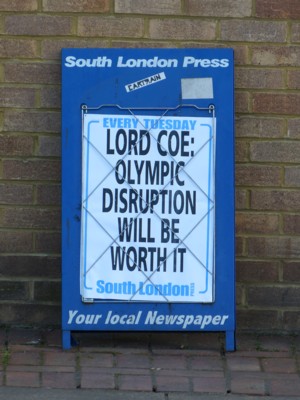
Here is a photo I took in March of this year, which I have been meaning to feature here for ages:
We shall see.
One of the many annoying things about the Olympic Games is how little clutches of contractors and workers, doing vital things, know that they can, during the frantic run-up to the Olympics, demand a hugely exorbitant price for merely doing their job, even if they had earlier sworn blind that they would not behave like this. I imagine that’s a very widespread Olympic phenomenon generally, which adds hugely to the final bill, and is just one more reason why I wish the damn things had gone to Paris and never come back, ever.
I surmise – no speculation of this sort could easily be proved – that if any such demand becomes just too demanding, the means used by the State to settle such demands are not confined to bribery. If I was the State, I’d also now be issuing threats. I’d send people round to knock on doors to explain, ever so politely (perhaps over a friendly cup of tea), to such persons as trade unionists and building contractors, just how nasty the State is now capable of being, to individual people whom it has taken against. The State knows where you live. The State decides how much tax you owe it. And so on. And it could get even nastier. So, don’t push your luck too far, there’s a good fellow.
This is all pure speculation on my part. I have zero inside knowledge of any such negotiations. It’s just that if that were now happening, I would not be surprised, whereas if it wasn’t, I would be very surprised indeed.
Another way of responding to such last minute demands is to say: Okay, if you don’t finish it in time, you don’t finish it in time and it doesn’t get finished in time. Pity, but there you go. And once the Olympic Games are over, we can then sack the damn lot of you and take our time. While keeping all your names on a Black List, for you to be suitably punished at our leisure.
This seems to be the approach being adopted in the matter of the Greenwich Cable Car. I am particularly interested in this New London Thing because, when finally finished and open for business, it will be another fine photo-op for me, to add to my London list of places like this.
Yes, says Mayor Boris, we do indeed hope that the Emirates Airline will be ready in time for the Olympics, as another way to get people back and forth across the river, to and from all that Olympicism. But if it isn’t ready by then, so be it. This is not an “Olympic Project”, or it only will be if it is ready for the Olympics.
Very wise.
I recall that the London Eye was supposed to be ready for the Millennium, but that, perhaps for the kind of reasons speculated about above, it wasn’t. Who now cares?
Pity you can’t take that line with such things as velodromes and swimming pools. Which is why I suspect that other means of persuasion are also now being deployed.
This would have made a good Samizdata quote of the day, but as that slot has already been grabbed, here I give you this item about the end-times for the euro:
“For European politicians, the most important task now is to cover their tracks and blame others. Inflation is confusing. It also is an unfair tax on savers and a transfer of wealth to borrowers (assuming that interest rates can be held down or otherwise controlled, probably through nonmarket means). The ECB will now be under great pressure to take actions that create inflation. This may bring the end of the euro.”
The problem is not that the BBC is on the wrong wavelength, it is that it is on any wavelength at all. That in this day and age a supposedly first world country has a tax funded state broadcast institution is simply absurd.
– Perry de Havilland
I am always on the look out for new spots from which to look out over London and take photos. Last week, I discovered another such place, on the roof of something called One New Change, which is a big new shopping centre right next to St Paul’s Cathedral. The weather during the last few weeks has mostly been vile but during a brief break in this weather, I journeyed to One New Change to check it out, and in particular to see if I could go up to its roof and take photos. Internet omens seemed good, but you never really know about such things until you get there.
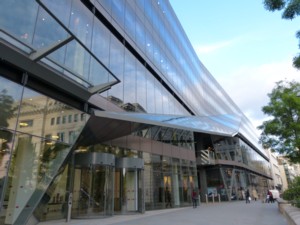
Here is the entrance I used to get inside One New Change:
Click on any of these pictures if you want to see them bigger.
Modernist architects used to be fond of a phrase to the effect that form should follow function. But the truth is that when it comes to architecture, form tends to follow not function but fashion.
To be fair to the architects, fashion tends also to follow what is technologically possible. At any given moment in modern architectural history, architects have asked themselves: what does building technology now enable us to do which we couldn’t do half a decade ago, thus enabling us to get passers-by to say: Wow, look at that. Is it fair to call this “fashion”? I think so. After all, that is surely how the fashion business itself tends to operate.
So it is with One New Change. Only if you already knew, as I already knew when I went looking for it, would you have known that this is a shopping centre. It could have been a university, an office block, an “arts” or “community” centre, a library, or any one of half a dozen other things. But, you can tell at once that it was only very recently constructed, because here is a building done in the planes of glass at bizarre angles style. Which is a very recent architectural fashion. (One of the growth service industries of our time is presumably specialist window cleaning, of windows that are not easily reached by the usual methods of simply hanging a platform out over the vertical edge of a building and then just going up and down and side to side.)
Where did this style come from? Much of it, as I say, is a case of “because we can”. Glass has got a lot stronger and cleverer in recent years, as have building materials generally. And now that architects have computers to keep track of everything, they can design – and more to the point can build – buildings made in these bizarre shapes.
Another influence at work on modern architecture generally and One New Change in particular is, I surmise, ships. Modernist architects have always been envious of and heavily influenced by ship designers, because with ships, form really does have to follow function, far, far more than is the case with most buildings. Many a nineteen thirties block of flats, with its long horizontal outdoor walkways and curved corners, was designed by an architect with his head full of ocean liner imagery.
More recent ships, of the stealth sort, now offer further “inspiration”. My first reaction to One New Change was that here was a building that was trying to avoid being spotted on anyone’s radar. Which is a very reasonable thing for a building to want to do if it is only a stone’s throw from St Paul’s Cathedral.
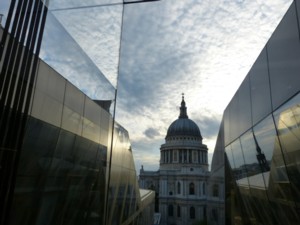
So anyway, I went in through this entrance, and found escalators, and a big lift shaft. I decided to try the lift. Early indicators, in the form first of the lift, and then in the form of this very striking view of St Paul’s from this lift, were very good:
That’s a rather wonkily angled photo, what with the lift being in motion and me having only one go at it. Plus, it looks misleadingly dark, on account of me looking towards the afternoon sun. But I like it anyway, because of the sky and the reflections and St Paul’s.
Nobody tried to stop me getting into this lift, as the somewhat warlike appearance of the outside the building was perhaps subconsciously suggesting to me might have happened. I just pushed the usual buttons, just as in any other shopping centre, or for that matter big department store, and up I went.
The lift itself, made from reassuringly solid slabs of that new and clever glass that I have already mentioned, was clearly designed with the viewing experience of those travelling in it very much in mind. It isn’t buried in a lift shaft. Rather is it hung out on the inside of the building, as happens in grand American hotel lobbies that you see in movies. And a slice has been cut from top to bottom through the building to enable St Paul’s to be visible from this lift, throughout one’s ascent. All of which strongly suggested that a similar concern for viewing pleasure might also prevail at the top of the building. The lift rose upwards, and my level of photographic optimism rose with it.
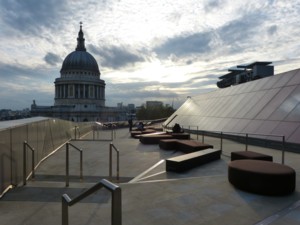
When I got to the top, nobody made me buy a ticket or tried to check my bag or any such thing. And I was right to be photographically optimistic:
Wow. → Continue reading: One New Change
|
Who Are We? The Samizdata people are a bunch of sinister and heavily armed globalist illuminati who seek to infect the entire world with the values of personal liberty and several property. Amongst our many crimes is a sense of humour and the intermittent use of British spelling.
We are also a varied group made up of social individualists, classical liberals, whigs, libertarians, extropians, futurists, ‘Porcupines’, Karl Popper fetishists, recovering neo-conservatives, crazed Ayn Rand worshipers, over-caffeinated Virginia Postrel devotees, witty Frédéric Bastiat wannabes, cypherpunks, minarchists, kritarchists and wild-eyed anarcho-capitalists from Britain, North America, Australia and Europe.
|





Recent Comments